Traditional SEO vs AI Visibility: Capturing Intent Early in the 2026 Buyer Journey
The digital ecosystem in 2026 requires a clear distinction between traditional blue-link search engine optimization and generative AI visibility. While traditional SEO validates brand credibility at the lower end of the funnel when users actively compare specific solutions, AI visibility captures consumer intent much earlier in the decision-making cycle. Generative summaries answer complex, multi-turn queries directly, effectively neutralizing the need for a website click during the initial validation phase. Balancing both visibility types requires structuring web data so it is simultaneously scannable for search crawlers and semantically rich for language models. Navigating this shift allows brands to establish authority during early research phases and maintain dominance as user behavior moves away from conventional search loops.
Case Study: 65%+ Engagement Rate from AI Referrals.
A healthcare client faced a complete lack of visibility on generative AI platforms, while their existing traditional organic search traffic suffered from low interaction and high bounce rates. To capture early-stage intent, BusySeed implemented a targeted generative optimization strategy designed to position the brand as a primary recommended authority within conversational AI engines. Following the optimization cycle, traffic originating from AI referral platforms surged, consistently delivering a 65%+ engagement rate on the client's website. This targeted audience vastly outperformed traditional organic search traffic in depth of interaction, session duration, and final event completion, proving the superior commercial intent of AI-driven discovery.
TL;DR
- 68.01% of Google searches in the first four months of 2026 ended with zero clicks (SparkToro, 2026).
- The click-through rate on traditional results is 8% when an AI summary appears in search results, compared with 15% without one (Pew Research Center, 2025).
- 1.13 billion AI referral visits to the top 1,000 websites in June 2025, up 357% YoY (Similarweb, 2025).
- A BusySeed healthcare client saw 65%+ engagement on AI referral traffic after BusySeed ran a generative optimization strategy for them.
- Being cited in an AI Overview increases organic clicks by 35% compared to not being cited (Seer Interactive, 2026).
What Actually Changed And Why Most Teams Are Still Fighting the Last War
Most digital marketing teams in 2026 are organized around a single objective:
Get higher up in the rankings ➔ Get more clicks ➔ Get more traffic
It’s a sensible strategy when you think about it, because it worked for so long. In fact, it worked for so long that we tended to forget that the buyer’s journey is not a single, linear process but has gone through several iterations over the years. And now there are two different moments in time, and you are optimizing for only one of them.
Understanding the “GEO vs SEO” game is not a matter of abstract discussion; it is the working difference between entering a buyer’s consideration set early on and arriving at the shortlist after other brands have been considered. As with so much else in 2026, SEO has changed. Its function in the buyer’s journey is different now than it was three years ago. It is not the primary objective of SEO and digital marketing to drive traffic, but that is the starting point for most teams. And that’s the problem.
For instance, the user types in “how to manage patient intake for a multi-location healthcare practice” into the Google search bar, and the AI summary appears, listing the different ways to manage patient intake for a multi-location healthcare practice. The user would then click on a
BusySeed healthcare client’s website
only 8% of the time, compared with
15% without the AI summary.
That’s the problem. And it’s more urgent than most teams realize. The decision-making process has fundamentally shifted, requiring brands to adapt their strategies to account for both traditional search and AI-driven discovery. This is exactly where partnering with an expert team like
BusySeed ensures your brand doesn't get left behind.
GEO vs SEO: Are These Actually Two Different Jobs Now?
Yes. They are. And pretending otherwise is costing brands real pipeline.
The GEO vs SEO debate has reached a new level of maturity. Instead of only speculating about what could happen, we now have hard data describing what happens at every level of visibility. In the end, it’s up to each organization to decide what they want to achieve with its SEO efforts.
Blue-link organic rankings are where people who already know what they are looking for go to find:
- Pricing
- Specs
- Comparison pages
- Documentation and reviews
They are close to making a decision and are looking to validate their thinking. Don’t throw the baby out with the bath water and abandon traditional SEO.
The kind of visibility from AI that opens up for websites is upstream from the typical points of visibility that websites can get buyers to. When a buyer opens up ChatGPT, Perplexity or Google’s AI Mode and does a search for something like "what’s the best way to manage patient intake for a multi-location healthcare practice", they are:
- Forming an opinion about what good management looks like before even naming any single brand.
- Figuring out a category and making a shortlist of potential solutions.
Your website could get
100 sessions from a buyer searching for the patient intake management of a multi-location healthcare practice, and get
none of them from the kind of search above.
A recent
Pew Research Center study of U.S. adults found that AI summaries appeared in:
- Just 8% of one- or two-word searches.
- A surging 53% for searches consisting of ten or more words.
These are top-of-funnel, exploratory searches in which the buyer is trying to understand a category and form an opinion of what a good might look like. The long, conversational search query is likely to be answered by an AI summary before the user even sees your organization’s listing in the organic results. Thus, GEO vs SEO are two very different disciplines, and most organizations are poorly served by treating them as if they were the same.
Understanding user intent SEO is critical in this context. Brands must now consider how their content appears in AI-driven summaries, not just in traditional search results. This shift requires a fundamental rethinking of how to optimize content for Google AI overviews.
User Intent SEO: Has the Definition Actually Changed?
It has, and not in a minor way.
When the term user intent SEO was first released to the SEO community, the typical explanation for the term would refer to categorizing keywords into informational intent, navigational intent, transactional intent, and commercial intent, and writing corresponding content to match the intended use of a search query by a user conducting a search for that keyword.
In 2026, all of that is still correct; however, SEO practitioners must now add an additional layer of visibility to how a search query will be answered by AI prior to a user’s consideration of clicking to go to a web page to answer the user’s search query.
For years, SEO marketing consultants have grouped terms by user intent SEO:
- Informational intent
- Navigational intent
- Transactional intent
- Commercial intent
Then matched content formats to the intent behind a term. Such as a definitive guide for terms with Informational intent. The search term “how does generative AI affect healthcare compliance” would be a strong opportunity for content marketing. The SEO would write content to rank for the term, and then people would click the link to the brand’s site and convert for the brand. However, with the current AI setup,
it can answer the question before the user even considers clicking a link to the brand’s site.
So, the reframing of the term user intent SEO for 2026 needs to center on the following basic query: “Where will this person encounter the answer to their query, and what must you do to be included in the answer they encounter?”
This is where the need to optimize content for Google AI overviews becomes paramount. Brands must ensure their content is structured so that AI systems can easily extract and cite it.
The decision-making process now begins in AI interfaces, making it essential for brands to adapt their content strategies accordingly. This means creating content that not only ranks well in traditional search but also appears in AI-driven summaries. At
BusySeed, we help clients map these new user intent SEO pathways to ensure they capture this early visibility.
Ecosystem 2026: SEO and Digital Marketing?
SEO or digital marketing: how do the two fit together?
From the outside, it appears that those practicing SEO generally exist in their own world and in the worlds of paid media, content, and brand, yet they are highly interconnected.
This complicated relationship has historically made sense, given that earlier forms of SEO practice consisted mainly of highly technical work (including keyword research) that differed from that in other areas of SEO and digital marketing. But today, things are quite different.
Converging all channels into a single Visibility strategy is the new direction for SEO and digital marketing in 2026. All forms of online marketing are to be executed as a single process to achieve the one big goal:
Visibility.
In a recently updated study by Seer Interactive, the AIOs (artificially generated search results) that Google is using to enhance user experience have been analyzed as part of Google’s search results (Seer Interactive, 2026). The study shows that a brand's visibility in AI-Generated Search Results strongly influences the CTR of organic results. It states that:
- When a brand is NOT mentioned in an AI-Generated Overview, the CTR of organic results declines by a massive 65.2% YoY.
- When a brand is mentioned in the AI-Generated Overview, the CTR of organic results declines by 49.4% YoY.
- 35% of total organic clicks were generated by those cited queries in the AI Overview.
For example, for a buyer with informational intent, such as “how does generative AI affect healthcare compliance?”, you could still use this opportunity for effective content marketing. But now, the way your buyer will encounter, read, and click on that information to learn more will be dramatically different from before.
Previously, your content marketing efforts would lead a buyer to click after they read a definitive guide on how generative AI is affecting compliance in healthcare. Now, the buyer would read the answer to their question first within an AI interface (e.g., Google Search results page Overview), and then potentially click on other links for more information.
In the ongoing GEO vs SEO landscape, while there is considerable evidence that improving content to earn more AI citations will also improve traditional organic rankings, it is not entirely clear how SEO and digital marketing will change as a result of this new form of Search Engine Optimization. After all, the Seer Interactive study that provided all the evidence cited above examined only a number of variables, and it would be foolish to assume that all situations are the same.
To optimize content for Google AI overviews, brands must focus on creating content that is easily extractable by AI systems. This involves structuring content so that AI can understand and cite it, for example, by using
clear definitions,
step-by-step processes, and
comparison tables. This approach aligns with the evolving decision-making process, where buyers increasingly rely on AI-driven summaries to inform their choices. If you need help engineering these formats,
BusySeed's team of experts can seamlessly integrate them into your existing pages.
How to Optimize Content for Google AI Overviews
There is no GEO markup or special schema that can be added to a website to suddenly activate all of Google’s AI features. There is no “llms.txt” file that can be added to the root directory, and suddenly a website will have all the AI-enabled features of Google Search turned on.
According to Google’s AI Optimization Guide,
SEO fundamentals still apply. No special optimization is required beyond what good SEO already demands, and Google explicitly states that llms.txt has no effect on Google Search (Google, 2025a). If you are being sold a proprietary 'GEO framework' that claims to require entirely separate technical infrastructure outside of standard SEO practices, be skeptical; such claims lack technical merit.
1. Building Citation-Ready Content Blocks
SEO and digital marketing strategies must now account for optimizing content for Google AI overviews. To achieve this, your team should construct pages using highly semantically structured formats that language models can naturally parse. These structured layouts help AI systems contextualize and reference your content effectively, which is crucial for visibility in AI-driven search results.
SEO practices for Google’s AI overviews are real and matter for now. But this will fall squarely within the remit of content strategy and information architecture. So, for now, we can write up a piece of content to ensure that a language model can pull out a
specific,
citable, and, most importantly, trustworthy answer from it. Again, that’s not to say that this is not related to writing a page in order to rank for a particular keyword, but it’s not the same thing either.
There is no secret GEO markup or special schema for Google’s search ecosystem. Consequently, there is:
- No special llms.txt hack that magically unlocks Google’s AI features.
- No separate AI optimization strategy is required just to gain visibility.
- No distinct workflow required in addition to your usual SEO efforts.
- No entirely new “GEO framework” requiring technical infrastructure outside of standard SEO practices.
- None of that pseudo-SEO stuff.
On the other hand, creating so-called
Citation-Ready Content Blocks is a best practice to optimize content for Google AI overviews. Such blocks of content include, for instance:
- A short definition.
- A list of steps with the result of each.
- A comparison of A vs B, or, even better, A vs C, where A, B, and C are options for achieving something.
- A table with clearly labeled columns and, within each column, data that doesn’t need additional context outside the table itself.
- And finally, a summary of a page’s content that is 100% identical to the content on said page.
Such a summary is used for the structured data (schema) on said page. Therefore, such a summary is also used for the structured data of said pages once it is created for a page.
2. The Role of Authority Signals in AI Search
Google’s success guide for AI search outlines four areas where brands will see greatest success with the new search interface (Google, 2025b):
- Information architecture
- Entity structures
- Authority
- Distribution
The new AI-powered search results will favor brands that have created the clearest information architecture on their websites, have well-defined entities, and have the greatest credibility and the widest distribution of their content where humans and models would look for authoritative information on a subject. Examples include
industry publications,
research papers,
expert roundups, and
third-party reviews of products and services.
One last thing, for those creating content that will appear in Google AI overviews: there are going to be certain authority signals that matter far, far more to you than others.
For example, the Pew Research Center recently released a short read examining Google users, links, and how we interact with search results that include an AI summary. They report that
.gov sites account for 6% of sources linked in AI Overviews, compared with 2% in regular results (Pew Research Center, 2025).
So, to gain visibility in AI Overviews for healthcare, finance, and legal brands, you will need to create content of similar rigor and with similarly strong authority signals. This means including:
- Primary citations that directly back up your claims.
- The author's published credentials to prove subject matter expertise.
- A clear methodology explaining exactly how the content was researched or developed.
- A clear, up-to-date timestamp showing exactly when the information was last updated.
If you’re creating content intended for use in AI overviews, it should have the same level of quality as content created by the big, institutional sources that already appear in your results. Navigating and building these rigorous trust signals are core parts of the SEO and digital marketing services offered by
BusySeed.
Understanding user intent SEO is crucial in this context. Brands must ensure their content aligns with modern buyers' decision-making process, who increasingly rely on AI-driven summaries to inform their choices. This requires a strategic approach to SEO and digital marketing that accounts for both traditional search and AI-driven discovery.
The Decision-Making Process: Where Does AI Visibility Actually Intervene?
Here is a hypothetical for a hospital administrator that every brand strategist should read and think about.
The Scenario:
Imagine a hospital administrator who’s been tasked with finding a better patient communication platform. She doesn’t start with Google. She opens an AI assistant and types: “What are the most important features to evaluate when selecting a patient messaging system for a mid-size hospital?” The AI gives her a thoughtful, multi-point answer.
It names two or three vendors as examples of platforms that address these criteria well. It doesn’t name your brand. She takes notes, builds a rough evaluation framework, and two days later starts searching Google for specific vendors. Your brand ranks well for “patient messaging platform.” She finds you. But you’re already playing catch-up because the evaluation phase formed a shortlist before you entered the picture.
This is the 2026 buyer journey in a nutshell. The early stage of the decision-making process now occurs within AI interfaces. Therefore, AI visibility and the buyer's journey are two things that, as a growth strategist, you need to think about hand in hand.
It is also very important to note that the buyer's process of
researching, evaluating,
comparing, and
deciding
has not changed; only the starting point has. The influence on the buyer’s search for information now begins within the AI interfaces. For the vast majority of search queries, this is where the first chapter of the buyer's decision-making process unfolds.
All this means that for brands, the first chapter of the purchasing funnel is created by the
‘mention → cite → click → convert’ pipeline, which can be optimized by brands. If a brand is not mentioned first, it will start the conversation with the buyer after someone else has already defined the category.
The influence of AI on this journey will differ between categories:
- In some niche B2B categories, AI top-of-funnel query volume is still low.
- In categories like healthcare, finance, and consumer services, the trend is clear: the paradigm has already shifted.
To effectively optimize content for Google AI overviews, brands must understand how AI visibility intervenes in the decision-making process. This requires a strategic approach to SEO and digital marketing that accounts for both traditional search and AI-driven discovery, ensuring content is structured so AI systems can easily extract and cite it.
The BusySeed Healthcare Case Study: Getting 65%+ Engagement from a Hospital’s Patient Communication Search
Numbers without context are just decoration. So let’s be specific about what happened here and why it matters.
We had a healthcare client with two major problems:
- First, no one could find them on generative AI platforms (e.g., they weren’t cited in the AI Overviews and never appeared in a ChatGPT or Perplexity query).
- Second, their traditional organic traffic was terrible: lots of traffic but very little engagement (high bounce rates, shallow sessions, few event completions, etc.).
Our approach to optimizing online content for generative AI was to make the hospital administrator’s job easier by helping her to identify and select the best patient messaging system for her mid-size hospital. To do this, our team reorganized the hospital’s online content to make it easier for AI systems to extract.
This was achieved by creating
‘citation-ready content blocks’ (CRBs). The CRBs were created to address a number of questions frequently used by AI systems in the healthcare space. In addition to making the online content more extractable by AI systems, we worked to make sure that all of the client’s online and offline branded entities were clear and consistent. This was important for improving online authority signals, indicating to AI systems that the client was the primary recommended authority on patient messaging platforms.
For the healthcare client mentioned above, our marketing team achieved very good results:
- Engagement Rate: The client achieved more than 65% engagement, a figure well above average for most organizations.
- Session Duration: Most sessions were long, with visitors reading many pages before leaving the site.
- Conversions: The client received many conversion events.
The traffic this client received from our marketing efforts was of very high quality and was therefore converted at a very high rate. In fact, the traffic this client received was so distinct from the rest of their organic traffic that it could be considered a separate micro-channel in its own right.
Traffic from AI platforms is high-quality because it comes from AI-generated summaries that already mention the brand. Therefore, the traffic generated from these interfaces is highly qualified, as it has already been filtered by the interface for the buyer. Thus, all downstream metrics for sessions originating from these interfaces are very good.
This case study highlights the importance of understanding GEO vs SEO and how to optimize content for Google AI overviews. By creating
citation-ready content blocks and improving authority signals, we significantly enhanced the client’s visibility in AI-driven search results, leading to higher engagement and conversion rates. This approach is a key component of user intent SEO and modern SEO and digital marketing strategies. To see more examples of how our team drives measurable growth,
explore our full library of case studies.
Is AI Referral Traffic Big Enough to Care About Yet?
This is where honest practitioners need to resist hype in both directions.
AI referral traffic is growing rapidly. It’s something you should care about right now. In Similarweb’s Generative AI Report, the
top 1,000 websites received a total of
1.13 billion AI referral visits, up a massive 357% year-over-year (Similarweb, 2025).
However, Google Search referral traffic is still
many orders of magnitude larger than the AI traffic reported above. Thus, despite the rise of Generative Engine Optimization (GEO), traditional SEO (or “organic search”) is not going anywhere fast.
As mentioned above, to win at marketing in 2026, one will need to be adept at marketing across the various channels (or layers) that make up the overall marketing mix and develop effective strategies to drive traffic and convert customers within each. Treat all of these channels as if they were one (e.g., GEO), and that marketing professional would be making a monumental mistake.
Don’t, however, confuse SEO for traditional organic search with the new GEO (Generative Engine Optimization) that’s being developed in AI systems. The two systems are interlinked, and the ranking and quality signals for organic search on Google are the same as those for source ranking in AI systems. Thus, until you have done a complete SEO audit and have fixed any problems with your site’s authority, content, etc., you should not be spending time trying to optimize for GEO.
In summary, AI Referral Traffic is a large and growing channel that merits the attention of practitioners and researchers alike. As mentioned previously, Similarweb reported 1.13 billion AI Referral Visits to the top 1,000 websites in June 2025, a
357% year-over-year increase (Similarweb, 2025). These visits form high-intent traffic and, as such, are a channel worthy of your time.
Make sure to set up your source/medium channels for Referrals from AI interfaces such as ChatGPT, Perplexity, and Gemini, and measure engagement metrics such as:
- Overall engagement rate to gauge traffic quality.
- Average engagement time per user.
- Average session length to measure content depth.
- Conversion rates for sessions originating specifically from AI referral traffic.
Understanding the nuances of GEO vs SEO is essential for modern SEO and digital marketing strategies. Brands must learn to optimize content for Google AI overviews while maintaining strong traditional SEO practices to ensure visibility across all stages of the decision-making process.
The Crawl-to-Click Gap: A Technical Problem You Might Be Ignoring
While the press continues to debate Generative Engine Optimization (GEO) on the technical side of the house, there is far more interesting material to discuss, for example, the interface of AI “bots” with web content.
Cloudflare’s recent article on AI ‘Bots’ covers several topics relevant to Search (Cloudflare, 2025). In particular, it looks at the growing
‘Crawl-to-Click Gap’ or, in simple terms, the amount of content that AI ‘Bots’ are now reading vs the amount of referral traffic that they generate as a result.
In a recent analysis covering the period from January to the end of July 2025, the company found that the largest proportion of activity by AI ‘Bots’ was training, at
78% (up from 72% in the previous year).
In practical terms, this means that most of the activity from AI ‘Bots’ that crawl a website is not actually referring to that site in the analytics package. As a result, those involved in Search need to carefully consider the trade-offs:
- Allowing uncontrolled access by ‘Bots’ to allow for the possibility of content being used in AI-generated answers could have negative effects on a website's performance (e.g., server load).
- Blocking all ‘Bots’ could mean a site is never cited in AI-generated search answers.
Those involved in Search, therefore, need to consider these trade-offs, make a decision based on their goals, and act accordingly.
There are new challenges for brands seeking to allow access to their content while trying to be included in AI-generated answers, as well as distinguishing between human sessions that have come via AI referral and pure AI bot crawling activity. This can cause problems if not instrumented correctly and could skew the engagement rate.
Imperva's Bad Bot Report outlines in greater detail how automated traffic now dominates the majority of total web traffic (Imperva, 2026). So it is crucial to distinguish the numbers for your AI referral performance from those of your AI bot traffic. For example, our team reported a very successful case study on generating healthcare leads through AI referrals, in which the engagement rate for all human sessions referred by AI was
65% or
higher.
Understanding the crawl-to-click gap is essential for brands looking to optimize content for Google AI overviews. This technical challenge highlights the importance of balancing AI bot access with server performance to ensure that content remains visible in AI-driven search results. This is a key consideration for user-intent SEO, modern SEO, and digital marketing strategies.
Traditional SEO vs. AI Visibility: A Direct Comparison
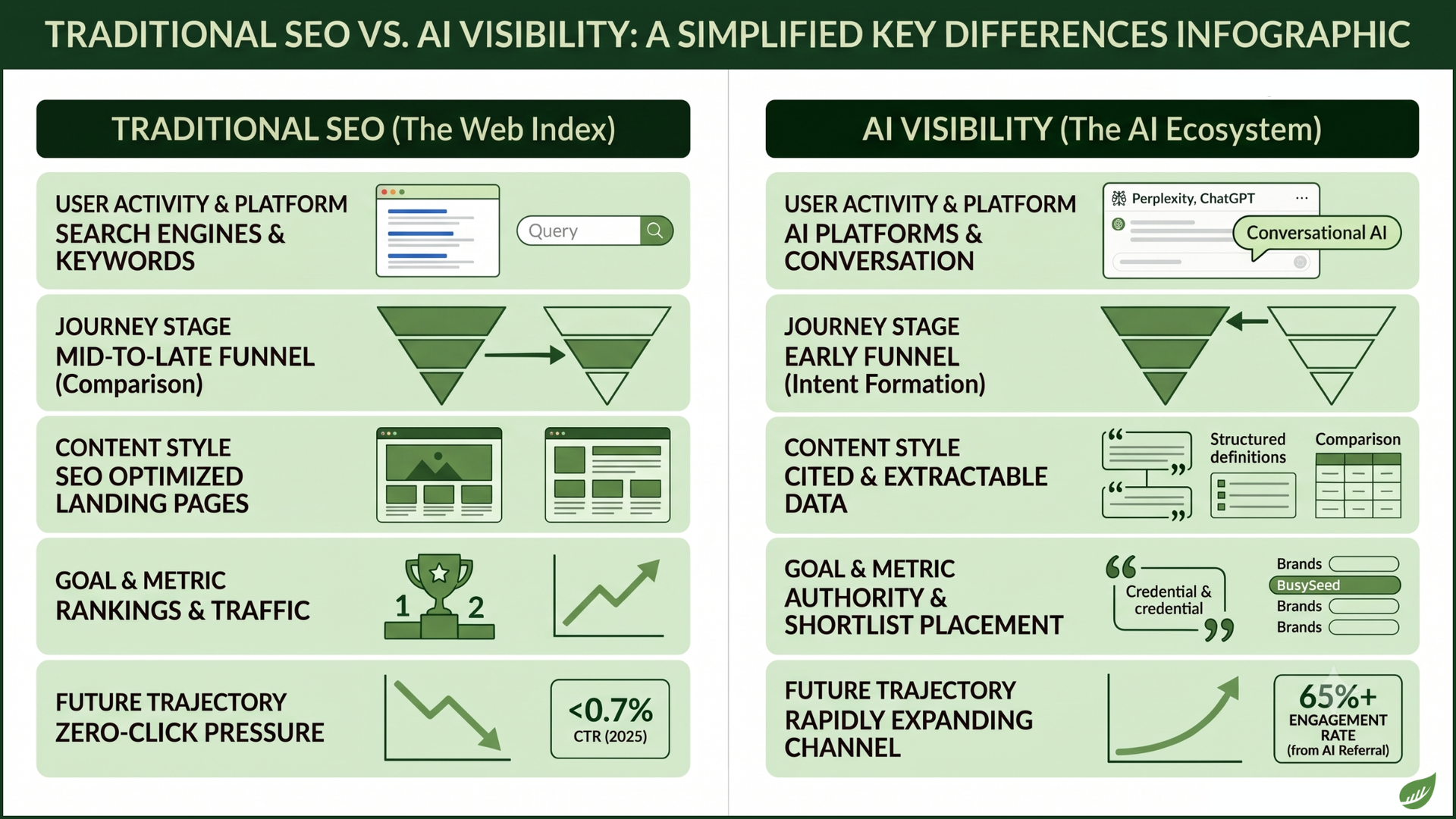
| Dimension | Traditional SEO | AI Visibility |
|---|---|---|
| Where it operates | Google and Bing blue-link SERPs | ChatGPT, Perplexity, Google AI Overviews, Gemini, etc. |
| Buyer journey stage | Traditional SEO - Mid-to-late funnel - Comparison/validation | AI Visibility - Early funnel - Category/intent formation |
| User behavior | Active keyword search, click intent | Conversational query, answer consumption |
| Success metric | Rankings, CTR, organic sessions | Citation frequency, AI referral engagement rate |
| Content format | SEO-optimized landing pages, blog posts | Citation-ready blocks, structured definitions, comparison tables |
| Technical requirements | Core Web Vitals, schema, crawlability | Same foundation + entity clarity, author credentials, content extractability |
| Click outcome | Buyer clicks through to your site | Buyer may not click, but your brand enters the shortlist |
| CTR benchmark (2025) | 0.52%-0.70% when AI Overview present (Seer) | Engagement rate 65%+ when visitor arrives from AI referral (BusySeed) |
| Authority signals | Backlinks, domain authority, E-E-A-T | .gov/.edu-adjacent rigor, cited credentials, methodology transparency |
| 2026 trajectory | Volume under pressure from zero-click growth | Rapidly expanding referral channel (+357% YoY) |
This comparison highlights the key differences between GEO vs SEO and the importance of understanding both to effectively optimize content for Google AI overviews. Brands must adapt their SEO and digital marketing strategies to account for these differences. By mastering user intent SEO in this new landscape, organizations can ensure visibility across all stages of the decision-making process.
2026 Dual-Visibility Action Plan for Your Business
- Audit your current AI citation status. Run your brand's core topic areas through ChatGPT, Perplexity, and Google AI Mode. Document where you appear, where competitors appear, and what sources the AI is citing. This is your gap analysis.
- Restructure your most important content pages for extractability. If you have information that will remain relevant for a year or more, you must ensure your content can be extracted properly by incorporating structured features such as definition-based content blocks, step-by-step process descriptions, and comparison information organized in tables with clear column headings. Because AI models are most effective at extracting and utilizing information presented in these specific formats, it is vital that every important page on your site features at least one section that a model can pull from directly to answer user questions, even queries you haven't anticipated yet.
- Strengthen your author and entity signals. The author bios on your website should list the content creators' credentials. Include the methodology behind research-based content, complete with update timestamps, to show AI systems the rigor typical of the .gov and .edu sites that are over-represented in AI Overviews.
- Map your content to early-funnel conversational queries. 53% of searches with 10+ words trigger an AI Overview (Pew Research Center, 2025). Expand your top SEO keywords into long-tail, multi-word questions that a language model would summarize, and create content addressing them.
- Track your AI referrals in GA4. Set up a filter in your Sessions report for Session Source/Medium equals “AI & Chat” (covering ChatGPT, Perplexity, Gemini, etc.). Add a secondary dimension (like Engagement Rate) to compare pre- and post-optimization performance.
- Align the SEO and content teams around citation readiness. The typical divide between SEO technicians and content strategists does not work when both teams share the KPI of creating AI-citation-ready content.
- Build trust signals for search quality and AI reliability. Publish verifiable information reviewed by an expert. Maintaining a clear audit trail for how information was gathered and verified ensures the brand is viewed as a “safe source” for the AI system to cite.
- Separate AI bot crawling from human AI referrals. Monitor your analytics and server logs to correctly identify bot traffic, protect data integrity during high crawl rates, and accurately track engagement from actual human users referred by an AI model.
This action plan provides a comprehensive approach to navigating the complexities of GEO vs SEO and effectively optimizing content for both traditional search and AI-driven discovery. By following these steps, brands can enhance their visibility across all stages of the decision-making process and improve their SEO and digital marketing strategies.
The Bottom Line: Dual-Visibility is the New Standard
The era of relying solely on blue links is over. As the decision-making process shifts earlier in the AI interface, your brand must adapt to where the buyer's journey actually begins. Mastering GEO vs SEO isn't about abandoning your traditional strategy; it's about expanding it.
By restructuring your data to optimize content for Google AI overviews, you capture high-intent buyers before they even reach a traditional search engine, turning conversational answers into highly qualified referral traffic.
If your current SEO and digital marketing strategy feels like it's fighting the last war, it’s time for an upgrade.
BusySeed can audit your AI citation status, map your user intent SEO gaps, and build the exact citation-ready content blocks needed to drive massive engagement.
Ready to stop playing catch-up and start dominating AI-driven discovery? Let’s rebuild your visibility pipeline. Talk to BusySeed today.
Frequently Asked Questions
1. How to optimize a website for AI search without abandoning traditional SEO?
When figuring out how to optimize a website for AI search, one of the most effective methods is to restructure the important information on your site to make it easier for AI models to extract. This approach ensures your content remains effective for both traditional SEO and AI-driven search, aligning perfectly with the principles of user intent SEO.
To optimize content for Google AI overviews effectively, you should add specific elements to your high-ranking pages:
- A clear definition of a core term is explained on the page.
- A step-by-step explanation for any processes described.
- A comparison table for items being evaluated.
The restructured content should include a section that a language model can quote directly to answer a longer query. The model will typically summarize this in an AI Overview and trigger a click on a link to that page, allowing the user to read more.
2. What makes a digital marketing agency in New York City worth hiring for AI visibility in 2026?
Be very wary of so-called “AI SEO companies” promising higher visibility. While GEO means optimizing for generative AI, there is a huge difference between GEO vs SEO. If an agency cannot explain how to do the following, they are simply selling you standard SEO:
- Track AI referrals in GA4 separately from organic traffic.
- Find exactly where you are being cited across AI interfaces.
- Physically modify a page to increase content extractability.
This is why our digital marketing services page details the exact
BusySeed approach. We know how AI-generated search works and how to measure it. In a recent healthcare case study, we successfully built a large volume of AI citations and generated a 65%+ engagement rate for our client. Ultimately, the best digital marketing agency in NYC will have a proven track record of capturing AI visibility while maintaining strong SEO and digital marketing practices.
3. How do AI Overviews affect organic click-through rates, and should I be worried?
Seer Interactive studied the effect of AI Overviews on Google organic click-through rates (Seer Interactive, 2026). They discovered that when an AI Overview is present and a brand is not cited in the summary, organic click-through rates fall to 0.52%, representing a 65.2% year-over-year decline. When a brand is cited, click-through rates fall to 0.70% (a 49.4% decline).
However, there is excellent news here: brands cited in AI Overviews earn 35% more organic clicks than brands not cited for the same search query. This data shows that the biggest challenge a brand faces is getting cited in the first place. You must adapt your strategies to ensure visibility, as AI heavily impacts organic traffic and the overall decision-making process of modern buyers.
4. What's the real difference between GEO vs SEO? Aren't they the same thing?
Although the methodologies for achieving visibility are similar, GEO vs SEO have many differences, especially regarding the stages of research they target.
- Traditional SEO focuses on improving rankings and Click-Through-Rates (CTRs) for organic listings. These queries are typically long-tail and come from buyers in the middle to late stages of research who are comparing vendors, prices, and specific products.
- GEO focuses on making a brand visible to a buyer in the early stages of research. These queries are typically short-tail, and the content optimization focuses heavily on extractability.
Because of this overlap, content optimized for GEO purposes can also be used for SEO, but the opposite is not necessarily true. To measure SEO success, you look at rankings and CTRs. To measure GEO success, you track citation frequency and the engagement rate of referrals from AI to traditional web pages. Understanding both is crucial to ensuring visibility at every stage of the decision-making process.
5. How do marketing agencies in New York City approach the 2026 SEO shift for competitive industries like healthcare?
The most competitive industries (such as finance, healthcare, and law) have the greatest opportunity to reach people through the AI visibility shift, as AI models prioritize highly trusted sources.
According to a Pew Research Center report, published online summaries in Google results contain .gov sources 6% of the time, up from 2% in regular Google results (Pew Research Center, 2025). For .edu sources, the frequency rose from 2% to 3%.
For hospitals and health systems, the biggest trust signals are visible author credentials and primary sourcing. Other critical trust signals include a clear methodology and regular content updates. Agencies in competitive verticals leverage these exact elements to increase the likelihood that a brand will be cited. When users search using high-intent phrases like 'hire digital marketing agency New York 2026,' it becomes clear that it is essential to choose a team that understands how to optimize content for Google AI overviews and navigate the complexities of this evolving landscape.
Works Cited
- Cloudflare. Crawlers, clicks, and AI bots: the cost of training. 2025.
- Google. "AI Optimization Guide". 2025a.
- Google. "Succeeding in AI Search". May 2025b.
- Imperva. Bad Bot Report 2026: Bots in the Agentic Age. 2026.
- Pew Research Center. "Google users are less likely to click on links when an AI summary appears in the results". July 2025.
- Seer Interactive. The AIO Impact on Google CTR: 2026 Update. 2026.
- Similarweb. AI Discovery Surges: Similarweb’s 2025 Generative AI Report. June 2025.
- SparkToro. "In 2026, Less Than One-Third of Google Searches Still Send a Click". 2026.

About the Author
Omar Jenblat is a powerhouse in the digital marketing landscape, renowned as the Founder and CEO of BusySeed, an award-winning agency that has scaled over $1B revenue for 550+ businesses through high-performance growth strategies. With a technical foundation in computer engineering, Jenblat bridges the gap between complex data analytics and creative marketing, specializing in aggressive revenue scaling, SEO, and multi-channel lead generation. As a member of the Forbes Agency Council, The Org, and a visionary entrepreneur behind ventures like LeadChaser.ai, The Honest Agency, and Zeed Agency, he has established a global footprint by leveraging a "human-led, AI-assisted" philosophy to drive measurable ROI for major brands and startups alike. His expertise is characterized by a focus on digital automation and performance-driven results, consistently positioning his firms at the forefront of the evolving technological landscape.