How to Build an Inescapable Digital Presence Before the Buyer Even Searches
In 2026, capturing consumer interest requires moving upstream before a prospective buyer ever executes a traditional search query. Relying on lagging, search-driven intent forces brands into saturated markets where purchasing opinions have already been formed off-site. Establishing a proactive digital footprint demands a comprehensive approach to top-of-funnel discovery, combining visual-first content engines with automated distribution networks. This framework explores the strategic mechanics of mapping early-stage consumer touchpoints and deploying multi-channel syndication pipelines. By intentionally saturating discovery platforms, brands can systematically shape consumer preferences, optimize initial brand sentiment, and anchor their authority deeply enough to become the default choice during the formal evaluation phase.
Case Study: Reaching 100K+ Monthly Pinterest Viewers in Over 30 Days.
A client needed to quickly boost its top-of-funnel brand awareness from a baseline of minimal digital traction. Rather than relying on high-competition product searches, BusySeed deployed a hybrid strategy of targeted Pinterest ads and consistent organic posting. By curating specific boards surrounding high-interest lifestyle topics like pasta and dinner recipes, the account rocketed from obscurity to over 100,000 monthly active viewers in just over one month. This massive, engaged audience established a permanent brand presence across visual search and created a pre-qualified pool of users primed for future retargeting campaigns.
TL;DR
- U.S. retail e-commerce and digital marketing reached $1.23 trillion in 2025, and e-commerce discovery is shifting from search to always-on environments (U.S. Census Bureau, 2026).
- 64% of Gen Z use social media to research products before they ever type a query into a search engine (Deloitte, 2025).
- Pinterest now processes over 80 billion monthly searches across 619M global monthly active users (Pinterest, 2025).
- AI assistant tools reached 36% of desktop users in Q1 2026, adding a pre-search shortlist layer that most attribution stacks can’t even see (Comscore, 2026).
- Social media’s share of e-commerce revenue grew 40.3% year-over-year during the 2025 holiday season (Adobe, 2026).
Why Is “Waiting for the Search” Already Losing You the Sale?
Brands treat the wait for the search moment as the focal point of their strategy and maximize their efforts in SEO, paid search, and conversion optimization on the e-commerce site. However, these are merely confirmation moments for buyers who are already searching for products online. They validate the brand that the buyer chooses to purchase from.
If your site appears only when users search for what you sell, you are not a contender; you are merely a validation stop. At
BusySeed, we help brands break out of this reactive cycle by designing proactive, discovery-first funnels.
It becomes clear that the environments where customers form opinions about brands are now mainstream. According to
Deloitte’s Q3 2025 report on Emerging Trends in Retail and
Pew Research Center data:
- 64% of Gen Z research products on social media before ever conducting a search.
- 35% of these users discover products while browsing these platforms.
- This is combined with massive U.S. adult usage of YouTube (84%) and Facebook (71%).
To succeed in retail in 2026, companies must develop strategies to appear in environments where purchasing preferences are shaped before consumers even begin searching for products or services. This shift is critical for any online marketing e-commerce strategy aiming to capture pre-search intent and is the cornerstone of modern e-commerce and digital marketing.
Traditional paid media channels like Google Ads or Amazon Sponsored Products focus on capturing demand after it has already formed. However, the most effective social media management for business strategies now prioritizes building presence in algorithmic feeds, visual search platforms, and AI-driven discovery tools. These channels allow brands to influence decisions before the buyer even realizes they need a product.
What Does "Pre-Search Discovery" Actually Look Like?
Pre-search discovery occurs when consumers encounter products or brands in environments where they are not actively searching. For example, a cooking enthusiast might stumble upon a recipe video featuring a specific cookware brand. A week later, they search for that brand online. Similarly, a user browsing Pinterest might save a beautifully designed Pin, only to return to it or search for the brand later. These interactions are not accidental; they are the result of strategic e-commerce and digital marketing efforts designed to appear in the right places at the right time.
To capitalize on pre-search discovery, brands must establish an upstream presence across five key surfaces:
- Algorithmic feeds: TikTok’s For You page, Instagram Reels, YouTube Shorts.
- Visual search: Pinterest Pins, boards, and Lens-based discovery.
- Community platforms: Reddit threads, niche Facebook groups, Discord servers.
- Retail discovery: Amazon and Walmart onsite placements, as well as offsite retail media like Criteo.
- AI discovery: AI platforms such as ChatGPT, Google’s AI Overviews, and Microsoft Copilot form shortlists before users visit a website.
Comscore’s Q1 2026 AI Intelligence Report reveals that 46% of paid search ads in high-consideration categories were overlaid with AI Overviews in Q4 2025, up from 21% in Q3 2025 (Comscore, 2026).
This demonstrates that AI tools are increasingly shaping purchasing decisions before users even visit a website. If an online marketing e-commerce team focuses solely on traditional search rankings, they risk missing the opportunity to influence AI-driven shortlists.
By establishing a presence across these surfaces, brands can ensure they are considered before the buyer begins their search. Partnering with an experienced team like
BusySeed ensures your brand is seamlessly integrated into these critical pre-search environments.
How Do You Map the Touchpoints That Actually Shape Buying Decisions?
To systematically identify and leverage pre-search touchpoints, brands should create a Discovery Surface Map. This tactical tool underpins an effective e-commerce and digital marketing strategy by aligning content with the surfaces where audiences spend time. The map consists of three columns:
- Surface: The platform where your audience is active (e.g., Pinterest, TikTok, Reddit).
- Micro-Intent: The mindset of the user on that platform (e.g., "weeknight dinner ideas" on Pinterest vs. "Is [Brand X] worth it?" on Reddit).
- Content Format: The type of content that resonates with the audience on that surface (e.g., recipe videos, comparison guides, UGC-style posts).
For example, a user browsing Pinterest for "weeknight dinner ideas" is in a different mindset than someone asking about a specific brand on Reddit. Both surfaces, however, can influence opinions about products in the same category. This mapping exercise is particularly valuable for online marketing and e-commerce teams that focus on bottom-funnel metrics such as conversion rates. It highlights the surfaces and opinions that shape buyer decisions before they even visit a website.
Is Visual Search a Real Channel, or Just a Pinterest Talking Point?
Visual search is not just a Pinterest talking point; it is a rapidly growing discovery surface that most online marketing e-commerce budgets underinvest in. Pinterest is a critical platform for brands looking to capture pre-search intent, backed by staggering growth:
- In Q4 2025, Pinterest reported 80 billion monthly searches across 619 million global monthly active users, marking a 12% year-over-year increase (Pinterest, 2025).
- According to the Pew Research Center’s 2025 report, 37% of U.S. adults online use Pinterest regularly, compared with 32% for TikTok (Pew Research Center, 2025).
- The platform now processes 6.67 billion visual searches per quarter (Pinterest, 2025).
To succeed on Pinterest, brands must first create content that aligns with adjacent intent topics. For example, a cookware brand should target users searching for "weeknight dinner ideas" rather than just "non-stick pans." Pinterest’s Performance+ campaigns for catalog sales have shown a
20% improvement in cost per purchase compared to non-Performance+ campaigns (Pinterest, n.d.). Additionally, building boards around lifestyle topics (e.g., "comfort dinner ideas") can organically expose users to your brand before they search for it.
Visual search is not limited to Pinterest. Platforms like Google Lens and Amazon’s visual search tools are also gaining traction. Brands that invest in visual search as part of their social media management for business strategy will gain a competitive edge in capturing pre-search discovery.
Put It Into Action for Your Brand
BusySeed worked with a client in a highly competitive paid media landscape to build an upstream presence in just 30 days. The client started with a completely blank slate: no prior digital activity, no social presence, no engaged audience, and no organic reach.
Instead of competing in crowded search results, we focused on Pinterest as a discovery surface. We created targeted ads and organic boards focused on lifestyle topics such as "pasta recipes," "comfort dinner ideas," and "weeknight meals." These boards featured valuable content that aligned with the client’s product category but did not directly promote the products.
The results were transformative:
- The client went from zero online viewers to a total audience of 118,690 in just over a month, generating 163,640 impressions.
- These viewers were pre-qualified based on their interest in the lifestyle adjacent to the client’s products (pasta and dinner).
- They saved Pins, clicked through ads, and engaged with the content because it was useful to them, resulting in an engaged audience of over 1,400 users ready for the next funnel stage.
This approach to social media management for business treats social media as a long-term asset-building exercise rather than a single campaign. Industry data consistently confirms that strictly product-focused content yields poorer engagement, while lifestyle-focused content drives significantly higher interaction rates.
The real value of this audience lies in what comes next. With
100,000 engaged viewers, the client can now leverage retargeting ads on Facebook and other platforms to drive conversions at a fraction of the cost of acquiring cold leads. This upstream investment ensures that every downstream marketing dollar goes further, particularly in the competitive U.S. retail e-commerce and digital marketing landscape.
How Should You Actually Build a Content Engine That Travels?
Most companies treat content as a one-off asset. They create a piece of content, post it, and measure its performance in isolation. If it performs well, they celebrate briefly before moving on. If it doesn’t, they abandon it. This approach is ineffective for building a scalable online marketing e-commerce strategy. Instead, brands should adopt a content engine model in which a single core idea is broken into 10 to 20 "atoms" and distributed across multiple surfaces and stages of the buyer’s journey.
For example, a brand story about "sustainable cookware" can be repurposed into:
- Short-form videos for TikTok and Instagram Reels.
- Static Pins for Pinterest visual search.
- Carousel posts for Facebook and Instagram.
- Checklists and FAQs for AI assistant tools.
- Comparison guides for Reddit and niche forums.
- Tutorials for YouTube and blog posts.
This approach ensures that content is optimized for both human consumption and AI parsing. Comscore’s Q1 2026 report found that
36% of desktop users now use AI assistant tools monthly (Comscore, 2026).
These tools form shortlists of brands before users even conduct a search. By creating structured content (e.g., FAQs, comparison guides) that AI tools can parse, brands can influence these shortlists and improve their visibility in pre-search environments.
The IAB/PwC 2025 report on U.S. internet ad revenue highlights the massive growth of digital video
(25.4% year-over-year) and programmatic revenue (20.5% year-over-year) (IAB/PwC, 2026).
These trends underscore the importance of creating content in formats that align with upstream discovery channels, such as short-form video and visual social media. Effective social media management for business must prioritize these formats to maximize reach and engagement across all e-commerce and digital marketing initiatives.
If you need help breaking down your core stories into high-performing assets,
BusySeed can build and manage a content engine tailored to your audience.
Distribution Pipeline
Content is only as valuable as its distribution. Without a strategic pipeline, even the best content will fail to reach the right audience. Below is a framework for building a distribution pipeline that delivers content to audiences before they even think about searching for your product:
• Day 0-7: Seeding of Paid Distribution
Launch content across paid media channels to test which hooks and images perform best. This phase identifies the most engaging creative variants for broader distribution.
• Days 7-21: Replication
After identifying high-performing content, create 5 to 10 creative variants of the best-performing "hook." For example, if a video performs well on paid social, test static Pins or carousel posts that link back to the video. This phase also involves testing organic posting strategies to amplify the paid signal.
• Days 21-45: Syndication
Expand distribution by partnering with creators who have expertise in your topic area. Consider retail media placements and programmatic display ads to reach new audiences. Adobe’s 2025 holiday report found that social media accounted for 40.3% of online sales during the holiday season, while affiliate/partner revenue grew by 15.9% year-over-year (Adobe, 2026). Additionally, traffic from generative AI tools to retail sites increased by a staggering 693.4%, highlighting the importance of diversifying distribution channels.
A well-structured distribution pipeline is essential for business social media management. It ensures that content reaches audiences at the right time and in the right format, maximizing the impact of every marketing dollar spent.
How Do You Turn a Discovery Audience Into Buyers?
Upstream investment in discovery is only the first step. The real challenge lies in converting that audience into buyers. For most brands, a large discovery audience does not automatically translate into revenue; this is where smart retargeting, especially utilizing retargeting ads on Facebook, comes into play.
Smart retargeting bridges the gap between awareness and conversion by segmenting audiences based on their level of engagement. For example:
- Users who watched 50%+ of a video.
- Users who saved or pinned content.
- Users who swiped through a carousel.
- Users who left a comment or asked a question.
Each segment should receive tailored messaging based on its engagement level. For example:
- High-engagement users (e.g., those with 50%+ video views): Serve messages that highlight your products' key features and benefits.
- Mid-engagement users (e.g., saved Pins): Focus on building comfort with your brand through customer reviews, demos, or comparison content.
- Low-engagement users (e.g., carousel swipes): Address objections like return policies, shipping timelines, or ingredient transparency.
Retargeting ads on Facebook are most effective when they continue the conversation a user has already started with your brand. For example, a user who saved a Pinterest Pin about "weeknight dinner ideas" should not see a cold ad for your product. Instead, they should see a
product demo,
a special offer, or a customer review that aligns with their initial interest. This approach ensures that retargeting ads feel like a natural extension of the user’s journey rather than an interruption.
By segmenting audiences and tailoring messaging, brands can achieve higher conversion rates and a lower cost per acquisition (CPA) than competitors that rely on generic retargeting strategies. This is particularly important for online marketing e-commerce brands operating in competitive markets.
Which Paid Media Channels Are Worth Your Budget Right Now?
The most effective paid media channels are those where your buyers discover products, not necessarily those with the lowest cost per click (CPC). While search remains valuable, paid media outside of search has never been more effective for retailers.
According to the IAB/PwC 2025 report on U.S. internet ad revenue, social media ad revenue reached
$117.7 billion in 2025, while programmatic ad revenue hit
$162.4 billion (IAB/PwC, 2026). Video ad spend grew by
25.4% year-over-year, reflecting the shift toward upstream discovery channels.
Key paid media channels to prioritize include:
- Retail media networks: With a $53.7 billion market growing 23% year-over-year (IAB/PwC, 2025), retail media networks such as Amazon, Walmart, and Target enable brands to distribute ads within shopping contexts where consumers form opinions about product categories. These networks also provide access to privacy-compliant first-party audience data.
- Pinterest: Ideal for visual discovery and pre-search intent, Pinterest’s 80 billion monthly searches make it a critical channel for online marketing e-commerce brands.
- TikTok and Instagram Reels: Algorithmic feeds on these platforms are highly effective for capturing pre-search discovery, particularly among Gen Z and Millennial audiences.
- YouTube: Video content on YouTube is essential for building brand awareness and influencing AI-driven shortlists.
- Facebook and Instagram: These platforms are ideal for retargeting and lookalike audiences, particularly when combined with Facebook retargeting ads.
Not all brands will achieve the same results across all paid media channels. For example, a B2B company selling to purchasing managers may not find success on Pinterest. Instead, they should focus on platforms where their buyers spend time before searching, such as LinkedIn or industry-specific forums.
The key is to identify where your buyers form opinions and allocate budget accordingly. Navigating this channel mix can be overwhelming, but
partnering with BusySeed ensures you pinpoint exactly where your specific audience forms their purchasing opinions.
Creators: How Do They Integrate Into A Pre-Search Distribution Strategy?
Creators are no longer a tactical add-on for digital marketers; they are a core channel deserving of dedicated budget allocation within a broader paid media channel mix.
The IAB projects U.S. creator ad spend to reach
$37 billion in 2025, a
26%
year-over-year increase (IAB/PwC, 2026). This growth outpaces the overall media industry by 4x, making creators a critical component of any e-commerce and digital marketing strategy.
However, not all creators are created equal. The most valuable creators for online marketing e-commerce brands are
"information influencers" who produce content that aligns with your brand’s adjacent intent topics.
For example, a micro-creator with
15,000 followers in the "sustainable living" niche may generate higher returns than a celebrity with
2 million followers but little relevance to your product category. Research shows that relevance and engagement are far more important than follower count when selecting creators for a pre-search strategy.
To maximize the impact of creator partnerships, brands should consider creator whitelisting. Organic distribution of creator content is unpredictable, but paid amplification of high-performing content ensures repeatable reach.
For example, a creator’s video about "eco-friendly cookware" can be whitelisted and distributed as a paid ad to a broader audience, extending its lifespan and impact. This approach is particularly effective for social media management for business, as it combines the authenticity of creator-generated content with the scalability of paid media channels.
Comparison: Reactive vs. Proactive Discovery Strategy
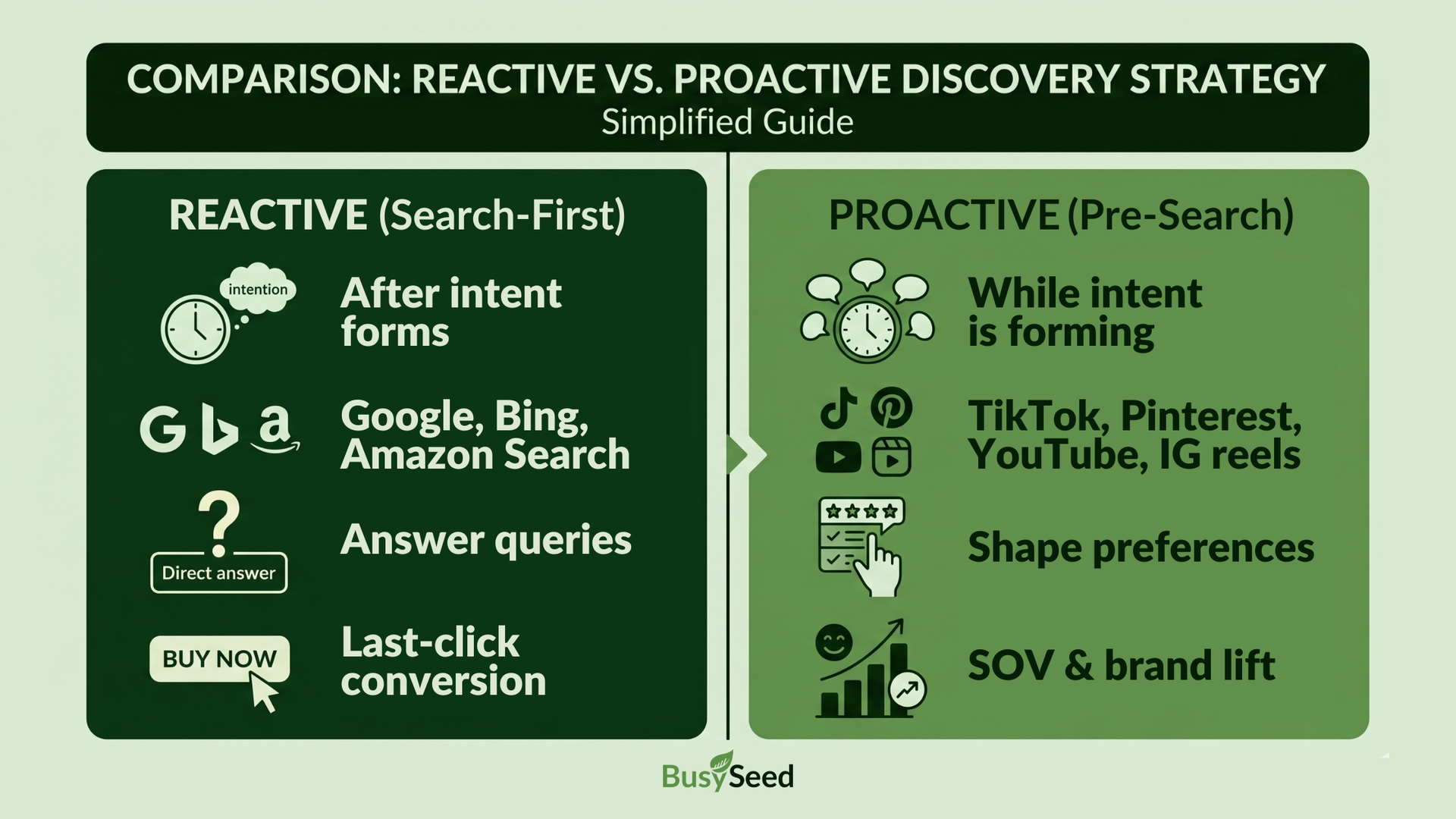
| Dimension | Reactive (Search-First) | Proactive (Pre-Search) |
|---|---|---|
| When the brand appears | After the intent forms | While intent is forming |
| Primary channels | Google, Bing, and Amazon search | Pinterest, TikTok, IG Reels, YouTube, Reddit |
| Content role | Answer queries | Shape preferences |
| Audience ownership | Borrowed (search traffic) | Owned (retargetable pools) |
| Cost | Rising CPCs in saturated markets | Compounding organic reach + efficient paid |
| AI visibility | Depends on the ranking position | Can influence AI shortlists through structured content |
| Creator integration | Optional bolt-on | Core distribution mechanism |
| Measurement | Last-click conversion | Discovery SOV + downstream brand lift |
| Timeline to impact | Days (for paid), months (for organic) | Weeks for audience building, ongoing compounding |
How To Measure the ROI of Pre-Search Presence?
Most upstream marketing efforts fail to demonstrate ROI because they are measured solely by reach. Executives see large audience numbers but struggle to connect them to revenue. To justify pre-search investment, brands must adopt a measurement framework that captures the full impact of their online marketing e-commerce strategies and broader e-commerce and digital marketing campaigns.
Key metrics to track include:
- Discovery Share of Voice (SOV): Your brand’s share of impressions and reach within a topic cluster compared to competitors. This metric quantifies your visibility in pre-search environments.
- Engaged Attention: Saves, shares, 50%+ video views, and outbound clicks. These metrics indicate whether your content is resonating with audiences.
- Audience Asset Growth: The size of your retargetable audience on each platform, tracked week over week. This metric acts as an "online balance sheet," reflecting the compounding value of your upstream efforts.
- Downstream Lift: Branded search volume, direct and organic traffic trends, email and SMS opt-in rates, and blended marketing efficiency ratio (MER). These metrics demonstrate the impact of pre-search efforts on downstream behavior.
AI-powered discovery tools are becoming increasingly opaque, making traditional last-click attribution models obsolete. Comscore’s Q1 2026 report highlights how AI tools influence consideration and awareness before users visit a website (Comscore, 2026).
To ensure that upstream investments deliver ROI, brands must measure and optimize for these pre-search signals. Without this framework, pre-search efforts will continue to be cut during budget reviews, leaving brands vulnerable to competitors who prioritize upstream presence.
Build Your Discovery Surface Map for Online Marketing E-Commerce Strategies
To implement a pre-search strategy, follow this 10-step checklist:
- Build your Discovery Surface Map. List every platform where your buyer spends time in the 30–90 days before purchase. Assign micro-intents and winning content formats to each surface.
- Audit your current pre-search visibility. Search your category terms on Pinterest, TikTok, and YouTube. If your brand doesn’t appear in the first 20 results, you lack upstream presence.
- Define your adjacent intent topics. Identify topics related to your product category’s lifestyle, hobbies, or problems. Create content around these topics rather than focusing solely on product features.
- Create a content atom library. Break 3–5 core brand stories into 10+ format variants (e.g., video, carousel, static image, checklist, FAQ, comparison guide).
- Hybrid paid-organic test. Spend a small budget across your paid media channels to test creative performance on each platform. Scale up winning creatives organically.
- Set up boards or accounts for visual search. On Pinterest, organize boards by lifestyle topics that align with your product categories. Consistent, high-quality content is key.
- Build creator relationships for topical reach. Identify 5–10 micro-creators in your adjacent topic spaces. Whitelist them for retargeting ads on Facebook and other platforms.
- Segment your retargetable audience by engagement depth. Divide your audience into four buckets: converted customers, retargetable leads, retargetable visitors, and retargetable crawlers. Tailor messaging to each segment.
- Downstream Measurement Signals. Track branded search volume, MER, and direct traffic trends before and after launching your campaign to measure lift.
- Create a creator compliance playbook. Ensure creators follow FTC disclosure requirements for sponsored content. Develop a playbook outlining disclosure rules for each platform.
How Does This All Connect Back to Revenue?
Upstream presence is a compounding investment in your brand. It does not deliver immediate return on ad spend (ROAS), but its long-term impact is undeniable. Adobe’s 2025 holiday report found that (Adobe, 2026):
- Social media accounted for 40.3% of online sales during the holiday season.
- Traffic from generative AI tools to retail sites grew by 693.4%.
These trends highlight the importance of building an upstream presence early and consistently.
For example,
BusySeed helped a client build an engaged audience of
100,000 users on Pinterest in
just 30 days. This audience could then be retargeted on Facebook at a fraction of the cost of acquiring cold leads.
Because the audience had already shown interest in the client’s product category, conversion rates for retargeting ads on Facebook were higher, and cost per acquisition (CPA) was lower. This demonstrates how upstream presence makes every downstream marketing dollar more effective.
Because the audience had already shown interest in the client’s product category, conversion rates for retargeting ads on Facebook were significantly higher, and the cost per acquisition (CPA) was lower. For this mid-market Consumer Packaged Goods (CPG) brand operating in a highly saturated niche, this upstream strategy was the key to unlocking affordable downstream conversions, proving that pre-qualifying traffic makes every marketing dollar more effective.
The Bottom Line: Stop Waiting, Start Shaping
The era of waiting for a search query to capture demand is closing. By the time a user types a product into a search bar, their mind is often already made up. Winning in 2026 requires moving upstream. By strategically saturating algorithmic feeds, visual search platforms, and AI shortlists, you shape consumer preferences while their intent is still forming. It’s about building audience assets you own, rather than constantly renting traffic in saturated, bottom-funnel markets, allowing you to maximize the ROI of retargeting ads on Facebook later in the buyer journey
Transitioning from a reactive, search-first model to a proactive, pre-search engine requires precise content mapping, smart distribution, and an integrated approach to e-commerce and digital marketing. If you want a partner who can build this architecture from the ground up and prove the lift with real revenue numbers, let's talk.
BusySeed can help you establish an inescapable digital presence before your buyers even realize they need you.
Let’s build your upstream strategy together!
FAQ: Questions Practitioners and Business Owners Actually Ask
1. What To Look For In the Best Digital Marketing Agency in NYC?
When searching for the best digital marketing agency in NYC, prioritize agencies that specialize in building an upstream presence for online retailers. The ideal agency should not only focus on downstream conversion but also maximize return on ad spend (ROAS) by capturing pre-search intent. Key factors to consider include:
- Pre-search expertise: Does the agency understand how to build visibility in algorithmic feeds, visual search, and AI-driven discovery tools?
- Hybrid strategy: Can the agency combine organic and paid efforts to create a scalable social media management for business strategy?
- Measurement framework: Does the agency track pre-search metrics like Discovery Share of Voice and Audience Asset Growth?
- Creator partnerships: Does the agency have experience working with micro-creators to amplify reach?
BusySeed is one of the few agencies in New York City that excels in all these areas, offering comprehensive digital marketing services tailored to modern consumer behavior. We build upstream presence for online retailers and optimize downstream conversion to deliver the highest ROAS in the industry.
2. Who Can Help Me Run Effective Social Media Campaigns That Actually Drive Revenue?
Running effective social media campaigns for business requires a strategic approach to distribution. The first step is identifying where your buyers consume information during their journey. For example, a local flower shop might distribute content on YouTube and Pinterest to influence buyers in the consideration stage. The second step is paid amplification, boosting high-performing organic content to reach a larger audience.
The most effective social media management for business strategies combines organic and paid efforts. Organic content builds long-term audience assets, while paid amplification scales reach and drives conversions. Agencies like
BusySeed specialize in this hybrid approach, ensuring that every dollar spent on online marketing e-commerce delivers measurable results.
3. How Do Retargeting Ads on Facebook Fit Into a Pre-Search Strategy?
Retargeting ads on Facebook are a critical component of a pre-search strategy. Once you’ve built an upstream audience, you can segment them by engagement (e.g., video views, saves, comments) and serve tailored messages. For example:
- High-engagement users: Serve product demos, customer reviews, or comparison content to reinforce their interest.
- Mid-engagement users: Offer discounts, bundles, or free shipping to encourage conversion.
- Low-engagement users: Address objections like return policies or shipping timelines to build trust.
This approach ensures that retargeting ads on Facebook feel like a continuation of the user’s journey rather than a cold ad. Brands that segment their audiences and tailor their messaging achieve higher conversion rates and lower CPAs than competitors using generic retargeting strategies.
4. What Paid Media Channels Should Small and Mid-Size E-Commerce Brands Prioritize?
For small and mid-sized online marketing e-commerce brands, the most effective paid media channels are those where buyers form opinions about products. Key channels to prioritize include:
- Pinterest: Ideal for visual discovery and pre-search intent, particularly for lifestyle and home goods brands.
- Facebook and Instagram: Effective for retargeting and lookalike audiences, especially when combined with retargeting ads on Facebook.
- YouTube: Video content is essential for building brand awareness and influencing AI-driven shortlists.
- Amazon Retail Media: Critical for brands selling on Amazon, as it allows ads to appear within shopping contexts.
The goal is to allocate budget to surfaces where users form opinions and complete purchases online. Avoid spreading the budget too thin across all paid media channels; focus on those that align with your audience’s behavior.
5. How Does Social Media Management for Business Differ From Just Running Ads?
Social media management for business is a long-term strategy that builds audience assets, while running ads alone is a short-term tactic focused on immediate conversions. A hybrid approach combines both:
- Organic social media. Builds a retargetable audience by creating valuable content that resonates with users.
- Paid amplification. Scales reach and drives conversions by boosting high-performing content.
Agencies like
BusySeed specialize in this hybrid approach, ensuring that social media management for business delivers both immediate results and long-term growth. By treating social media as an asset rather than a campaign, brands can achieve sustainable success in e-commerce and digital marketing.
Works Cited
- Adobe. 2025 Holiday Shopping Season Report. 2026.
- Comscore. Q1 2026 AI Intelligence Report. 2026.
- Deloitte. Q3 2025 Emerging Trends in Retail. 2025.
- IAB/PwC. 2025 U.S. Internet Ad Revenue Report. 2026.
- IAB/PwC. (2025, April). Internet Ad Revenue Report: Full Year 2024. Interactive Advertising Bureau.
- Pew Research Center. Social Media Use in the United States and Europe. 2025.
- Pinterest. (n.d.). Pinterest Performance+. Pinterest Business.
- Pinterest. Q4 2025 Earnings Report. 2025.
- U.S. Census Bureau. 2025 Q4 E-Commerce Report. 2026.

About the Author
Omar Jenblat is a powerhouse in the digital marketing landscape, renowned as the Founder and CEO of BusySeed, an award-winning agency that has scaled over $1B revenue for 550+ businesses through high-performance growth strategies. With a technical foundation in computer engineering, Jenblat bridges the gap between complex data analytics and creative marketing, specializing in aggressive revenue scaling, SEO, and multi-channel lead generation. As a member of the Forbes Agency Council, The Org, and a visionary entrepreneur behind ventures like LeadChaser.ai, The Honest Agency, and Zeed Agency, he has established a global footprint by leveraging a "human-led, AI-assisted" philosophy to drive measurable ROI for major brands and startups alike. His expertise is characterized by a focus on digital automation and performance-driven results, consistently positioning his firms at the forefront of the evolving technological landscape.