Reducing Cost Per Intake from $37 to $10 Through Funnel Optimization in 2026
High lead costs aren't always a Google Ads problem, they are often the symptom of a leaky conversion funnel. This step-by-step workbook guides you through the process of mapping your lead generation pipeline, analyzing conversion rates at every single stage, and deploying targeted fixes. Learn how to plug the operational leaks draining your budget, from slow speed-to-lead times to flawed algorithm signaling. Discover how to scale your service business without scaling your ad budget, backed by a real-world case study where we took a disability law group from a $37 Cost Per Intake to a lean $10.49 system, generating over 1,600 conversions in under 5 months.
TL;DR
- The average cost per lead for legal services was $131.63 in 2025, according to WordStream’s annual legal marketing benchmarks. Lead generation for service businesses has become a crucial component of marketing strategy for most law firms to survive.
- BusySeed reduced the cost per conversion for a disability law group from $37 per intake to $10.49 per conversion, achieving 1,600+ conversions in under 5 months for a busy legal practice with multiple lawyers across different locations.
- The median conversion rate for landing pages is 6.6% (based on 464 million visits in Q4 2024 by Unbounce).
- 74% of law firms respond to leads within 7 days, but up to 85% of callers who go unanswered won’t call back; your cost per intake is bleeding out in the operations gap.
- Reducing cost per intake from $37 to $10 can involve fixing 2-4 compounding leaks in your marketing and sales funnel, a core focus of ppc management services.
What's Actually Driving Your High Cost Per Intake?
Your high cost per intake isn’t Google’s fault. It’s yours. And that’s actually good news, because it means you can fix it.
Everyone looks at Google Ads cost increases and blames the platform and rising CPCs. In the 2025 Google Ads Benchmark Data by WordStream, the average cost per click rose to $5.26 in 2025 (up from $4.66 in 2024). However, the reality is that this is just the cost to get the click.
The real expenses begin after the click. This is why effective lead generation for service businesses depends just as much on follow-up systems and funnel structure as it does on ad targeting. There’s the development of a good landing page to capture that lead, the form for follow-up, the communication after submission, and scheduling an intake with the legal team of the service business.
Here’s how you can measure each part of your lead generation for service businesses process, find leaks, and use fixes that have multipliers to reduce cost over time.
BusySeed took on the challenge for the disability law group mentioned above in campaign development for less than 5 months, achieving 1,600+ conversions with a total of 209,295 impressions and a cost per conversion of $10.49, down from the previous agency’s cost per intake of $37 with a 12% conversion rate for the generate leads service.
This post is the step-by-step breakdown of how it works. Modern ppc management services must optimize the entire intake process rather than just campaign performance inside Google Ads.
Is Your Funnel Actually Broken, or Just Leaky?
A broken funnel never converts leads; a leaky funnel converts them, but with great variability and huge cost to scale.
Most service business funnels have several leaks that go unnoticed. These typically occur between steps in the funnel and take days to identify and fix (e.g., 45 minutes from form submission to first call). A poorly structured generate leads service often hides these leaks because it focuses on lead volume instead of downstream intake quality. Leads that leave a message on your voicemail at the end of the week are often returned the following Monday, having fallen through the cracks. Since these “leaks” can’t be monitored in your ad platform, you must “instrument” for them.
Think of your funnel as a series of stages that leads must travel through. To identify leaks, map out your entire process. Here’s an example of a complete Funnel Map for a service business:
The data support these findings. The 2025 study covering the websites and lead forms of 1,300+ law firms and over 150,000 data points found that the median response time to a lead form submission was 13 minutes. Even more concerning, 26% of law firms did not respond to lead form submissions at all. The study, Hennessey’s 2025 lead form response time study, is available
here.
Paid Search Benchmarks For Service Firms: A Complacent Manager’s Worst Enemy
The most important benchmark for paid search in legal services is the average cost per lead (CPL). According to WordStream’s 2025 Google Ads benchmark report, the average CPL for legal is $131. The problem is that many marketing teams treat this as the ceiling for what is “good” instead of striving to do better. The best ppc management services benchmark against profitability and completed intakes instead of average CPL metrics.
I often see people confusing “leads” with “intakes.” For example, if you’re paying $37 per lead, that means you’re paying $37 per pipeline for it to result in a single case. Every step in the pipeline (click, lead form fill, follow-up call, contact, lead qualification, scheduled intake, completed intake) costs you money. If you increase the conversion rate at any of these steps, you’ll see significant decreases in cost per intake.
By structuring your paid media efforts to drive toward a specific cost per qualified outcome (e.g., a conversion where the potential customer moves along in your sales process), you can work backward to optimize all prior steps in the funnel. These statistics are useful for comparing your paid search marketing to the average service businesses, but you should aim to do better than average in your paid media strategy. A successful paid media strategy focuses on improving downstream intake metrics rather than lowering CPCs alone.
What Does a Real Funnel Map Look Like?
Stop thinking about your Paid Search in terms of “campaigns.” Instead, organize your ad spend around your law firm’s funnel and focus on maximizing the quality and quantity of intakes at the end of the pipeline. Advanced ppc management services organize ad spend around conversion flow efficiency across the entire funnel.
Ad Spend → Clicks → Leads → Contacts → Qualified Leads → Scheduled Intakes → Completed Intakes
The cost per intake is the result of every conversion rate along the way. The most scalable lead generation for service businesses systems are built around improving conversion rates at every stage instead of relying purely on higher ad spend. For most law firms, the rates are: Clicks/Leads (7%), Leads/Contacts (60%), Contacts/Qualified (40%), Qualified/Scheduled (70%), Scheduled/Show (75%). These rates are often far from optimal. To go from $37 to $10, improving 2 or 3 stages by 35% would have a huge compounding effect.
The biggest gains in reducing cost per intake come from improving the 2-3 worst-performing stages in the funnel. For example, increasing click-throughs to leads by 35%, leads to contact by 40%, and contacts to scheduled intakes by 35% results in a 3.7x increase in intake per dollar spent. This is what lead qualification of the highest caliber looks like. It’s not just scoring or tagging leads in a CRM; it’s a highly structured funnel where you can track precisely where leads are dropping off and implement fixes.
How Do You Instrument a Funnel So the Leaks Are Visible?
To identify leaks in your funnel, you need to collect data at each stage. Most paid media platforms automatically collect click data, but this is often limited. A modern paid media strategy requires connecting CRM data and offline conversion outcomes back into the advertising platform. For this reason, paid media teams store additional fields about each lead in their CRM and upload them to the ad platform to tag leads with more data.
First – Log GCLID’s on Every Lead Record: By default, most ad platforms do not provide a GCLID for offline conversion imports in Google Ads. To report on GCLID-based data, log the GCLID on every lead record, whether from a website form or call tracking number. Google Ads Support provides details on setting up offline conversion imports
here. This method allows you to upload conversions generated from GCLIDs, enabling reporting on metrics like conversion value and cost per conversion in Google Ads.
Each step of the funnel must be timestamped. For example, when did the lead enter your system? When was the first touch? Speed-to-lead is critical. Most law firms do not respond to leads in less than 5 minutes; in fact, only 25% do.
Your CRM must contain fields for each stage in your funnel, such as Qualified, Scheduled for Intake, and Completed Intake. When you import conversions from Google Ads offline using GCLID data, you tell the algorithm which clicks produced real business outcomes. Enhanced conversions for leads (details here) allow you to use hashed first-party data to improve conversions. This is the beginning of the lead qualification process. Effective lead qualification requires connecting behavioral signals, intake outcomes, and CRM data into one unified reporting system. The rest of ppc management services involves ad testing, landing page design, and using data to map out your current funnel.
Compounding Leaks
Every high-performing paid media strategy starts with identifying where leads are being lost between the click and the completed intake.
Leak one: Landing Pages Converting at the Middle of the Pack (6.6% average for services)
The average conversion rate for all industries online is 6.6% for Q4 2024, based on 464 million+ visits to 41,000+ landing pages studied by Unbounce. Average is subpar for most business models. For example, the average law firm’s intake would cost about $37 for a 30-minute consult. Most law firms pay less than $10 per lead and aim to cut costs dramatically to achieve these numbers. Dramatic reductions in conversion costs are required to bring costs down to average for law firms.
Many articles address this topic, and implementing suggested steps can significantly improve conversion rates. The focus should be on ensuring the message in your ads matches the landing page and reducing form fields. After submission, direct visitors to a confirmation page that reinforces professionalism and timeliness.
Many ppc management services providers fail to account for operational leaks that occur after the lead submits a form or places a call.
Leak Two: Missed Calls and Slow Follow-Up
Here’s a painful fact: 85% of callers who go unanswered will not call back. In the legal industry, 28% of calls are missed. If you’re purchasing leads for your law firm and 28% of those leads result in unanswered calls, your cost per intake increases by 28% before any optimizations.
Effective ppc management services account for phone leads and mitigate issues that cause lead loss. Even the best ads and landing pages can’t compensate for unanswered phones or voicemails. Returning calls within a set time frame is key to converting leads into clients. A solid routing plan, adequate coverage, and Service Level Agreements (SLAs) for call returns are crucial to eliminating this leak.
Leak Three: The Wrong Conversion Signal is Being Sent to the Algorithm
Most teams using Google Ads for ppc management services treat form submissions as conversions. This is incorrect. The conversion for a service business lead campaign should be when an intake is completed. Promote completed intakes as the primary conversion for your ppc management services and upload them as offline conversions. Use enhanced conversions for leads to improve attribution.
This approach differs in that it focuses on real business outcomes. The best generate leads service models optimize campaigns around completed consultations and signed clients rather than basic form fills. Uploading offline outcomes via GCLID allows the algorithm to learn from real intake outcomes. Google Ads’ enhanced conversions for leads improve attribution durability, separating sophisticated marketers from the rest.
Comparison: Average-Funnel Math vs. Optimized-Funnel Math
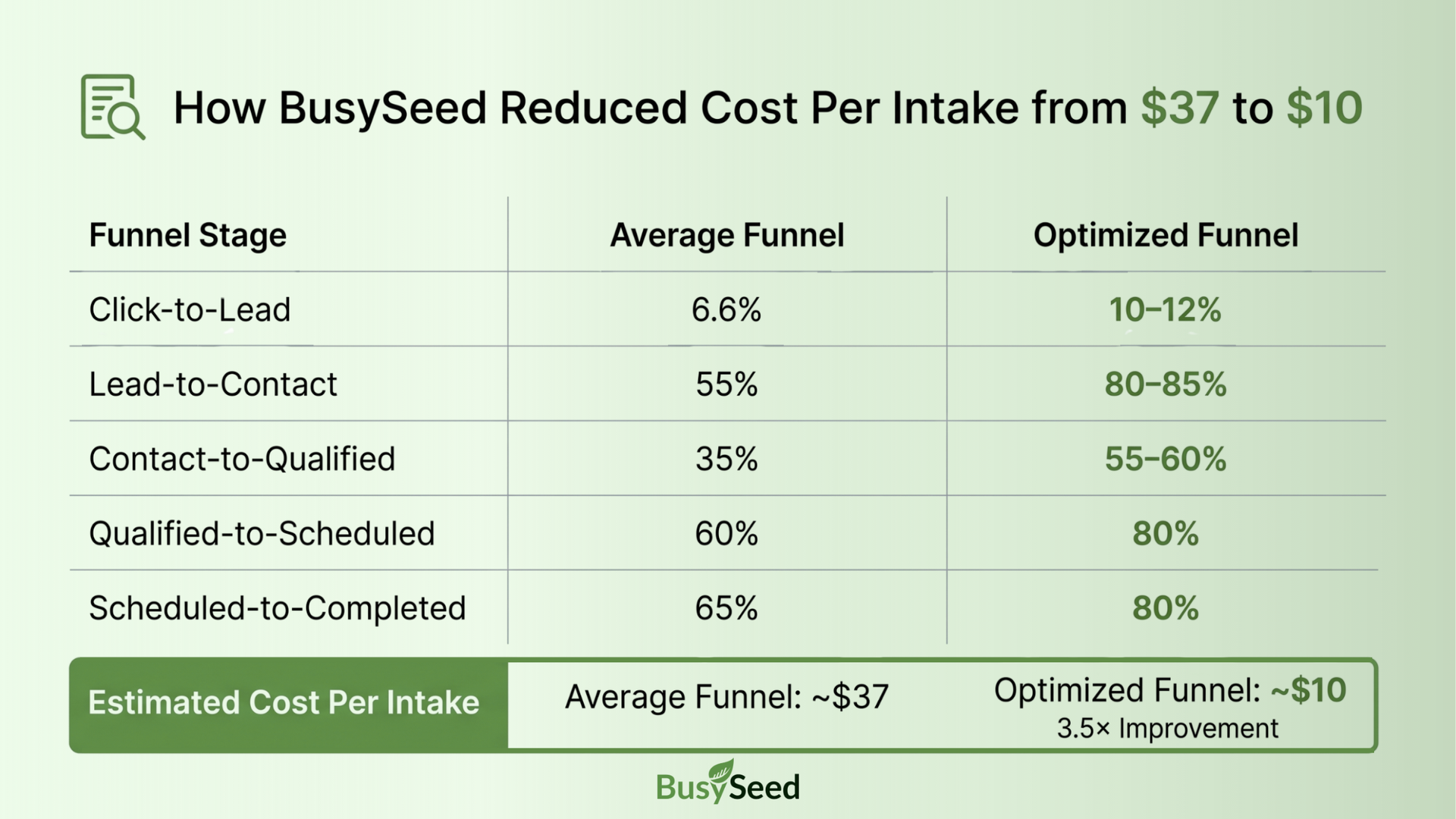
| Stage | Average Funnel | Optimized Funnel | Impact |
|---|---|---|---|
| Click-to-Lead Rate | 6.60% | 10–12% | Fewer wasted clicks |
| Lead-to-Contact Rate | 55% | 80–85% | Speed + routing fixes |
| Contact-to-Qualified | 35% | 55–60% | Better lead qualification |
| Qualified-to-Scheduled | 60% | 80% | Friction reduction |
| Scheduled-to-Completed | 65% | 80% | 15% improvement |
| Estimated Cost Per Intake | ~$37 | ~$10 | 3.5× improvement |
The numbers above are real. By optimizing the BusySeed disability law group campaign, we achieved a cost per conversion of $10.49 with over 1,600 conversions during the campaign.
The Step-by-Step Funnel Optimization Workbook
Elite ppc management services rely on structured operational systems, conversion tracking, and offline attribution.
1. Define Your Real Cost Per Intake
Calculate your real Cost per Intake by dividing your total ad spend by the number of completed intakes. This should only include completed intakes, not form submissions or calls.
2. Map Every Stage of the Funnel With Current Conversion Rates
Gather data for each stage in the funnel, including Clicks (from the ad platform), Contact info (in CRM), and calls (from call tracking). Identify gaps to tackle first to increase overall conversion rates.
3. Identify Your "CPI Cliff" the Stage Where the Most Leads Die
Fix the worst-performing step in the funnel first before optimizing other stages that are already performing well.
4. Capture GCLID on Every Lead Record
Track GCLID on every lead record in your CRM (e.g., Salesforce) and integrate it with call tracking software (e.g., CallTrackingMetrics). Import offline conversions according to Google’s documentation here.
5. Implement Speed-to-Lead Monitoring
Optimize conversion by ensuring service-based leads receive a human touch in real time. Add a timestamp field to capture the time of the first human touch. Set an SLA of 5 minutes to respond to high-intent leads and alert a human if the lead hasn’t been touched within that time. This will likely increase the lead-to-contact rate, a key cost per intake variable.
6. Test Landing Page Message Match
For every trigger term, review the highest volume of impressions going to a landing page. Compare the landing page headline to the ad copy and test the landing page with fewer form fields. This simple tweak can significantly improve click-through to lead conversions.
7. Promote Completed Intake to Primary Conversion
When enhanced conversions for leads are enabled, import hashed lead data tied back to the ads that drove the activity. The algorithm will return better audiences if your primary conversion is a completed intake rather than a form completion.
8. Build a Follow-Up Cadence for Non-Converted Leads
A 2026 CallRail case study of the disability law group Caviness & Cates found a 33% lift in lead-to-appointment conversion after adding a high-volume text follow-up process for leads who didn’t convert after the first call. Follow-up communications were set up on a 30-day calendar.
9. Review TCPA Compliance for Your SMS Follow-Up Workflow
Review your SMS follow-up process for compliance with the FCC’s updated rules for text messages. The FCC adopted new rules in February 2025, strengthening requirements for obtaining consent and opt-out processes. Review the FCC documentation here.
10. Run a Monthly Offline Conversion Upload
Create a recurring task to upload data of completed intakes and booked consultations to Google Ads using GCLID matching or enhanced conversions for leads. More details can be found in the Google Ads API documentation.
11. Define Lead Qualification for Your Business
Lead qualification means evaluating leads to determine if they would benefit from your services. For the disability law group we worked with, this meant determining if an SSI/SSDI claimant was eligible to proceed with their case. This ensures that only qualified leads are scheduled for intakes, rather than information seekers who may not show up. Strong lead qualification criteria also improve ad platform optimization by sending higher-quality offline conversions back into the algorithm.
BusySeed segmented SSI/SSDI claimants into three groups: (1) those eligible and ready for representation, (2) those seeking information on filing a claim, and (3) those too early in their process to be considered. This lead qualification process resulted in a highly qualified-to-scheduled rate and a repeatable, low cost per intake.
Qualifying leads for services can be systematized. Many factors affect a service business’s repeatable cost per intake of $10. The generate leads service chosen is critical. Lead generation for service businesses can come from many paid sources, such as search, social, and classifieds. The key is that the chosen generate leads service sends qualified leads. Generating high volumes of leads that qualify is far more important than generating large volumes of unqualified leads.
BusySeed's Service Business Lead Generation (for Law Firms & Attorneys)
BusySeed’s lead generation for service businesses focuses on the end result. Instead of tracking “traffic” metrics, we start with the end of the funnel and work backward. This is one of the major differences between BusySeed and generic PPC management services providers that focus only on clicks and impressions. Before discussing keywords or ad copy, we determine what a completed intake looks like for a given business.
The previous agency for the disability law group tracked form submissions from Google Ads with a 12% conversion rate at a cost per conversion of $37. This created a long funnel to completion, resulting in a high cost per intake. We streamlined the process to focus on completing intakes for the disability law firm.
Once we built the Google Ads funnel for the disability law campaign, we refined the leads. By uploading offline conversion data, the algorithm learned from past completed intakes. We also addressed operational issues affecting the call center and lead follow-up, such as timely responses, proper call routing, and appropriate follow-up.
BusySeed’s approach to lead generation for service businesses in the disability law space resulted in a repeatable process: 1,600+ conversions, $10.49 cost per conversion, and a system that can be replicated.
See how BusySeed builds a legal service campaign.
Not all services are equal, and dramatic improvements may not always be possible. However, the typical service business can expect to see an increase of $15 to $25 per lead.
Smarter Generate Leads for Your Service Business and Watch the Algorithm Change
The quality of your generated leads service and the conversion signal you provide to the algorithm are interconnected. By using a smarter lead-generation service for service businesses, you improve campaign performance by feeding conversions (intakes, scheduled consultations) into the algorithm. This helps the algorithm understand which keywords and ad copy lead to real outcomes and which audience segments are more likely to schedule consultations. An advanced way to generate leads should continuously feed intake and consultation outcomes back into the advertising platform to improve targeting accuracy over time.
A smarter generate leads service allows the algorithm to determine which ad copy variations attract people who convert past the form. For example, a program designed to help service businesses generate leads can be fed conversion data, allowing the algorithm to change behavior over time to drive more conversions, such as converting traffic into intake calls for a law firm.
This is how best-in-class ppc management services operate in 2026 for service businesses. A complete attribution chain from click to intake is tracked and used to send real signals to the platform for optimization.
Operational Variables to Include in Your Paid Media Strategy
Operational issues impact your paid media strategy. Many agencies overlook the operational side of lead generation for service businesses, even though intake speed and call handling directly affect campaign profitability. The strategy must coordinate with advertising to ensure call handling, follow-up, and intake capacity. If 85% of calls from ads go unanswered, it’s not an advertising problem; it’s an operations problem.
The data is clear: up to 85% of callers will not return a call that goes unanswered. In the legal space, this means 28% of calls left on voicemail are lost forever, per CallRail’s benchmark. For a service business buying paid search leads, this means more than a quarter of phone leads are lost at the first touch. This is not a problem with the ads but with the business’s operations.
When looking for a paid media strategy for a service business, choose someone who considers after-hours calls, response times, call-back setups, intake capacity, and follow-up. All these factors should be part of a complete paid media strategy.
Our process to rebuild the disability law group’s intake funnel wasn’t just about managing Google Ads. We developed a complete system to ensure the greatest number of conversions.
FAQ: Questions Smart Practitioners Are Actually Asking
Q1) What are the best tools for evaluating lead quality using behavior signals?
Historically, the biggest barrier to using behavior signals to score leads in PPC has been the cost of intent platforms. However, CallRail launched a feature for conversion signals in July 2025 that automatically tags converting calls and uploads them as conversion events in Google Ads. This can be set up in minutes. For form leads, Heap and Hotjar can analyze behavior to identify patterns correlating with higher-quality leads. These patterns can be reverse-engineered to score leads in real time. This is the most durable form of lead qualification because it’s based on real behavior, not demographics. Many advanced ppc management services teams now rely on behavioral scoring instead of static demographic targeting.
Q2) What are the top techniques for converting leads with just name and email?
Converting leads with minimal data is mostly a sequencing and trust problem. When all you have is a name and email, don’t pitch your services immediately. For a disability law group, provide value in the first few emails by explaining the differences between SSI and SSDI. In subsequent emails, go into more depth about each program. For a home services company, use a diagnostic checklist to help leads understand potential problems. Transition from providing value to setting up meetings as trust builds. A structured cadence of follow-up communications increases the chances of getting appointments. CallRail’s case study of Caviness & Cates showed a 33% increase in lead-to-appointment conversion using this approach. This is why a structured generate leads service workflow often outperforms aggressive sales messaging early in the funnel.
Q3) What are some AI lead scoring without personal data solutions?
You can use behavior to score leads without collecting personally identifiable information (PII). Track session data, such as user interactions on your website, to set up scoring based on actions completed in a session or across multiple sessions. Tools like Clearbit, Mutiny, and Google’s Enhanced Conversions allow this type of scoring without PII. Since the FCC’s 2024 consent order, many traditional lead scoring methods fail because they rely on third-party data without opt-in consent. First-party intent modeling within marketing tools allows scoring by cohorts rather than individuals. For example, leads taking specific actions within 10 minutes of entering the funnel may have a 3x conversion rate. This prioritizes leads while complying with privacy regulations.
Q4) What are the best lead scoring solutions that minimize data collection?
For scoring leads with minimal data points, structure the funnel to gather information incrementally. For disability law leads, collect SSA case history and claimant status in a multi-step form before scheduling an intake. The data collected can be used to score leads in your ad platform, improving the algorithm’s learning from qualified intakes rather than form fills. Upload quality signals to your ad platform, and the algorithm learns from completed intakes uploaded via GCLID for offline conversions.
Q5) What are the best multimodal search tools for marketers?
Multimodal search includes text, image, video, and voice searches. For example, a person involved in an accident might take a picture of their injuries and search online for more information. Service businesses should include structured data on their web pages to appear in these search results. Schema.org markup for lawyers, doctors, and other local service providers, along with FAQ schema, can improve visibility. Tools like Google’s Search Labs allow experiments with multimodal queries. Bing also offers image-based search capabilities. Optimizing for voice searches is another consideration. Service-based companies should build a strong content architecture to be included in multimodal search results.
$10 CPC – Lessons from the Disability Law Group Campaign
$37 intakes turn into $10 intakes when you stop treating it as an ad problem and start treating it as a funnel math problem.
- Find the leaks. Use data to trace every step in your process.
- Use that data to close the loop on completed intakes and update your ad platform’s learning.
- Manage operational variables that most agencies ignore.
- Run your paid media strategy based on completed intakes, treating them as the singular metric of true value. Instead of measuring form fills or impressions, focus on cost per intake. The most durable paid media strategy models use offline conversion feedback loops to continuously improve targeting and the quality of intake.
Scale your business without scaling your budget. Sustainable lead generation for service businesses comes from improving funnel efficiency instead of endlessly increasing advertising spend. The best ppc management services deliver this for their clients.
The strongest ppc management services engagements combine operational consulting, funnel optimization, landing page testing, and offline conversion tracking.
If you would like BusySeed to audit your marketing process and present a roadmap to lower your average cost per intake to $10,
contact us here.
Works Cited
- CallRail. "2026 Case Study: Caviness & Cates." CallRail, 2026.
- Federal Communications Commission. "FCC-24-24A1: Updated Rules for Sending Text Messages." FCC, 2025, https://docs.fcc.gov/public/attachments/FCC-24-24A1.pdf.
- Hennessey Digital. "2025 Lead Form Response Time Study." Hennessey Digital, 2025, https://hennessey.com/2025-lead-form-response-time-study/.
- Unbounce. "Conversion Benchmark Report Q4 2024." Unbounce, 2024.
- WordStream. "2025 Google Ads Benchmark Report." WordStream, 2025.

About the Author
Omar Jenblat is a powerhouse in the digital marketing landscape, renowned as the Founder and CEO of BusySeed, an award-winning agency that has scaled over $1B revenue for 550+ businesses through high-performance growth strategies. With a technical foundation in computer engineering, Jenblat bridges the gap between complex data analytics and creative marketing, specializing in aggressive revenue scaling, SEO, and multi-channel lead generation. As a member of the Forbes Agency Council, The Org, and a visionary entrepreneur behind ventures like LeadChaser.ai, The Honest Agency, and Zeed Agency, he has established a global footprint by leveraging a "human-led, AI-assisted" philosophy to drive measurable ROI for major brands and startups alike. His expertise is characterized by a focus on digital automation and performance-driven results, consistently positioning his firms at the forefront of the evolving technological landscape.