Scaling Content & Distribution to Reach 100K+ Monthly Active Viewers in One Month in 2026
Content creation is only half the battle; the true engine of scale lies in strategic, aggressive distribution. Reaching a massive top-of-funnel audience in a matter of weeks requires a hybrid approach that amplifies organic production with targeted, visual-first advertising. This interactive growth framework demonstrates how to produce content efficiently and maximize its reach across highly engaged platforms. Through actionable sections on content repurposing, automated scheduling, and multi-channel distribution, marketers will map out a highly leveraged plan to turn obscurity into hundreds of thousands of active monthly viewers.
Case Study: Reaching 100K+ Monthly Pinterest Viewers in Over 30 Days. Medallion Foods needed to quickly boost its top-of-funnel brand awareness. By deploying a hybrid strategy of targeted Pinterest ads and consistent organic posting, BusySeed rapidly scaled its audience. We curated specific boards surrounding high-interest topics like pasta and dinner recipes. In just over one month, the account rocketed from obscurity to over 100,000 monthly active viewers, creating a massive, engaged audience for future retargeting.
TL;DR
- U.S. social media marketing ad revenue reached $117.7 billion in 2025, up 32.6% year over year (IAB and PwC, 2026). Fast reach is increasingly bought rather than earned through organic efforts alone.
- Pinterest now has 631M global MAUs as of Q1 2026; hitting 100K monthly viewers on this platform isn't a moonshot, it's a math problem (Pinterest, 2026a).
- 83% of ad executives say they’ve deployed AI in the creative process, but the brands winning aren’t just generating content, they’re distributing it with precision (IAB, 2026).
- BusySeed scaled Medallion Foods from 0 to 100K+ monthly Pinterest viewers in just over 30 days using a hybrid approach of a paid media strategy and organic distribution built around intent-driven boards, proving the immense value of structured social media management for business.
- Pinterest’s distribution engine is non-linear: a Pin can earn engagement hours, days, months, or even years after publishing (Pinterest, n.d.-b).
100K Monthly Viewers in 30 Days - What Are We Talking About?
Here, we're referring to the exact metric you think of when you hear “100K monthly viewers on Pinterest”: Total audience. This is the number of unique users who viewed your Pins and were engaged with your content over a rolling 30-day period.
Note that Impressions and Engaged Audience are also important Pinterest metrics, but they differ from the Total audience:
- Total impressions: Counts each time one of your Pins is shown.
- Engaged audience: Counts every user who interacts with a Pin of yours (e.g., clicks the link to the site, saves your Pin to a board, etc.).
The number of viewers is a real metric and should be a compelling one to sell to your clients if you develop downstream steps to reach them effectively, which is the cornerstone of successful social media management for business. If you need an expert team to build out these downstream steps,
BusySeed can help you map out a complete conversion architecture.
The above information gives a clear understanding of the meaning of “100K in 30 days”. As previously stated, BusySeed scaled Medallion Foods from 0 to 100K+ monthly viewers in about 30 days. The information clarifies the distribution used to reach the above numbers. The main point is a hybrid approach that combines a
paid media strategy with
organic distribution, focusing on a handful of intent-driven boards. The above information also explains that the metric used to measure viewership is total audience. This measures the number of unique users who have seen or interacted with an account’s Pins within a 30-day period.
Why Is Distribution the Real Engine of Scale in 2026?
Many content marketing strategies fail at the point of distribution. Their contents exist, but nobody sees them because no good has been done at the amplification stage, highlighting a common flaw in modern social media management for business. In short, all the content BusySeed created was distributed on Pinterest, reaching the 100,000+ monthly viewers for Medallion Foods in just over 30 days.
According to IAB and PwC’s 2025 Internet Ad Revenue Report, U.S. internet ad revenue hit a record high of
$294.6B in 2025 (IAB and PwC, 2026). Digital video saw the strongest year-over-year growth at
25.4%, and social media marketing ad revenue reached
$117.7B, up 32.6% year over year. It is no surprise that companies are reaching huge audiences fast and distributing their content effectively. This is not being done through organic distribution of content. Instead, it is being distributed through paid media to seed distribution and draw attention to the content, which can then be distributed by the platform’s algorithms to the winning content’s appropriate audiences.
- Paid ignites the distribution engine.
- Organic keeps it going.
- AI social media marketing boosts the creation of high-quality content.
Platform-native social signals (e.g., saves, clicks, repins) tell the distribution engine what to amplify next. A well-built paid media strategy is NOT the backup plan when Organic fails. It is the launch pad for your distribution efforts. For brands struggling to find the right budget allocation,
BusySeed's paid media experts can design a launch pad tailored to your specific audience.
Is Pinterest Still a Credible Fast-Growth Channel in 2026?
We continue to see a clean trajectory for Pinterest, which in Q1 reached 631M global monthly active users and reported $1.007B in revenue, up 18% year-over-year. As a platform with strong commercial intent and continued growth, we see value in reaching customers here.
According to the Pew Research Center,
37% of U.S. adults
use Pinterest (Pew Research Center, 2025). This is NOT a niche craft platform, nor a dying breed of online publishers. Rather, it’s a mainstream discovery platform that happens to be visually driven. And, most importantly, Pinterest content lives on for long periods of time; there is “no set engagement window” for a Pin to perform (more on that in a follow-up post).
This, in turn, creates a fundamentally different type of content economy than that of Instagram or TikTok. Social media marketing on Pinterest requires a very specific posture: optimize towards saves, while building Boards around intent clusters. And then let the algorithm do its magic once it’s been proven that a certain piece of content is performing well.
When implementing social media management for business on Pinterest, it is recommended that brands with an online presence publish consistent, high-quality content and engage with others in their market, optimizing Pins for Saves and using intent clusters as the foundation for Boards and Pin groupings. The social media marketing algorithm will then do the rest for the brand, promoting the Pins that perform best for the marketer.
Case Study: BusySeed & Medallion Foods
The results of BusySeed’s efforts to reach 100K+ viewers at Medallion Foods in one month were no accident. The distribution of their content did not happen by chance. The algorithm that picked a Pin and drove traffic to a video did not happen by chance. A paid media strategy was quickly put in place.
For the paid portion, it was necessary to launch the paid media strategy to ignite the entire structure. This included launching a campaign of paid Pins on Pinterest to kick-start content distribution and generate top-of-funnel awareness of Medallion Foods among potential customers. The strategy was a hybrid approach in which
BusySeed created a number of Pinterest boards on high-interest topics, such as different types of pasta and weeknight dinner recipes, and then published the content for Medallion Foods as relevant Pins. These Pins were then optimized and launched as paid ads on Pinterest to accelerate early saves and help the algorithm start receiving social signals about the quality of the published content.
As a result, the number of monthly active viewers on Pinterest for content created for Medallion Foods quickly reached over 100,000 in just over 30 days. What is more, this audience can then be retargeted and used as a pool of social signals (such as saves, clicks, and repins) fed into Pinterest's distribution engine to continue working with the content well after the paid push has finished.
The result for Medallion Foods was that they went from having no presence on Pinterest to having 100,000+ monthly active viewers within a month. This created a retargeting pool for BusySeed, and the social signals (i.e., saves, clicks, repins) from organic traffic sustained the brand's content distribution long after the paid push had finished. This level of compounding momentum is exactly what expert social media management for business aims to achieve.
Great social media management for business is not just posting and then boosting the occasional Pin. It’s building a machine that earns reach and then sustaining that reach over time.
What Role Does AI Play in Social Media Marketing for Business on Pinterest?
AI is used in production to increase the volume and speed of content creation (Kontent.ai, n.d.). But it is not used for strategy or to make decisions based on taste and creativity.
The cost to query models has decreased so dramatically over the last 2 years (down 280x from $20.00 per million tokens in November 2022,
down to $0.07 in October 2024) (Stanford HAI, 2025) that the amount of content a human can produce in a set time has dramatically increased. As an example, previously it would take a team of designers 2 days to produce 15 Pin variations off of a single concept. With AI, that same amount of content could be produced by a single person in the afternoon. And the more content you can distribute via social media marketing, the better the chance it will reach the right people.
IAB AI Gap research showed that while
83% of ad executives now use AI in the creative process for their social media marketing campaigns, there is a
growing gap between creators’ perceptions of AI-generated content and consumers’ perceptions (IAB, 2026). For now, it is best to use AI to produce variations, then rely on human judgment to select the best Pin from among many AI-generated options. This was seen in the case of Medallion Foods with BusySeed, where the creative director had 20 Pin variants of a new Medallion product created by AI and picked the three that didn’t look as if they were written by a chatbot.
While tools can process and significantly influence creativity, no AI can replace the creative director or human intuition when selecting the final product. In large volumes of creation, the creative director has more to select from and thus can achieve better results. Embracing AI social media marketing means letting the machine handle the high-volume generation while the human handles the taste. But in the end, the human is the filter, so the AI needs to generate, and the human has to select, which is the root of all conflict when it comes to using AI to create. Navigating this conflict requires a finely tuned workflow;
reach out to BusySeed to see how we seamlessly blend AI efficiency with human-led creative direction.
How Do You Build a Paid Media Strategy That Actually Generates Scale?
The two main paid media strategies for social media management for business are:
- First, to reach new followers with top-of-funnel Pins.
- Second, to retarget the majority of that audience to stay top of mind and convert them into customers.
When you first put up a Pin, there is no signal to the algorithm, so if it gets no engagement
in the first 48 hours, it will likely not get distributed to many more people. But by putting a small paid spend behind that Pin to get it some saves and some clicks, you have created a signal with the algorithm that your content resonates with people. After your paid campaign is over, that Pin will continue to get distribution from Pins saved from your past campaigns, as well as from engagements on that Pin in the past.
JCPenney ran a campaign on Pinterest that used the Top of Search placement. These Pins saw a
277% increase in click-through rate and a
116% increase in return on ad spend compared with other ad placements on the platform (Pinterest, n.d.-a). This is a perfect example of the unit economics of paid media strategy on Pinterest. JCPenney had the right purchasing intent at the right time to drive online sales.
A great example of a multi-objective campaign is the hair vitamins campaign run by OLLY for their hair vitamins product. For the awareness-building portion of the campaign, OLLY created a variety of Pins to raise awareness of its hair vitamins product. The team then promoted viewers of the brand’s Premiere Spotlight video to ads that drove consideration to buy hair vitamins. The results were fantastic:
- Aided brand awareness went up +2.9 percentage points.
- 79% of users who viewed the Premiere Spotlight video were new to the OLLY hair vitamins brand.
The OLLY team applied this campaign approach to their 30-day marketing sprints and achieved great results.
What Does a Social Media Management Framework for Scale Actually Look Like?
We’ve created a fictional online retailer of high-quality pasta sauces called Pastabilities. Pastabilities has a simple website that lists the various sauces that they sell online. They also have a Pinterest account with 12 followers and an average of 400 monthly viewers. But without a clear social media management for business strategy, the person managing Pastabilities’ Pinterest account is left to post as much as possible in the hopes that something will stick.
Social media management for business at scale starts with the right infrastructure before you can even publish Pins. First, set up a business account on Pinterest and claim your website there. This will help Pinterest attribute all the “Other Pins” created from your domain. After that, you need to define your KPI stack and make sure you have the right proxy for “monthly viewers” on Pinterest:
- For distribution, focus on increasing the saves rate.
- For traffic, focus on the click rate of outbound links.
If you don’t set up all of these before week one, you will have no idea what is working for you. Furthermore, properly integrating AI social media marketing tools into this infrastructure from day one ensures you can analyze these metrics at an unprecedented speed. Setting up this infrastructure can be technically demanding, but the
BusySeed team has the exact frameworks ready to deploy for your brand immediately.
The social media management for business framework at scale is equal parts infrastructure, a publishing engine, and distribution. By distribution here, we mean publishing content on Pinterest via a publisher’s account rather than a personal account, following a strict posting schedule. A scheduling-based approach is often used by personal Pinterest users to distribute Pins, but publishing via a business account on Pinterest is typically distributed on a much larger scale to reach a wider, more varied audience.
To get the most value from a publisher’s distribution on Pinterest:
- First, set up an appropriate business account.
- Connect your website to ensure all “Other Pins” are tracked.
- Then, set up your KPIs and trackables.
From there, it is simply a matter of implementing your approach to publishing distribution and then determining what is working and how to scale it. This is known as your publishing engine.
The term refers to an efficient way of creating a large amount of high-quality content. The term "large amount of content" refers to the number of Pins distributed through a user’s Pinterest account. In the context of a publishing engine here at OLLY, we refer to a system that allows us to create and distribute a large volume of high-quality content from a single high-quality piece. This content can be a hero asset, such as a recipe, a product page, or a how-to.
From that single piece of content:
- The 10 to 15 odd Pins that are distributed will each have a different hook.
- They will each be cropped differently, and in some cases, they will even have different overlays.
- In addition to the Pins, 2 to 4-minute videos will be cut from the very same footage.
All of that content will then be distributed across a variety of Boards, which are themselves organized in a specific manner.
How Do Social Signals Drive Pinterest Distribution?
The fuel for the Pinterest distribution engine is social signals like saves, clicks, follows, and repins. According to Pinterest’s own documentation, as people search, save, and engage with Pins, Pinterest uses these social signals to distribute your Pins to other users who match your target audience (Pinterest, n.d.-b).
All this activity on Pinterest creates social signals that the Pinterest distribution engine uses to determine what to distribute to more people on the site. The performance of a Pin can increase over time as it is distributed to more people and as it accumulates authority from the social signals it receives as people search, save, and engage with the Pin on Pinterest (Sprout Social, 2026). This is why the performance metrics for Pins on Pinterest (such as impressions and engagement) indicate a Pin’s distribution, and why tracking them is so important for measuring a Pin's performance on the site.
And finally, to track early on in your social media marketing strategy, you should keep an eye on your save rate, as it measures how resonant your content is and what Pinterest’s algorithm uses to organically distribute your Pins (i.e., without you paying for distribution). And therefore, combining a paid media strategy with some strong organic social signals can create a really powerful growth loop where your Paid earns you some saves in the early days, and then as your organic distribution increases, so too will your save rate.
Paid social signals
DO NOT EXPIRE after the campaign end date. This is a simple principle of compounding, and thus, a 30-day campaign can create a very strong and permanent audience for a brand.
What Is The Role Of AI Social Media Marketing During A 30-Day Pinterest Distribution Sprint?
How to use AI social media marketing without losing control of your brand’s voice and your audience’s trust.
AI social media marketing will be more than just using ChatGPT to come up with captions for a brand’s social media posts in 2026. In reality, it refers to the use of AI at every step of the content creation process.
For example, the AI can automatically generate a large number of different headlines in order to do A/B testing, automatically create the image overlay copy, suggest the name of a board or Pin description based on the keywords that have been clustered together to form the basis of a brand’s content, and automatically schedule the content to go live at the right time based on past performance of similar Pins by the brand. The AI is used by brands to increase the volume of creative content on their social media marketing accounts while maintaining brand standards and ensuring all claims are accurate.
The use of AI social media marketing in 2026 to enhance the organic distribution of Pins on Pinterest is essentially a cost play, given that production costs have been reduced by
280x
over the last year, according to the Stanford AI Index (Stanford HAI, 2025). The vast majority of the effects of this form of social media marketing are felt as a speed play, meaning that one can test 15 different variations of a Pin in Week 1 of a 30-day distribution-focused sprint as opposed to only 3 variations of a Pin in Week 1 of a 6-month distribution-focused campaign. Furthermore, one learns much faster when using this form of social media marketing, enabling one to promote the best-performing Pins to distribution-focused channels more quickly.
Another key point to bear in mind when it comes to AI social media marketing is that Pinterest will reward you with greater distribution for high-quality social signals (i.e., saves and clicks) rather than for a large number of impressions from mediocre-quality Pins (Sprout Social, 2026). So while the AI can produce a large amount of raw material of potential Pins for you to share, you need to sift through this to pick the best to distribute via your Pinterest accounts.
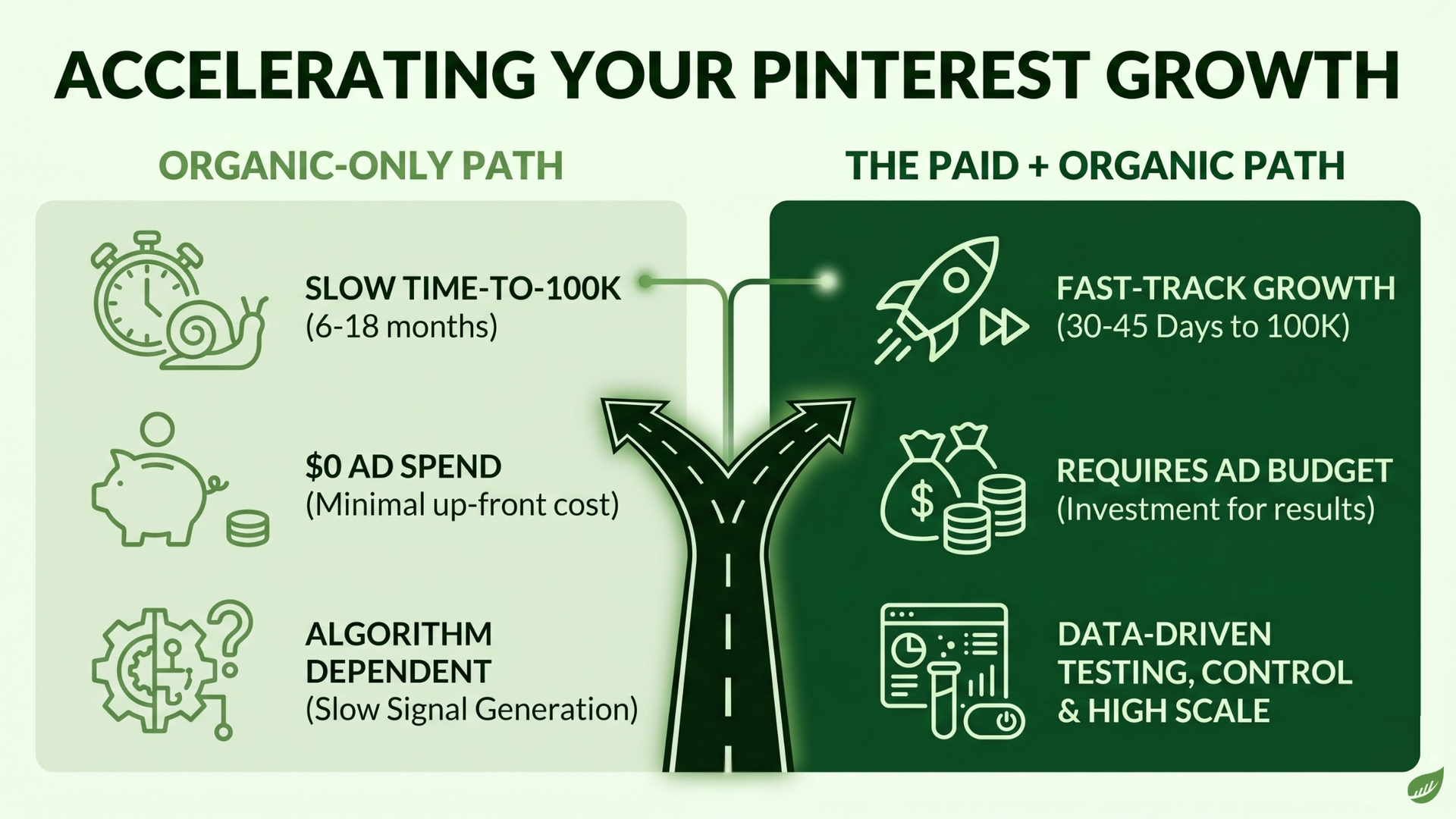
30-Day Sprint - Paid Media Strategy vs. Organic-Only: Which Approach to Grow on Pinterest Scales Faster?
| Factor | Paid Media Strategy + Organic | Organic-Only |
|---|---|---|
| Time to 100K monthly viewers | 30-45 days (with the right setup) | 6-18 months (typically) |
| Algorithm signal generation | Paid social media marketing generates early saves and clicks to feed the algorithm. Organic social signals come slowly from the existing audience. | Social signals come slowly from the existing audience. |
| Creative testing speed | High (budget funds multivariate testing) | Low (limited natural reach for testing) |
| Content longevity | High (paid saves compound organically) | High (but slower to compound) |
| Retargeting pool build | Within 2-3 weeks | Very slow |
| Cost | Paid media requires a budget to get results, whereas Organic Media has a $0 cost to market. | $0 cost to market |
| Control | High (targeting + placement control) | Low (algorithm-dependent) |
| Scalability | Very high | Moderate |
By comparing Paid-only to Paid + Organic, Paid + Organic wins for Speed. While paid distribution (amplification) of your content is the distribution to ‘ignite’ the hybrid approach of Paid + Organic (amplification + consistent, organic publication to your audience to gain ‘saves’ and ‘repins’), the Paid-only approach is slow. Paid + Organic (as seen with BusySeed and Medallion Foods) saves time to top-of-funnel goals for attainment of 100K MVM. If you want to skip the guesswork and implement a proven hybrid sprint, let BusySeed build and execute your 30-day growth roadmap!
30-Day Action Plan for BusySeed
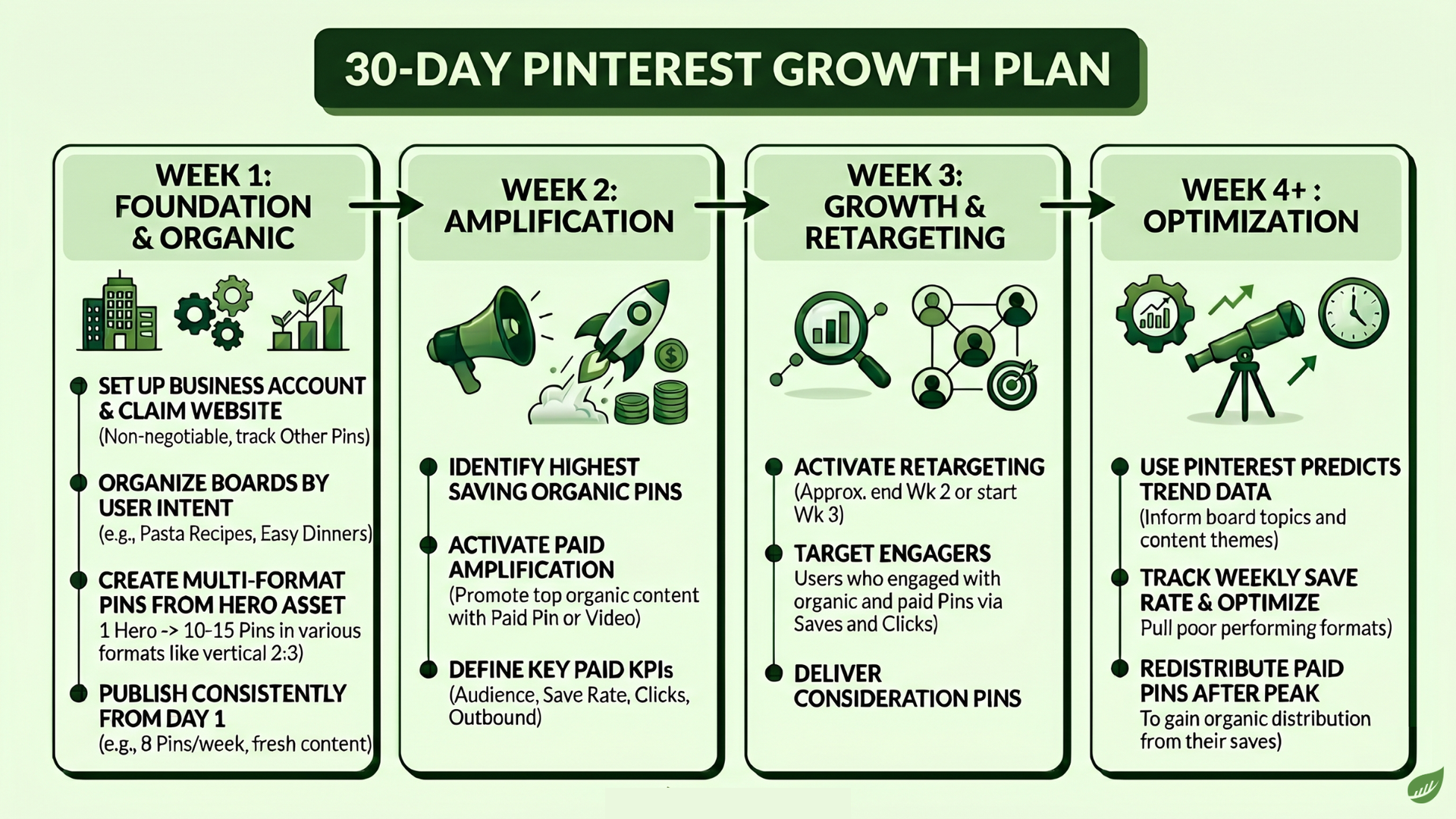
Here is the 30-day plan to replicate the distribution built by BusySeed for Medallion Foods on Pinterest:
- Set up your Pinterest business account and claim your website. This is non-negotiable. Claiming your domain lets you track “Other Pins” created from your site, a significant source of earned distribution.
- Set up your KPIs for paid Pins before you publish the first Pin. Here’s what to track: Total audience (this is your monthly viewers proxy for top of the funnel), Save rate (click rate (paid clicks, average clicks for all Pins), paid save rate, save rate for Other Pins, average save rate for all your Pins), Outbound.
- Organize your Pinterest boards around the user’s intent. View content around specific topics or ideas. For example, BusySeed organized their Pinterest content into boards around specific topic ideas or ‘intents’ such as pasta recipes, easy weeknight dinners, or 30-minute meals instead of organizing around their brand or categories of content that they’d like to drive people to (i.e., your products, your brand name, your typical marketing content).
- Build your first content bundle from a single hero asset. In the case of BusySeed and Medallion Foods, BusySeed began with a Pinterest marketing campaign featuring a single core piece of content: a hero asset. This one asset was then reworked into 10-15 pieces of content in various formats for Pin (e.g., vertical format for a 2:3 Pin ratio, with different text and other changes to create different ‘hooks’). For BusySeed, the content type was a how-to Recipe video for pasta dishes, and all were distributed via board(s) mapped around relevant intent clusters.
- Publish consistently from day one. This means publishing fresh content each week. In the example above, the owner of BusySeed published 8 Pins in the first week. Don’t try to publish too much in week one and then nothing for the rest of the time. Pinterest’s distribution algorithms favor publishers of consistent content.
- Activate paid amplification in week two. Promote your top organic content (e.g., Pin with the highest save rate) using paid amplification (a paid channel) such as Paid Pin or Paid Video.
- Activate retargeting once you have enough engagers. Do this approximately at the end of week 2 or the beginning of week 3. Target all users who engaged with your organic and paid Pins (saves and clicks) with consideration-oriented Pins.
- Use Pinterest Predicts trend data to inform board topics and content themes. Pinterest’s 2026 Marketing Playbook reports 88% of trend predictions “have come true” over six years, and 65% YoY growth in outbound clicks on Predicts-related content (Pinterest, 2026b).
- Track save rate by week. Revisit the highest saving Pin formats and distribute them as needed. Saves are your distribution engine. If the formats you’re currently distributing aren’t getting saved, pull them or remake them in the highest-saving format possible.
- Distribute your Paid Pins performing best. Do this well after their performance peak to gain distribution for the related Organic Pins. There are always enough impressions to be earned from the saves your Paid Pins received while they were performing best.
Social Signals and Long-Term Brand Equity
Social signals on Pinterest are not just for your brand. They are also signals for your brand’s equity. And in 2026, these social signals are also starting to translate into commercial outcomes for your brand.
The full-funnel Pinterest strategy created by Sharpie utilized targeting, retargeting, and even direct carting paths. This campaign generated an NCS Offline Sales Lift Study with (Pinterest, 2026c):
- A 4.93% incremental sales lift
- 74% of those sales originated from new buyers
Building an audience of
100,000+ viewers on Pinterest creates social signals that can be used for retargeting. It also seeds brand recall in users’ minds. Reaching the top of the funnel builds audience equity that converts down the line.
This content will be most valuable to businesses running large ad budgets and complex campaigns. A small food brand, for example, will not get Premiere Spotlight placements in a 30-day campaign. But the same principles of reach and social signals, of retargeting and converting, can be and are being applied by these businesses.
What Is The Big Difference Between Pinterest And Other Social Media Platforms For Fast Reach Social Media Marketing
While most social media marketing on other platforms, such as Instagram or TikTok, is centered on short-lived Reels or Feed Posts to go viral within 24 to 72 hours, the marketing approach on Pinterest differs significantly. Distribution of Pins on Pinterest is not short-lived; instead, it follows a non-linear pattern to achieve peak performance over time.
It is worth noting that Sharpie was running a full-funnel Pinterest strategy that included targeting, retargeting, and even driving direct cart activity on the platform. An NCS Offline Sales Lift Study was also conducted with Sharpie, where they saw
an average 4.93% incremental sales lift from Pinterest. Furthermore,
74% of the incremental sales lift was driven by new buyers, a key indicator that Sharpie saw real commercial impact from its social media marketing efforts.
This also serves as a clear example of how social media marketing can drive real sales and build a brand online. Sharpie’s ability to use Pinterest to successfully drive new buyers to offline stores is a powerful use case for the platform, and we see a lot of room for other brands to replicate this success.
It is worth noting that Pinterest is fundamentally different from other social media sites:
- On TikTok and Instagram, you have 24 to 72 hours to get your content to go viral.
- On Pinterest, a strong Pin can get saves weeks after it has been published.
In addition, Pinterest’s distribution model is non-linear and will continue to distribute a compounding asset, such as a high-performing Pin, for months. Because of this, Pinterest is a great platform for businesses to
reach 100K+ viewers
and drive commercial outcomes in a 30-day sprint. A critical mass of high-quality Pins, earned social signals (saves, clicks, product taps) from a combination of a paid media strategy and organic distribution, and Pinterest’s non-linear distribution engine are key to achieving results in a 30-day sprint.
How Should You Think About the Creator Economy in Your Distribution Plan?
IAB Reports Creator Economy Ad Spend to Reach $37 Billion in 2025, Growing 4X Faster than the Total Media Industry.
It’s also worth noting that UGC-style creative is no longer purely organic; it’s also being used as a paid creative variant. Pinterest’s platform is increasingly creator-compatible, and as such, UGC-style Pins can perform well in paid placements as they mimic the aesthetic of organic Pins discovered through the platform’s discovery features. For your business's social media management in a 30-day sprint, it would be wise to include 2-3 variants of UGC-style Pins in your creative testing alongside your brand-produced Pins.
For the content, you’re going to get a lot of value out of AI social media marketing tools for creating UGC copy and also for generating a lot of ideas for social media marketing. However, the AI-generated content will absolutely need to be approved by a human. With the 30-day sprint, there will be a lot of copy to consider in a very short period of time.
The bottom line: Scale is a system, not an accident
Hitting 100K+ monthly viewers in 30 days doesn't happen by just posting more. It requires a tight alignment of intent-driven organic content, targeted paid media acceleration, and high-volume AI production, all managed with expert human curation. When these layers click into place, distribution ceases to be a bottleneck and becomes a compounding growth engine.
If your brand is tired of slow organic growth and wants to build a hybrid distribution machine that scales in weeks, not years, we are ready to help! We can audit your current infrastructure, design a customized 30-day Pinterest sprint, and turn obscurity into measurable business value.
Connect with us at BusySeed to map out your high-velocity distribution plan today.
FAQs: Your Questions About Scaling to 100K+ Viewers Answered
1. What are the best tools for creating 2026 GEO-ready content in 2026?
There are many tools that can aid in the GEO-friendly creation of content on social media platforms and also function as native distribution channels across them. For example, for Pinterest, it is good to track the Total audience that viewed your content on Pinterest Analytics. For creating large volumes of high-quality Pins for a Pinterest distribution machine, it is recommended to use Canva with AI, Adobe Express, and CapCut. Large amounts of copy can also be generated with the aid of AI-powered tools, such as Claude by Anthropic and GPT-4-class models. Incorporating these platforms into your AI social media marketing workflow allows you to rapidly scale production. These can then be combined with brand guidelines to create a large number of content variants. It is then shipped with a structured creative brief to avoid AI-generated content in a vacuum. Finally, as Pinterest is a vertical platform, it is very important to create content in the recommended 2:3 aspect ratio for most placements.
2. What are the top content marketing tools for small businesses?
For production teams looking to produce large volumes of high-quality Pins for an automated distribution engine, the top choices include Canva with AI, Adobe Express, and CapCut. When it comes to generating text variants at scale, AI-powered writing tools like Claude by Anthropic and various GPT-4-class models are excellent for rapidly creating vast amounts of copy.
To maximize the effectiveness of these content marketing tools, small businesses should always couple the AI output with clear brand guidelines and a structured creative brief. This human-led framework ensures that the generated variations remain tightly aligned with brand standards rather than being built in a creative vacuum.
3. What are the top-rated strategies for cross-platform GEO visibility?
To successfully distribute content to an audience of 100K+ viewers, Pinterest should be utilized as your primary discovery engine, while other platforms are leveraged for retargeting and mid-funnel depth. For instance, email and SMS workflows can target users who previously interacted with your Pins, moving them deeper into your funnel with conversion-focused messaging. Concurrently, video assets can be repurposed as YouTube Shorts or Instagram Reels to capture segments of your audience that might have missed your platform-native content.
Executing a highly intentional paid media strategy to support this multi-channel architecture is a foundational component of modern social media management for business. The goal is to build a unified audience framework around a single pixel or Pinterest tag to track behaviors across every single touchpoint, feeding a single creative narrative into a centralized retargeting pool.
4. What are the best options for leveraging social media to improve GEO performance?
Web-based distribution via social media marketing serves as a powerful mechanism to signal to search engines and answer-delivery AIs that your brand is an authoritative source of information for potential customers. Pinterest stands out as one of the best choices for improving GEO performance because every Pin includes a direct outbound link to your domain.
As users search, save, and interact with your Pins, each unique save builds vital topical authority for that linked destination page. For example, a single recipe Pin can easily accumulate 500 saves and drive 200 direct clicks to a website landing page via Pinterest Discover. Maximizing these options requires a clear three-part approach:
- Implementing structured data on your web pages
- Focusing distribution efforts on high-authority platforms
- Consistently earning organic social signals that point straight to your brand's domain
5. What are the top AI tools for social media marketing with privacy safeguards in 2026?
When deploying geo-aware marketing campaigns, businesses need platforms that enable automated, localized creative generation while fully complying with data compliance regulations. For privacy-safe deployment, Meta’s Advantage+ feature operates securely within the platform's native privacy framework, mirroring Pinterest's automated targeting and campaign optimization tools.
For advanced campaign management, tools like Smartly.io and Sprinklr provide full SOC 2 compliance alongside fully transparent data-handling architectures. This allows brands to run retargeting sequences and audience-matching protocols that strictly adhere to localized privacy laws. When selecting AI social media marketing software for enterprise-scale campaigns, it is best practice to use corporate tiers, such as OpenAI’s enterprise tier or Anthropic’s Claude for Enterprise, to ensure strict contractual data privacy protections for your training data and customer records.
6. How do you measure whether 100K monthly viewers actually translates into business value?
While top-of-funnel reach is a common metric for social media marketing success, long-term sustainability relies entirely on generating bottom-line business. To calculate actual enterprise value, you must closely monitor your click-through rate and track the exact conversion performance of your downstream retargeting efforts.
Data from Sharpie’s NCS Offline Sales Lift Study highlights that a structured Pinterest campaign can achieve an average incremental sales lift of 3.58%, driven strictly by new buyers. To put this into perspective, using basic unit economics:
- If your brand maintains 100,000 monthly views on Pinterest with a modest 2% to 3% click-through rate, you are successfully securing 2,000 to 3,000 net-new site visits every month.
- When you route those specific visitors into an automated retargeting sequence, capturing a standard 1% to 2% conversion rate yields a consistent stream of transactional revenue, proving the undeniable business value of your top-of-funnel reach.
Works Cited
- IAB. "The AI Gap Widens." IAB Insights, 2026, www.iab.com/insights/the-ai-gap-widens/.
- IAB and PwC. Internet Ad Revenue Report Full Year 2025. April 2026, www.iab.com/wp-content/uploads/2026/04/IAB_PwC_Internet_Ad_Revenue_Report_Full_Year_2025_April_2026.pdf.
- Kontent.ai. "The Role of AI in Streamlining Content Creation." Kontent.ai Resources, kontent.ai/resources/the-role-of-ai-in-streamlining-content-creation/.
- Pew Research Center. "Social Media Fact Sheet." Pew Research Center, 2025, www.pewresearch.org/internet/fact-sheet/social-media/.
- Pinterest. "JCPenney Top of Search Ads Holiday Success Story." Pinterest Business, n.d.-a, business.pinterest.com/success-stories/jcpenney-top-of-search/.
- Pinterest. "Pinterest Analytics." Pinterest Help Center, n.d.-b, help.pinterest.com/en/business/article/pinterest-analytics.
- Pinterest. "Form 10-Q Quarterly Report for the Period Ended March 31, 2026." U.S. Securities and Exchange Commission, 2026a, www.sec.gov/Archives/edgar/data/1506293/000150629326000068/pins-20260331.htm.
- Pinterest. "Pinterest Predicts 2026 Marketing Playbook." Pinterest Business, 2026b, business.pinterest.com/en-gb/pdf/pinterest-predicts/2026-marketing-playbook.
- Pinterest. "Sharpie Full-Funnel Strategy Success Story." Pinterest Business, 2026c, business.pinterest.com/en/success-stories/sharpie-full-funnel-strategy.
- Sprout Social. "How to Win with the Pinterest Algorithm in 2026." Sprout Social Insights, 2026, sproutsocial.com/insights/pinterest-algorithm/.
- Stanford HAI. AI Index Report 2025. 2025, hai.stanford.edu/assets/files/hai_ai_index_report_2025.pdf.

About the Author
Omar Jenblat is a powerhouse in the digital marketing landscape, renowned as the Founder and CEO of BusySeed, an award-winning agency that has scaled over $1B revenue for 550+ businesses through high-performance growth strategies. With a technical foundation in computer engineering, Jenblat bridges the gap between complex data analytics and creative marketing, specializing in aggressive revenue scaling, SEO, and multi-channel lead generation. As a member of the Forbes Agency Council, The Org, and a visionary entrepreneur behind ventures like LeadChaser.ai, The Honest Agency, and Zeed Agency, he has established a global footprint by leveraging a "human-led, AI-assisted" philosophy to drive measurable ROI for major brands and startups alike. His expertise is characterized by a focus on digital automation and performance-driven results, consistently positioning his firms at the forefront of the evolving technological landscape.