What’s Working in Lead Generation Right Now: Proven Growth Patterns Across Industries
Lead generation in 2026 is no longer a one-size-fits-all game. Reaching peak performance requires identifying and applying the proven growth patterns that actually resonate within your specific industry. Structured as a comparative workbook, this guide breaks down successful frameworks from the legal, e-commerce, events, and B2B sectors to help you identify the exact strategy that fits your unique business model. Learn the five repeatable patterns of intent capture, intake operations, and omnichannel sequencing to stop funnel leaks and scale your ROI. Backed by real-world data, including a legal case study that slashed cost per intake from $37 to just $10.49.
TL;DR
- Lead generation for service businesses in 2026 follows five repeatable patterns: intent capture, sequenced omnichannel, intake operations, measurement durability, and video/commerce demand building.
- U.S. internet ad revenue hit a record $294.6B in 2025, with programmatic growth up 20.5% year over year; paid media strategies must deliver stronger signals to return value to platforms better as budgets grow.
- 61% of B2B buyers prefer a rep-free buying experience (Gartner, 2024), which means the "shortlist" gets built before
- Up to 85% of customers whose calls go unanswered won’t call back (CallRail, analysis of 1.1M leads). The biggest leak in most funnels isn’t ad spend allocation, it’s the phone.
- BusySeed generated 541 total calls with an average cost per call of $4.02 for events, decreased the cost per intake for legal from $37 to $10.49, and generated $146,000 in retail sales in 4 months of running lead generation for service businesses by replicating these exact 5 growth patterns for service-based businesses.
Most of the material you can find about lead generation for service businesses online is outdated (by 5 years or more) and generic. We created this article to provide valuable content, meet customers where they are, and test and iterate on different approaches. This is how we at BusySeed have grown to generate leads for service businesses online over the last 4 months by refining a scalable “generate leads” service framework, proving these patterns are repeatable across the events, legal, e-commerce, and B2B service industries.
Each of the 5 patterns must be applied in sequence for each service business to build a scalable “generate leads” service system to qualify buyers in real time, list events in real time, hand off customers correctly to staff, achieve proper conversion rates, and measure the durability of lead generators to drop losers and focus on winners.
The answers to lead generation for service businesses follow five patterns for generating new leads, to be applied in full, that work because they follow time-tested patterns for growing sales. Read down the page to your industry, apply the audit questions for the 5 patterns, find the leaks, and watch the dollars that had been leaking start to pour in as you stop throwing money at those same leaks.
Step 1: How Do B2B Buyers Actually Buy and What’s the New Full Funnel Operating Principle?
Most information available on lead generation for service businesses is outdated or generic. There are repeatable growth patterns currently working in legal, events, retail, B2B services, and e-commerce. This report details the main pattern for each sector and outlines audit points to test your current approach against the most up-to-date methods.
Buyers research before reaching out for leads. They do most of their research online before contacting a seller. For B2B and B2C companies alike, this means buyers conduct extensive online research before reaching out. For example, a buyer researching services may read reviews, watch videos, compare pricing pages, ask peers for references, search for companies on LinkedIn, and more. 6sense’s 2024 B2B Buyer Experience Report found that 81% of buyers choose a preferred vendor before speaking with sales.
Furthermore, 69% of the purchase process occurs before the buyer engages with sellers. This is a significant shift in buyer behavior, impacting how companies structure a modern “generate leads” service strategy for service businesses.
Another important note is that while many businesses excel at generating interest or converting a few leads into customers, there is enormous room for improvement at both ends of the funnel for most businesses.
Why Is Your Paid Media Strategy Leaking Money Before Leads Even Arrive?
Your paid media strategy is likely generating more interest than you realize. The key issue is what you do with that interest once generated.
Let’s examine a specific example. We worked with a disability law firm to run Google Ads and drive traffic to their website. When someone clicks their ads, they’re directed to a site where they can fill out a form to request a callback. The firm receives a decent number of calls from its paid ads, but 28% go unanswered. In the legal space, which has one of the highest missed call rates (CallRail analysis of 1.1 million leads), up to 85% of unanswered calls result in the caller not calling back. The disability law firm is paying for calls but not converting many into clients, not because of their Google Ads or paid media strategy, but because of how they handle calls. If they answered all calls, their paid ads would likely perform much better.
A large portion of interest from paid media strategy goes unanswered. For example, a disability law firm running Google Ads may spend considerable sums on generating clicks and calls, but 28% of those calls go unanswered. This figure is higher than average for legal companies. However, up to 85% of those who call and don’t get an answer won’t call back. This is an operations problem, not an advertising one. To succeed with a paid media strategy, the handoff from paid to conversion must be flawless. A high-performing “generate leads” service depends on reducing friction between ad clicks and sales conversations. The perfect handoff is crucial in legal, healthcare, high-ticket retail, and other high-consideration services where a conversation is required to close a sale.
BusySeed's work with a disability law group reduced the cost per conversion from $37 to $10.49, resulting in 1,600+ conversions in under five months. The ad structure mattered, but the intake process was equally important. Both had to work together to generate leads and service effectively.
Lead Generation Strategies For Service-Based Companies
To create leads for service-based businesses that convert into paying customers, you must align your marketing channels with the buyer’s research, evaluation, and decision-making process for your specific market. To audit lead generation for service businesses, create a framework that maps potential customers' buying patterns and populate it with real data from your business.
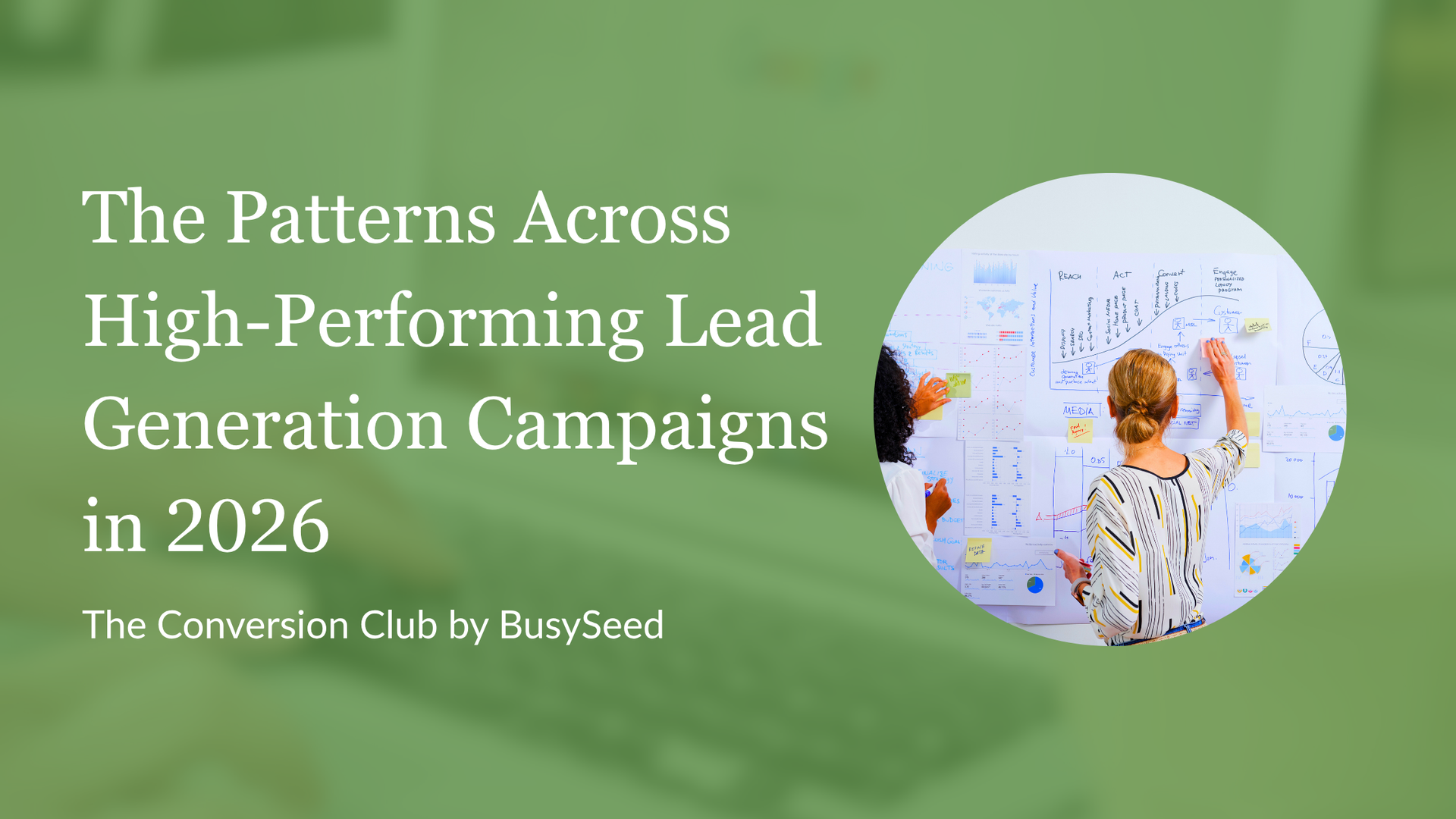
The 5 lead-generation patterns that service businesses across sectors depend on follow a specific framework. Each pattern is supported by data and examples from BusySeed’s work with clients in various industries. These systems form the foundation of a modern “generate leads” service model built around buyer behavior and operational efficiency.
Pattern #1: Events: Is Your Registration Flow the Real Bottleneck?
For events businesses, the bottleneck is rarely where people think. It’s rarely awareness.
The events industry focuses on three things in its marketing strategy: 1) how many people attend events; 2) attendance relative to budget; and 3) attendance compared to similar companies. The best marketing strategy for an events company is to maximize event registrations.
The Bizzabo 2026 State of Events report highlights that dynamic registration flows convert at 24.4%, compared to static flows at 11.6%. Organizations using dynamic flows get more than double the conversion from the same traffic. Top organizations host 25+ events per year with an average of 412 registrations per event and 52% attendance. The average conversion from visit to registration is 21.5%.
A conversion-optimized registration experience is critical to maximizing value from ad spend allocation. Assuming a registration page with extensive copy is optimized is a mistake. BusySeed’s omnichannel approach for an events client generated 40% year-over-year registration growth, with 31% of new registrants being first-time attendees. This is key to growing a successful events business. BusySeed developed a dynamic registration experience that funnels users to the best conversion endpoint based on multiple factors, followed by an omnichannel follow-up strategy to encourage repeat attendance. The strategy paired LinkedIn for professional reach with Google for active intent capture to create a repeatable “generate leads” service engine for event registrations. It worked because the registration experience was built to convert.
To implement this, look at companies that have succeeded. For example, BusySeed ran an omnichannel lead-generation campaign for an events business, achieving 40% year-over-year growth in registrations. Importantly, 31% of new registrations were first-time attendees. The key to scaling events businesses is bringing in new audiences. BusySeed used LinkedIn for professional reach and Google for active-intent capture, sequencing all channels into a conversion-optimized lead-generation experience.
Your audit questions:
- Where are your registrations coming from, and which channels introduce genuinely new audiences versus re-engaging your existing base?
- Is your registration experience dynamic (e.g., multiple tracks, progressive, pre-filled fields) or static (e.g., a long form with all fields required upfront)? If static, you’re likely converting at roughly half your potential rate.
- Do you have a post-registration follow-up process to encourage additional actions, such as booking a demo, joining a membership, or making a donation?
Pattern #2: Legal: Are You Optimizing for Leads or for Intake?
Most law firms measure the wrong things and thus overspend on legal marketing. They measure cost per lead, but they should measure cost per qualified intake. There’s a huge gap between these numbers, meaning much of the legal marketing budget never translates into revenue.
Many law firms track paid ad leads by cost per lead, allowing marketing budgets to run amok with little ROI. The intake process is a major barrier to converting leads to revenue and a competitive advantage for firms that operationalize it. When examining poor lead-to-revenue conversion, we often find the issue lies in the intake process. Clio’s 2024 Legal Trends Report found that over 50% of law firms ignore client inquiries, meaning they don’t reply at all. Introducing operational competence into the intake process would be a huge advantage.
For lead generation in service businesses in the legal vertical, the common playbook is to capture intent through paid ads on Search and Maps. These leads must go through a fast, multi-touch intake process (e.g., a call and text within 15 minutes) and be handed off to the CRM, with the lead source tracked to a signed case.
AI is becoming a staple in legal professionals’ toolkits. Clio’s 2024 Legal Trends Report found 79% of legal professionals used AI in 2024, up from 19% in 2023. Automating initial intake stages with AI-powered software, followed by a personal call or email, is a winning strategy. AI can process large amounts of data quickly, saving time in intake stages. This allows legal firms to scale a more efficient “generate leads” service workflow without increasing staff overhead. However, relying on a front desk to answer calls during business hours is ineffective.
The implications of this ad spend allocation pattern for this service pattern are similar. If your lead generation for service businesses costs $37 per conversion and you leak half the leads through intake, optimize the intake process to see your effective cost per acquisition (CPA) drop dramatically. In BusySeed’s legal case, the marketer reduced CPA from $37 to $10.49 by optimizing intake and improving ads, generating 1,600+ conversions in under 5 months. Both ad and funnel improvements were necessary to generate leads for service operations sustainably.
Your audit questions:
- What percentage of your leads receive a same-day response? What percentage gets a two-touch follow-up, call plus text, within 15 minutes?
- Are you measuring and targeting “form submit or call over 60 seconds” (volume) or “qualified intake and booked consult” (actual value)?
- Is the lead source tracked into your case management system, with final disposition fed back to your ad platform?
Pattern #3: E-Commerce and Retail: Are You Measuring the Right Conversion Points?
Online spending in e-commerce retail is significant for companies that have the right online-to-offline conversion process. In the U.S. alone, online retailing reached $1.2337 trillion in 2025, up 5.4% from the previous year and accounting for 16.4% of all retail sales. In October 2025, online spending was $88.7 billion, up 8.2% from the same period the previous year. With this demand, there are significant returns to setting up effective lead generation for service businesses and conversion processes for online retail sales.
For service-oriented e-commerce and retail businesses with higher average order values or complex catalogs, the high-intent loop of paid ads driving traffic to landing pages that convert via calls, text, or chat will generate leads that service businesses can close. Invoca’s benchmark analysis of over 60 million calls shows 37% of phone leads convert during the call. If you don’t track phone conversions, you’re systematically undercounting results.
BusySeed worked with a retailer to boost digital sales using various strategies. After four months, they reached $146,000 in sales, a 592% increase over prior digital sales. The paid media strategy focused on high-intent signals, and the conversion infrastructure was built to close (e.g., landing pages with proof elements and call tracking).
Personalization of customer experiences has become a core component of e-commerce strategies. However, implementing personalization is challenging. According to the Twilio 2024 State of Customer Engagement report, customers are willing to spend 54% more for personalized experiences, but only 16% of businesses have the necessary customer information. Crucially, 49% of consumers would trust a business more if it disclosed how it uses customer data for AI-powered experiences.
Your audit questions:
- What is the fastest path to purchase by segment (new vs. returning customers, high vs. low AOV customers) for your business? Check out, call, SMS, or book an appointment for a consult?
- Do the landing pages you’re sending traffic to for conversion (calls, text, chats) include a “proof block” (e.g., shipping guarantees, returns policy, reviews, user-generated content) to address the top 3 objections from customer service/support tickets?
- Are all conversions tracked, including phone, chat, form, and checkout conversions, in your paid ad platform?
Pattern #4: B2B: Are You Building Shortlist Presence or Just Generating Form Fills?
B2B lead generation is in an identity crisis. Most B2B marketing organizations operate as if they’re in retail, optimizing for top-of-funnel volume, such as MQLs and gated content form fills. However, most buyers complete their purchasing process without ever filling out a form.
61% of B2B buyers prefer a rep-free buying experience. 73% actively avoid suppliers sending irrelevant outreach. B2B buyers are changing how they interact with suppliers. The 6sense 2025 B2B Buyer Experience Report found that buyers engage with sellers earlier than in 2024, with the percentage of process completed before first contact decreasing from 69% to 61%. However, more than half of the buyer’s process is still completed before interacting with a seller.
LinkedIn's benchmark report (Factors.ai analyzed over 100 B2B companies from Q3 2024 to Q3 2025) found that paid ads search traffic decreased by 39% while CPC increased by 24%. In contrast, budgets for LinkedIn increased by 31.7%, while Google ad spend allocation increased by just 6%. The number of gated assets, such as webinar registrations and analyst report downloads, decreased by 12.7% and 26.3%, respectively.
Use LinkedIn to create awareness and build trust, then use Search to capture high-intent customers already in the evaluation phase. This layered approach is central to any B2B-focused generate leads service strategy. Ensure corresponding content on landing pages establishes your “proof” for that customer.
The allocation of ad spend between awareness and retargeting campaigns is critical to efficiency. Awareness campaigns on LinkedIn should drive lead form completions to maximize value. Search ads should capture high-intent buyers ready to purchase. Running Search ads without sufficient brand presence on LinkedIn wastes budget on expensive CPCs for cold clicks. By first creating awareness and building a shortlist on LinkedIn, businesses can retarget via Search ads to capture buyers at peak intent.
Your audit questions:
- How would you know if a buyer never filled out a form for your lead gen asset? Track target accounts visiting sites, pricing pages, demo videos, etc., for return visits.
- What are your three “shortlist assets” per persona, ungated content answering: why you, why now, why trust?
- Are you running LinkedIn as a lead-form tool in isolation, or as a sequenced system that moves buyers from awareness to retargeting to conversion?
Paid Ads Formats By Growth Rate
The way we pay for advertising has changed dramatically in the last 4 years. Digital video advertising grew 25.4% year over year (IAB/PwC 2025). Commerce media, or shopping-enabled advertising, grew 18% year over year (IAB/PwC 2025) to $63.4B in spend. Social media advertising in the U.S. grew to $117.7B, a 32.6% year-over-year increase (IAB/PwC 2025). Total internet advertising spend in the U.S. for 2025 is $294.6B, with programmatic spend at $162.4B or 20.5% year-over-year growth (IAB/PwC 2025). If your paid media strategy focuses on buying clicks and sending buyers to gated content to “nurture” via email, you’re likely wasting money on declining channels.
Invest in paid ad formats that are growing and part of current digital marketing trends. Spend on new formats while demand is growing. Focus on short-form video, programmatic display ads, and commerce media formats. These formats are becoming essential for any modern “generate leads” service strategy focused on scalable growth.
Don’t misread this as “never use paid search for leads again.” We provide evidence of where the highest intent to buy is, proving that search is the best channel for capture. According to CallRail’s study of conversations, Google Ads and its paid ads efforts accounted for 37% of total conversations, followed by Google Business Profile at 23% and Organic Search at 22%. We’re not advocating abandoning paid search for lead generation in service businesses; we're only saying that running 100% paid search without upstream brand awareness spend will be expensive and competitive as CPCs rise. Actively monitor returns and make smart ad spend allocation decisions.
There are many channels for paid ads to grow your business. To determine which to use, understand the available channels and how to use them. Once you understand the channels and their applications, create a strategic framework to measure performance. A general framework is to start with a trust-building layer of paid ads, such as LinkedIn video or social ads, followed by a high-intent capture layer, such as Google Ads Search ads, for converting leads into customers. Retarget to close the gap between layers, and implement a measurement feedback loop importing qualified outcomes from your CRM into your ad platform for automation to learn from real results, not just clicks.
How Should You Think About Ad Spend Allocation Across Channels?
How you allocate funds between channels indicates how well thought-out your strategy is and how well you execute.
Don’t over-allocate to easily measurable channels and under-allocate to upper-funnel spend for brand awareness and customer trust. Such practices can lead to over-reliance on Google Ads (for Search, Google My Business, and Maps) and to cutting back on difficult-to-measure LinkedIn-branded content, resulting in rising CPCs and declining online marketing returns.
Google’s Enhanced Conversions for Leads is a widely underutilized tool in performance marketing. It allows teams to track hashed first-party lead data across digital video, display, search, and social, and then import offline outcomes, such as qualified leads or booked consults, into Google Ads. This feature enables advertisers to teach automation and bidding algorithms to optimize for activities driving the highest revenue, not just costly form fills. How teams use Enhanced Conversions for Leads will change what they view in campaign performance reports and what they perceive as “good” or “expensive” performance.
For individual campaign allocation, if you’re simply buying clicks and driving conversions (measured in form fills), there are many ways to optimize within Google Ads. By setting Enhanced Conversions for Leads and tracking call outcomes (and other offline metrics) through a CRM, businesses can teach ad platforms to bid on their behalf in a revenue-driven model. In this way, campaigns that appear “costly” in the ad platform may actually drive the most pipeline for the business.
However, for lower lead volumes, importing offline conversion statistics may not be immediately meaningful. Typically, dozens of conversions per month are required for meaningful use of Enhanced Conversions for Leads. In the meantime, use upper-funnel metrics to drive more leads for automatic optimization based on conversions.
Comparison: Which Growth Pattern Fits Your Business?
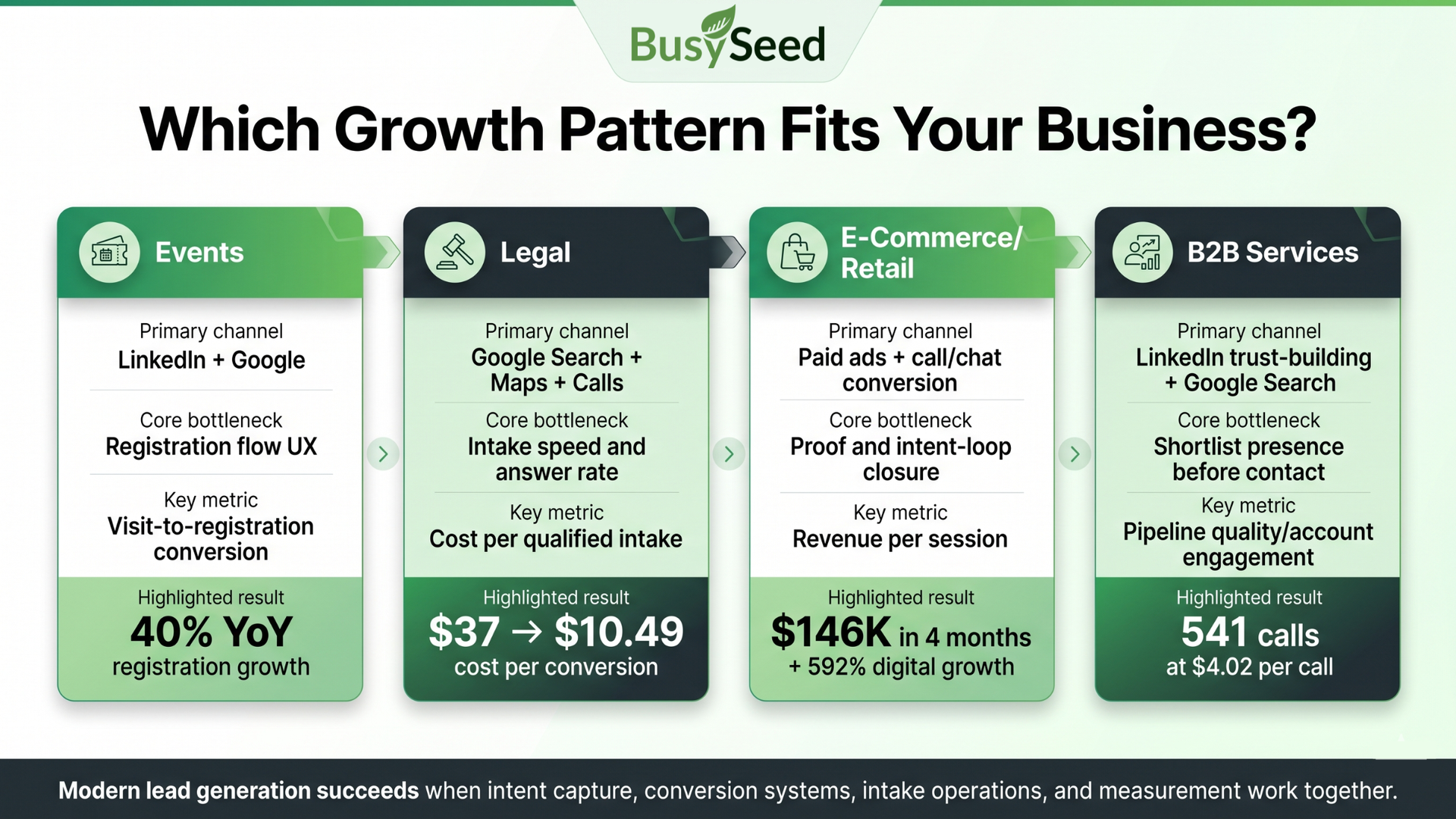
| Business Type | Primary Channel | Core Bottleneck | Key Metric | BusySeed Benchmark |
|---|---|---|---|---|
| Events | LinkedIn + Google (sequenced) | Registration flow UX | Visit-to-reg conversion | 40% YoY registration growth |
| Legal | Google Search + Maps + Calls | Intake speed and answer rate | Cost per qualified intake | $37 → $10.49 cost/conversion |
| B2E (E-Commerce/Retail) | Paid ads + call/chat conversion | Proof and intent loop closure | Cost per call/revenue per session | $146K in 4 months; 592% digital increase |
| B2B Services | LinkedIn (trust), Google Search (capture), Shortlist presence before contact, Pipeline quality/account engagement | Shortlist presence before contact | Pipeline quality/account engagement | 541 calls at $4.02/call |
High-Performance Lead Generation Measurement Stack
Lead gen programs often fail at the measurement stage. It’s easy to care about data, but most measure the wrong things and feed poor signals to increasingly autonomous platforms. Invoca analyzed 60 million+ calls and found that only 35% of calls from digital marketing are qualified leads.
When analyzing customer calls, Invoca determines whether calls from digital marketing are qualified leads. They analyzed over 60 million calls and found that only 35% were qualified. This reveals a critical insight: If you report “cost per lead” based on call volume, your numbers are likely inaccurate. Either your cost per qualified lead is competitive, or your conversion rate from calls to qualified leads is very low, making your reported cost per lead appear expensive.
Businesses should set up a Measurement Stack with three types of measurement to support each pattern: 1) Measuring qualified leads (e.g., booked appointments); 2) a CRM with source, campaign, keyword, call information, and final disposition as required fields; and 3) weekly import of offline conversions into paid channels.
Importing offline outcomes into online platforms is becoming a key competitive differentiator as lead generation and conversion are increasingly influenced by online platform automation. With programmatic online spending forecast to hit $162.4 billion by 2025, the signal fed to platforms about what constitutes a closed case, a signed contract, or a completed purchase is critical to preventing cost per acquisition from spiraling out of control in competitive markets.
The Lead Generation Audit: An 8-Step Checklist to Find Your Leaks
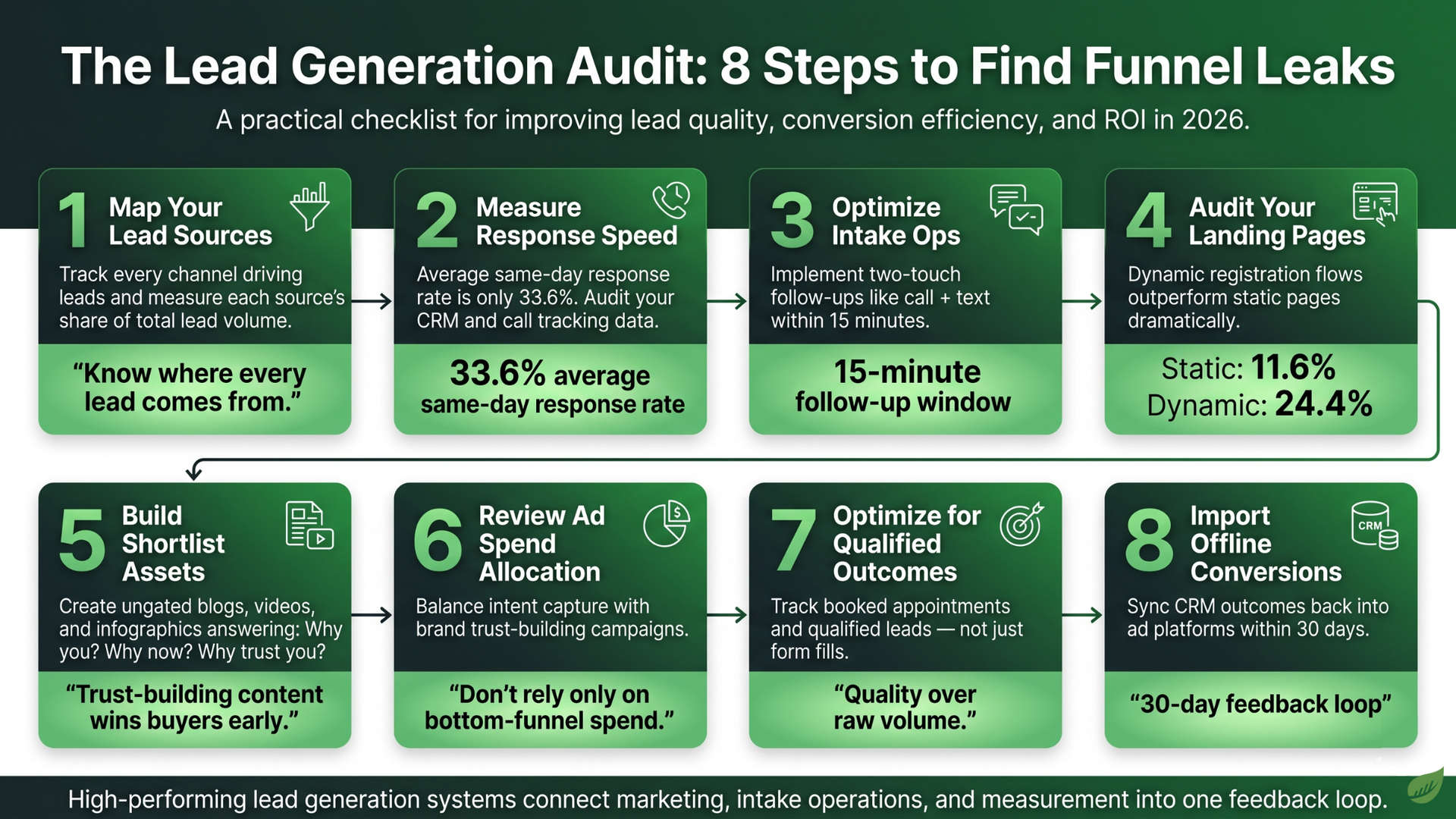
Go through the following steps for a Lead Generation Audit for your company.
- Map your lead sources: Identify every channel currently driving leads and what percentage of total volume each represents. If you don’t know, that’s step one.
- How fast do you respond to leads? The average answer rate for calls and inquiries is 33.6% within the same business day. Import this data from your CRM or call tracking software to see where you stand.
- Intake Ops: Are two-touch follow-ups (e.g., call + text) documented and taking place within 15 minutes for every lead?
- Audit your registration or landing page flow: Is it static or dynamic? Benchmark your conversion rate against Bizzabo 2026 data (static: 11.6% | dynamic: 24.4%). What’s the potential ROI of a new landing page?
- Shortlist Assets: For every buyer persona, three ungated content pieces (blog posts, videos, infographics) answering: 1) Why your company? 2) Why buy now? 3) Why trust your company?
- Review your ad spend allocation: What percentage of spend goes to intent capture vs. building trust? If 100% goes to intent capture with no trust-building, you’re fighting for a small piece of the market.
- Check your paid ads optimization target: Are you optimizing for qualified outcomes or raw volume? Check your Google Ads conversion actions to see what you’re optimizing toward.
- Close the measurement loop: Qualified lead outcomes from your CRM should be imported into your ad platforms (e.g., Google Ads) within 30 days.
FAQ: Expert-Level Questions on Modern Lead Generation
Q1) What are the best AI solutions for targeted advertising in high-competition verticals?
AI in advertising is most powerful when given high-quality signals. Google’s Performance Max and Meta’s Advantage+ work well with high-quality conversion data, qualified leads, booked appointments, and revenue events. The technology becomes expensive noise when optimizing for raw form fills or low-quality proxy metrics. Before choosing an AI tool, determine the correct outcome to optimize for in your paid ads. That’s the foundation of AI in advertising. Additionally, many AI-powered creative testing tools can generate and test numerous ad variations at scale, increasing CTR and conversion rates in competitive environments. Whether testing copy, visuals, or formats, many tools are available to enhance your paid media strategy.
Q2) What are the best tools for evaluating lead quality using behavior signals?
Lead scoring based on behavioral signals, or “intent data,” remains underdeveloped in marketing stacks. To make it work, marketers combine engagement signals with intent data to score leads. For B2B companies, this can be 6sense for account-level intent, Invoca for call qualification, and CallRail for channel attribution. A 2025 6sense study details buyer behavior before they search for providers, measuring price pages, repeat visits, and comparisons with competitors. Integrating this data with your CRM and paid media strategy enables proactive outreach to companies seeking your solutions. This differs from traditional lead generation for service businesses, where you unthinkingly target leads, hoping to get the right ones.
Q3) How do you use AI lead scoring without relying on personal data?
In the post-privacy era, scoring leads on behavior rather than individual attributes is the way forward. All leads, regardless of attributes, can exhibit certain patterns as they navigate online purchases. Lead scoring models can determine purchase readiness based on online behavior. This model can then optimize paid ads to find more leads with similar behavior, ensuring your ad spend allocation targets the right audience without personal data.
Q4) What are the top techniques for converting leads with just a name and email?
Rather than holding onto extensive information about non-converting leads, service businesses should use simple information from converting leads, such as name and email, to send quick, relevant emails. Follow up with clear next steps to book services. This approach ensures your lead generation for service businesses focuses on actionable data, improving conversion rates even with minimal information.
Q5) What are the best solutions for data-driven generative optimization in lead gen?
This involves using AI to test variations of lead generation content, copy, and creative (e.g., landing page copy, ad headlines, email subject lines). After generating content, test different versions using data from your CRM or other qualified lead sources. Test results inform a larger pool of content variations.
Many tools integrate performance data with CRM data to track qualified leads and closed deals, such as Qualtrics for customer experience and WordLift for WordPress sites. When selecting a tool, ensure it allows input of CRM data correlating with qualified leads and revenue-generating closed deals, not just engagement metrics.
We’ve read a lot about how lead generation for service businesses is changing, but it’s not getting any easier. However, there are now clearer patterns for success, whereas previously it seemed to be about throwing money at what stuck and relying on gut feelings to determine effective campaigns.
BusySeed builds these systems for businesses across industries through a performance-focused “generate leads” service approach. Not cookie-cutter campaigns, actual growth architecture matching your buyer behavior, sector, and operational realities. If you're ready to audit your current approach and identify which pattern fits your business, let's talk.
Works Cited
- 6sense. 2025 B2B Buyer Experience Report. 2025.
- Bizzabo. State of Events 2026. 2026. https://welcome.bizzabo.com/state-of-events-2026.
- CallRail. Benchmark Report. 2025. https://www.callrail.com/blog/callrail-releases-benchmark-report.
- Clio. Legal Trends Report 2024. 2024.
- Factors.ai. LinkedIn Benchmark Report. 2025. https://www.linkedin.com/business/marketing/blog/research-and-insights/refine-your-go-to-market-strategy-with-insights-from-the-factors-ai-linkedin-benchmark-report.
- Gartner. B2B Buyer Survey 2024. 2024. https://www.gartner.com/en/newsroom/press-releases/2025-06-25-gartner-sales-survey-finds-61-percent-of-b2b-buyers-prefer-a-rep-free-buying-experience.
- IAB/PwC. Internet Advertising Revenue Report 2025. 2026. https://www.iab.com/wp-content/uploads/2026/04/IAB_PwC_Internet_Ad_Revenue_Report_Full_Year_2025_April_2026.pdf.
- Invoca. Conversion Benchmark Report. 2025.
- Twilio. State of Customer Engagement 2024. 2024.
- U.S. Census Bureau. E-Commerce Data. 2025.

About the Author
Omar Jenblat is a powerhouse in the digital marketing landscape, renowned as the Founder and CEO of BusySeed, an award-winning agency that has scaled over $1B revenue for 550+ businesses through high-performance growth strategies. With a technical foundation in computer engineering, Jenblat bridges the gap between complex data analytics and creative marketing, specializing in aggressive revenue scaling, SEO, and multi-channel lead generation. As a member of the Forbes Agency Council, The Org, and a visionary entrepreneur behind ventures like LeadChaser.ai, The Honest Agency, and Zeed Agency, he has established a global footprint by leveraging a "human-led, AI-assisted" philosophy to drive measurable ROI for major brands and startups alike. His expertise is characterized by a focus on digital automation and performance-driven results, consistently positioning his firms at the forefront of the evolving technological landscape.