From 20 Keywords to 1,500+: How Home Service Businesses Are Scaling Organic Growth
For home service businesses, local visibility is the lifeblood of lead generation. Moving from a handful of rankings to total market dominance requires a shift toward GEO-focused SEO and AI-aware content optimization. This step-by-step guide walks you through the exact process of expanding your keyword footprint by targeting high-intent local search terms. Learn how to restructure your site around intent clusters, optimize your Google Business Profile, and build an organic engine that turns your brand into a recommended authority. Includes a real-world case study showing how BusySeed took one client from 23 keywords to 1,500+ tracked queries, a massive 65x organic expansion!
TL;DR
- 80% of U.S. consumers search online for local businesses at least weekly, and 32% do it daily; your organic footprint is either capturing that demand or handing it to a competitor (SOCi Consumer Behavior Index, 2024).
- One BusySeed home service client scaled from 23 keywords to 1,500+ tracked queries (a 65x increase) after reorganizing their site around intent clusters and completing GEO optimization at every level.
- 93% of homeowners plan home improvement projects in 2025, and 71% plan to focus on preventive maintenance rather than replacement projects (Angi, 2025).
- 88% of consumers would use a business that responds to all reviews, versus only 47% who’d use one that doesn’t respond at all (BrightLocal, 2024).
- 46% of tracked AI Overviews triggers now correspond to specific, tracked queries. A new “AI Search Insight” is published every week, in which BrightEdge tracks an AI Overview for a set of hand-selected, highly relevant queries over the course of a year and publishes key findings on how the model evolves and cites sources over time (BrightEdge, 2026).
Why Are Home Service Businesses Still Operating With 20 Keywords?
The average home service business has a website. And most home service businesses have the demand for their services online. But few home service businesses are visible online. And most home service businesses have no idea that they are invisible online.
The reason is simple: Most home service businesses have no idea what a complete set of keywords for their business looks like. As a result, they can’t possibly hope to compete for the high-intent searches that really matter to their business while competing for every low-intent search of their own business name and a handful of generic keywords for their services.
For each service offered by a home service provider, there are 8-20 intent modifiers. So, for 10-12 services offered by a plumbing company serving a metro area, there would be 80-240 possible keywords to target. But then there are 8-20 locations for that company to target in the neighborhoods or suburbs it serves.
So now we are up to 640-4800 possible keywords to target. If a home service provider only publishes 20 keywords, then that company has the potential to get ranked for the other 1,480 (4800-3200) possible keywords for that company.
That’s not a gap. That’s an opportunity if you build the right system with the right local SEO services and GEO marketing strategies.
What Actually Happened With BusySeed’s 65x Case Study?
The case study results for the home service provider worked by BusySeed were impressive indeed. After the project, the provider’s site had 1,500+ tracked keywords, all of which brought leads to the provider. What was also impressive was that the provider’s brand was now recommended as a reliable source of information in the AI Overviews triggered by all the tracked queries for the provider’s services.
What they did was build out a structure to support intent clusters: for example, for emergency work vs. non-emergency work for the same service, or service pages versus location pages for the same service. Their prior site tracked 23 keywords, all of which appeared in their results for the relevant searches. The work they did resulted in 1,500+ ranked keywords, creating a stream of consistent leads for the business.
Remember that every business doesn’t start from the same starting line. And in terms of keywords that should rank for, no market is the same. But what you can replicate from the case studies above is a proven blueprint to turn an invisible business into a lead-generating machine through GEO optimization and user-intent SEO.
Understanding GEO Marketing for Home Services
GEO marketing is different from GEO targeting and local SEO. The term GEO marketing refers to marketing that uses GEO targeting and local SEO. GEO marketing is a framework consisting of content, architecture, and signals for search terms related to geographic regions. Therefore, GEO marketing is more than adding a city name to a page title to target that page locally. While local SEO of home service companies traditionally also aims for GEO targeting, GEO marketing is a separate field with its own objectives.
GEO marketing aims to show search engines where a company is located and thus prove to them that said company is embedded in a region of customers. This can be achieved through local SEO by creating local relevance, proximity, and prominence. The other important thing to recognize about GEO marketing is that GEO targeting is different from Local SEO. GEO targeting refers to the act of targeting users in a GEO location, while Local SEO targets users within a specific GEO region and signals to Google that your business is relevant for that region.
In other words, GEO marketing matches GEO targeting and Local SEO. This concept is very important for a business’s online presence because Google uses three sets of factors to determine the best results for a Local search: Relevance, Distance, and Prominence. Relevance includes a host of online signals, not limited to link equity, indicating how well a business’s online presence matches up with the intents of potential customers searching for products or services in a local geographic area.
To further define Relevance for this purpose, it includes the volume and recency of reviews on a business’s verified Business Profile, its response rate to reviews and questions, as well as other Business Profile attributes indicating a business is credible and able to serve customers. Implementing a robust on page SEO strategy is crucial for enhancing these signals.
What is GEO Optimization and How to Use it for Home Services?
Instead, many home service companies take a ‘broadcast’ approach to GEO marketing within their local search landscape. Instead of creating pages of content to program search results for emergency plumbing services in a single city or surrounding metro area, for instance, they create a single page of content to market all of the emergency plumbing services to customers in the same markets. They also create pages of content to market the non-emergency plumbing services, repairs, and maintenance for the construction of new homes, for instance.
When a homeowner is searching for help for an emergency situation online, for instance, for tradespeople to send a) troubleshoot an emergency problem or b) complete a work order for a pre-scheduled repair or new construction project, that customer is more likely to be connected with another GEO-targeted company in the same markets that has also taken the time to develop and program search results to market an array of relevant services in real time.
GEO optimization at scale for Home Services is about building a site architecture where every legitimate local query for work has a home on your site. Yes, you read that right… a site architecture that enables all local queries for work to have a home on your site. That’s not the opposite of creating 300 thin, templated, city pages and praying that Google indexes enough of them to find customers searching for local work online. Scaled content abuse, such as the kind described above, was targeted in Google’s March 2024 spam policy update core update, and the approach described above is no longer effective for ranking highly in Google’s results for local work searches online (Google Search Central, 2024).
GEO marketing requires local proof (reviews, testimonials) and a complete online listing for a local business. GEO marketing also requires a sound local link-building strategy. Local links come from geo-specific local sites and from customers of a local business, in locations served by that business. GEO marketing results in a business appearing highly in the search results within a geographic location, for relevant queries, and for users with queries similar to those for which services are offered by that business.
User Intent SEO for Home Services
Yes. User intent SEO is not a fad. It’s the way that the Search Engines work now, and most home service companies are doing a poor job. The old way to handle creating a page about AC repair was to stuff it with AC repair [city name]- type content. The way to create a page about AC repair now is to answer the questions of a person with a job to be done and map the content to address all the questions of that particular job.
This would be a page created to answer the questions of someone searching for "AC not cooling house emergency [city name]" as opposed to a page created to answer the questions of someone searching for the cost of an AC tune-up in [city name], for example. People who search for Home Services are trying to complete a job. There are many different types of jobs that need to be completed. Some are more time-sensitive than others.
For example, people searching for things to do with their Air Conditioner after it has stopped cooling their home are trying to complete a job as quickly as possible. They typically do these searches late at night when their AC stops working. An example of a search query that would result in a list of emergency AC repair companies in a city is “AC not cooling house emergency [city].”
BrightEdge data from 2026 shows that AI Overviews are now triggering on almost 50% of the tracked queries. And according to Google’s own update notes, users are forming longer, more complex questions when AI features are enabled on Google Search (Google Blog, May 2024). Thus, user intent SEO can prepare your content to surface in both traditional rankings and receive AI Overview citations.
Split your keyword targets into four intent buckets:
- Emergency intent: "burst pipe," "AC not working," "burning smell from outlet."
- Transaction intent: "water heater replacement [city]," "ductless mini split install quote."
- Commercial investigation: "cost to replace furnace," "repair vs replace AC," "how long does water heater last."
- Trust intent: "licensed plumber [city]," "insured HVAC contractor," "same-day electrician."
As before, each of the four main buckets of keyword intent for home services should have its own content type, written differently. Implementing a strong on page SEO strategy ensures that each intent bucket is optimized for maximum visibility.
Home Services On Page SEO for 2026 & Beyond
For on page SEO strategy in home services, we focus on three elements that create the right framework for ranking in search results: dedicated-intent landings, internal linking with the right intent, and content depth that matches the complexity of the search query.
Make dedicated intent landings. Every core service should have its own page with its own title tag and H1. This page should have its own structured content. This content should outline the problem the service will solve, the solution to that problem, the process the consumer can expect to go through, pricing for the service, safety information, etc. This type of content can be surfaced by Google’s AI Overviews for complex multi-step intent and can aid the site’s traditional rankings as well as its AI retrieval.
The internal linking on your home service website is also very important. Each page of content that highlights problems homeowners encounter should include a link to the most relevant service page on your home service website. A call to action to contact the company for service should also be included on that page. A testimonial or about us page is also a great place to include information on the license to practice as a plumber, as well as the geographic service areas that you serve.
Also, make sure you have proper headers on your services pages. These are very important and will help ensure the page is read by both Google and humans. Typically, the header tags will align with the questions your typical customer would ask when searching for your services and with your target keywords, helping you get the most out of the page it was created for. This is a critical component of any on page SEO strategy.
How Do Local SEO Services Actually Drive the 65x Keyword Expansion?
Professional local SEO services aren’t just about citations and Google Business Profile management anymore. The businesses seeing 65x keyword growth are getting something more comprehensive. Local SEO services are redoing the home service companies’ sites, and as a result, those companies are getting 65x keyword growth. The entire system is being optimized, including the site architecture, content, site optimization, reviews, and the geographic signal the site sends.
Keyword research for home services starts by identifying the keywords potential customers would use to search for a home service provider online. Commercial investigation keywords are also important for local SEO services. These are the words that homeowners use when considering whether to hire a service to fix a problem their home is experiencing. Some examples of commercial investigation keywords are “cost to,” “repair vs. replace,” “how long does,” and “signs you need.”
A home service provider’s website could contain a lot of helpful content to potential customers and also increase the website’s rankings for related keywords. As previously stated, the intent of local SEO services is to increase a website’s coverage density for all of the keywords that are relevant to a specific business. Therefore, by filling in the gaps in a home service provider’s commercial investigation content, the business can go from ranking for 20 keywords to ranking for 200 or more.
In conclusion, local business listings are playing an increasingly important role in local SEO strategies today, as previously mentioned. The impact of a business’s listings (GBP in particular) stating they are open when they are actually closed can have devastating effects for businesses, affecting their reputation in the negative for starters, and in addition to that, according to research put forth by SOCi in their “The Consumer Behavior Index for the 2024-2025 season,” found that 47% of the studied consumers would immediately seek out a competitor of the frustrated closed business had they traveled to the closed business.
As for the search volume for emergency services, for the majority of home services businesses, having the incorrect business hours or service area on a business’s GBP can result in losing a lot of potential calls for the business. This is why local SEO services must include accurate and up-to-date business listings as part of their on page SEO strategy.
GEO Marketing for Single-Location and Multi-Location Home Service Operators
For single-location companies, the focus for GEO marketing would be depth in local search results for all relevant keywords and phrases within a specific GEO region or service area. You would create high-quality content relevant to the local area (neighborhoods, streets, cities, etc.) to build local authority on your core service pages for the problems homeowners in a defined service area face. This will enable a GEO marketing campaign that ranks for the most relevant keywords and generates high-quality leads for your business.
The approach for multi-location home service companies (e.g., plumbers, HVAC) on GEO marketing is to build a brand with Repeatable Structure plus Local. Meaning, you can build the same brand authority that can be repeated to other locations in the country while still establishing local relevance for consumers searching for each individual location. This is very different from building out template city pages for, say, 50 different cities and then hoping for the best after Google’s 2024 spam policy changes for local search.
The AI systems are now more sophisticated at reading the local content at a very granular level (e.g., by paragraph, by sentence). Therefore, the win condition for multi-location GEO marketing is: repeatable structure plus locally unique proof plus matching intent at each location. For purposes of GEO marketing, the important thing to keep in mind is that businesses of different sizes can be targeted in much the same way since, in the end, the position of local search results is determined by the same factors: relevance, distance, and prominence.
How Do Local SEO Services Actually Drive the 65x Keyword Expansion?
Reviews for home service companies are conversion tools, ranking signals, and even new laws. The review landscape for local businesses has changed a great deal in the last few years, and as part of the launch of our 2024 local consumer review survey, we take a look at how businesses should be approaching reviews under new FTC rules. Firstly, BrightLocal’s 2024 local consumer review survey found that 88% of consumers who read reviews would use a business that responded to every review for that business, compared to 47% who read reviews for a business where every review had a response from the business.
In essence, every review for your home service company needs to be replied to by you, your staff, or even your automated system. This means that your review responses are essentially a second website for your home service company and could have the power to cause a call or stop a call before the customer has even visited your website for that query. As the area of Review Marketing continues to evolve, particularly in relation to the use of AI in writing and publishing online reviews for local businesses, we are very interested to see how it may develop, particularly with regard to efficiency gains for multi-location home service providers and their review marketing agencies.
This would be a massive innovation, as currently such companies would typically set up a large team of local marketing specialists in each area, answering all reviews in a timely fashion. With AI, this could all be managed in real time by one person with a system to identify all relevant reviews and then automatically publish a review response. This leaves a risk to manually written reviews from multiple locations. Recently, there has been significant discussion within local SEO services about the use of AI-powered review responses for home service companies and their marketers.
Interestingly, BrightLocal’s 2024 local consumer review survey found that 58% of participants in a blind test preferred an AI-generated review response over a human-written one. Importantly, this only applies to companies that actually respond to reviews. BrightLocal found that 88% of consumers would use a service if the company responded to every review. This figure contrasts with only 47% of participants who would use a company that never responded to a review.
As mentioned earlier, the FTC’s changes to the rules for fake reviews and testimonials were finalized and put into place on October 21, 2024. It is worth noting that AI-generated fake reviews would be considered a federal violation under the new rules. Google remains the top review platform with 81% of local consumers using Google reviews for local businesses in 2024. This is down slightly from 87% in 2023 (BrightLocal, 2024). However, the statistics also reveal that 74% of local consumers use two or more review platforms. As a result, businesses cannot ignore listings on Yelp, Angi, and the Better Business Bureau, among others.
Scalable Home Service SEO Process for 20 Keywords to 1,500+
Step 1: Create An Intent Map Prior To Page Development
Maps out how customers are trying to solve problems for their homes into categories of urgency and creates pages accordingly. For example, pages created to handle emergency-type calls will be structured to handle inquiries of that nature versus comparison pages. Pages created to try and gain the trust of a service provider to perform work in their home need to have content created that will allow the business to establish trust with their potential customers in order to close transactions for work to be done for their homes.
Step 2: Audit What You Have Against What the Market Demands
To develop a scalable review strategy for your business, you first have to pull all of the keywords from your Google Search Console data to figure out the different queries for which your business already shows up. You then look at the impressions (i.e., how many times this shows up in the search results) and compare that to the clicks to make sure that you are showing up in the right places.
Sometimes you will find that even though your page is on page 4 or 5 of the search results for a particular keyword, it is pulling in a huge amount of search volume because of the high number of impressions.
Once you have found those queries, you can look at your intent map to start developing a plan to tackle them. This is where local SEO services can play a critical role in expanding your keyword footprint through GEO optimization and user intent SEO.
Step 3: Restructure Site Architecture Around Intent Clusters
Serve one specific intent on one page, rather than just making a location variant of a page with similar content (a city hub page for a site’s primary service areas, problem-specific pages for high-volume emergency and investigation-type search queries). This approach is a key component of any effective on page SEO strategy.
Step 4: Implement a Serious On Page SEO Strategy for Every Core Page
Create quality content on each page with proper SEO structure (title tags, H1 tags, page structure, etc.). Also, link from individual pages to relevant service pages, city hubs for relevant services in that city, and review/contact information on the GBP profile. Use local business and service schema where relevant. Use accurate licensing information, service area information, and other relevant details to build trust on local pages. This is a critical part of any on page SEO strategy.
Step 5: Align Google Business Profile with Organic SEO Strategy
Hours: Accurate, Service Areas: Accurate, Categories: Accurate for your primary services, Posts: Weekly, Photos: Current jobs, Q&A: Answer the questions that your customers ask. This alignment is essential for any local SEO services provider to ensure maximum visibility.
Step 6: Build a Review Response Operation That Runs on Autopilot
Automate asking for reviews after completing a job. React to every review (positive or negative) within 48 hours by using AI-powered templates that allow for a highly personal reaction. This is a key part of any GEO marketing strategy.
Step 7: Create Content That Wins in AI Overviews and GEO Optimization
The key to writing for GEO location searches and citation sites is to write in citation-friendly blocks of copy (answer first, then detail to follow). This type of copy is also known as ‘FAQ’ type copy and can be written out as: What causes X? What to do first? When to call a pro? Typical cost? These types of blocks of copy work really well as the AI Overviews pull the answers from the pages in these ‘block’ formats and read well for humans too. This is a critical part of GEO optimization.
Step 8: Allow OAI-SearchBot to Crawl Your Site
For GEO search, if you want to be recommended by ChatGPT searches for a certain search (like BusySeed in the case study above), then you should make sure that OAI-SearchBot can crawl your pages. ChatGPT uses the OpenAI search bot, OAI-SearchBot, for its search results (see the OpenAI Documentation for GPTbot). You can track referrals from ChatGPT.com in your analytics by setting the utm_source parameter to chatgpt.com. This is GEO optimization for the next level of search.
Step 9: Build Internal Links That Move Authority Where It Matters
Make a map of your internal linking. Each blog post or problem that you write should link to the most relevant service page. Each service page should link to the relevant city hub page. Each city hub page should then link to your contact information and GBP-reinforcing pages. This is a key part of any on page SEO strategy.
Step 10: Local SEO Services Track Keyword Footprint - Not Site Traffic
If you’re tracking keywords for a single zip code, then set up rank tracking for all locations. Monitor Search Console impressions on a monthly basis and set a target for the ‘footprint’ to grow. This could be for a number of keywords to rank in the top 20, top 10, or even top 3. Review on a quarterly basis, and you’ll have evidence that your system is working before you start attributing any revenue to it. This is how local SEO services drive measurable results.
Comparison Between GEO-Focused SEO and Local SEO
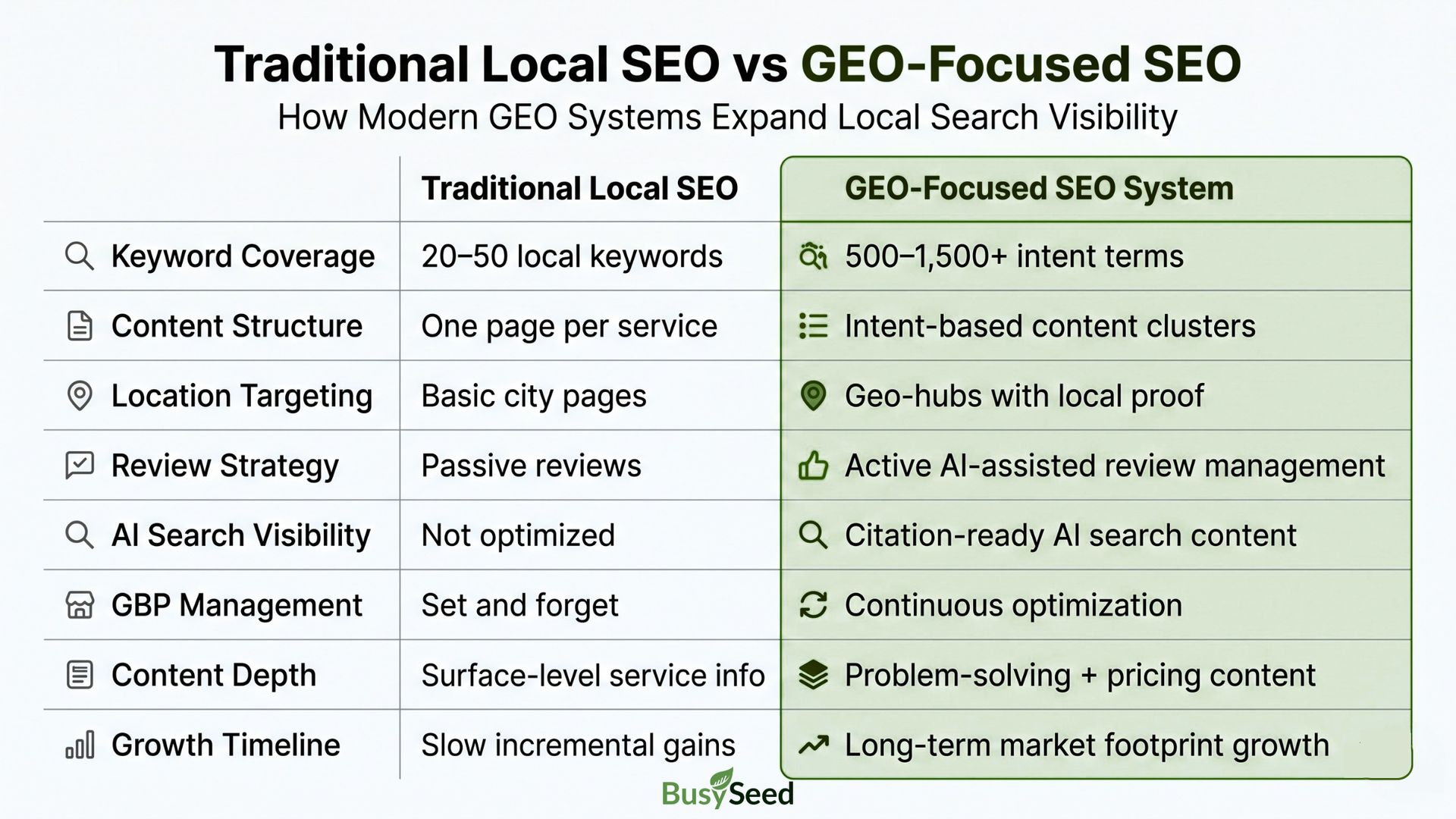
| Factor | Traditional Local SEO | GEO-Focused SEO System |
|---|---|---|
| Keyword footprint | 20–50 branded/generic terms | 500–1,500+ intent-mapped terms |
| Content structure | One service page per category | Intent clusters with dedicated landings |
| Location targeting | A list of cities in the footer of a thin, location-based page. | Clustered geo-hubs with local proof. |
| Review strategy | Passive collection | Active request + AI-assisted responses |
| AI search visibility | Not addressed | OAI-SearchBot access + citation-ready content |
| GBP Management | Set GBP(s) and forget. | Use the GBP optimizer to actively manage GBP(s) in line with on-page changes. |
| Content Depth | Surface-level services, such as paintball marking and more | Diagnose a problem with your building, such as a leaking roof, and provide a variety of options to fix it, including pricing for a particular solution and steps that would be taken for a job of that size. |
| Results timeline | 6–12 months for modest gains | 6–18 months for footprint-level transformation |
Google 2024 Post SEO Audit: What’s Changed? And How Do You Actually Win?
The post-2024 SEO environment for Google Search has become harder for most SEOs in two main ways. Firstly, the core algorithm update of Google Search in March 2024, in combination with the updated spam policies, significantly increases the risk of Google’s location pages (scaled location pages) being flagged for spam. If you are building GEO expansion with scaled location pages (swapping city names in templates), you are building on ground that Google has recently designated as likely to be spam.
The new win condition for SEO in 2024 is non-template local proof. This means instead of having a large number of location pages, you would have service pages with real photos from real jobs in real neighborhoods. The testimonials on these pages would describe the specific problems that the business was able to solve for its customers in specific areas. The pages of a locally optimized entity would be internally linked together in a way that makes sense for the reader following a link between them.
In other words, instead of keyword stuffing a large number of city variants across many location pages, the pages would be organized in a way relevant to a local reader, with links between them. Note that businesses using the systems for optimized home service SEO for 23 keywords now have 1,500+ keywords across their site’s pages and continue to use the systems 12-18 months later. One-time fixes aren’t enough for continued ranking increases. This is why local SEO services must focus on ongoing GEO optimization and user intent SEO.
FAQ: What Experts and Homeowners Are Actually Searching
Q1) What Are the Best Strategies For Using Social Signals to Improve Local Rankings for Home Service Businesses?
The signals we previously discussed for Search do not carry direct ranking weight (i.e., no link equity). However, social signals or ‘buzz’ can increase local visibility in two ways. Firstly, engagement signals on social platforms, such as likes and shares, can increase branded search volume, which Google can interpret as a signal of local prominence. Secondly, all social content (e.g., posts, reviews, community mentions) tagged with a job's location (e.g., a before-and-after photo of a completed job) constitutes distributed brand presence, or so-called GEO optimization.
The best way to leverage social signals for home service businesses, therefore, is to use the social content to surface real job evidence and then send that traffic back to the local business’s website and Google My Business listing where the relevant ranking signals are registered. This approach complements any on page SEO strategy by enhancing local relevance and prominence.
Q2) What Are The Best GEO marketing guides for local businesses Search Rankings in a Competitive Service Area?
There are many GEO marketing frameworks out there, but they are essentially broken down into three main elements: building a business with geographic relevance, achieving local prominence, and developing content that matches the intent of searches in a service area. The GEO marketing approach from BusySeed follows a similar framework. First, we create an intent map for a service area. Next, we create landing pages to deliver relevant experiences for intent clusters. Finally, we GBP-optimize and review each of those landing pages to ensure they pass offline ranking signals.
These GEO marketing guides emphasize the importance of GEO optimization and user intent SEO in creating a scalable and effective local search strategy. By following these GEO marketing guides, home service businesses can significantly improve their local search rankings and visibility.
Q3) What Are The Best Visibility Tracking Tools Offering Platform Independent GEO Insights?
For home service businesses with user intent SEO and GEO optimization in many locations, it is crucial to have a platform-independent visibility tracking stack. We recommend: Google Search Console for query-level footprint data of a geo-located business, a rank tracker (e.g., BrightLocal or SEMrush) for a service-area grid, and GBP Insights for call, direction, and website clicks. BusySeed is tracking AI Search referrals via utm_source=chatgpt.com in Google Analytics. In all likelihood, your competitors have not even started to measure AI-driven discovery yet.
These tools provide critical insights into the effectiveness of your GEO marketing and local SEO services, allowing you to refine your on page SEO strategy and improve your local search rankings.
Q4) What Are The Top Strategies for Optimizing GEO Ready Content in 2026?
When optimizing your GEO-ready content for search, it should serve three types of audiences: 1) The actual searcher with local intent; 2) The Google Ranking algorithm(s), even if the Ranking algorithm changes to include AI; 3) New AI Search environment “bots” that ‘crawl’ the web for searches and surface them in new environments such as chat, etc., such as OAI-SearchBot and Googlebot.
The framework for creating strong GEO-content should serve as a good citation. The framework should also prove strong geographic relevance (for local search). Lastly, the content itself should be easily crawled by search engine bots and bots in the new AI Search environment. You can also include many signals of trust (such as verifying a business’s licensing online, embedding a map of a service area, etc.), and such content will get ranked well for traditional Google rankings as well as for new AI-generated citations.
This approach to GEO optimization ensures that your content is optimized for both traditional and AI-driven search environments, making it a critical component of any on page SEO strategy.
Q5) How Long Does It Take for a Home Service Business to See Results From a GEO Optimization Strategy?
This would generally take a home service company 6-12 months to start seeing GEO search rankings grow for the areas where they provide services. However, some of the greatest ranking improvements in GEO search results for home service companies have been seen within the first 60-90 days after the initial GBP (Google My Business Profile) listing has been optimized. This is because a home service company’s ranking in the local pack is based on the ranking signals entered into Google My Business, such as a complete listing and the review responses left for the listing.
However, other on-page SEO work completed to drive GEO optimization can take a long time to start showing ranking improvements because of the time search engines take to crawl, index, and begin evaluating the new SEO changes made to a web page. Here at BusySeed, we run 90-day sprints to focus on the highest-returning SEO architecture for our home service clients, and then review ranking momentum every 6 months. We hold a 12-month milestone for a home service company with a footprint-type ranking growth.
This timeline underscores the importance of ongoing local SEO services and user intent SEO for achieving and maintaining strong local search rankings.
Conclusion: The Future of Home Service SEO
The home service marketing strategies that are yielding the most organic search results right now are those home service businesses that have a marketing system in place for their specific service area. A home service marketing system for a service area maps user intent, SEO for search for a service area, and then provides on page SEO strategy (or off-page SEO) to landing pages for a service area clustered by the intent of the search.
These home service marketing systems support local marketing (GMB, GBP, etc.) and are highly scalable for growth and GEO expansion. The results for the above home service businesses include an increase from 23 keywords with hundreds of pages of 100+ words of on-page SEO to support 1,500+ keywords overall, resulting in very positive organic search rankings and business growth.
BusySeed has worked in GEO marketing for a large array of home service companies. Find out how our SEO process can work for your company. BusySeed has a team of experts who offer free SEO consulting for a wide array of GEO marketing techniques and methodologies for home service companies. Our team at BusySeed has seen a 65x increase in rankings for a home service company case study and knows that what worked for that company can work for you.
All BusySeed needs is information about your service area and the work your company does, and BusySeed will create an ongoing SEO system that will produce results and bring in leads for your company. If you are interested in finding out how GEO marketing with BusySeed can work for your home service areas, fill out the form for a free SEO consultation with a BusySeed SEO expert.
Works Cited
- Angi. "Angi’s 2025 State of Home Spending Pulse Report." Angi, 2025, www.angi.com/press/angis-2025-state-of-home-spending-pulse-report.
- BrightEdge. "AI Overviews: One Year of Presence, Size, and Citing." BrightEdge, 2026, www.brightedge.com/resources/weekly-ai-search-insights/ai-overviews-one-year-presence-size-citing.
- BrightLocal. "Local Consumer Review Survey 2024." BrightLocal, 2024, www.brightlocal.com/research/local-consumer-review-survey/.
- Google. "AI Overviews Update May 2024." Google Blog, May 2024, blog.google/products-and-platforms/products/search/ai-overviews-update-may-2024/.
- Google Search Central. "March 2024 Core Update & New Spam Policies." Google Search Central Blog, 2024, developers.google.com/search/blog/2024/03/core-update-spam-policies.
- SOCi. "Consumer Behavior Index 2024." SOCi, 2024, golocal.soci.ai/rs/355-TUF-572/images/WEB%202024-02%20Consumer%20Behavior%20Index%202024.pdf.

About the Author
Omar Jenblat is a powerhouse in the digital marketing landscape, renowned as the Founder and CEO of BusySeed, an award-winning agency that has scaled over $1B revenue for 550+ businesses through high-performance growth strategies. With a technical foundation in computer engineering, Jenblat bridges the gap between complex data analytics and creative marketing, specializing in aggressive revenue scaling, SEO, and multi-channel lead generation. As a member of the Forbes Agency Council, The Org, and a visionary entrepreneur behind ventures like LeadChaser.ai, The Honest Agency, and Zeed Agency, he has established a global footprint by leveraging a "human-led, AI-assisted" philosophy to drive measurable ROI for major brands and startups alike. His expertise is characterized by a focus on digital automation and performance-driven results, consistently positioning his firms at the forefront of the evolving technological landscape.