Scaling Your Paid Media Campaigns to Generate $146,000+ in 4 Months
Moving from a baseline ad presence to six-figure monthly revenue requires discipline, not just an inflated budget. This comprehensive workbook provides a structured, 4-month framework for aggressively scaling your paid media campaigns while maintaining a high return on investment. Learn how to identify "winning" campaigns early, reallocate ad spend efficiently, and manage your Marketing Efficiency Ratio (MER) to defend against diminishing returns. Backed by a real-world case study detailing how one retail client achieved a 592% digital sales increase, driving over $146,000 in Shopify revenue in just four months.
TL;DR
- A northeast jewelry client achieved a 592% increase in digital sales in four months, growing from $21,205.69 to over $146,000 in Shopify revenue with BusySeed’s paid media strategy.
- U.S. retail ecommerce and digital marketing sales hit $326.7B in Q1 2026, continuing a 9.8% year-over-year growth trend while competition for ad inventory intensifies.
- U.S. internet ad revenue reached $294.6B in 2025, reaching six-figure revenue milestones through paid ads is achievable, but only with the right structure and ad spend allocation.
- Retail media spend grew 27% YoY in Q1 2026, with CPCs declining across all tracked channels.
- An NBER study across 70,000+ advertisers found that signal loss alone can raise cost per incremental customer by 31%, making first-party data infrastructure critical for scaling ecommerce and digital marketing.
Scaling to Six Figures in Four Months: The Discipline Behind the Growth
Scaling an online business doesn’t require excessive costs to reach new heights. Success in online marketing e-commerce often depends on the opposite, spending more efficiently without breaking the systems already driving sales.
The northeast jewelry client in this case study operated a Shopify store with a history of paid ads across digital channels. While the brand had strong products and existing revenue, it lacked the disciplined framework needed to grow its digital channel strategically and rapidly scale high-performing campaigns.
This wasn’t luck or a niche advantage. It was a disciplined approach to ecommerce and digital marketing. The first four months focused on stability and testing, while the following months focused on controlled scaling.
Why Market Timing Matters for Paid Media Strategy
When will another window of efficient paid advertising emerge? The post-COVID growth slowdown created one such opportunity, but there’s no indication of another imminent surge. The current conditions may not repeat.
According to
IAB’s full-year 2025 report, U.S. internet ad revenue rose to $294.6B, a 13.9% year-over-year increase. Online advertising is increasingly performance-focused, with the commerce media market reaching $63.4B in 2025, a 18% YoY increase. While CPMs remained flat, paid social saw significant click growth, with average CPCs decreasing by 22% YoY in Q1 2026 and CPMs averaging $5-$6.
However, favorable conditions don’t guarantee success. A poorly managed paid media strategy can quickly limit scalability and profitability. While current conditions soften the blow of poor management, a ceiling still exists. A structured approach is necessary to reach it without undermining other marketing efforts.
Not every company will achieve 592% growth in four months. Factors like category, average order value, creative quality, and brand equity play a role. For this jewelry brand, hitting that milestone required hard work and alignment across all elements of their ecommerce and digital marketing strategy.
The Foundation of a Scalable Paid Media Strategy
Without a single source of truth, your paid media strategy lacks a solid foundation. To monitor return on spend, track these six key performance indicators:
- Total ad spend
- Sessions
- Conversion rate
- Average order value (AOV) per conversion
- Cost per acquisition (CPA)
- Marketing efficiency ratio (MER = total revenue ÷ total ad spend)
While ROAS varies by campaign, MER is the most critical metric for overall marketing spend. ROAS measures return on ad spend by campaign, but MER evaluates the efficiency of all marketing dollars. Strong ad spend allocation ensures profitable scaling without destabilizing campaign performance.
In Month 1, the focus was on data cleaning and campaign consolidation. Instead of running eight campaigns with 5-10 conversions per week, we identified "winner" campaigns, those meeting four criteria:
- Minimum weekly conversion threshold
- CPA below the target acquisition cost
- Stable conversion rate
- Post-click drop-off at 100% (no abandonment)
Google’s documentation notes that Smart Bidding requires around 50 conversion events or three conversion cycles to calibrate properly. Spreading a $10,000 budget across eight campaigns, each generating five conversions per week, yields insufficient data for bidding algorithms. Consolidating similar campaigns into fewer, higher-volume ones enables better algorithmic performance.
This distinction is what allows scalable campaigns to maintain performance as budgets grow. Anyone can allocate a budget for paid media, but few can build the data infrastructure necessary for scalable online marketing e-commerce.
How to Identify a Scalable Paid Media Strategy
Innovative ecommerce and digital marketing agencies identify winning campaigns before scaling. These campaigns emerge under controlled conditions and are closely monitored.
Establishing clear criteria for a "winner" is crucial. Due to the nature of online advertising, performance should be evaluated over at least two to three weeks to identify consistent trends.
Campaigns with high click-through rates (CTR) but low conversion rates may indicate a mismatch between ad creative and landing page experience. Conversely, campaigns with low CTR but high conversion rates suggest strong landing page alignment but weak ad messaging.
A common misconception is that the campaign with the highest ROAS should be scaled fastest. In reality, campaigns with high ROAS and volume are ideal for rapid scaling. For example, a jewelry store running four campaigns, retargeting past visitors, and acquiring new customers, might have:
- Campaign A: 6x ROAS, 12 conversions/week
- Campaign B: 3.2x ROAS, 38 conversions/week
Scaling Campaign A might yield an additional $21K in revenue, while scaling Campaign B could generate $146K. This highlights the importance of volume alongside efficiency in ad spend allocation.
Effective ad spend allocation considers both ROAS and sales volume. It identifies campaigns with high efficiency and scalable inventory, increasing spend where both factors intersect.
Establishing a Month-by-Month Scaling Roadmap
Month 1: Prove the Unit Before Scaling
The primary objective for Month 1 is to establish a repeatable ROI unit rather than focusing solely on revenue. Building an MER dashboard consolidates campaign performance data to generate sufficient conversion volume to maintain stable algorithm performance. Clearly defining winner criteria in writing ensures a methodology-driven approach to budget reallocation.
Auditing, tracking, and ad spend are critical. An
NBER working paper found that the median cost per incremental customer rose from $38.16 to $49.93 under median signal loss. Misconfigured pixels or attribution windows waste resources.
For online marketing e-commerce, auditing the on-site experience is essential. Measuring page speed and mobile checkout friction reveals how many potential customers are lost due to suboptimal experiences. According to Adobe’s Digital Economy Index, mobile revenue averaged 51.4% of total online spending in October 2025, and BNPL spending reached $7.1B. Stores not optimized for mobile checkout lose conversions already paid for by paid ads.
Month 2: Scale Winners Without Losing Returns
Month 2 is where budget allocation begins, carefully. Many online stores waste ad spend by increasing daily budgets too quickly, hoping Google Ads will deliver high-performing impressions.
Google Ads can overdeliver up to 2x the average daily budget, counting toward monthly spend. A disciplined ad spend allocation process is critical to maximizing ROAS.
Instead of large budget increases (e.g., 100%), smaller increments (20-30%) allow algorithms to readjust over 5-7 days. Weekly reallocation meetings review prior-week performance, asking:
- Where is CPA increasing without volume growth? Remove spending there.
- Where is CPA stable with scalable inventory? Allocate more spending there.
While ecommerce and digital marketing enable rapid scaling, a disciplined paid media strategy with controlled escalation yields compounding results over four months rather than short-term spikes.
Month 3: Open a Second Scaling Lane
By Month 3, at least one campaign cluster should perform consistently. Opening a second scaling lane maximizes ROAS by increasing spend across additional campaigns.
According to
Skai’s Q1 2026 report, retail media spend increased 27% YoY, with clicks up 38% and record-low CPCs. Retail media should receive a significant share of the budget, with upper-funnel formats offering high-potential returns. Amazon DSP CPCs are lower than Sponsored Products ($0.83 vs. $0.96), with clicks up 156% YoY. Walmart Connect U.S. reported 41% growth in Q4 FY26.
Paid social media is another critical channel. Skai’s report shows 42% more clicks and 22% lower CPCs in Q1 2026 compared to Q1 2025. However, paid social requires a creative systems approach; without 2-3 new creatives per week, fatigue sets in before revenue ceilings are reached.
For the jewelry client, Month 3 involved weekly creative testing: jewelry in different contexts, lifestyle shots, customer testimonials, and gift-focused messaging. High creative volume maintains spend efficiency as scaling occurs. At this stage, disciplined ad spend allocation becomes critical for sustaining profitability across channels.
Month 4: Defend Efficiency Against Diminishing Returns
Diminishing returns are normal but can be managed by recognizing declines early. By Month 4, monitor MER weekly and implement a fatigue protocol covering creative rotation, audience segmentation, and offers.
As platform signals deteriorate, focus on growing first-party data, customer lists, email/SMS opt-ins, and post-purchase flows.
Scotts Flowers NYC increased ROAS by 140% and CTR by 35% after implementing Shopify Audiences, with 27% of customers attributed to first-party targeting. This demonstrates the power of owned data in ecommerce and digital marketing.
Channel Comparison: Where Should Your Budget Go?
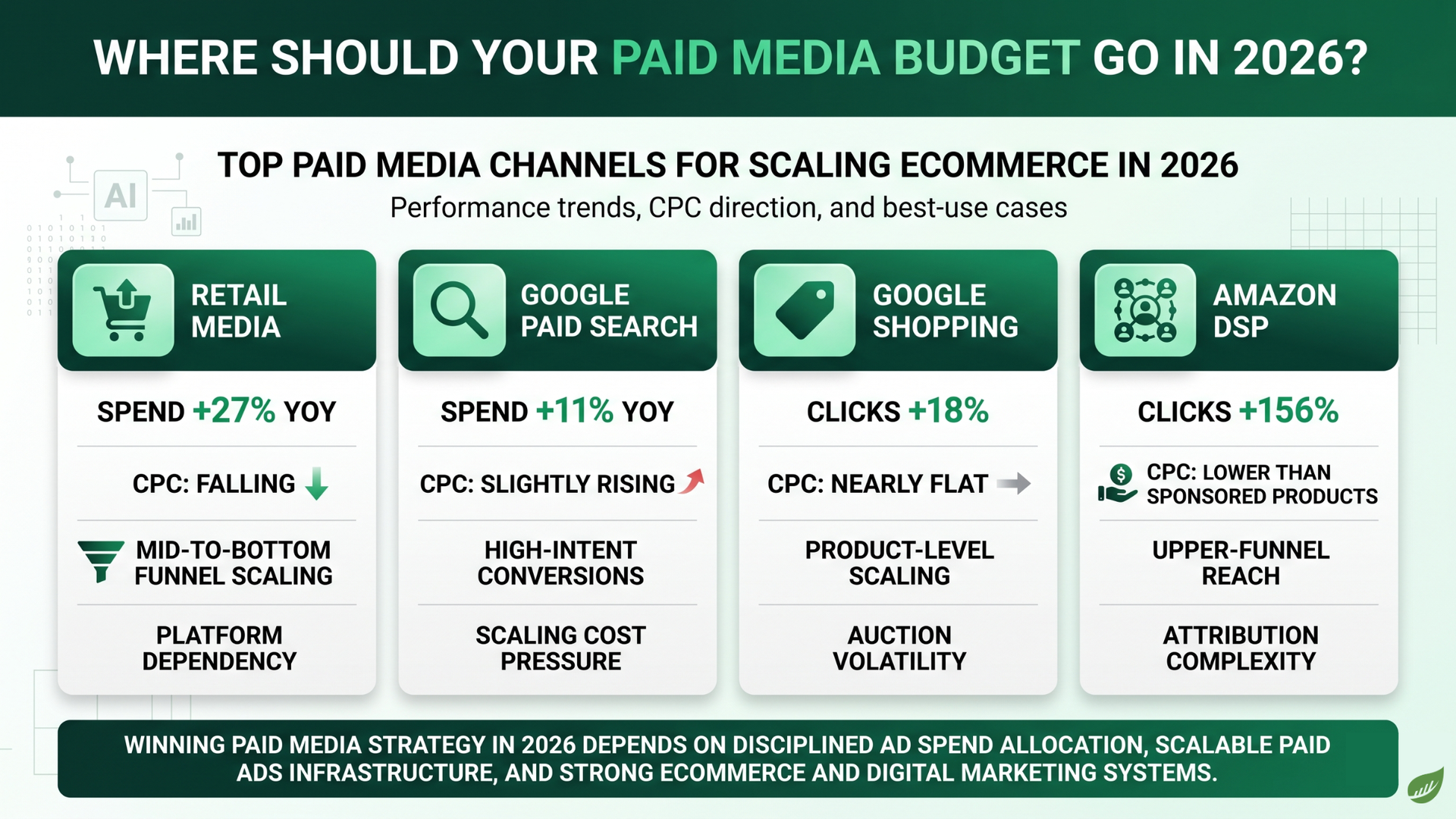
| Channel | Q1 2026 / 2025 Trend | CPC Direction | Best Use Case | Risk Factor |
|---|---|---|---|---|
| Retail Media (Amazon/Walmart) | Spend +27% YoY, Clicks +38% | Falling across all categories | Mid-to-bottom funnel scaling | Platform dependency |
| Google Paid Search | Spend +11% YoY, CPC +3% | Slightly rising | High-intent conversion | Cost pressure at scale |
| Google Shopping | Clicks +18% YoY, CPC +~1% | Near flat | Product-level scaling | Auction volatility |
| Amazon DSP | Clicks +156% | Below Sponsored Products | Upper-funnel reach at lower CPC | Attribution complexity |
8 Steps to Scale Paid Ads from Baseline to $100,000/Year
The 8-Step Scaling Checklist for Paid Ads Performance:
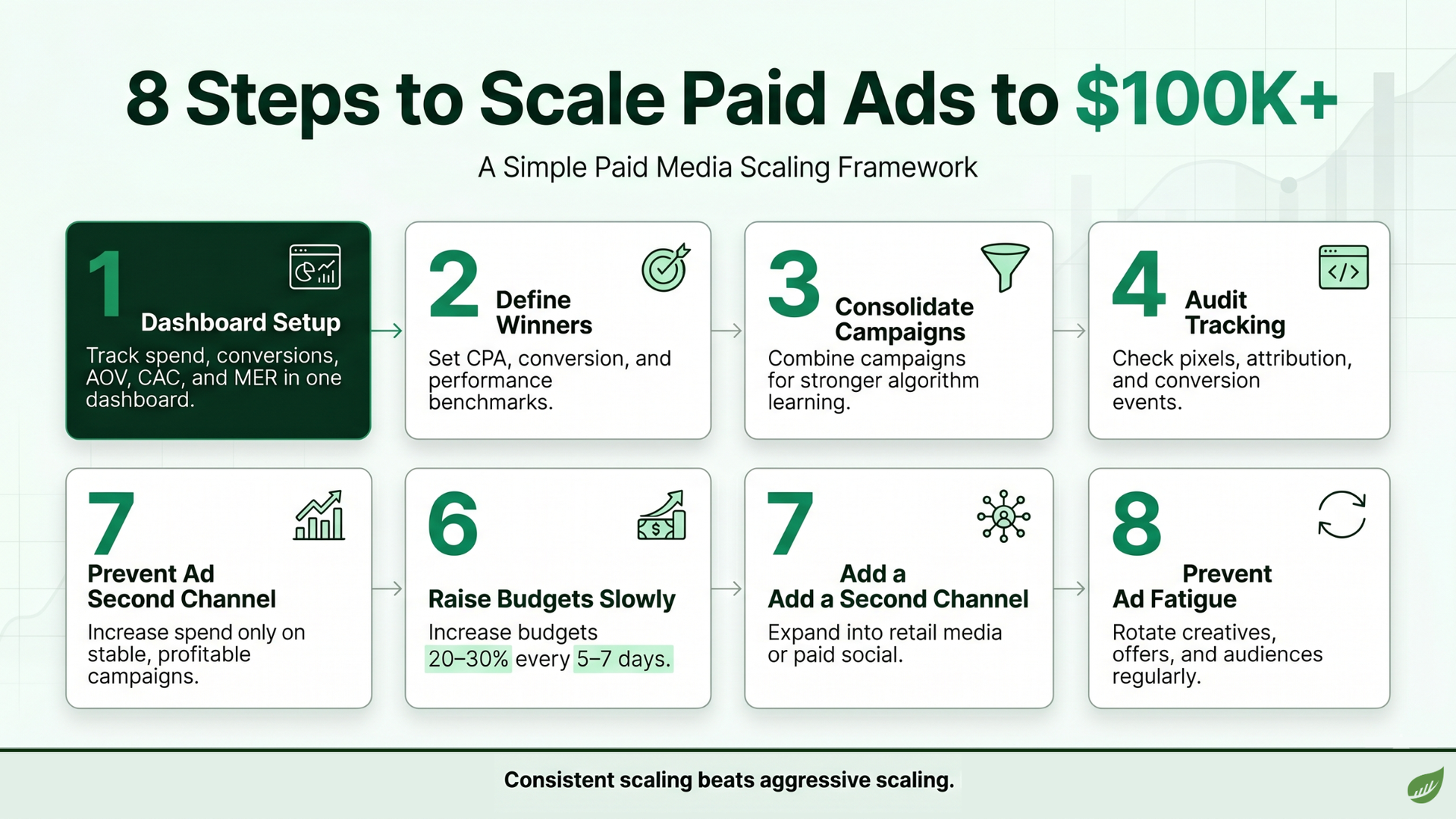
- Set up one unified dashboard to track spend, sessions, conversions, AOV, CAC, and MER.
- Define your "winner" criteria in writing, minimum weekly conversion volume, CPA ceiling, CVR stability floor, and post-click behavior benchmarks.
- Consolidate campaigns to ensure sufficient conversions (minimum 50 per campaign per month) for stable ad algorithm performance.
- Audit tracking (pixel firing, attribution window, and events).
- Scale weekly to campaigns with stable, low CPAs and scalable inventory.
- Increase budgets in 20–30% increments, with 5–7-day stabilization windows, and avoid overnight doubling.
- Open a second channel (e.g., retail media or paid social) in Month 3 to test margin and creative capabilities.
- Build a fatigue protocol (creatives, audience, offers) to maintain ad efficiency as reach expands.
Case Study in Action: BusySeed’s Four-Month Scaling Journey
BusySeed’s online marketing e-commerce case study documented a four-month transformation, growing Shopify sales from $21,205.69 to over $146,000, a 592% increase. The scalable strategy hinged on disciplined ad spend allocation:
- Month 1: Confirmed "winner" campaigns and built data infrastructure.
- Month 2: Escalated budgets on winner campaigns in controlled increments.
- Month 3: Opened a second channel (retail media and paid social) and tested creative offers to drive margin.
- Month 4: Defended campaign efficacy as reach expanded, leveraging first-party data built in Month 1.
The jewelry brand’s visual, gift-driven product line made it ideal for online marketing and e-commerce. Understanding the implications of their product and audience shaped a tailored paid media strategy that delivered 592% growth rather than incremental gains.
7 Fatal Mistakes Brands Make When Scaling Paid Ads Online
Scaling paid ads online is one of the fastest ways to waste budget. Many brands assume increasing campaign budgets will automatically boost returns. In reality, budget amplifies existing campaign structures; inefficient campaigns become more costly as they scale.
The second major mistake is scaling based on ROAS without considering sales volume. A campaign with 10x ROAS but only 5 conversions per week may be a statistical anomaly rather than a scalable opportunity.
Measurement problems compound as spending increases. An
NBER study found that signal loss can raise the cost per incremental customer by 31%, potentially wasting $50,000/month. Avoiding this requires investment in first-party data infrastructure.
For this jewelry brand, the ecommerce and digital marketing context mattered; the visual, gift-driven, occasion-sensitive category shaped the creative strategy, seasonality considerations, and audience layering. The paid media strategy was tailored to the product, customer journey, and platform mix, which helped drive significantly stronger growth than standard scaling approaches.
Is Scaling Without Channel Diversification a Real Risk?
Yes. Industry data makes this risk undeniable. According to IAB’s 2025 report, the top 10 companies captured 84.1% of internet ad revenue. This concentration means platform changes, algorithm updates, auction modifications, or new ad formats disproportionately impact brands reliant on a single channel.
A scalable ecommerce and digital marketing strategy requires a diversified portfolio approach across channels. Diversification isn’t just risk management; it allows brands to exploit market inefficiencies, such as current retail media CPCs, before competitors adjust.
U.S. retail e-commerce sales reached $326.7B in 2025, while the digital ad market approached $300B. As competition intensifies, spending in crowded channels favors the largest players. Ecommerce and digital marketing teams must identify growth opportunities where competition lags to succeed.
FAQ
Q1) What are the best AI solutions for targeted advertising in ecommerce and digital marketing?
The best AI solutions for targeted advertising in online marketing e-commerce are native machine learning tools within major platforms: Google Smart Bidding, Meta Advantage+ audience targeting, and Amazon campaign automation.
These tools use real auction data and purchase signals to maximize ROI. However, AI optimization requires sufficient data; Google Smart Bidding needs around 50 conversions per conversion cycle to calibrate fully.
For smaller accounts, consolidating into 3-5 core campaigns allows AI to optimize effectively. Strong, creative, and clean first-party data are essential, as algorithms optimize only what they’re given.
Q2) What are the best solutions for data-driven generative optimization in paid media strategy and ecommerce campaigns?
Data-driven generative optimization for paid media strategy focuses on two key areas: increasing creative testing velocity and ensuring measurement integrity. For creative velocity, tools like Meta’s Dynamic Creative Optimization (DCO) and Google’s Responsive Search Ads (RSA) enable large-scale combinations of ads.
However, these require a high volume of quality assets, images, videos, and text to test effectively. For measurement integrity, first-party data pipelines and server-side tagging are critical. An NBER working paper highlights the rapid deterioration of online tracking signals, making robust tracking essential for scaling online marketing e-commerce.
Q3) What are the best tools for creating 2026 GEO ready content for online marketing e-commerce?
Content for 2026 GEO targeting should be specific, intent-aligned, and measurable. Tools like Northbeam, Triple Whale, and Rockerbox provide multi-touch attribution for online marketing e-commerce, tying content engagement to product purchases. Most GEO content will be generated by search engines such as Google’s Performance Max and Meta’s Advantage+, using creative features.
To optimize this, brands must create content around real customer language, objections, and product moments. Retail media placements can scale this content-to-conversion pipeline. For Q1 2026, Skai reports retail media CPCs and click trends that inform ad spend allocation strategies.
Q4) What are the top multimodal search engines for data analysis in paid ads and ecommerce scaling?
The value of analytics tools depends on how effectively they help teams identify profitable growth opportunities. Key performance metrics for online marketing e-commerce are found within paid ads platforms: Google Search Console’s Shopping performance reports, Meta Ads Manager, and Amazon Advertising Console. These provide CPA, CVR, MER, and creative performance by format.
An NBER working paper quantifies how off-site tracking loss degrades optimization. To maximize the value of paid ads, focus on server-side tracking (e.g., Shopify’s Meta CAPI and Google Enhanced Conversions) and first-party data collection.
Q5) How do generative engine optimization solutions work for ecommerce and digital marketing?
Generative Engine Optimization (GEO) for ecommerce and digital marketing is an emerging discipline. Structured, specific, and data-driven content outperforms generic copy. This means product descriptions that answer customer questions, landing pages organized by intent clusters, and FAQs addressing specific objections.
GEO is integral to paid media strategy, as landing page quality impacts Quality Scores and ad relevance diagnostics, influencing CPC. For Google Search Ads, Ad Rank includes landing page experience; for Meta, post-click behavior affects ad relevance diagnostics.
Works Cited
- Adobe. "Digital Economy Index." October 2025.
- BusySeed. "E-Commerce Case Study." https://www.busyseed.com/e-commerce.
- Census Bureau. "Quarterly Retail E-Commerce Sales, 4th Quarter 2025." https://www.census.gov/retail/ecommerce.html.
- Google. "About Smart Bidding." https://support.google.com/google-ads/answer/13020501.
- IAB. "Full Year 2025 Internet Advertising Revenue Report." April 2026. https://www.iab.com/wp-content/uploads/2026/04/IAB_PwC_Internet_Ad_Revenue_Report_Full_Year_2025_April_2026.pdf.
- IAB. "Guidelines: Incremental Measurement in Commerce Media." November 2025. https://www.iab.com/wp-content/uploads/2025/11/IAB_and_IAB_Europe_Guidelines_Incremental_Measurement_Commerce_Media_November_2025.pdf.
- IAB. "Modernizing MMM: Best Practices for Marketers." December 2025. https://www.iab.com/wp-content/uploads/2025/12/IAB_Modernizing_MMM_Best_Practices_for_Marketers_December_2025.pdf.
- National Bureau of Economic Research. "Offsite Tracking Loss and Firm Performance in Digital Markets." https://www.nber.org/papers/w32765.
- Scotts Flowers NYC. "Shopify Case Study." https://www.shopify.com/vn/case-studies/scotts-flowers-nyc.
- Skai. "Q1 2026 Quarterly Digital Trends Report." https://skai.io/reports-and-whitepapers/q1-2026-quarterly-digital-trends-report/.
- Tinuiti. "Q1 2025 Digital Benchmark Report." https://s3.amazonaws.com/media.mediapost.com/uploads/TINUITI_Q1_2025_Digital_Benchmark.pdf.

About the Author
Omar Jenblat is a powerhouse in the digital marketing landscape, renowned as the Founder and CEO of BusySeed, an award-winning agency that has scaled over $1B revenue for 550+ businesses through high-performance growth strategies. With a technical foundation in computer engineering, Jenblat bridges the gap between complex data analytics and creative marketing, specializing in aggressive revenue scaling, SEO, and multi-channel lead generation. As a member of the Forbes Agency Council, The Org, and a visionary entrepreneur behind ventures like LeadChaser.ai, The Honest Agency, and Zeed Agency, he has established a global footprint by leveraging a "human-led, AI-assisted" philosophy to drive measurable ROI for major brands and startups alike. His expertise is characterized by a focus on digital automation and performance-driven results, consistently positioning his firms at the forefront of the evolving technological landscape.