How Optimizing B2B Lead Generation Funnels Can Secure Consistent Demo Appointments in 2026
For B2B SaaS companies, generic outreach to mid-level managers often leads to inflated costs, frustrated sales teams, and empty calendars. Scaling to consistent demo appointments requires a data-backed shift toward refined, executive-level targeting and rigorous lead qualification. This workbook-style guide walks you through the exact process of aligning marketing efforts with sales intent to build a reliable demo pipeline. Learn how to close the "form-to-meeting gap," shift from activity-based scoring to intent bundles, and implement a precision architecture. Includes a complete case study showing how we achieved a groundbreaking $26.84 B2B Cost Per Lead for an executive search tech company.
TL;DR
- 61% of B2B buyers now prefer a rep-free buying experience, and 73% actively avoid vendors who send irrelevant outreach, meaning B2B lead generation precision isn't optional anymore; it's survival (Gartner, 2024).
- Form-fill to booked meeting conversion rates for companies using Chili Piper’s routing and meeting activation technology average 69% compared to 30-40% for companies that rely on a more manual follow-up process with sales reps (Chili Piper, 2025). This major gap in conversion rates highlights the likely choke point in the funnel within B2B lead generation strategies.
- BusySeed helped an executive search technology company reach a cost per lead of $26.84 by building an executive funnel to replace their current B2B lead-generation targeting.
- In the past year, the role of LinkedIn in B2B research has increased by 19% (up 36% to 55% in 2024, according to Demand Gen Report 2024), but only 27% of buyers said that ads had a positive effect on their perception of a vendor, underscoring the need for refined B2B lead generation strategies.
- Gartner found that when content was targeted to the buying group as a whole, there was a 20% increase in consensus among team members, whereas content personalized to an individual decreased consensus by up to 59% in most cases. Thus, targeting the champion of the buying group is unlikely to result in a deal closing, a critical insight for B2B lead generation.
Why Is Your Demo Calendar Still Empty?
Your demo calendar is empty because your funnel is optimized for the wrong conversion event. Most B2B SaaS teams build their funnels around “lead captured” as the primary KPI. This means they’re training their ad platforms to find people who love filling out forms rather than people with budget, authority, and problems your SaaS product can solve. The biggest problem in B2B lead generation is that most agencies are just looking to get as many leads as possible into a salesperson’s pipeline and are blind to the actual problem that the salesperson is trying to solve.
Most B2B SaaS companies run paid advertising campaigns to drive traffic to their websites. The majority of that traffic converts into form fills. Then that lead is handed off to a sales team, and the marketing team watches as the AE tries to convert that lead into a demo. At the end of the week, the marketing team reviews the dashboard on cost-per-lead, and the sales team reviews their pipeline, with the AEs discussing why the month's leads didn’t turn into demos. The marketing team claims to be sending lots of high-quality leads to the sales team, while the sales team claims the leads from marketing aren’t any good. No one is looking at either organization taking a step back to examine the entire funnel and ask what events the funnel is being used to measure for conversion.
Problems in B2B lead-generation funnels often stem from how teams build them. The majority of B2B SaaS companies build their funnels around the wrong conversion event. For a long time, the vast majority of B2B companies have built their funnels around “form fill” as the primary conversion event, training the ad platforms to show the right ad to the right person at the right time. However, form fill does not equal a qualified lead. The cost to acquire a lead should be in line with the deal's potential value. For a $10,000/month deal, the cost to acquire a lead should be lower than for a $500/month deal. The 2026 environment will make this problem sharper, not softer. Gartner’s 2024 survey of 632 B2B buyers found that 61% prefer a rep-free buying experience, and 73% avoid vendors that send irrelevant outreach.
This post is designed to serve as a guide to best practices for each step of the B2B lead generation process. Rather than reiterating other resources on how to “maximize” your lead gen, the goal here is to give you a step-by-step workbook on how to ensure you’re doing the best possible job at each part of the funnel.
Consistent Demo Appointments in 2026: What Does It Mean for Your Business?
Consistent Demo Appointments = A System that Consistently Produces Qualified Lead Meetings with Decision-Makers.
The current approach to getting demos is focused on volume rather than revenue. This will not work in 2026, and teams need to focus their funnel on the correct conversion event and tie every step to driving revenue. The way buyers purchase today is very different from how it was even a few short years ago. Forrester predicts that more than half of large B2B deals will be completed via a vendor’s website or online marketplace within the next 12-18 months. This means the bulk of your funnel consists of your website, pre-demo assets, and qualification processes. If these items aren’t doing the heavy lifting for you before a buyer even speaks with a sales representative, then your paid spend is leaking. The companies seeing the strongest demo pipelines in 2026 are using B2B lead generation strategies that connect targeting, qualification, routing, and executive-level messaging into one cohesive system rather than treating them as isolated marketing activities.
Buying committees have grown and, in some cases, become more dysfunctional over time.
Gartner's research found that 74% of buying teams have “unhealthy conflict” during the decision process. This means that in many cases, the buying team will fight amongst themselves regarding your product or service. As a result, a single-champion strategy, so commonly employed by B2B sales organizations, will fail at the demo-to-deal stage.
Is Your B2B Lead Generation Strategy Reaching The Right People?
Are You Selling to a Person or a Committee?
Most B2B lead generation strategies are still based on a single persona. An ICP (Ideal Customer Profile) that forms the framework for your B2B lead generation funnels is typically created with a single buyer in mind. The challenge in the vast majority of B2B purchasing decisions is that they are made by a committee of individuals before a final decision is reached.
The typical B2B lead generation strategy is built around a single ICP (Ideal Customer Profile) and decision-maker(s). However, buying decisions are typically made by multiple people across functions. To close deals, you need to sell to a committee. Therefore, single-persona targeting is not only inefficient but also fundamentally misaligned with the purchasing decisions of a growing number of buying groups.
Here’s an example of a typical B2B sales funnel. BusySeed’s SDRs cold call the CHROs of companies that meet our Ideal Customer Profile. When the CHRO is interested, the SDR sets up a demo. Then, during the demo, the CHRO shows the other relevant people in the company (the procurement team and the CFO). This is where things typically fall apart. The SDR did a great job qualifying the qualified lead, but in the demo, the CFO wants to know how the product will return on investment, and the Legal department wants to know how the company will govern the use of the data. This was never discussed with the CHRO prior to the demo, so the SDR is unprepared to answer these questions. It’s a funnel problem, not a sales problem.
For each of the four functions listed for your organization (e.g., HR, Finance, IT, and Legal), write down the following two pieces of information regarding each of their involvement in the buying process:
- The “yes-if” (a requirement or condition that must be met in order for that function to say yes to moving forward with the buying process).
- The “no-because” (a risk or barrier that could kill the deal if that function perceives that risk to be too high).
Now that you have completed that step for all four functions, create a demo CTA for each of the functions identified above. Keep in mind that you are using the exact same product, but you will be using a completely different proof package in order to best address the pain points and interests of each respective function. Note that the end destination of each demo CTA is the same, but the on-ramp for each function is dramatically different.
Research by Gartner found that content targeted at buying group relevance increased consensus by 20% on average. Conversely, individual-level personalization actually decreased consensus 59% of the time. Thus, the typical B2B seller’s instinct to become more targeted to individual stakeholders within buying groups will have the opposite of the intended effect and actually make some stakeholders feel chosen while others are ignored, a critical insight for refining B2B lead generation strategies.
Reframing Your ICP for Targeting Executives
Board targeting is the silent budget killer in B2B lead generation. Most B2B lead generation strategies are still based on a single ICP, typically a few defined by firmographics. But how many functions within a company need to be convinced before a purchase can take place? Typically, Marketing targets one champion, and the rest of the buying committee is sold internally by that single contact. But where is the heavy lifting being done to target all of the necessary stakeholders within a potential account?
If you are selling to executives, targeting them with paid search and social media campaigns is unlikely to work well. That type of targeting works best for companies selling to people in departments with purchasing budgets. Buying from B2B companies costs money and, therefore, requires a budget. C-level executives do not have budgets. Their job is to make money for their company. Therefore, the way to market to them is based on business risk, competitive positioning, and ROI.
BusySeed recently worked with a company that provides executive search technology. They had a small workforce of 50 employees. They were spending a lot of money running numerous campaigns on LinkedIn and Google. The results were not good. BusySeed redesigned the B2B lead generation funnel and, within a few months, consistently generated leads at $26.84 per lead. In addition, they generated a steady stream of demo appointments.
Metadata has recently published data from their 2024 B2B Marketing and B2B lead generation Benchmark Study. For those interested in how B2B lead generation on LinkedIn is performing, the average cost per lead is $190. The cost per industry average cost per lead for LinkedIn advertising is as follows: In reviewing this data, it’s very important to remember that the cost per lead for B2B advertising on LinkedIn is directly impacted by how well you have defined your ideal customer profile (ICP) and created a conversion architecture that doesn’t waste qualified leads. In other words, your ICP needs to be very accurately defined, and your conversion funnel needs to be well-engineered in order to obtain good quality leads at a reasonable cost.
Modern B2B Lead Scoring: Intent Bundles Not Activity Points
A Probing Question
Are you still using outdated lead scoring models? The typical approach to scoring leads in B2B marketing is to assign activity points (e.g., visiting the pricing page on your website = 10 points, downloading an e-book = 5 points, opening 3 emails = 3 points × 3 = 9 points, etc.).
However, as mentioned above, this is not an effective way to score leads in 2026. Instead, lead scoring should be designed to score intent bundles. This means that the lead scoring system should first score fit (e.g., firmographics, role seniority, tech stack, etc.) and then score intent bundles that occur in close proximity to one another (e.g., someone visiting the pricing page of your website, visiting the comparison page of your competitor’s website, reading ROI content within a 7-day or so time frame, etc.). These intent bundles occur in close proximity to one another, indicating that someone is actively in the market and evaluating vendors. Three page views spread out over 6 weeks indicate very little.
The third dimension for lead scoring is buying-group depth. Most B2B organizations only score individual contacts within an account and have no idea what is happening with other stakeholders. By failing to account for buying-group dynamics, organizations are no wiser about account-level momentum, which is precisely what the sales organization wants to surface to prioritize and drive demo activity. Buying committee research conducted by Gartner indicates that organizations are making purchasing decisions as a group; the entire organization must be considered when lead scoring. The organization is not trying to find a hot lead; rather, it’s looking for a hot account with high account-level momentum.
What Makes a Qualified Lead in 2026?
A qualified lead is not a form fill. This is NOT an MQL generated from a lead magnet download. A qualified lead is a contact at an account that meets VERY specific fit criteria and is showing intent signals that indicate that the contact and account are actively evaluating for a solution. These two components should be written down and agreed to by both Marketing and Sales as the definition for a qualified lead.
Typically, the Marketing organization defines qualified leads in terms of easily measurable criteria (e.g., form fill-outs, score increases, etc.). On the other hand, the Sales organization defines qualified leads in terms of BANT: Budget, Authority, Need, and Timing. In reality, the biggest struggle between Marketing and Sales is that the two definitions of qualified leads rarely align; as a result, leads are deemed “poor quality” by Sales and receive little to no follow-up. All of this breeds distrust between Marketing and Sales. Both know that the other group is NOT doing its job in helping grow the organization's pipeline.
6sense's 2025 research found that 29% of 392 measured B2B marketing organizations are expected to increase marketing-generated pipeline without an increase in budget. That means each dollar spent on leads that don’t close has the potential to be a dollar that can’t be recovered. The above lead scoring workbook is a great way for organizations to define a qualified lead that drives the right pipeline for their organization.
Create a “qualified lead” workbook (a simple Excel document) to get Marketing and Sales aligned. Write down three definitions: 1) A qualified lead is someone who meets the fit criteria AND intent behavior; 2) A qualified meeting is a meeting that an AE puts on their calendar; and 3) A sales-accepted lead is a lead that an AE commits to follow up with within a set time frame (e.g., X days). One operational rule to get right before scaling any new channel: the SAL-to-SQL ratio has to remain stable. Otherwise, you’ll just be throwing money down the drain, generating lots of noise but no pipeline.
Is Your Paid Media Strategy Built for Demos or Just Clicks?
What Should a Paid Media Strategy Actually Optimize For?
A paid media strategy is best optimized for qualified lead meetings held (or downstream events), not for clicks and leads. If you optimize for clicks and leads, your paid media strategy will deliver a large volume of very poor-quality leads that waste a lot of money.
The root cause of underperformance in many B2B paid campaigns is that the conversion event the marketer has chosen to optimize for is too high up in the funnel. The marketer has outsourced lead qualification to the platform because it optimizes for the lead form to be submitted as many times as possible. The platform has no idea what a qualified lead looks like to the AEs at the B2B SaaS company. A strong paid media strategy also requires alignment between ad targeting, routing logic, and post-demo follow-up to maintain consistent meeting quality.
Note that the initial drop in numbers lasts for 2-4 weeks as the algorithm readjusts to the new optimization criteria. After this initial period, the platform will start optimizing for very high-quality leads that convert to meetings. The example from 6sense’s research above, where LinkedIn CPL went from $400 to $35, is a case in point where the focus was on targeting and on structuring a paid media strategy to drive the right conversion for that customer.
Also, worth noting is that simply changing your conversion event to something downstream is not going to instantly start to convert more leads for you. In fact, for 2-4 weeks, your volume of qualified leads is likely to drop for you, as the algorithm “learns” to prioritize leads that are optimized for the new conversion event. If you are not booking enough qualified lead meetings (for us, 30-40 or so is a good sample size), then it may make more sense to optimize for a mid-funnel event and manually qualify the leads that come in through your marketing funnels.
How Does Executive Targeting Change Your Paid Media Strategy?
Executive targeting changes paid media strategy spend, sequence, and even measurement. Executives are not to be targeted with the same content types, ad types, and even value propositions that mid-level managers would be targeted with. They are not looking to compare features; instead, they are looking for business outcomes, ways to reduce risk, and gain insight into the current state of the market and how your company can help them with their goals.
Demand Gen Report’s 2024 B2B Buyer’s Survey found that 41% of buyers are now adding more detailed ROI analyses to their purchase evaluation process, 34% are spending more time researching, and 33% are relying more heavily on peer recommendations and reviews. These aren’t mid-level manager behaviors; these are the behaviors of people who are accountable for the business impact of their purchasing decisions. That’s your executive audience.
57% of buyers noticed online ads during their research process. However, less than one-third indicated that those online ads actually had a positive impact on the buyer’s perception of said brand. So, until we can develop more complex paid media strategy campaigns that provide true value to the highest-level buyer, we need to shift our messaging from a generic product-pitch to provide true insight for the executive-level buyer, such as: industry insights, ROI models, and data and/or research that support the direction of the market.
Worth noting that not every brand will see the same results from LinkedIn-first approaches. If your ICP is in manufacturing, field services, or highly regulated industries where decision-makers aren't active on LinkedIn, you may need to weight your mix differently. The principle of meeting executives where they do their research online remains the same. Chances are that LinkedIn will be part of the solution for many.
The only exception to this rule would be if your ICP consisted of executives in very specialized industries (e.g., manufacturing, field services, highly regulated industries) who are not active on LinkedIn. In these cases, executives would need to be targeted through other channels in your marketing mix. However, as noted above, the key is to meet the executive where they are by researching solutions to problems your product or service can solve for them.
Turning Paid to B2B Growth
Why Is the Form-to-Meeting Gap Your Biggest Conversion Problem?
A Demo Pipeline is an operations problem disguised as a marketing problem. Even the best marketing, creative, targeting, and landing pages can result in very few booked meetings if the handoffs from form fills to meetings are not operating effectively. The most effective B2B lead generation strategies reduce friction between the moment a prospect submits a form and the moment they secure a meeting with sales.
Chili Piper's data showed in their 2025 report on Conversion Rate that after a form fill on a demo request page, manual follow-up converted at a rate of 30-40%. This compares with Form Concierge routing, which converted at 66.7%, and Live Concierge routing, which converted at 69.2%. This means that by implementing a better system to handle lead handoffs after they fill out a form on your website, you can increase conversion rates for those leads by nearly half.
While 65.09% is the average form-fill-to-booked meeting rate based on Chili Piper’s January 2026 data from nearly 3 million form fills, this figure stands in stark contrast to industry averages of 30% to 40% for form-fill-to-booked meeting rates. If your own form fill-to-booked meeting rate is closer to this lower end of the industry average, you’re not just losing leads, you’re losing almost half or more of qualified leads that have been generated at considerable expense by your paid budget.
As mentioned above, go through the workbook for your highest-intent form (demo request, pricing inquiry, contact sales) to define: 1) your routing rules (e.g., firmographic and behavioral data) to qualify leads instantly for your AE’s calendar versus a nurture stream; 2) your instant booking path (e.g., calendar embed within the form to allow the highly-intent visitor to book a demo immediately while their intent is highest); and 3) your fast-fail path (e.g., send leads that don’t qualify for a demo request to webinars, to a partner referral, or to free resources that are relevant to them in order to maintain the relationship and protect the time of your AE).
What Does Sales-Marketing Alignment Really Look Like?
Are You Actually Aligned or Just Saying You Are?
The biggest conversion problem for demo pipelines is the form-to-meeting gap. As described above, this problem can be presented as a marketing problem (terrible conversion rates on the landing page), but it’s really an operations problem.
Forrester found that 82% of C-level B2B leaders claim their product, sales, and marketing teams are aligned, with 41% saying they’re “highly aligned.” Meanwhile, anyone who’s sat in a weekly pipeline review knows that the frontline reality is often completely different. Alignment is declared at the leadership level and experienced as dysfunction at the execution level. That gap is where demo pipelines die.
For many companies, alignment is more than just handoffs between sales and marketing; both groups must share a common understanding of the process. It is an operating model codified in the CRM that details how both groups handle lead handoffs. Specifically, three key definitions for both groups must be consistent: 1) qualified leads, 2) qualified meetings, and 3) sales accepted leads (SAL).
It is also important to note that you should NOT scale any individual channel until SAL-to-SQL is optimized for that channel. In English, this means that all leads (from all channels) should be scored and managed as if they were from a “spray-and-pray” campaign, until leads accepted by sales convert at a predictable rate into opportunities. Only then can you scale individual channels to build a healthy pipeline of qualified leads rather than a pipeline full of noise.
2026 B2B Funnel Optimization: Spray-and-Pray vs. Precision Architecture
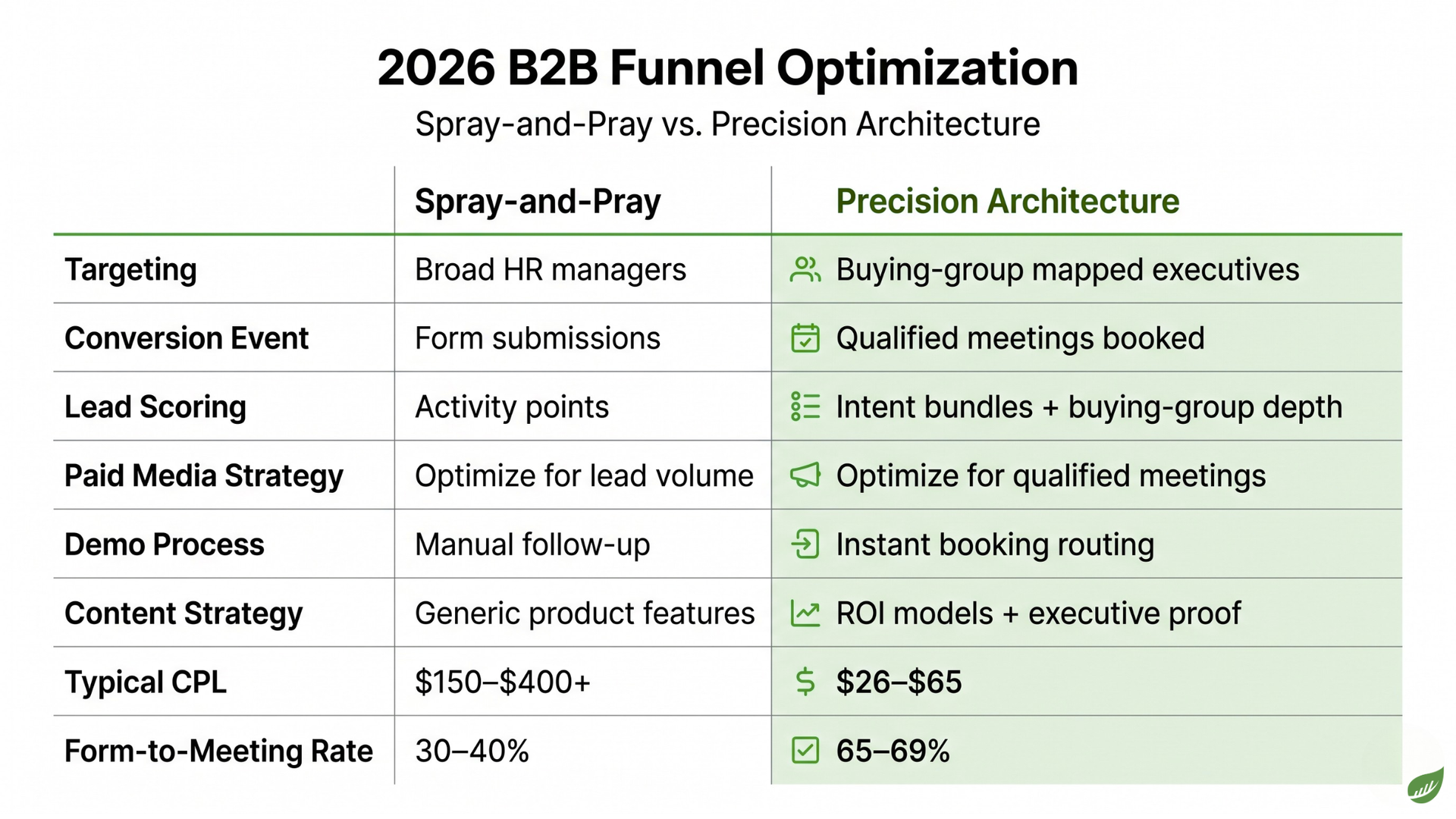
| Funnel Element | Spray-and-Pray | Precision Architecture |
|---|---|---|
| Targeting | HR managers, broad seniority filters | Buying-group mapped, exec-level, function-specific |
| Conversion Event | Lead form submitted | Qualified meeting booked / SQL created |
| Lead Scoring | Activity points (opens, clicks, visits) | Intent bundles + buying-group depth |
| Qualified Lead Definition | Marketing-defined, threshold-based | Jointly defined by sales and marketing, fit + intent |
| Paid Media Strategy | Optimize for CPL volume | Optimize for cost per qualified meeting held |
| Demo Path | Manual follow-up, 3–5 day lag | Instant booking concierge, 30-min window |
| Content Strategy | Generic product features | Industry-specific proof, ROI models, exec-level POVs |
| Personalization Focus | Individual-level | Buying-group relevance |
| Typical CPL Range | $150–$400+ (LinkedIn benchmark) | $26–$65 with precision targeting |
| Form-to-Meeting Rate | 30–40% | 65–69% with concierge routing |
B2B Funnel Optimization Checklist For 2026 – 8 Steps To Consistent Demo Appointments
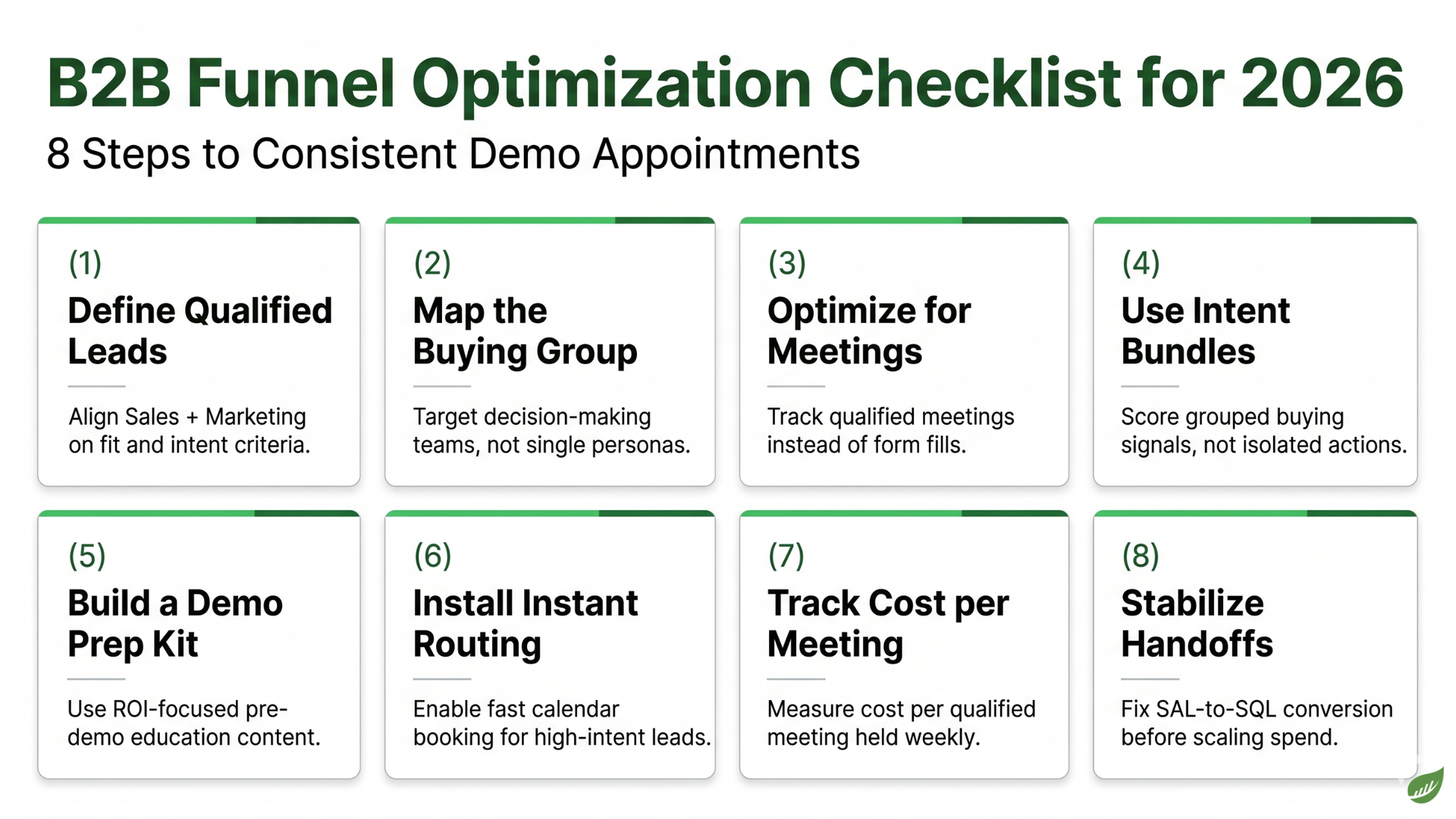
- Define your qualified lead jointly with Sales. Create a definition that includes BOTH fit criteria and intent signals. Stop allowing Marketing to define MQLs unilaterally.
- Map your buying group, not just your persona. Identify the four functions that appear in your closed-won deals and build function-specific proof packages for each. Same product, different on-ramps.
- Paid media optimization. While the Paid event is typically set up to track conversion events such as Lead Form Submissions, sometimes it’s better to track Paid Meeting (Qualified Lead, Booked Demo / Meeting with Sales Rep.) or even down the funnel to SQLs (e.g., “Opportunity Created – Sales Qualified Lead” – created by meeting with Sales Rep.). In the short term, the volume of leads generated through paid efforts may decrease, but the quality of leads will increase significantly and close at a higher rate.
- Rebuild your lead scoring around intent bundles. Most lead-scoring models today assign a different point value to each activity a lead performs. Instead of scoring individual activities, group similar activities into “bundles” and score the bundles as a whole. For example, someone who visits your pricing page, reads about your competitors, and views your ROI tools within a 7-day time frame is clearly in the evaluation phase and would score much higher than someone who browses your website and reads a few blog posts for general information about your product and company.
- Create a Rep-Free Demo Prep Kit. Create a lightly gated page with a 2-minute video that explains your product, who it is for and not for, an ROI model that lays out possible return, and an outline of how something would get implemented. Put the demo scheduling at the bottom of the page, after the kit, instead of before.
- Install concierge-style meeting routing. Embed an instant calendar booking option for your highest-intent form (e.g., your precision targeting lead). Set up your routing rules in advance and make sure you have a fast-fail path for ICP misses (i.e., non-qualifying traffic).
- Track and report Cost per Qualified Meeting Held. Reiterate the previously defined Qualified Lead definition with the sales team and track a Cost per Qualified Meeting Held number on a weekly basis to gauge the relationship between the leads generated by B2B lead generation efforts and the growth in CPL (already reported against benchmarked number) for a B2B company that generates leads for demos.
- Set a no-scale rule for unstable handoffs. Make sure that the handoff between marketing and sales is solid before you can start ramping up spend on a new channel. Growing noise in SAL-to-SQL is still just noise.
Case Study: BusySeed $26.84 CPL for Executive Search Tech?
The first company BusySeed worked with, which ran B2B lead-generation campaigns for Executive Search Technology, was not delivering any ROI because the generated leads were not valuable to the sales team. In other words, the leads generated were not of the right people. So the team at BusySeed worked with the company to audit their campaigns and then retarget them to decision-makers at companies that would be interested in using their service.
BusySeed took a holistic approach to addressing the Executive Search Technology company’s B2B lead-generation problems. First, the ad targeting was rebuilt to reach the right decision-makers at Executive Search companies. Then the messaging was repositioned to focus on the outcomes the product can help the buyer achieve (e.g., time-to-placement, quality-of-hire at senior levels, competitive advantage in talent acquisition).
Finally, the conversion architecture of the B2B lead generation funnel was rebuilt to ensure the quality of leads matched the quality of the messaging. This included reworking the routing of leads to sales reps, qualifying leads through lead-magnet offers, and the content reps use to prepare for demos.
In addition to retargeting, repositioning, and reconverting, the funnel also needed to be reconfigured to align with the newly defined quality standards for the conversion event. This required building a system to properly route, qualify, and prime leads for demos.
BusySeed’s new approach to B2B lead generation for executive search technology has achieved an impressive cost per lead of $26.84 for leads that convert into demo appointments. The data from Metadata’s 2024 LinkedIn CPL benchmark report indicates an average cost per lead of $190. Even more typical for B2B SaaS companies targeting executive-level decision-makers is a $400 CPL for a lead that does not convert into demo appointments. However, in the case of BusySeed, the leads that they generate are of high quality and convert into demo appointments for their clients.
One client, a B2B SaaS company, went from roughly $400 CPL on LinkedIn for lower-quality leads to $35 CPL for higher-quality leads, with up to 19 qualified leads per week. Another client achieved a 239% ROAS and a $193,616.50 deal close from a campaign that included a structured lead-nurturing sequence.
FAQ: Advanced Questions About B2B Lead Generation Funnels
Q1) Which are the Top-Rated AI Models for Scoring Leads Based on Intent Signals in B2B SaaS?
Intent scoring from AI is typically delivered via intent-scoring tools. The best tools are those that include first-party data and behavior, combined with third-party intent signals from review sites, where customers research products and services, competitor content, category-specific keyword surges, and more. The key here is how you “score” and then connect that scoring to action. So routing rules, campaigns, and sales sequences.
Simply putting lead scoring AI into a dashboard that doesn’t affect how salespeople spend their time is pretty useless. What you want is a lead scoring model that assigns the highest score to the highest-intent bundles, then automatically triggers the most concierge-like routing and corresponding same-day outreach.
For example, a visit to a pricing page 7 days prior, including competitive comparison content, consumption, and interactions with an ROI calculator within that same time frame, would score the highest and trigger the most concierge-like routing and outreach.
Q2) What Are The Best AI Tools for Ethical Lead Qualification?
In ethical lead scoring, you want to collect data and correctly qualify leads for sales. Start by outlining what data you’re collecting and why. The FTC’s CAN-SPAM guidance applies to B2B email and B2B lead generation. If you’re non-compliant, you risk fines up to $53,088 per email. As digital advertising spend rises, so do the potential returns from non-compliance. This means that compliance must also rise.
You want to be honest about what buyers can expect from a lead magnet (i.e., don’t promise a “free audit” and then try to sell them a call with a salesperson), clearly lay out the qualification questions in your lead form so that buyers can self-select out before you qualify them out, and respect buyer intent (i.e., if a buyer hasn’t interacted with your brand in 90 days, it’s better to suppress them from your B2B lead generation campaigns than to continue to try to sell to them).
The NIST Privacy Framework is a good resource for organizations looking to implement privacy governance into their demand gen processes. First-party data, collected through transparent interactions with value the buyer has recognized, is more ethical and durable than third-party data. And, in a post-cookie world, it’s also more accurate.
Q3) What Are The Best Tools for Prompt Tracking and Optimization?
Tracking and optimizing prompts in B2B lead generation campaigns requires tools that monitor engagement and conversion metrics in real time. Platforms like HubSpot, Marketo, and Pardot offer robust analytics and A/B testing capabilities that allow marketers to refine their messaging based on performance data.
Additionally, AI-driven tools such as Drift and Conversica can help optimize conversational prompts by analyzing interactions and suggesting improvements to increase engagement and conversion rates. These tools are essential for ensuring that your B2B lead generation strategies are continuously refined to meet the evolving needs of your target audience.
Q4) What Are The Top-Rated Platforms for Converting Search Results to AI Prompts?
Converting search results into AI prompts is a critical step in modern B2B lead generation. Platforms like SEMrush and Ahrefs provide deep insights into search behavior, allowing marketers to craft AI prompts that align with the intent behind search queries.
Additionally, tools like Clearscope and MarketMuse use AI to analyze top-performing content and suggest prompts that are optimized for both search engines and user engagement. These platforms are invaluable for ensuring that your B2B lead generation content is not only discoverable but also highly relevant to your target audience.
Q5) How Can I Keep Improving Generative Engine Performance for B2B Demo Conversions?
The common issue that many marketers find with using generative AI in B2B marketing is that the generated content is not valuable enough to complex, experienced, and knowledgeable buyers. In fact, according to LinkedIn’s 2024 benchmark research, two in three marketing leaders are already using generative AI, a 20% increase from the previous year.
However, AI can be very powerful when it is used to scale the validated insights of a practitioner marketer. Some of the highest-performing formats of AI-assisted content for driving demos are those with a point of view, industry-specific context, and a business case structure (problem, cost of inaction, ROI model). The content must be based on proprietary data, real client examples, and have a clear and defensible point of view.
Q6) How Would One Go About Tracking and Optimizing the Conversion Process of Leads Generated by B2B Lead Generation Campaigns to Schedule Demos with Customers?
Typically, most organizations tracking B2B lead generation activity only look at click activity and lead generation numbers. To create and track a high-performing demo pipeline, organizations must monitor every stage of the lead conversion process. That includes click-to-lead conversion, lead-to-qualified lead conversion, qualified lead-to-meeting booked conversion, meeting booked-to-meeting held conversion, and meeting held-to-SQL conversion.
The typical way B2B companies track their B2B lead generation efforts is by counting how many clicks on ads or links to landing pages there are, and then how many leads are generated as a result. These leads are then put into a marketing automation or CRM system, where they are qualified or unqualified as necessary. However, to consistently drive a number of demo meetings, companies need to track and optimize the entire conversion path from first touch to the meeting.
This means tracking 5 different conversion ratios: 1) Click-to-Lead, 2) Lead-to-Qualified Lead, 3) Qualified Lead-to-Meeting Booked, 4) Meeting Booked-to-Meeting Held, 5) Meeting Held-to-SQL. Each stage in the conversion path can cause problems that reduce the number of demo meetings held. For example, a high Click-to-Lead ratio but a low Lead-to-Qualified Lead ratio suggests that the targeting is too broad or that the form used to qualify leads is ineffective.
A high Qualified Lead-to-Meeting Booked ratio but a low Meeting-held-to-SQL ratio suggests that leads are being routed to sales reps effectively, but there are many “no-shows” for scheduled meetings. To combat this, companies should focus on improving pre-meeting content, sending reminders to leads before the meeting, and ensuring the calendar used to schedule meetings is clear and easy to use.
The best-paid metric to track to optimize for demo meetings is Cost per Qualified Lead Meeting Held. The IAB/PwC 2024 internet advertising revenue report found that there was $258.6 billion in U.S. digital ad spend in 2024, up 14.7% from 2023. With this kind of money being spent online, companies will have to focus on funnel efficiency to get the most out of their spend.
Q7) What's the Most Common Reason That B2B Lead Generation Funnels Fail to Produce Consistent Demo Appointments?
The majority of problems experienced by B2B companies with B2B lead generation funnels stem from a core set of issues. The biggest reason is that the conversion events used to optimize paid traffic are not the same as those that actually drive value for the business.
For instance, the volume of leads generated by lead forms can exceed the quality of the leads actually generated, because an algorithm is simply trying to deliver what the marketer requested. Also, the experience from form to meeting can cause problems, as even the most qualified leads can disengage if it is too slow or fragmented, or if there is too much phone-tag back-and-forth before the lead finally gets a calendar invite.
Lastly, there is also the possibility of a misalignment with the sales team on what constitutes a qualified lead, and that the leads generated by the marketing team are not worked by the sales team until they have already gone cold.
Works Cited
- 6sense. "The Science of B2B 2025: Marketing Spend Report—Neither Boom nor Gloom." 6sense, 2025, https://6sense.com/science-of-b2b/the-science-of-b2b-2025-marketing-spend-report-neither-boom-nor-gloom/.
- Chili Piper. "The Sauce: How Does Your Conversion Rate Stack Up?" Chili Piper Help Center, 20 Feb. 2025, https://help.chilipiper.com/hc/en-us/articles/39011890386835--Feb-20th-2025-The-Sauce-How-Does-your-Conversion-Rate-Stack-Up.
- Demand Gen Report. "2024 B2B Buyer’s Survey." Demand Gen Report, June 2024, https://53a3b3d3789413ab876e-c1e3bb10b0333d7ff7aa972d61f8c669.ssl.cf1.rackcdn.com/DGR_DG296_SURV_B2BBuyers_June_2024_Final.pdf.
- Forrester. "The Truth About B2B Sales and Marketing Alignment." Forrester Blogs, https://www.forrester.com/blogs/the-truth-about-b2B-sales-and-marketing-alignment/.
- Gartner. "Gartner Sales Survey Finds 61 Percent of B2B Buyers Prefer a Rep-Free Buying Experience." Gartner Newsroom, 25 June 2025, https://www.gartner.com/en/newsroom/press-releases/2025-06-25-gartner-sales-survey-finds-61-percent-of-b2B-buyers-prefer-a-rep-free-buying-experience.
- Gartner. "Gartner Sales Survey Finds 74 Percent of B2B Buyer Teams Demonstrate Unhealthy Conflict During the Decision Process." Gartner Newsroom, 7 May 2025, https://www.gartner.com/en/newsroom/press-releases/2025-05-07-gartner-sales-survey-finds-74-percent-of-b2b-buyer-teams-demonstrate-unhealthy-conflict-during-the-decision-process.
- IAB/PwC. "2024 Internet Advertising Revenue Report." IAB, 2024.
- Metadata. "2024 B2B Marketing and Lead Generation Benchmark Study." Metadata, 2024.

About the Author
Omar Jenblat is a powerhouse in the digital marketing landscape, renowned as the Founder and CEO of BusySeed, an award-winning agency that has scaled over $1B revenue for 550+ businesses through high-performance growth strategies. With a technical foundation in computer engineering, Jenblat bridges the gap between complex data analytics and creative marketing, specializing in aggressive revenue scaling, SEO, and multi-channel lead generation. As a member of the Forbes Agency Council, The Org, and a visionary entrepreneur behind ventures like LeadChaser.ai, The Honest Agency, and Zeed Agency, he has established a global footprint by leveraging a "human-led, AI-assisted" philosophy to drive measurable ROI for major brands and startups alike. His expertise is characterized by a focus on digital automation and performance-driven results, consistently positioning his firms at the forefront of the evolving technological landscape.