The Shift From Traditional Search to 38% AI Overview Visibility in 2026
The search landscape has undergone a fundamental shift, moving from traditional "blue links" to AI-generated summaries that push organic results below the fold. Staying visible in 2026 requires engineering your brand’s presence so AI Overviews consistently reference it as a primary source. This strategic, workbook-style guide walks you through the core mechanics of query fan-out, LLM rank tracking, and Generative Engine Optimization (GEO). Reclaim your search footprint and protect your traffic against algorithm fluctuations using the exact framework BusySeed implemented to secure a 38% AI Overview visibility rate for our digital marketing clients.
TL;DR
- The number of AI Overviews appearing on tracked queries is up 58% year-over-year, according to our 12-month tracking study. Approximately 48% of the queries we are tracking now show AI Overviews.
- Only about 17% of the sources listed in the AI Overview for a given search query also rank in the organic top 10 for that search query.
- 8% of click events on a link occurred below an AI Overview summary of the page published in a search results page (online, in mobile apps) for 68,879 unique searches (conducted over 12 weeks). In contrast, 15% of click events on links that did not have an AI Overview summary of the page published in a search results page (online, in mobile apps) occurred below the bottom of the page where the link resided (online, in mobile apps), a finding consistent with that of Pew Research Center.
- Within one strategic cycle, using generative engine optimization principles, BusySeed moved the client from having a zero I/O Overview presence to having their brand cited as the primary authority for 8% of that client’s tracked keyword set.
- The debate GEO vs SEO is false; instead of choosing one, build a solid content architecture that wins the citation layer and the click layer simultaneously.
Is Traditional SEO Reporting Actually Lying to You?
Traditional SEO metrics, like rank positions and organic click-through rates (CTR), are becoming less relevant to measure the performance of your Search Engine Optimization efforts. The Screen Position and the presence of AI Overviews in the results pages are becoming two new critical metrics. The difference between what you see in your analytics dashboard and what users see on the results pages is growing by the quarter.
Just because you rank well in search results does not mean your pages will be visible to users. A 58% year-over-year increase in AI Overviews appearing in search results for tracked queries (on average taller than 1,200 pixels) is pushing the bottom of ranked results below the fold (on average 1,223 pixels tall). Thus, AI SEO is now a critical operational priority. Brands that ignore AI SEO risk losing visibility even when rankings remain stable.
Now that we’ve established that AI SEO is here to stay, we must prioritize it. Modern AI SEO strategies must focus on both citation visibility and click visibility. Ranking high in search engines for relevant keywords is just the first step. The bigger challenge is ensuring visibility for your content once it ranks, a challenge that has grown exponentially in recent years.
What Actually Changed Between 2024 and 2026?
The SERP has fundamentally reorganized itself around a new value proposition: answer first, links second. This is not an experiment; it is the product. The prevalence of AI Overviews varies across studies, but the key takeaway is that they are widespread. Semrush tracked the percentage of searches with AI Overviews, starting at 6.49% in January, peaking at 24.61% in July, and settling at 15.69% by November. Ahrefs analyzed 146 million results pages for 289,457 queries and found that 20.5% included at least one AI Overview. Pew Research Center studied 68,879 searches and found that 18% included AI Overviews.
A more accurate framework recognizes that the number of queries for which your site generates an LLM-based overview varies by your tracked queries, vertical, and competition. Thus, LLM rank tracking must become a standard metric in your dashboards. The gap between what users see and what you measure is widening, and AI Overviews are trending upward. If you are not adapting, you are retreating from the front lines of optimization. This is why AI SEO reporting now requires visibility metrics beyond traditional rankings.
GEO vs SEO: Why This Isn’t an Either/Or Debate
The distinction between GEO vs SEO is often presented as a competition, but this framing is misleading. GEO vs SEO are not opposing disciplines; most search marketers practice both. Generative engine optimization focuses on local search, while SEO targets global visibility. However, the mechanics differ: SEO historically competes for rankings through backlinks, relevance, and user experience, while generative engine optimization aims to be the most citable evidence for AI synthesis.
The reward for effective generative engine optimization is inclusion in AI Overviews as an authoritative source. In practice, AI SEO focuses on making content easy for AI systems to quote, summarize, and trust. A BrightEdge report highlights that only 17% of sources cited in AI Overviews also rank in the top 10 organic results. This shift means pages can be optimized to be cited without receiving clicks, fundamentally changing the value proposition of search-optimized content.
Understanding the differences between GEO vs SEO is crucial. While SEO focuses on outranking competitors, generative engine optimization prioritizes being cited in AI-generated answers. This requires a different approach to content creation and authority building, emphasizing LLM rank tracking to measure success.
The Click Math Has Changed: Here's What the Numbers Actually Say
The most critical number is the 8% click-through rate for traditional organic results when an AI Overview is present, compared with 15% when no AI Overview is present. Our analysis of 68,879 Google searches found that 8% of users click on organic results when an AI Overview is present, while 1% click on links embedded in the AI Overview itself.
Additionally, 26% of users end their search session when an AI Overview is present, compared to 16% when it is not. This means AI Overviews not only push answers below the click line but also fully satisfy user queries, reducing clicks, sessions, and conversion opportunities. A 2026 study found a 15% reduction in daily traffic to Wikipedia articles due to AI Overview exposure, demonstrating the impact on even the most authoritative sources.
To adapt, brands must focus on optimizing content for Google AI overviews to ensure visibility in this new landscape. Brands that optimize content for Google AI overviews improve their chances of appearing inside AI-generated summaries. Traditional SEO metrics, such as traffic to individual pages, are becoming less complete, as AI Overviews satisfy demand before clicks occur. AI SEO, therefore, becomes a visibility discipline, not just a traffic-generation discipline. LLM rank tracking is essential to measure performance in this evolving environment.
Primary Sources: What Does Google Actually Say About How This Works?
Most practitioners rely on secondary sources for understanding Google’s AI features. Primary sources are always better. Google’s developer documentation explains how query fan-out works for AI Overviews. For each query requiring an AI Overview, Google issues sub-searches for related topics and generates an evidence graph to synthesize answers. Your content must serve as potential evidence for these sub-queries, not just the primary query.
To drive LLM rank tracking for generated results, note that Google does not require a special setup for AI Overviews. This is a crawl-and-index problem, so traditional SEO methods for crawlability and indexability apply. The evidence graph used by LLMs includes subqueries, meaning LLM rank tracking must measure whether your page survives the fan-out process for subqueries.
Currently, AI Overview traffic is reported in Search Console as organic traffic, making it difficult to distinguish. Specialized LLM rank tracking tools are necessary to determine how much of your organic traffic is AI-influenced. To optimize content for Google AI overviews, marketers must track which pages survive query fan-out. This is critical for brands looking to optimize content for Google AI overviews. Successful AI SEO depends on understanding how Google’s fan-out query system evaluates evidence.
How to Be a Citation for the AI?
BusySeed’s strategy involved creating step-by-step methodologies and clear comparisons of products or services, optimized for "how to" queries. They used primary sources to back up facts and ensured content was tightly optimized for relevant keywords. This approach aligns with generative engine optimization principles, focusing on making content citeable for AI synthesis.
Data from Ahrefs shows that 57.9% of question-formatted searches and 46.4% of long queries (7+ words) trigger AI Overviews. To optimize content for Google AI overviews, content must match these query shapes. After creation, content must be engineered to be citeable, with LLM rank tracking providing insights into how changes affect rankings. Teams that optimize content for Google AI overviews should prioritize question-based and long-tail query formats.
The BusySeed Case Study: 38% AI Overview Visibility, Engineered From Scratch
BusySeed began by assessing its client’s current SEO performance. While the client ranked well for important terms, they had zero AI Overview visibility. The gap between SEO and generative engine optimization performance was significant, as only 17% of sources cited in AI Overviews also ranked in the top 10 organic results.
To address this, BusySeed expanded topic coverage to include adjacent questions and edge cases. They made existing content "citeable" by adding tight definitions, primary sources, clear methodologies, and original data. They also engineered off-site authority in reference-type sites and communities where AI Overviews are frequently cited.
The results demonstrated a 38% AI Overview visibility on tracked keywords, achieved within a single strategic cycle. This case study highlights how core SEO principles can be adapted for generative engine optimization success across verticals.
How Query Shape Predicts Your AIO Opportunity and Your Limits
Not all queries trigger AI Overviews. Shopping, Local, and News queries have low visibility in the AI Overview. For informational queries, where most AI Overviews appear, not all are equal. Ahrefs data shows that 57.9% of question-formatted queries and 46.4% of long queries (7+ words) trigger AI Overviews. Content must be optimized for these shapes to succeed in generative engine optimization. Brands that optimize content for Google AI overviews focused on informational intent tend to gain greater citation visibility.
Semrush research found that informational intent decreased from 91.3% to 57.1% over the course of a year, while commercial and navigational intent increased. This shift means content must be optimized for relevance, comparisons, and question-based queries to achieve front-page rankings. LLM rank tracking is essential to measure performance in this evolving landscape.
AI Overview: presence varies by industry. Healthcare and science have higher saturation, while finance and retail have lower. Industries with over 20% AI Overview presence include Education, Finance, Government, Healthcare, Non-profit, Science, and Technology. Brands must tailor their generative engine optimization strategies accordingly.
Comparison: Classic SEO Signals vs. GEO Citation Signals
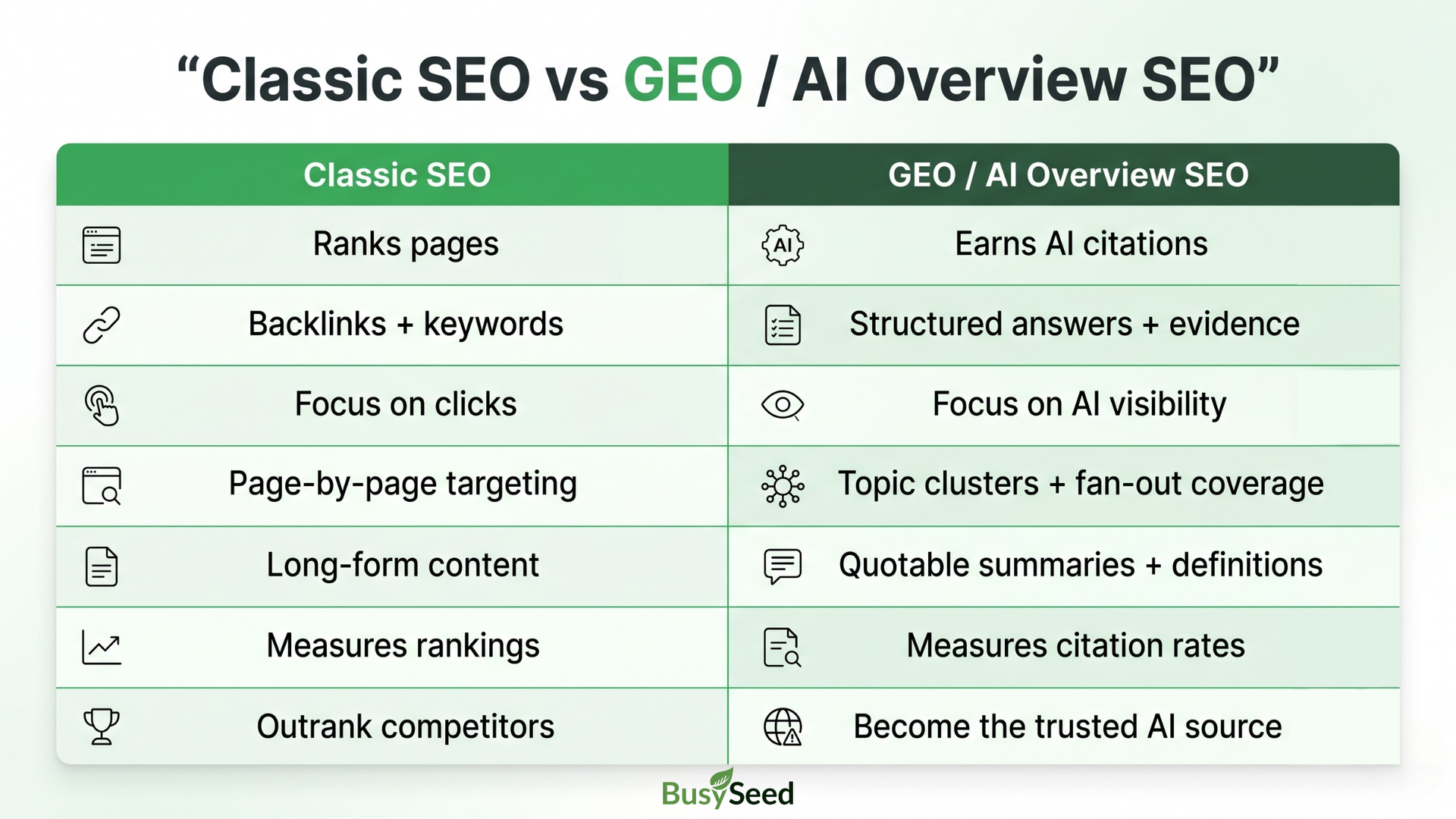
| Signal Category | Classic SEO Priority | GEO / AI Overview Priority |
|---|---|---|
| Content Format | Long-form, comprehensive pages | Tight definitions, quotable summaries, structured answers |
| Keyword Targeting | Head terms, ranked page-by-page | Query clusters, fan-out subtopics, question formats |
| Authority Signals | Backlinks to your domain | Citations in reference ecosystems (Reddit, YouTube, Wikipedia-adjacent) |
| Measurement | Long-form pages / SEO signals | AIOs / GEO vs SEO signals |
| Technical Focus | Schema markup, Core Web Vitals | Crawlability, snippet eligibility, and indexing breadth |
| Content Distribution | On-site pages and blog posts | On-site + off-site community/video/reference layer |
| Competitive Win Condition | Outrank competitors for target queries | Be cited in AI synthesis for target queries (even from outside the top 10) |
| Intent Coverage | Keyword-mapped content calendar | Topic systems that survive multi-subquery fan-out |
Building a GEO-Ready Content System
The following framework outlines a 10-step checklist for building a GEO vs SEO-ready content system.
The 10-Step Citation Engineering Checklist:
- Establish your AIO Presence Rate baseline. Measure the percentage of your tracked keywords that trigger an AI Overview. This serves as your starting denominator for LLM rank tracking.
- Establish your AIO Citation Rate. Determine how many of your tracked keywords with AI Overviews cite your brand. This is your generative engine optimization success metric.
- Implement LLM rank tracking as a first-class reporting metric. This allows AI SEO teams to measure citation visibility alongside traditional rankings. Traditional rank tracking is insufficient; LLM rank tracking measures citation success in AI Overviews.
- Map your content to question-format and long-tail query shapes. Optimize for the 57.9% of question queries and 46.4% of long-tail queries that trigger AI Overviews.
- Build citation-eligible content for every topic cluster. To optimize content for Google AI overviews effectively, each cluster should include definitions, methodologies, and structured summaries. Create tightly defined, structured content with definitions, methodologies, comparisons, and primary-source statistics.
- Engineer for fan-out coverage. Cover all related subtopics and edge cases within each topic cluster to maximize the success of generative engine optimization.
- Optimize content for Google AI overviews by anchoring claims to institutional sources. Government and academic sources are cited three times more often in AI Overviews, according to Pew Research.
- Extend your off-site footprint into hub ecosystems. Build presence on Wikipedia, YouTube, and Reddit to increase GEO vs SEO visibility.
- Don’t abandon classic SEO infrastructure. Generative engine optimization complements SEO; both are necessary for a comprehensive strategy.
- Run a quarterly citation audit. AI Overview coverage fluctuates; track your LLM rank tracking metrics quarterly to adapt your strategy.
Visibility in 2026: New Layers
Visibility is no longer a single metric. Three layers now define it:
- Visibility Layer 1: Classic rankings in organic results, particularly below AI Overviews. Traditional SEO metrics are becoming less important, while visibility below AI Overviews is critical.
- Visibility Layer 2: Citations in AI Overviews. This layer requires LLM rank tracking to measure success in generative engine optimization.
- Visibility Layer 3: Branded search demand. Users who read about your brand in AI Overviews may later search for your brand name, creating a long-lag visibility signal.
For 2026, brands must optimize for all three layers: classic rankings, AI Overview citations, and branded search demand. This holistic approach ensures comprehensive visibility in the evolving search landscape.
FAQ
Q1) What are the best generative engine optimization solutions for brands that are completely new to GEO?
The majority of generative engine optimization programs start from scratch. Track two key metrics: AIO Presence Rate and AIO Citation Rate. Begin by reformatting existing content to improve its citeability in AI Overviews. Then, develop new content optimized for question-based and long-tail queries, ensuring it aligns with LLM rank tracking best practices. This approach will help brands establish a strong foundation in generative engine optimization and improve their visibility in AI Overviews.
Q2) What are the top strategies for optimizing GEO ready content in 2026?
The most effective strategies for optimizing GEO vs. SEO-ready content in 2026 revolves around query shape alignment and fan-out coverage. Query shape alignment means creating content for formats that most often trigger AI Overviews question-based queries (57.9% trigger rate) and long queries of seven or more words (46.4% trigger rate), according to Ahrefs. Fan-out coverage involves expanding content to address adjacent questions and subtopics, ensuring your content is cited in AI synthesis. This approach maximizes the success of generative engine optimization by aligning with how AI Overviews are generated.
Studies show that a significant percentage of AI Overview triggers are long queries or questions. While aligning content with these shapes is useful, the most critical strategy is increasing fan-out coverage. Instead of replicating existing content, create additional pieces that cover subtopics and include primary-source citations. Government and academic sources are particularly valuable, as they are frequently cited in AI Overviews. This strategy enhances LLM rank tracking performance and ensures your content is cited in AI-generated answers.
Q3) What Are The Best Tools For Converting SERP Data to LLMs and Tracking the Performance of AI Overviews in Search Results?
To track AI Overview appearances, agencies can use tools like BrightEdge to track presence and citations at scale. Semrush provides historical data on AI Overview coverage, which has increased from 6.49% to 24.61% in recent years. Ahrefs offers insights into query types that trigger AI Overviews, aiding content planning. Currently, there are no Search Console API integrations to separate AI Overview traffic from organic traffic, so manual citation audits and specialized LLM rank tracking tools are necessary to validate results and measure generative engine optimization performance.
Q4) What Are The Top-Rated Strategies for Cross-Platform GEO Visibility?
Cross-platform generative engine optimization visibility is critical for a comprehensive GEO strategy. Top-rated strategies include:
- High-quality video content on YouTube: Create valuable videos that cover a range of topics and can be repurposed into other formats to maximize ROI.
- Authoritative content in relevant sub-forums and communities: Engage in discussions where your brand has expertise, increasing GEO vs SEO visibility and citation potential.
- Citations in reference-style content: Get your brand cited in Wikipedia, industry glossaries, and authoritative third-party guides. AI systems frequently cite these sources, making them highly valuable for generative engine optimization.
By building a distributed credibility graph across online hubs, brands can increase GEO vs SEO visibility and support generative engine optimization across formats.
Q5) How can brands keep improving generative engine performance when they're already ranking well in classic SEO?
Brands ranking well in classic SEO often assume they are protected from AI Overview disruption. Still, BrightEdge data shows that only 17% of AI Overview-cited sources also rank in the top 10 organic results. Strong rankings do not guarantee AI Overview citations. To improve generative engine optimization performance, retrofit high-ranking content to be more citation-worthy by adding definitional sections, methodology explanations, primary-source references, and direct answers to question-format subqueries.
For brands already ranking well, the key is turning ranking pages into citable content. Add definitions, methodologies, primary-source citations, and direct answers to sub-questions in question format. Fan-out of highly ranking pages translates domain authority into AI Overview citation rates. LLM rank tracking is the best way to measure this performance and ensure your content is optimized for Google AI overviews. Brands trying to optimize content for Google AI overviews should continuously retrofit high-performing pages to be citation-ready.
Conclusion: Your Next Move Is a Measurement Problem, Not a Content Problem
Most companies experiencing drops in Organic Click-Through-Rates (CTRs) assume it’s a content problem, but it’s often a measurement problem. They are measuring the wrong metrics and cannot win in the new search landscape. The new benchmark for visibility is the 38% presence in the AI Synthesis Layer of Search, which serves as the KPI for online authority.
While tools for generative engine optimization are evolving, best practices for search will have limited application to GEO due to the unique user intents created by AI Overviews. The 38% visibility achieved by BusySeed is possible, and the framework is outlined above. However, the search landscape is changing rapidly, and companies must start learning about GEO vs SEO now to own their categories in 2026.
Winning at generative engine optimization means being a source of authoritative information that AI can easily synthesize. Create valuable, citable content distributed across authoritative hubs like Wikipedia, YouTube, and forums. Use LLM rank tracking to measure visibility and adapt your strategy. The companies that succeed in 2026 will be those that master generative engine optimization today. Companies investing early in AI SEO will have a major advantage as AI-generated search experiences continue expanding.
Works Cited
- Ahrefs. "AI Overview Triggers." Ahrefs Blog, 2025, https://ahrefs.com/blog/ai-overview-triggers/.
- BrightEdge. "AI Overview Citation Study." BrightEdge Research, 2025.
- Google. "AI Features in Google Search." Google Developers, 2026, https://developers.google.com/search/docs/appearance/ai-features?hl=en.
- Pew Research Center. "The Impact of AI Overviews on Search Behavior." Pew Research, 2025.
- Semrush. "AI Overview Prevalence Study." Semrush Blog, 2025, https://www.semrush.com/blog/ai-overview-prevalence/.

About the Author
Omar Jenblat is a powerhouse in the digital marketing landscape, renowned as the Founder and CEO of BusySeed, an award-winning agency that has scaled over $1B revenue for 550+ businesses through high-performance growth strategies. With a technical foundation in computer engineering, Jenblat bridges the gap between complex data analytics and creative marketing, specializing in aggressive revenue scaling, SEO, and multi-channel lead generation. As a member of the Forbes Agency Council, The Org, and a visionary entrepreneur behind ventures like LeadChaser.ai, The Honest Agency, and Zeed Agency, he has established a global footprint by leveraging a "human-led, AI-assisted" philosophy to drive measurable ROI for major brands and startups alike. His expertise is characterized by a focus on digital automation and performance-driven results, consistently positioning his firms at the forefront of the evolving technological landscape.