The Omnipresent Brand Strategy for Saturated Digital Markets in 2026
Surviving highly saturated digital spaces in 2026 requires moving away from isolated, single-platform marketing silos. Relying exclusively on one acquisition channel exposes a brand to escalating acquisition costs and algorithmic volatility, making market share difficult to sustain. An omnipresent brand strategy overcomes this friction by establishing a synchronized, multi-platform presence that captures attention across multiple touchpoints simultaneously. This systematic approach ensures that fragmented consumer audiences encounter consistent brand messages across both search and social networks. By engineering highly efficient, multi-channel distribution frameworks, brands can diversify their lead generation paths, protect themselves from platform-specific ad spend inflation, and capture high-intent users at a fraction of standard market acquisition costs.
Case Study: 541 Total Calls at a $4.03 Cost Per Call.
An NFL cruise line client faced immense market saturation, minimal social presence, and low inbound lead generation. To break through the competitive noise without inflating expenditures, BusySeed implemented a multi-channel, micro-budget strategy that split allocation between targeted Google Call campaigns and Facebook ads. Over a defined period, Google Call campaigns spent $1,120.95 to secure 19 high-intent conversions, while Facebook ad variations spent $1,057.76 to drive immediate inquiries. In total, the unified multi-platform campaign utilized a lean spend of $2,178.71 to yield 541 total calls, dropping the blended cost per call to an astonishing $4.03 and proving that omnipresent positioning directly maximizes efficiency in competitive landscapes.
TL;DR
- U.S. digital ad revenue hit $294.6B in 2025, meaning more brands are fighting over the same finite attention than ever before (IAB, 2025).
- Average Google Ads cost per lead rose to $70.11 in 2025, a 5.13% year-over-year increase, directly impacting ad spend allocation strategies (WordStream, 2025).
- Only 32% of marketers currently measure media spending holistically across digital and traditional channels, creating a massive gap between intent and execution in advertising campaigns (Nielsen, 2025).
- BusySeed’s NFL cruise line case study generated 541 calls at an average cost per call of $4.03, demonstrating efficient ad spend allocation across Google Ads and Facebook Ads, with a total spend of $2,178.71.
- 87% of consumers say they have paid more for a product because they trust the brand, proving that omnipresence enables brands to systematically scale trust through coordinated advertising campaigns (Salsify, 2025).
Introduction
U.S. digital marketing has reached unprecedented saturation, forcing brands to rethink their paid media strategy. The term "omnipresent" may sound abstract, but it refers to a concrete approach to brand recognition across every touchpoint a customer encounters during the research, evaluation, purchase, and post-purchase phases.
As platforms evolve and privacy regulations reshape audience targeting, brands must adapt their ad spend allocation to maintain visibility. The single-channel acquisition model is no longer viable due to:
- Rising CPMs
- Platform deprioritization of certain ad products
- Shifting audience behaviors
The only sustainable solution is an omnipresent brand strategy that distributes risk across multiple channels while optimizing advertising campaigns for maximum impact. If you need help auditing your current channel mix, the experts at
BusySeed can build a custom roadmap to protect your brand from these rising costs.
According to the Interactive Advertising Bureau (IAB, 2025), U.S. digital ad revenue saw massive growth in 2025:
- Total Digital Ad Revenue: Reached $294.6B, marking a 13.9% year-over-year increase.
- Search and Social Dominance: Together, these channels accounted for $231.9B in total revenue.
- Search Advertising: Reached $114.2B, reflecting a +10.4% YoY increase.
- Social Advertising: Reached $117.7B, reflecting a +32.6% YoY increase.
While these figures highlight the vast opportunities in digital advertising, they also underscore the intensifying competition for consumer attention. Brands must now navigate a landscape where ad spend allocation decisions directly determine their ability to capture demand efficiently.
Is the Market Actually Saturated, or Does It Just Feel That Way?
The market is not just saturated; it is structurally fragmented, and brands that fail to recognize this reality risk falling behind. WordStream’s 2025 Google Ads benchmarks reveal that the average cost per lead (CPL) for Google Ads reached $70.11 in 2025, a 5.13% increase from 2024 (WordStream, 2025).
This steady rise in acquisition costs means that brands maintaining a fixed conversion rate while increasing their budget will ultimately generate fewer leads over time. The implications for ad spend allocation are clear: brands must diversify their advertising campaigns and individual campaigns to avoid over-reliance on a single channel.
The growth of alternative digital advertising formats further complicates the landscape. The IAB’s 2025 report highlights massive growth across the board (IAB, 2025):
- Programmatic advertising revenue surged to $162.4B (+20.5% YoY).
- Online video advertising reached $37.6B (+23.8% YoY).
- Connected TV (CTV) advertising saw explosive growth, hitting $10.3B (+53.8% YoY).
These trends indicate that consumer attention is increasingly dispersed across multiple formats, making a single-channel paid media strategy inherently risky. Brands must now consider how to allocate ad spend across search, social, video, and emerging platforms to maintain omnipresence without overextending their budgets.
Practical Questions About the Omnipresent Brand Strategy
Omnipresence does not require an infinite budget it demands strategic ad spend allocation and a portfolio-based approach to demand generation. Many marketers mistakenly assume that omnipresence means being everywhere at once, but the reality is far more nuanced. A well-structured paid media strategy should operate across three distinct layers:
- Demand Capture. This layer focuses on high-intent placements such as search, marketplaces, and other platforms where consumers are actively seeking solutions. The goal is to efficiently intercept and convert these users, ensuring that ad spend is allocated to the most motivated buyers. Google Ads, Amazon Sponsored Products, and integrated SEO and PPC approaches are prime examples of demand capture channels that deliver immediate returns when optimized correctly.
- Demand Creation. Demand creation targets consumers who may not yet recognize their need for a product or service. This layer includes short-form video, creator content, connected TV, and community-based marketing. The objective is to build brand recognition and trust before the purchase moment, which requires a different ad spend allocation approach than demand capture. Platforms like TikTok, YouTube Shorts, and Meta’s Reels are ideal for demand creation due to their high engagement rates and ability to reach broad audiences.
- Owned Conversion and Retention. Once a customer has been acquired, brands must focus on converting them at lower costs through owned channels such as email, SMS, and website optimization. This layer ensures that advertising campaigns extend beyond the initial touchpoint, maximizing lifetime value. A well-executed retention strategy reduces reliance on paid acquisition, allowing brands to reallocate ad spend to other layers of the funnel.
The intersection of these three layers is where omnipresence truly takes shape. Mastering this intersection is exactly what we do at
BusySeed; we help brands distribute their ad spend allocation effectively to create a cohesive paid media strategy that adapts to changing consumer behaviors and platform algorithms.
How Fragmented Is Audience Attention in 2026, and Why Does That Destroy Single-Platform Reach?
Audience fragmentation is one of the most significant challenges facing modern marketers. A Pew Research survey from 2025 (n=5,022) reveals that U.S. adults engage with multiple platforms daily, with no single platform dominating usage (Pew Research Center, 2025):
- YouTube: 84%
- Facebook: 71%
- Instagram: 50%
- TikTok: 37%
- WhatsApp: 32%
- Reddit: 26%
- X: 21%
This fragmentation means that brands relying on a single platform for their advertising campaigns are
missing vast segments of their target audience.
The solution is not to be present on every platform but to strategically select channels where the target audience is most active. This requires thorough research into consumer behavior and a willingness to adapt ad spend allocation based on performance data.
For example, a brand targeting Gen Z may prioritize TikTok and YouTube Shorts, while a B2B company might focus on LinkedIn and Google Ads. The key is to ensure that each ad campaign aligns with the platform’s strengths while maintaining a consistent brand message.
Omnipresence, in this context, means
reassembling fragmented audiences by meeting them where they are. A single-channel paid media strategy is no longer sufficient because it fails to account for the diverse ways consumers interact with content. Brands must instead adopt a multi-channel approach that distributes ad spend across platforms while measuring performance holistically.
Does Omnichannel Consumer Behavior Justify the Complexity of an Omnipresent Strategy?
The complexity of an omnipresent strategy is not just justified, it is necessary. Salsify’s 2025 Consumer Research Report found that shoppers exhibit a highly non-linear consumer journey (Salsify, 2025):
- 65% conduct product searches online.
- 54% research on marketplaces.
- 51% visit physical stores before making a purchase.
This demands a paid media strategy that spans
multiple touchpoints, ensuring that brands remain visible at every stage of the decision-making process.
The report also highlights the growing trend of
"showrooming", where consumers research products in-store before purchasing online. This behavior underscores the need for brands to integrate online and offline advertising campaigns, ensuring that ad spend allocation accounts for both digital and physical interactions.
Additionally,
87% of consumers stated they would pay more for a product from a trusted brand, proving that omnipresence is not just about visibility; it is about building trust through consistent messaging (Salsify, 2025).
Trust is built through repeated exposure, which is why SEO and PPC must work in tandem. SEO establishes long-term authority for organic rankings, while PPC captures high-intent traffic immediately.
Together, they create an omnipresent system that reinforces brand recognition. For example, a consumer searching for "best running shoes" may first encounter a brand’s PPC ad, then later see its organic listing, and finally engage with its social media content. Each touchpoint reinforces trust, making the brand more likely to convert when the consumer is ready to purchase.
Changes in Platform Rules for Ad Distribution
Platform volatility is a constant threat to single-channel advertising campaigns. Google’s 2026 announcement to retire Call Ads, preventing new creations in February 2026 and ceasing all existing ads by February 2027, serves as a stark reminder of this reality.
Brands that built their entire acquisition funnels around Call Ads now face a crisis, as their ad spend allocation must be entirely reworked. This is why an omnipresent paid media strategy is also an operational resilience strategy.
Platforms frequently change their
algorithms,
ad products, and
targeting capabilities. For example, the UK Competition and Markets Authority’s scrutiny of Google’s Privacy Sandbox has led to significant changes in how ads are served, particularly in programmatic environments.
These external factors are beyond a marketer’s control, making it essential to distribute ad spend across multiple platforms to mitigate risk. A brand that relies solely on Google Ads for demand capture is vulnerable to sudden changes, whereas a brand with a diversified ad campaign portfolio can adapt more easily.
Search advertising is also evolving rapidly. Ads are no longer confined to the top or bottom of search results but are increasingly embedded within AI-generated overviews. This dynamic environment makes it impossible to guarantee consistent performance from a single ad placement. The only way to mitigate this risk is to distribute ad spend allocation across multiple surfaces, reducing dependence on any single platform or ad format.
Case Study: NFL Cruise Line (BusySeed)
The NFL cruise line case study demonstrates how a lean budget can achieve remarkable results when ad spend allocation is optimized across multiple channels. BusySeed faced a saturated market with minimal brand awareness, making it difficult to generate inbound leads. Instead of relying on a single-channel paid media strategy, our agency implemented a dual-channel approach:
- Google Call Ads: $1,120.95 spent, generating 19 high-intent conversions.
- Facebook Ads: $1,057.76 spent to create additional touchpoints with potential customers.
The total ad spend of
$2,178.71 generated
541 calls at an average cost per call of
$4.03. This result is particularly impressive given the market’s saturation and the client’s lack of prior brand recognition. The key takeaway is that a well-structured ad campaign can outperform single-channel efforts by
3-4x when ad spend allocation is distributed strategically.
BusySeed’s approach highlights the importance of measuring performance at the business level rather than relying on platform-specific metrics like ROAS. By focusing on blended customer acquisition cost (CAC), we ensured that our paid media strategy delivered real business outcomes, not just platform-specific vanity metrics. If your team is ready to achieve similar efficiency and turn lean budgets into measurable growth,
explore our multi-channel services at BusySeed today.
How to Split Ad Spend Between Channels When Budgets Are Lean
Most brands allocate ad spend by channel, but this approach is flawed. Instead, budgets should be distributed based on the buyer journey stage. Gartner’s 2025 CMO Spend Survey found that marketing budgets average 7.7% of company revenue, yet only 41% of CMOs feel they have sufficient funds to execute their strategies (Gartner, 2025). This disconnect underscores the need for smarter ad spend allocation.
A lean budget does not negate the value of an omnipresent paid media strategy. Instead, it requires a system-based approach in which creative assets are repurposed across platforms and learnings from one channel inform others. Nielsen’s 2025 Annual Marketing Report found that
only 32% of marketers measure their entire media budget holistically (Nielsen, 2025). The majority rely on last-click attribution, which overvalues bottom-funnel channels and undervalues top-funnel touchpoints that drive long-term growth.
To optimize ad spend allocation, brands should:
- Prioritize demand capture channels (e.g., search, marketplaces) for immediate conversions.
- Allocate a portion of the budget to demand creation (e.g., social, video) to build brand awareness.
- Invest in owned channels (e.g., email, SMS) to maximize retention and reduce acquisition costs.
This approach ensures that advertising campaigns are not siloed but work together to create a cohesive, omnipresent strategy.
A Framework for a Multi-Channel Paid Media Strategy That Actually Works
The following framework outlines a paid media strategy designed to thrive in saturated markets:
- Intent-First Architecture. In saturated markets, the priority should be acquiring the most efficient customers first. Demand capture campaigns (e.g., search and marketplace ads) target high-intent buyers, delivering immediate returns while generating data to inform demand creation efforts. This approach ensures that ad spend allocation is optimized for both short-term conversions and long-term growth.
- Creative as the Connective Tissue. A core proof story detailing how a brand transforms customers’ lives should serve as the foundation for all advertising campaigns. This story can be broken into 15-30 second "mini-ads" with different hooks to appeal to various audience segments. These mini-ads can then be deployed across platforms, ensuring consistent messaging while adapting to each channel’s format. For example, a 30-second video ad for Meta can be repurposed for YouTube Shorts, TikTok, and CTV, maximizing creative efficiency and reducing production costs.
- Measurement at the Business Level. Most paid media strategies measure performance in isolation, but business-level metrics are far more valuable. Tracking blended CAC across all channels provides a holistic view of marketing effectiveness. While incrementality experiments (e.g., geographic holdouts, channel dark tests) may be less precise than platform-specific ROAS, they offer a more accurate assessment of how ad spend allocation drives real business outcomes.
For example, a brand might run a geographic split test to determine whether turning off a specific ad campaign in one region affects overall conversions. If conversions remain stable, the brand can reallocate ad spend to more effective channels. This approach ensures that advertising campaigns are optimized for long-term growth, not just short-term platform metrics.
Single-Channel Paid Media Strategy vs. Omnipresent Paid Media Strategy for Saturated Markets
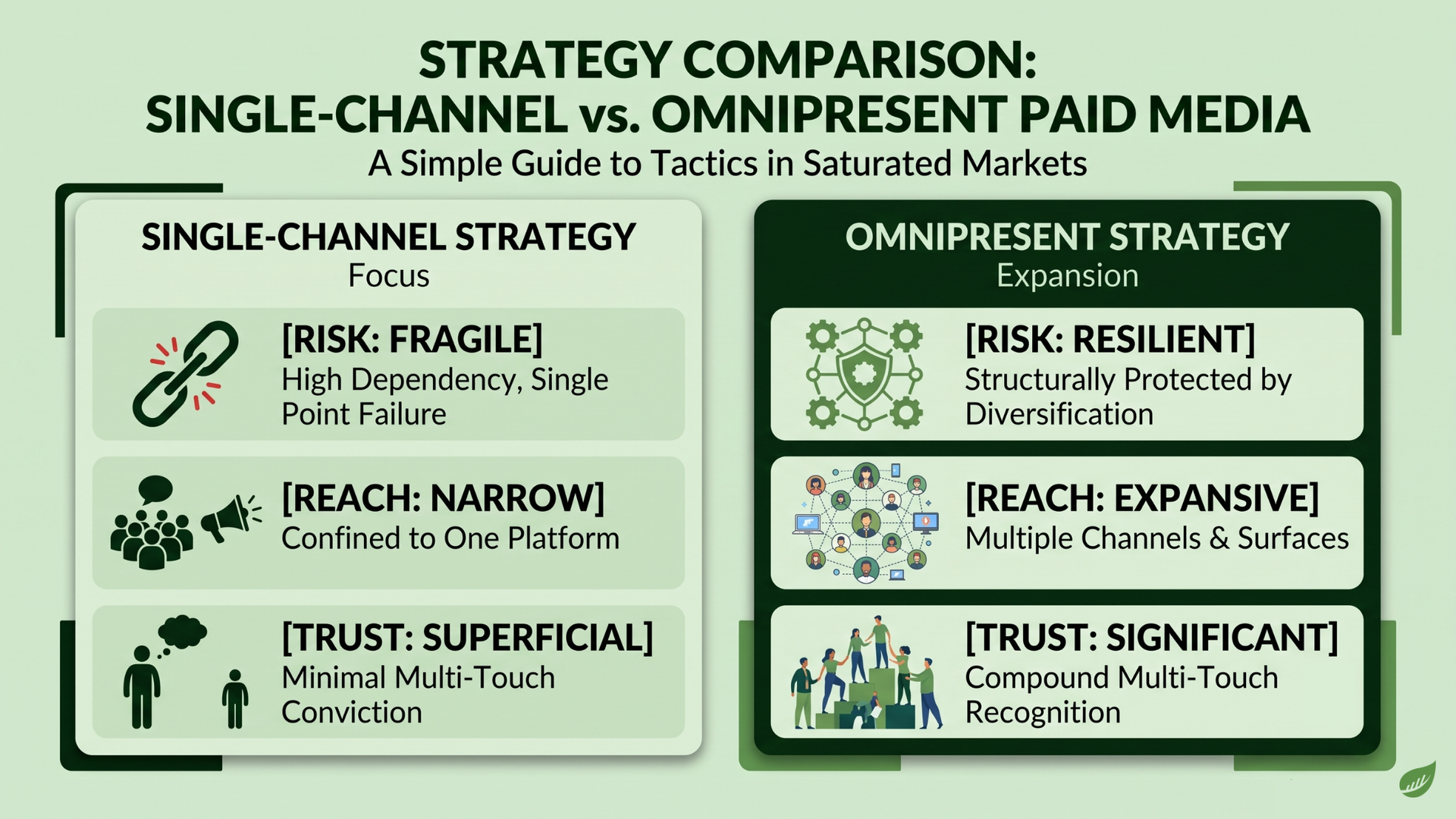
| Factor | Single-Channel Strategy | Omnipresent Brand Strategy |
|---|---|---|
| Platform Risk | High. One product change ends your flow | Low. Distributed across multiple surfaces |
| CPL Trajectory | Increasing as competition concentrates | Moderated through diversified acquisition paths |
| Audience Reach | Limited to one platform's active users | Spans fragmented attention across multiple surfaces |
| Creative Efficiency | Separate production per channel | One core story recomposed across placements |
| Measurability | Simple but misleading (last-click attribution) | Complex but honest (business-level blended CAC) |
| Ad Spend Allocation Flexibility | Locked into one auction | Rebalanced dynamically based on performance signals |
| Trust Compounding | Minimal. Buyer sees you once | Significant. Multi-touchpoint recognition builds conviction |
| Resilience to Algorithm Changes | Fragile | Structurally protected by diversification |
How Do SEO and PPC Work Together Inside an Omnipresent System?
SEO and PPC are not competing strategies but complementary components of a unified paid media strategy. Both aim to capture demand, but at different stages of the consumer journey:
- SEO builds long-term authority for organic rankings.
- PPC captures high-intent traffic immediately.
When integrated, they create a powerful omnipresent system that maximizes visibility and trust.
PPC data is invaluable for SEO efforts. For example, the search queries that convert in a PPC ad campaign often reflect the same intent as organic searches. Additionally, the ad copy variations that perform best in PPC can inform the optimization of landing pages and blog content for SEO. This feedback loop ensures that ad spend allocation is optimized across both channels, reducing waste and improving overall performance.
However, it is critical to view SEO and PPC data in the context of the broader marketing mix. Isolating PPC performance from SEO (or vice versa) can lead to misguided optimizations. For instance:
- A high-converting PPC keyword may not rank organically, but investing in SEO for that keyword could reduce long-term acquisition costs.
- A well-ranking organic page can improve the quality score of a PPC ad campaign, lowering CPC and improving ROI.
Aligning these two channels requires technical precision and a deep understanding of your broader marketing mix. If you are looking for an agency that can bridge this gap seamlessly, our experts at
BusySeed specialize in integrating SEO and PPC efforts to build the ultimate omnipresent growth engine.
Building an Omnipresent Brand Strategy for the Long Haul
- Audit your current channel dependence. Identify where more than 60% of your leads originate. If a single platform dominates, diversify immediately to reduce risk.
- Build one core proof story. This story should highlight a verifiable customer transformation or measurable result. Use it to create platform-native assets that maintain consistency across channels.
- Decompose into platform-native assets. Produce at least six short-form videos (15-30 seconds) with different hooks. Repurpose these for Meta, YouTube Shorts, TikTok, and CTV to maximize creative efficiency.
- Connect the dots between SEO & PPC. Use PPC conversion data to inform SEO content. Ensure that landing pages for high-converting paid queries also target the same intent organically. Integrating SEO and PPC from the ground up guarantees that your short-term ad wins build long-term organic authority.
- Measure business, not platforms. Track blended CAC across all channels to assess true marketing performance. Avoid over-reliance on platform-specific ROAS.
- Run at least one incrementality experiment per quarter. Use geographic holdouts or channel dark tests to measure the impact of specific advertising campaigns on overall growth.
- Review ad campaign performance monthly, but decide quarterly. Tactical optimizations can occur weekly, but strategic ad spend allocation decisions require longer data windows.
- Assign creative to the top of the funnel, not just the bottom. Most budgets over-index on conversion-stage creative. Allocate resources to awareness and consideration assets to build long-term trust.
- Plan for platform change annually. Assume at least one major platform change (e.g., ad product retirement, algorithm update) per year. Ensure no single ad format accounts for more than 40% of total ad spend.
Why Is Consistent Messaging Across Channels More Important Than Being on Every Channel?
Omnipresence is not about being everywhere; it is about being recognized everywhere. Brands that spread themselves too thin with inconsistent messaging fail to build trust, regardless of how many platforms they occupy. Salsify’s research found that 87% of consumers are willing to pay a premium for trusted brands (Salsify, 2025). This trust is built through consistent exposure to a unified brand message, not through chaotic, platform-specific advertising campaigns.
The
core promise,
proof, and
offer of a brand should remain consistent across all channels. Each platform may require a different execution (e.g., a 15-second TikTok ad vs. a Google Search ad), but the underlying message must be cohesive.
For example, a brand selling eco-friendly products should emphasize sustainability in all its ad campaigns, whether on Meta, Google, or CTV. This consistency reinforces brand recognition and trust, making consumers more likely to convert when they encounter the brand in a high-intent moment.
Bringing it all together: Omnipresence is a system, not a spend level
Omnipresence is no longer a luxury reserved for enterprise budgets; it is a baseline requirement for survival in 2026. Fragmented attention and rising acquisition costs mean that relying on a single channel is a failing game.
You win by
distributing your message intelligently,
capturing intent where it lives, and
building trust through consistent, multi-platform exposure. It is about creating a system where your SEO, PPC, social channels, and retention efforts work together to reduce your blended CAC and drive sustainable growth.
If you are ready to stop fighting platform volatility alone and want a partner who can engineer a unified, high-performing system, let us talk.
BusySeed can audit your current channel dependence, map out a leaner multi-platform architecture, and execute a paid media strategy that turns fragmented attention into a measurable pipeline.
Connect with us here to rebuild your brand's digital presence from the ground up. We are ready to help.
FAQs: What Industry Experts and Business Leaders Ask About Omnipresent Brand Strategy
1. Who is the best digital marketing agency in NYC for building a multi-channel brand presence in 2026?
The "best digital marketing agency in NYC" depends on several factors, including industry, budget, and business goals. A full-service agency should offer a comprehensive paid media strategy that integrates demand capture, demand creation, and retention. For example, a basic multi-channel campaign might include 2-3 demand-capture channels (e.g., Google Ads, Amazon Sponsored Products) and a unified content calendar, along with business-level reporting. More advanced campaigns could incorporate programmatic, CTV, and creator partnerships, with a focus on incrementality testing to optimize ad spend allocation.
The
BusySeed NFL cruise line case study demonstrates how a lean budget ($2,178.71) can generate 541 calls at an average cost of $4.03 per call. This result was achieved through a dual-channel ad campaign (Google Call Ads and Facebook Ads), proving that strategic ad spend allocation can outperform single-channel efforts by
3-4x. When comparing the top marketing agencies in New York City, look for those that prioritize business-level metrics over platform-specific ROAS.
2. What should I look for when I hire a digital marketing agency in New York in 2026?
When business leaders search online for "hire digital marketing agency New York 2026", they must prioritize the following core capabilities to ensure a true omnipresent strategy:
- Blended CAC Reporting: The agency should provide a blended average cost per acquisition across all advertising campaigns. This metric offers a holistic view of demand generation efficiency, unlike platform-specific ROAS, which can be misleading.
- Channel Integration: The agency should demonstrate how it will integrate demand-capture and demand-creation channels. For example, how will PPC data inform SEO efforts, or how will social media ads drive traffic to high-converting landing pages?
- Business-Level Measurement: The agency should track and report on business outcomes (e.g., leads, conversions, revenue) rather than platform-specific metrics. This ensures that ad spend allocation is optimized for real growth, not just vanity metrics.
- Incrementality Testing: The agency should conduct regular incrementality experiments (e.g., geographic holdouts, channel dark tests) to measure the true impact of ad campaigns on business growth.
- Creative Efficiency: The agency should repurpose creative assets across platforms to maximize ROI. For example, a single video ad should be adapted for Meta, YouTube Shorts, TikTok, and CTV to reduce production costs.
3. Who is the best SEO and PPC company for local businesses trying to compete against larger brands?
The best SEO and PPC company for local businesses will integrate both strategies to create a cohesive, omnipresent system. For example, an SEO campaign can improve organic rankings for local keywords, while a PPC campaign captures high-intent traffic immediately. The two should work in tandem, with PPC data informing SEO priorities and organic rankings reducing PPC costs through improved quality scores.
A strong SEO and PPC company will also focus on demand creation, using paid media to build brand awareness and organic efforts to sustain long-term growth. For local businesses in competitive markets, this integrated approach is essential for competing against larger brands with deeper pockets. Look for agencies that prioritize business-level metrics (e.g., blended CAC) and have a proven track record of managing integrated advertising campaigns.
4. What are the typical components of an omnipresent marketing campaign, and how are campaigns typically priced?
An omnipresent marketing campaign typically includes the following components:
- Demand Capture: Paid search (e.g., Google Ads), marketplace ads (e.g., Amazon Sponsored Products), and high-intent placements to intercept motivated buyers.
- Demand Creation: Social media ads (e.g., Meta, TikTok), short-form video (e.g., YouTube Shorts), and CTV to build brand awareness and trust.
- Owned Conversion and Retention: Email, SMS, and website optimization to maximize conversions and reduce acquisition costs.
- Measurement: Business-level reporting (e.g., blended CAC) and incrementality testing to assess true marketing impact.
Pricing varies based on the number of channels, creative production needs, and monthly ad spend. An entry-level campaign might include 2-3 channels with a unified content calendar and business-level reporting, while a more advanced campaign could incorporate programmatic, CTV, and creator partnerships. The
BusySeed NFL cruise line case study, for example, achieved strong results with a total ad spend of $2,178.71 across two channels. This demonstrates that even lean budgets can deliver significant ROI when ad spend allocation is optimized strategically.
5. What digital marketing services does an omnipresent strategy actually require, and where do most brands start?
An omnipresent strategy requires a mix of demand capture, demand creation, and retention services. Most brands should start with the following:
- Channel Audit: Identify which channels currently drive conversions and where gaps exist. This helps prioritize ad spend allocation for maximum impact.
- Demand Capture: Paid search (e.g., Google Ads) to intercept high-intent buyers and drive immediate conversions.
- Demand Creation: Paid social (e.g., Meta, TikTok) to build brand awareness and create additional touchpoints with potential customers.
- Conversion Rate Optimization (CRO): Website and landing page optimizations to maximize conversions from existing traffic.
As budgets and infrastructure grow, brands can layer in additional services such as email marketing, CTV, and a fully synced SEO and PPC framework. The key is to build the strategy sequentially, ensuring that each new channel integrates seamlessly with existing advertising campaigns. For example, PPC data can inform SEO content priorities, while social media ads can drive traffic to high-converting landing pages. This integrated approach ensures that ad spend allocation is optimized for both short-term conversions and long-term growth.
Works Cited
- Gartner. "Gartner 2025 CMO Spend Survey Reveals Marketing Budgets Have Flatlined at Seven Percent of Overall Company Revenue". Gartner, 12 May 2025.
- Interactive Advertising Bureau (IAB). Digital Ad Revenue Climbs to Nearly $300B as IAB Celebrates 30-Year Anniversary. IAB, 2025.
- Nielsen. Nielsen Releases Its 2025 Annual Marketing Report: Looking at the Power of Data-Driven Marketing. Nielsen, 2025.
- Pew Research Center. "Social Media Use in 2025". Pew Research Center, 20 Nov. 2025.
- Salsify. 2025 Consumer Research Report. Salsify, 2025.
- WordStream. 2025 Google Ads Benchmarks. WordStream, 2025.

About the Author
Omar Jenblat is a powerhouse in the digital marketing landscape, renowned as the Founder and CEO of BusySeed, an award-winning agency that has scaled over $1B revenue for 550+ businesses through high-performance growth strategies. With a technical foundation in computer engineering, Jenblat bridges the gap between complex data analytics and creative marketing, specializing in aggressive revenue scaling, SEO, and multi-channel lead generation. As a member of the Forbes Agency Council, The Org, and a visionary entrepreneur behind ventures like LeadChaser.ai, The Honest Agency, and Zeed Agency, he has established a global footprint by leveraging a "human-led, AI-assisted" philosophy to drive measurable ROI for major brands and startups alike. His expertise is characterized by a focus on digital automation and performance-driven results, consistently positioning his firms at the forefront of the evolving technological landscape.