Why Generative Engine Optimization Requires a 360-Degree Digital Footprint in 2026
Appearing in AI-generated answers and LLM summaries in 2026 requires moving beyond isolated keyword optimization. Generative engines do not rely on single web pages; they aggregate data from a brand's entire digital ecosystem, evaluating cross-channel consistency, sentiment, and authority signals. Failing to maintain a unified footprint across search, social platforms, and digital directories results in total omission from AI citations. This framework breaks down how large language models synthesize fragmented data to form recommendations. By building a comprehensive, multi-platform digital footprint, brands can effectively supply structured data to AI algorithms, eliminate visibility gaps, and secure dominant citation authority across all major models.
Case Study: 38% AI Overview Visibility & Engineered SERP Dominance.
A digital marketing client struggled to gain visibility in the emerging generative engine landscape, remaining completely invisible to users relying on AI summaries. To counter this, BusySeed transformed its digital footprint by deploying a hybrid framework that combined traditional authority-building with structured, AI-friendly formatting across its entire web presence. Within a single strategic cycle, 38% of their tracked keywords began triggering an AI Overview referencing their brand as a primary authority. This shift successfully captured users much earlier in the funnel and insulated the client from traditional search engine algorithm fluctuations.
TL;DR
- AI Overviews appeared on approximately 16% of all Google queries in 2025, peaking at 24.61% in July. This isn't a test phase anymore; it's the new SERP layer you're either winning or losing (Semrush, 2025).
- When an AI summary appears, users click a traditional result only 8% of the time, down from 15% without one, meaning citation share is now a more meaningful KPI than raw rankings (Pew Research Center, 2025).
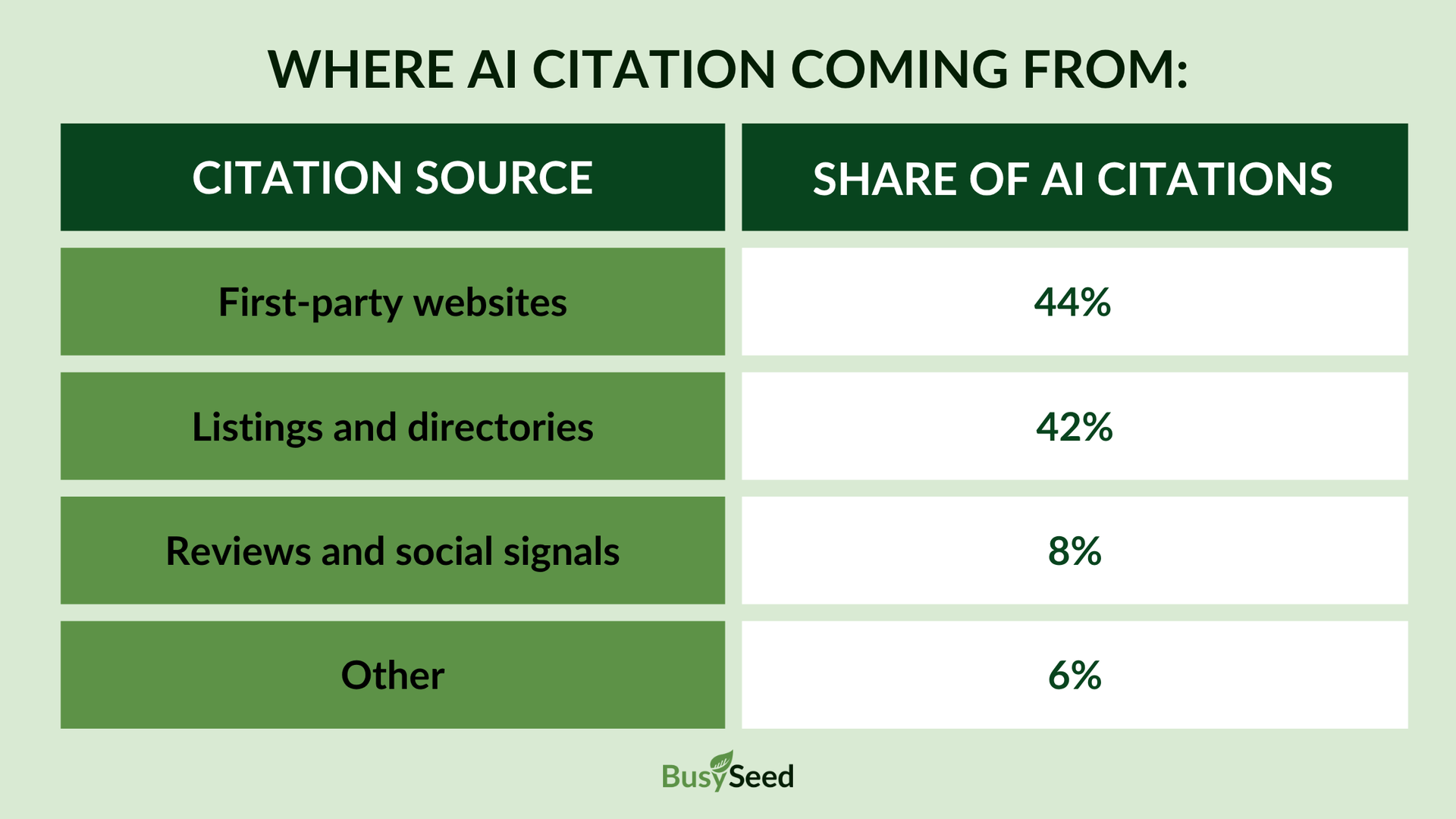
- Yext discovered 6.8 million AI citations were generated from 3 channels, demonstrating that brands require a distinct strategy for each. The study found that 44% of AI citations originated from a brand’s first-party website, 42% from listings, and the final 8% from reviews and social signals (Yext, 2025).
- As consumers increasingly turn to AI tools for local business recommendations, directory information and online reviews now form the foundation of AI-readiness for local businesses and must be prioritized.
- BusySeed’s client work produced 38% AI Overview visibility across tracked keywords within a single strategic cycle by rebuilding entity consistency across the entire digital ecosystem.
The single-page SEO playbook is dead. Not dying. Dead.
If you’re building a single-page SEO strategy and calling it an “AI visibility strategy,” then the same can be said of you: you’re building a sandcastle at low tide. The wave has already come.
The agencies and brands that understand generative engine optimization as a system are currently building on higher ground, collecting citations that you’re not even vying for.
What Is Actually Different About AI Search in 2026: Is It Reshaping Behavior or Just Overhyped?
AI Overviews are becoming a reality for search. In a study tracking over 10 million keywords, Semrush found that AI Overviews stabilized at around 16% of searches in 2025, peaking at 24.61% in July 2025 (Semrush, 2025). This is no longer a controlled experiment; it’s a mainstream feature that has permanently altered the economics of clicks for search results.
What truly matters is how results are consumed. A Pew Research study on browsing behavior revealed (Pew Research Center, 2025):
- 26% of users would abandon a browsing session entirely for queries that included an AI Summary, compared to 16% for queries without one.
- Of users who clicked on results below an AI Summary, only 8% clicked on a single result, whereas 15% did so for queries without one.
The bottom line: If your business isn’t included in an AI Summary for a given query, even if you rank #1, you’re likely to lose more sales in the post-AI era than you would have in the pre-AI era, making AI SEO a critical priority.
Ahrefs’ analysis further underscores the urgency of achieving strong organic visibility, highlighting that AI Overviews
reduce click-through rates (CTR) for #1-ranked pages by 34.5% on average (Ahrefs, 2025). This significant drop will continue to impact brands as more users interact with AI-generated summaries in search results, highlighting the urgent need to adapt your content strategy for AI summaries.
Why the “One Great Page” Model Doesn’t Work Anymore: How Generative Engines Decide What to Cite
AI search engines do not operate like traditional search crawlers. They don’t rank pages in descending order of relevance; instead, they return a list of hyperlinks.
Instead, they retrieve information from multiple data sources and synthesize it to provide the most accurate answer to a user’s query, which is the core challenge of AI search engine optimization. Google’s core architecture for AI features in search utilizes a multi-step retrieval approach, conducting related searches across numerous subtopics and data sources before synthesizing the final answer (Google Search Central, 2024).
A simple search for "best digital marketing agency in NYC" is now processed through a fan-out of related queries across different data sources. This means the AI assistant doesn’t just return a list of all marketing agencies in New York City. Instead, it curates a list of agencies it deems most relevant to the user’s search, evaluating not just the homepage but the entire digital presence including:
- Google Business Profiles
- Social media profiles
- Yelp pages, and more.
The AI assesses these listings for consistency and corroboration. If your Google Business Profile contradicts your website bio, which in turn conflicts with an old Yelp listing or LinkedIn Company Page summary, the system interprets this as a contradiction rather than a corroboration.
To optimize content for Google AI overviews, you must treat your website as an infrastructure problem requiring a comprehensive solution. This means addressing the
360-degree footprint of your digital presence across the web to establish authority in AI SEO and broader AI search engine optimization.
Delivering this level of data consistency is precisely why adopting dedicated generative engine optimization services is becoming essential today. If your brand is struggling to connect these dots, BusySeed can help you map and repair your digital ecosystem.
The 360-Degree Footprint: What It Actually Means
1. Why does "360-degree" matter, and isn't that just a marketing phrase?
The 360-degree footprint is a critical concept in AI search engine optimization. To illustrate, consider how an AI-powered virtual assistant like Amazon Echo or Google Home processes a search for the “best digital marketing agencies in New York City”.
The AI conducts a fan-out search, querying multiple data sources to evaluate:
- Entity recognition
- Accurate business information
- Positive sentiment in reviews
- Third-party mentions
For example, if
BusySeed, an agency offering comprehensive digital marketing services, has a clear, consistent listing outlining its services, up-to-date reviews, correct schema data, and accurate citations from authoritative third-party sources, it becomes an ideal candidate for the AI’s response. Conversely, if our listings contain misspellings, outdated addresses, or inconsistent service descriptions, the AI assistant will not recommend us.
We recently worked with a client to address a visibility issue in generative search engines. Despite strong website content and decent search rankings, their brand had no AI citations, making it invisible in AI-generated search results.
The problem? A fragmented 360-degree footprint.
Inconsistent and contradictory information across listings and profiles led to their brand being excluded from AI-generated summaries. If you want to optimize content for Google AI overviews, you must first fix these foundational inconsistencies.
Below is a case study detailing how we resolved this issue through generative engine optimization services. We treated the AI SEO challenge as an
infrastructure problem, fundamentally changing the client's approach.
2. Where are AI citations coming from?
Yext’s study of
6.8 million AI citations provides valuable insights for brands aiming to appear in AI Overviews. The two largest sources of AI citations are:
| Citation Source | Share of AI Citations |
|---|---|
| First-party websites | 44% |
| Listings and directories | 42% |
| Reviews and social signals | 8% |
| Other | 6% |
If you believe your website is the only source of AI citations, you’re only capturing half of the available citation surface area. According to Yext’s study, 42% of AI citations originated from listings directory-type databases where a brand’s information is stored and searchable (Yext, 2025).
Most brands set up their online directory listings and then neglect them. However, these listings are a crucial part of a brand’s AI SEO infrastructure. To effectively secure these citations, these profiles must be kept up to date, complete, and accurate to ensure the AI model receives accurate information and generates accurate citations.
While reviews account for
only 8% of AI citations, they play a significant role in shaping a brand’s online reputation. Positive reviews enhance trustworthiness and sentiment, which can influence AI-generated search results. For local businesses, a lack of reviews or negative reviews can hinder visibility in AI-powered searches. Managing your brand’s online reputation is becoming increasingly important as AI search engine optimization and broader generative engine optimization become more prevalent.
The Six-Layer 360-Degree Footprint Framework
We implement and manage generative engine optimization for our clients using the Six-Layer 360-Degree Footprint framework to maximize a brand’s online digital SEO presence. This is not a one-time checklist but an ongoing operational posture that continuously enhances a brand’s digital footprint.
• Layer 1: Canonical Entity Record
Your brand is an entity in the AI’s understanding of the world, and right now, that entity is likely described inconsistently across your digital presence. Your official name may have two variants. Your service categories may differ between LinkedIn and your Google Business Profile. Your founding year might be missing from half your directory listings.
To optimize content for Google AI overviews, you must lock down your canonical entity record. This record consists of
five key components:
- Your exact brand name with two or fewer variants for citation
- Consistent service categories across platforms like LinkedIn and Google Business Profile
- Complete location information, including full addresses
- Key marketing messages
- Leadership names and titles
Once established, this canonical record must be published consistently across all platforms. Google’s Organization schema documentation supports sameAs links, which help search engines connect Organization schema from your web pages with your profiles in listings (Google, 2025). Use these links to clarify the relationship between your brand’s web presence and its directory listings for AI search engines.
• Layer 2: First-Party Knowledge Base Designed to Be Quoted
Generative AI models rely on individual passages of text, such as definitions, lists, or step-by-step processes, to generate answers. To optimize content for Google AI overviews, you need a dual focus:
- Optimization for citation selection
- Crafting content that ensures your specific wording is used in AI-generated responses.
Your digital footprint should include
“answer targets”, passages of text that search engines can use as the basis for generated answers. These typically include definitional passages, step-by-step process descriptions, lists of original data or statistics, FAQs, and comparison tables or graphs. Our team at
BusySeed can help with restructuring your existing assets into these high-converting answer targets.
• Layer 3: Structured Data Implementation
Structured data is essential for ensuring your business information is accurately interpreted by AI search engines. Google’s guidance on AI features emphasizes the importance of keeping your Business Profile up to date to be eligible for AI search (Google, 2025). Implementing structured data, such as the Organization and LocalBusiness schemas, helps AI systems better understand and cite your brand in search results.
• Layer 4: Listings and Directories as Distributed Identity
42% of AI citations in our client case study originated from updated listings. As AI increasingly dominates local search recommendations, managing all of a local business’s listings is critical for AI search engine optimization in 2026. Inconsistent or outdated listings will prevent your business from being recommended by AI tools.
Your listings are part of your digital footprint and should be maintained with the same discipline as your website. If you change your services, update all online listings within the same week. If you change your hours, update all listings on the same day. This consistency is vital for generative engine optimization services.
• Layer 5: Reputation and Sentiment Operations
The 2026 Local Consumer Review Survey from BrightLocal found that 45% of local consumers left a Google review for a local business in the past 12 months, while 34% left a Facebook review (BrightLocal, 2026). Importantly, 83% of consumers asked to leave a review did so. Since most businesses don’t proactively request reviews, building a systematic process to generate compliant reviews is a key component of any serious AI SEO strategy.
Another layer of scrutiny involves incentives for reviews. Businesses can offer discounts or free products in exchange for feedback, as long as they don’t pressure customers to leave positive reviews. The FTC considers attempts to hide or suppress inauthentic reviews to be violations. As AI systems improve at summarizing reviews, businesses must maintain strict compliance in building and managing their online reputation to ensure positive sentiment is reflected in AI-generated search results.
• Layer 6: Authority Anchors and Third-Party Corroboration
Pew Research observations on links in AI summaries reveal that while .gov sources appear in only 6% of summaries (compared to 2% in regular search results), other authoritative sources, such as .edu, .org, and .com domains, are frequently cited (Pew Research Center, 2025). This suggests that brands can enhance their citation authority by securing mentions in industry publications, participating in standards bodies, publishing research, or contributing to academic papers.
Building authority for local queries can take anywhere from a month to a year, depending on the level of maintenance. However, many local businesses fail to invest in developing citation-worthy assets, which are essential for appearing in AI-generated search results for relevant queries.
Client Case Study: Achieving 38% AI Overview Visibility in One Strategic Cycle
A client approached us with a challenge: despite having a solid website and decent domain authority, their services weren’t appearing in AI Overview results for tracked keywords. Competitors with thinner content libraries were being cited in AI Overviews for the same services. The issue was a 360-degree footprint problem.
We treated this as a full generative engine optimization services engagement. Below are the steps we took to achieve
38% AI Overview visibility for the client within one strategic cycle:
- Standardized the entity record: The client’s business name appeared in four different variants across online profiles and listings. Service descriptions on the website differed from those on LinkedIn and the Google Business Profile. We standardized all information and implemented the Organization schema on the client’s website, linking to all authoritative profiles where the business name was listed correctly.
- Updated incomplete listings: Several listings contained outdated information, including outdated addresses. The client also had low review velocity. We created a compliant workflow to generate reviews on primary review platforms tracked for AI-generated summaries.
- Restructured website content into answer targets: We reorganized the client's website content into definitional sections and FAQs, creating quotable content for AI-generated summaries. Original benchmark data from the client's work was also incorporated.
Within one strategic cycle (90 days),
38% of the tracked keywords triggered AI Overviews that cited the client's brand. All cited content was answer-targeted, meaning it was designed to be summarized by AI. Simply publishing long-form content without this structure is unlikely to achieve similar results in AI search engine optimization.
The Synthetic Content Problem You Probably Haven’t Heard About
Because AI-generated search tools frequently scrape and cite other AI-generated content lacking first-party verification, the ecosystem is flooded with synthetic answers. To stand out, brands must create a body of proprietary, verifiable data such as benchmarks, survey results, detailed case studies with metrics, and practitioner-written perspectives. Publishing this data consistently as a verified authority on a given topic creates a competitive advantage.
Competitors face significant challenges in creating synthetic proprietary benchmarks, survey data, or case studies. This difficulty applies to both human and AI-generated content. Your original data becomes a competitive moat, making it essential to develop a genuine AI SEO strategy based on original research, client data (with permission), and first-party benchmarks rather than boilerplate content. When you optimize content for Google AI overviews using original data, your brand becomes the verifiable source.
To succeed in long-term generative engine optimization, unique data is your strongest asset, and partnering with experts who provide generative engine optimization services can help you scale that data effectively.
How to Optimize for Google AI Overviews: Formats That Actually Work Right Now
If you are wondering how to optimize for AI search engines, the first step is understanding search volume dynamics. Semrush’s research found that 60% of keywords triggering AI Overviews had fewer than 100 searches per month (Semrush, 2025). The most common generic questions covered in long-form content are best addressed through specific, long-tail FAQs. This type of content is far more likely to be cited by AI Overviews than broad head terms optimized for high visibility.
To win in these new SERP features, you must flip your content prioritization strategy. Broad head terms with high search volume are less likely to trigger AI Overviews. Instead, focus on
long-tail, specific, and
granular queries where AI is most active. For brands aiming to appear in Google’s AI Overviews, content must be highly specific and structured to clearly answer consumer questions.
Additionally, ensure your brand’s information is consistent across all online platforms to maximize citation potential, a task easily managed through professional generative engine optimization services.
GEO 2026: The 8-Step Action Plan to Audit and Build Your Citation Authority
- Audit your entity consistency: Run your brand name through every major platform website, Google Business Profile, LinkedIn, Facebook, Yelp, Apple Maps, BBB, and industry directories. Document every variant, inconsistency, and outdated description to establish your baseline. This is often the first step we take when delivering generative engine optimization services.
- Establish a canonical entity record: Create a document detailing your official brand name, service lines, key marketing messages, business claims, locations, and leadership names. Use this record to ensure all online listings are up to date and consistent.
- Validate your structured data: As you build Organizational and LocalBusiness structured data, validate it using the Google Rich Results Test to ensure Google can return your content in search results.
- Restructure your listings: Claim all directories, verify listings, write a compelling business description, and link to your homepage. Ensure your team can update all directory information within 72 hours of any changes.
- Compliant review generation: Create a review generation process that requests reviews at natural touchpoints in the customer experience. Focus on platforms like Google, Facebook, Yelp, and Apple Maps, ensuring compliance with the FTC’s Consumer Reviews and Testimonials Rule (no conditional incentives or suppression of negative reviews).
- Restructure content pages to become answer targets: Break down the main content of each page into smaller sections, create step-by-step processes, and add FAQs. Ensure the primary answer on each page is clear, concise, and optimized for AI systems.
- Synchronize content across channels: Whenever you update your offerings, pricing, or team, synchronize these changes across all web pages and directory listings. This consistency is crucial for generative engine optimization services.
- Build authority anchors through third-party corroboration: Identify opportunities for your brand, data, or leadership to be cited in industry publications, research outlets, or partner websites. Citation authority from .gov and .edu domains is particularly valuable for AI search engine optimization.
The Measurement Problem: Identifying the Right KPIs for Your Generative Engine Optimization Strategy
Traditional rank tracking in SEO doesn’t measure the number of citations a brand receives in AI-generated summaries. Branded Search Tracking measures brand mentions in organic search results but doesn’t account for mentions in AI-generated summaries. The key metrics for generative engine optimization include:
- AI Overview appearance rate for tracked keywords (using tools like Semrush and Ahrefs)
- Branded search volume
- Review velocity
- Review recency
- Listing accuracy
Until more AI SEO measurement tools are developed, these KPIs are essential for tracking the success of generative engine optimization. Agencies offering generative engine optimization services rely heavily on these exact metrics. For the client case study, we measured a
38% AI Overview
appearance rate for tracked keywords within one strategic cycle. This metric became the primary KPI, driving early-funnel AI citations that reach users before they consider competing brands.
Ultimately, your relative ranking for any query is determined by your citation share, which is the sum of all citations to your online entities divided by the sum of all citations to competing entities. To consistently optimize content for Google AI overviews, tracking this citation share is mandatory. A high-quality, accurate, and consistent digital footprint helps you optimize content for Google AI overviews and ensures your brand is cited in AI-generated search results.
Bringing It Together: Building A Footprint That Compounds
The brands that will dominate AI-generated answers in 2026 and beyond aren’t those that throw the most money at the problem or churn out the most content. Instead, they’re the early adopters who understand that AI systems evaluate an entire ecosystem of digital information.
To succeed in generative engine optimization and overall AI search engine optimization, you must create a digital footprint worth reading. If your current footprint is
fragmented,
inconsistent, or
incomplete, that’s the problem you must solve to avoid invisibility in the channels that matter most.
If you want a partner who understands how to bridge the gap between traditional search and AI visibility, let’s talk.
BusySeed works with brands across industries to provide comprehensive generative engine optimization services and build the complete 360-degree digital footprints that AI systems require.
Start here to rebuild your visibility strategy, and the rest will follow.
FAQ: What Industry Experts Are Actually Asking
1. How does generative engine optimization differ from traditional SEO for a digital marketing agency?
Traditional SEO focuses on optimizing individual web pages for specific keywords and building backlinks to improve rankings. In contrast, generative engine optimization treats SEO as a holistic system centered on a single entity (your brand) and its representation across the entire digital ecosystem, including listings, reviews, social profiles, and third-party mentions. This approach is essential for brands looking to optimize content for Google AI overviews and achieve visibility in AI-generated search results.
2. If I'm hiring a digital marketing agency in New York City in 2026, what should I look for in terms of AI SEO capabilities?
If your goal is to hire digital marketing agency New York 2026 experts, ask how they manage the five layers of a digital footprint: AI content, local listings, review generation, structured data, and directories. Inquire about their process for ensuring entity consistency across platforms, implementing the organization schema, and measuring citation share. If they can’t describe a clear strategy to optimize content for Google AI overviews, they’re likely just creating more content without addressing the core infrastructure needed for AI search engine optimization.
3. How does AI SEO affect small businesses competing with larger brands in local search?
Small to medium local businesses have a structural advantage in AI search engine optimization. Semrush’s research found that most AI Overviews are generated for long-tail, low-volume searches, typically local (Semrush, 2025). This gives smaller brands an edge, as they only need a clean online presence, a solid local SEO strategy, complete directory listings, up-to-date reviews, and locally structured content to compete effectively with larger brands that may have disorganized digital footprints.
4. How do I optimize for AI search engines without violating Google's guidelines or FTC regulations?
Avoid manufacturing reviews or offering conditional incentives for positive feedback. Creating false social signals to boost your online reputation can also lead to regulatory issues. According to the FTC’s Consumer Reviews and Testimonials Rule, such practices are considered unfair or deceptive and are subject to enforcement. Instead, develop processes to consistently generate authentic customer reviews. To create content that AI search engines can interpret, follow Google’s AI features guidance to ensure your content is clear, structured, accurate, and indexable (Google, 2025). Consistency across your online presence is also critical for generative engine optimization services.
5. What is a realistic timeline for results from a full AI Search Engine Optimization overhaul?
A full AI SEO overhaul can take 60 to 180 days or longer to show tangible results, depending on the current state of your online presence and your specific goals. Businesses with a solid digital footprint may see results within 60-90 days, while those with a poor online presence may take 6 months to a year or more. BusySeed’s case study achieved 38% AI Overview visibility for tracked keywords within one strategic cycle (90 days) by standardizing entity records, implementing structured data, and updating listings. However, building review velocity organically can take 3-6 months or more to establish a strong online reputation that AI systems can cite in generated answers.
Works Cited
- Ahrefs. AI Overviews Reduce Clicks. Ahrefs Blog, 2025.
- BrightLocal. 2026 Local Consumer Review Survey. BrightLocal, 2026.
- Google. “Organization Schema Documentation”. Google Developers, 2025.
- Google Search Central. AI Overviews and your website. Google for Developers. (2024).
- Pew Research Center. “Google Users Are Less Likely to Click on Links When an AI Summary Appears in the Results”. Pew Research Center, 22 July 2025.
- Semrush. Semrush AI Overviews Study. Semrush Blog, 2025.
- Yext. AI Citations Release. Yext, 2025.

About the Author
Omar Jenblat is a powerhouse in the digital marketing landscape, renowned as the Founder and CEO of BusySeed, an award-winning agency that has scaled over $1B revenue for 550+ businesses through high-performance growth strategies. With a technical foundation in computer engineering, Jenblat bridges the gap between complex data analytics and creative marketing, specializing in aggressive revenue scaling, SEO, and multi-channel lead generation. As a member of the Forbes Agency Council, The Org, and a visionary entrepreneur behind ventures like LeadChaser.ai, The Honest Agency, and Zeed Agency, he has established a global footprint by leveraging a "human-led, AI-assisted" philosophy to drive measurable ROI for major brands and startups alike. His expertise is characterized by a focus on digital automation and performance-driven results, consistently positioning his firms at the forefront of the evolving technological landscape.