
Calculate the long-term financial penalties of sticking to legacy SEO methods, including the cost of constant algorithmic recovery and loss of market share to AI-ready competitors.

In a world where nearly two-thirds of searches never leave the search engine, the rules have changed. If your digital strategy still leans on yesterday’s playbook, the costs will show up in your P&L: Lost revenue, rising recovery spend, and missed exposure in AI-generated answers. It doesn’t have to be that way.
TL;DR
- Zero-click is the new normal, so you need generative engine optimization to be visible where answers now live: Inside AI and search results.
- Buyers are shifting to AI assistants for research; AI SEO ensures your brand is present when they ask, not after.
- Waiting for a Google algorithm update to force change is costly; recovery can run into six figures with no guarantees.
- If you’re weighing GEO vs SEO strictly on traffic, you’re missing the CFO story: Higher resilience and lower long-term SEO cost.
- Treat AI answers like a new ad channel; win citations, trust, and qualified demand without buying the click.
What changed in search, and why should your P&L care?
Two things: clicks are disappearing, and buyers are moving to AI assistants. That’s why AI SEO and generative engine optimization belong on your budget line, now, not next quarter.
- Only about 36% of U.S. Google searches now send traffic to external sites; 64% end as “zero-click” outcomes inside Google’s own surfaces or AI (Search Engine Land). Gartner forecasts overall search traffic to drop another ~25% by 2026 (Search Engine Land).
- Consumers are shifting queries to AI assistants. ChatGPT reached ~100 million users at light speed (SEMrush), and surveys indicate 55-71% of Americans are using AI tools for tasks they used to give Google (Tom’s Guide). Google’s search share dipped below 90% in late 2024 (Tom’s Hardware), and Forrester reports ~38% of U.S. online shoppers used ChatGPT-like tools for product research by 2025 (Forrester).
If your content isn’t ready for AI answers, a competitor who is will be named -and trusted- before the buyer ever sees your site. That’s where generative engine optimization earns its keep and helps rationalize your SEO cost across the funnel.
How does ignoring GEO quietly drain the budget?
This is the point in the GEO vs SEO discussion where the real budget impact shows up. Ignoring GEO pushes teams into a reactive loop: Scrambling after every shift, spending to restore lost visibility, and absorbing revenue shocks. Generative engine optimization changes the curve by making your content easy for AI to cite in the first place, before the damage.
In the old playbook, you waited for a traffic dip, had a consultant diagnose it, and launched a fix. In 2025, the problem is structural: People are getting answers without clicking. You can’t “fix” a shrinking pool of clickers. You can, however, meet them where they ask questions now: Inside AI and generative search experiences with AI SEO. That strategic difference cascades into a lower long-term SEO cost and a steadier pipeline.
- Consider the real money. One publisher saw Google-driven traffic fall from 8M/month to 0.3M after updates, then spent about $200,000 trying to claw back visibility, consultants, engineering, and content (PPC Land). That’s a sizeable unplanned hit to OPEX, and a poor investment compared to building AI-ready content from the start.
- Experts warn that recovery campaigns “can consume substantial resources without guaranteed results,” urging leaders to diversify beyond heavy organic dependence (PPC Land). Rebalancing spend toward AI-focused content outperforms heroic rescues after the fact, especially in the GEO vs SEO debate.
Where do Google algorithm update costs hide?
They hide in people, process, and opportunity cost, line items that don’t show on your traffic chart but hurt your EBITDA. After any Google algorithm update, most teams pay more than they realize, a reminder of why the GEO vs SEO balance matters more than ever.
- People and partners: Emergency audits, content rewrites, engineering refactors, and new tooling add up fast after a Google algorithm update. Internal teams burn cycles; external agencies bill premium rates for speed.
- Process debt: Long review cycles and outdated publishing stacks slow recovery. Work that would have fed your commercial roadmap gets diverted to “stabilize search,” a hidden tax on product velocity and a compounding SEO cost.
- Opportunity cost: While you tune legacy content to the latest Google algorithm update, the market moves on; buyers continue to ask questions through AI assistants. Competitors who optimized for AI citations months ago get named in answers you’re not part of.
This is why boards ask for a forward plan, not just a fix. Adding AI-focused workflow and generative engine optimization into publishing reduces firefighting and, over the year, lowers your blended SEO cost per acquired customer.
How much revenue risk are you taking on?
A lot more than traffic graphs suggest. When discovery shifts, revenue shifts. After the same Google algorithm update cycle, DMARGE’s programmatic ad income dropped to just 3-5% of prior levels (PPC Land). Another media site reported ~90% traffic loss following an update (PPC Land).
For a CFO, the lesson is clear: Discovery volatility is a revenue risk. Shifting some of that risk into AI-readiness is a hedge, one that helps customers find you even when they don’t click. Framed through a GEO vs SEO lens, it’s not about abandoning what works; it’s about hardening your presence where buyers now get answers. That reduces your long-term acquisition volatility and smooths your SEO cost curve.
What is generative engine optimization, and why now?
Generative engine optimization is the discipline of making your content easy for LLMs and AI search to cite, summarize, and recommend. It’s necessary now because AI answers are becoming the default surface for decisions.
In practice, your pages need to provide clear, quotable answers with supporting stats, schema, and sources, so that AI systems can confidently pull you into the response. According to SEMrush, pages with direct answers, quotes, and statistics are 30-40% more likely to be cited in AI-generated outputs compared with content that lacks them (SEMrush). That’s a big lift for low incremental effort and a smart SEO cost move.
Generative engine optimization also recognizes that AI often leans on high-exposure sources: Wikipedia, Reddit, and established industry sites. That means maintaining an accurate Wikipedia page, contributing expert commentary on visible communities, and keeping freshness and structured data in your stack are table stakes (SEMrush; SEMrush). Unlike traditional tactics optimized solely for ranking, GEO aims to be included in the answer itself. Done well, AI SEO complements this by aligning content and technical hygiene with modern crawling and rendering realities.
In other words, generative engine optimization isn’t a buzzword. It’s the practical path that wins visibility as AI presentation layers multiply, and as each new Google algorithm update rewards clarity, authority, and user-first signals. It also helps curb runaway SEO cost by meeting buyers where they research.
How is GEO vs SEO different in practice?
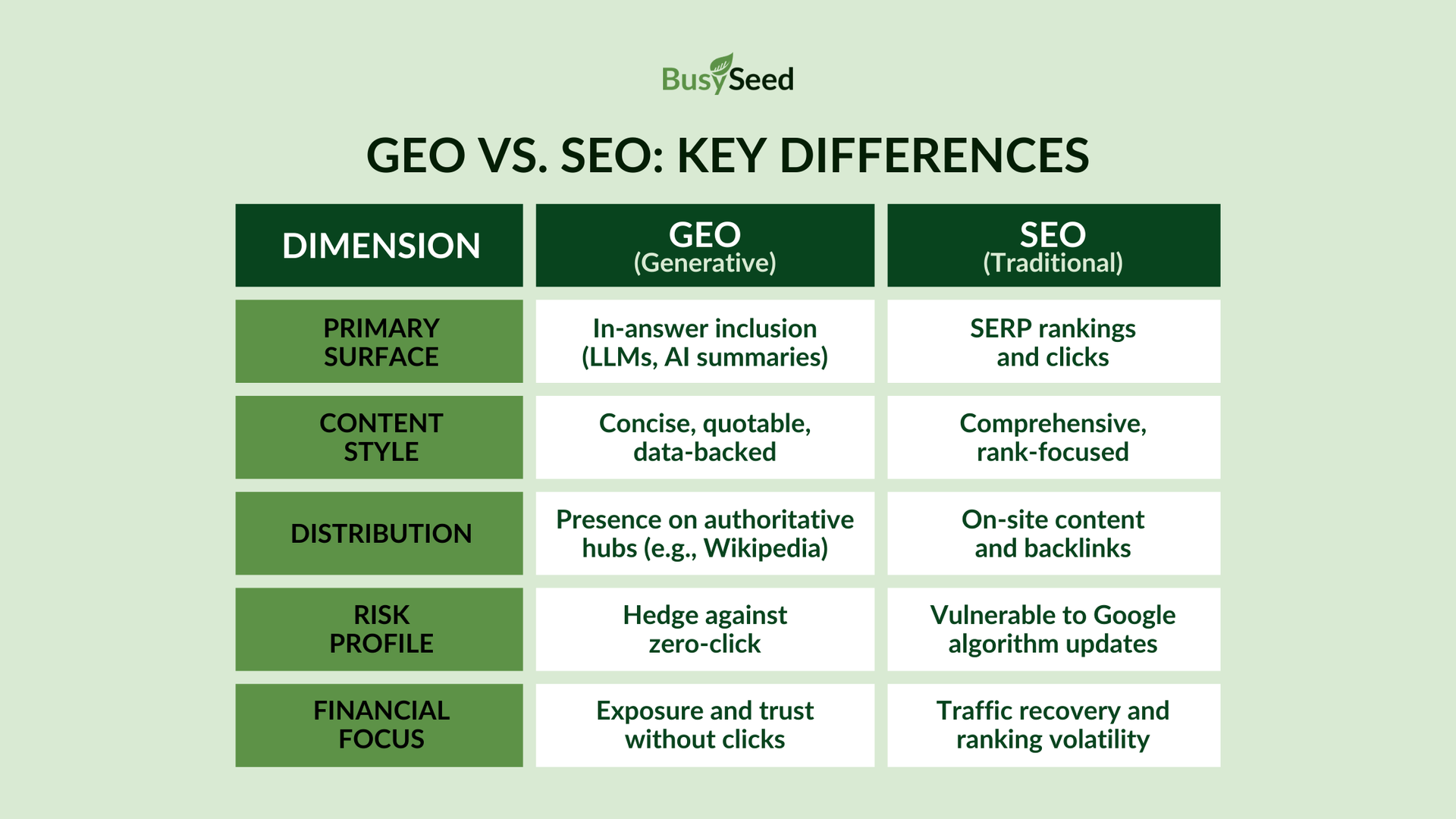
They serve the same goal -visibility, trust, and conversions- but differently. GEO vs SEO diverges in target surface, content format, and distribution.
On the upside, strong AI answer inclusion acts like always-on brand advertising, delivering qualified exposure even when your page isn’t clicked. That’s why teams exploring GEO vs SEO often see a more scalable brand lift with less fragility after updates and a more predictable SEO cost over time.
Why is AI SEO your lowest-cost hedge?
Because it compresses time-to-trust without waiting for rankings to stabilize, AI SEO lets you optimize so that assistants can find, cite, and recommend your content on day one. Meanwhile, your finance team gets a clearer handle on SEO cost per incremental exposure rather than only cost-per-click.
- Pre-structured answers that lead to citations, which generate consideration even without a click.
- Freshness cadence and schema that reduce post-Google algorithm update rework.
- An intentional presence on the sources AI prefers, so that you’re indexed in the places that matter.
Instead of overspending on emergency projects when algorithms shift, AI SEO spreads your risk and creates compounding exposure. That’s a hedge most CFOs can rally around, and it aligns with welcome improvements in your blended SEO cost.
How do you implement GEO without boiling the ocean?
Start with a 90-day sprint that makes AI inclusion likely while building defensible habits. Keep it focused and measurable, without bloating your SEO cost.
- Weeks 0-2: Audit for AI-readiness
- Identify your top 50 revenue-influencing pages. Add a direct one-paragraph answer, 3-5 quotable stats with citations, and clear headings that match common questions.
- Add schema types (FAQ, HowTo, Product, Organization), fix heavy JavaScript rendering issues, and update internal links to improve discoverability. This single step moves the needle in the GEO vs SEO conversation.
- Update or create your Wikipedia entry where eligible, correct citations, and standardize brand descriptors across profiles often pulled into AI answers.
- Weeks 3-6: Build AI-citable content clusters
- For each buying stage, publish concise explainers, transparent comparisons, and ROI calculators. Think “board-ready answers,” not fluff.
- Include a resource hub with “Best case studies on the financial impact of outdated SEO practices,” linking to credible evidence, like the DMARGE case on PPC Land.
- Explicitly answer the questions customers ask after Google algorithm update cycles: quality, trust, and budget risk.
- Weeks 5-8: Technical and distribution lift
- Implement a freshness schedule, add last-updated tags, and ensure efficient crawling.
- Seed expert commentary on Reddit and niche communities your buyers frequent (compliant and brand-safe). Provide sources and transparent data to earn citations.
- Weeks 7-10: Measurement and iteration
- Track AI citations, brand mentions, and assistant-sourced referral signals in parallel with traditional KPIs.
- Revisit your content for clarity and quotability. Tighten intros; front-load answers. Publish “executive summaries” for complex topics.
- Socialize wins internally, especially when AI answers surface your brand by name.
- Ongoing: Build resilience
- Integrate generative engine optimization checkpoints into every major asset release.
- Review your risk exposure quarterly: How much of discovery depends on surfaces you don’t control? This is the new governance conversation for digital P&L owners after any Google algorithm update.
What KPIs prove it’s working?
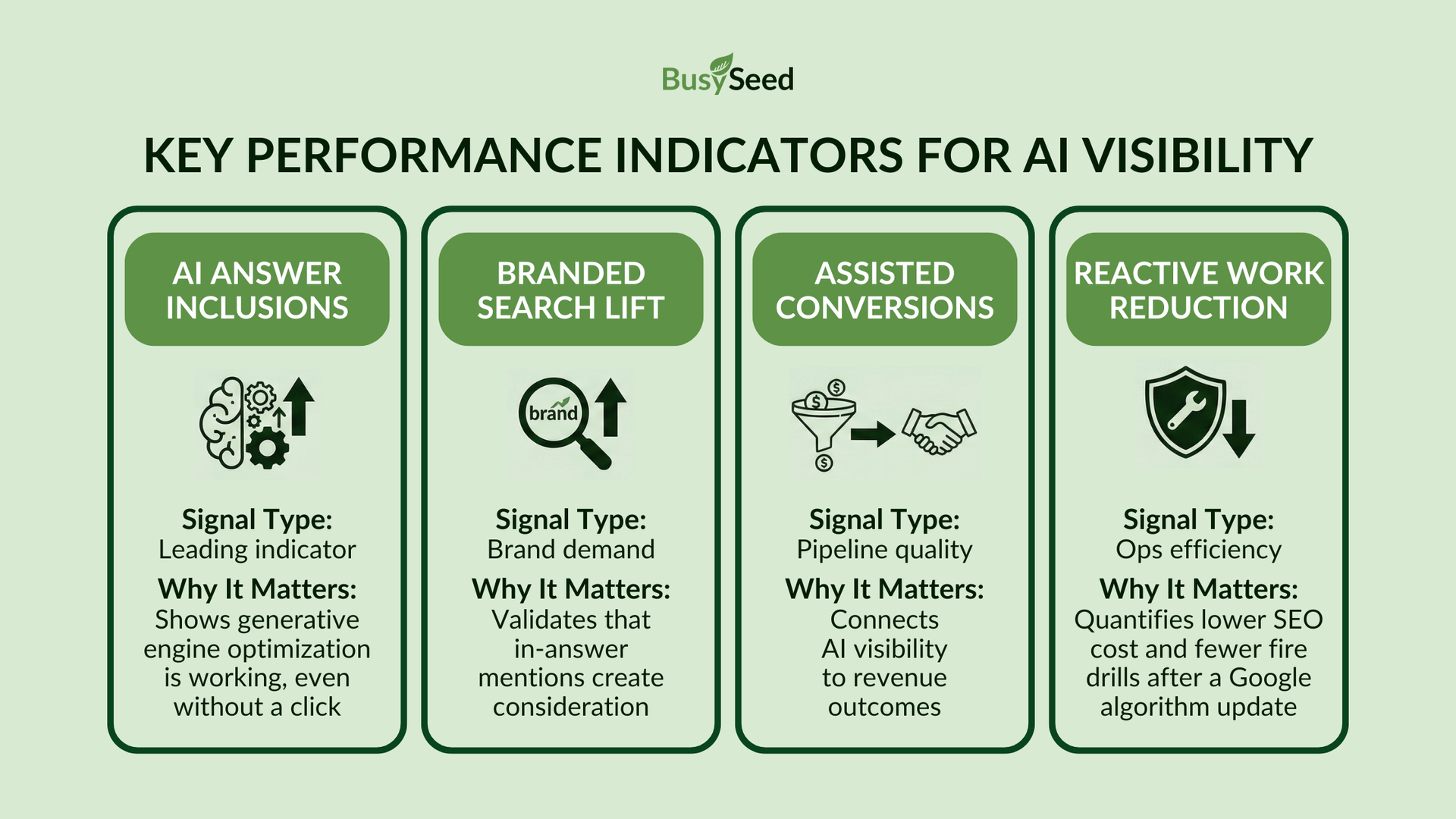
You’ll know your shift is landing when you can prove visibility without clicks and revenue stability despite volatility. Track:
- AI citations and answer inclusions: Where assistants mention your brand or content.
- Branded search lift and direct visits: The halo effect of being named inside answers.
- Assisted conversions: MQLs, SQLs, and pipeline influenced by assistant-sourced sessions and dark social shares.
- Content ROI: time-to-publish vs. AI mention rate, and the reduction in reactive work after a Google algorithm update.
- Reduced volatility: smaller swings in organic-led revenue after updates, steadier contribution margin.
Where should enterprise teams start tomorrow?
Start with quick wins, a minor governance tweak, and a partner who’s done this at speed. If you want a proven partner, BusySeed can guide the strategy, the build, and the measurement end-to-end.
- Commission a 2-week AI-readiness audit of your top revenue pages and technical stack.
- Launch a “board-ready answers” initiative across product, pricing, and ROI content, core to AI SEO and generative engine optimization.
- Assign a single owner for GEO checklists in your workflow to protect SEO cost discipline.
- Bring in a specialist team for speed. Start the conversation with BusySeed.
Who’s doing it right, and what can we learn?
Think like the companies that publish to be cited, not just ranked. They:
- Lead with clarity: One-paragraph executive answers, supported by data, sources, and schematics.
- Publish where AI listens: Owned sites, plus a presence on credible hubs that AI often pulls from.
- Invest in evergreen credibility: Definitions, benchmarks, regulatory context, and sourced statistics.
These teams view AI SEO-ready content as a force multiplier. They appear in questions users ask assistants at 2 a.m., and they earn consideration before the click. The upside is not only efficient exposure but resilience when markets shift and a healthier long-run SEO cost.
FAQ: Practical answers for leaders balancing risk and growth
Q1). What are the real risks of relying on legacy tactics, and where can I find the best case studies on the financial impact of outdated SEO practices?
The core risk is revenue volatility and escalating rework. When discovery moves to AI and zero-click surfaces, outdated practices under-deliver. For a vivid example, review the DMARGE case, in which traffic collapsed, and roughly $200,000 was spent on recovery efforts, with ad revenue falling to 3-5% of its prior level (PPC Land). Pair that with zero-click and traffic decline analyses from Search Engine Land, and Gartner’s forecast for 2026. A pivot to generative engine optimization and AI SEO aligns your content with how answers are consumed today and protects your SEO cost structure.
Q2). What are the best SEO alternatives to reduce financial risk if our channel mix is too organic-heavy?
Shift part of your investment toward AI-ready content (generative engine optimization), highly citable product education, and credibility assets on authoritative hubs. Complement with paid experiments that amplify your best content and capture demand already created by AI answers. Balance controllable channels (email, community, partnerships) with assistant visibility, so a single Google algorithm update can’t disrupt the plan. If you want a blueprint and forecast modeling, the BusySeed team can help.
Q3). Where can I find the best guides to mitigate costs associated with outdated SEO practices as we modernize?
Start with industry-specific research on AI search trends and what makes content more citable by assistants (e.g., direct answers and stats lift citation likelihood by 30-40% per SEMrush). Pair that with operational best practices from credible industry sources on search volatility (Search Engine Land) and real-world cost analyses after updates (PPC Land). Then codify these into your GEO vs SEO playbooks to stabilize SEO cost.
Q4). How quickly should we expect results after shifting to AI-ready publishing?
Expect early signals within 30-60 days: Assistant citations, brand mentions, and improved engagement on executive-summary assets. Pipeline effects follow as those mentions influence discovery and consideration. Consistency is key, steady freshness, structured data, and distribution on trusted hubs. This approach reduces rework after a Google algorithm update and improves your long-term SEO cost.
Q5). If we’re already strong in organic search, why add GEO now?
Because strength in SERPs doesn’t guarantee visibility in AI answers. Generative engine optimization acts as insurance and upside. It helps your brand get named in the very answers that reduce clicks, and it makes you less vulnerable to platform shifts. In short, it refines your GEO vs SEO balance, contains SEO cost, and future-proofs your presence across surfaces.
The bottom line
Every dollar you spend reacting to volatility is a dollar you didn’t spend creating durable visibility. The market has moved: Buyers get answers inside AI surfaces, and clicks are scarcer. An innovative pivot to generative engine optimization and AI SEO turns this shift from a threat into an advantage, one that stabilizes revenue, lowers rework, and compounds trust.
If you want a partner who can move fast, measure rigorously, and speak the language of the C-suite, BusySeed is here. Let’s build an AI-ready visibility engine that protects your P&L and grows market share. Start the conversation!
Works Cited
“GenAI Reshapes Shopping and Revives SEO.” Forrester, 2025, https://www.forrester.com/blogs/genai-reshapes-shopping-and-revives-seo/. Accessed 4 Dec. 2025.
“Google Search Share Dips Below 90 Percent.” Tom’s Hardware, 2024, https://www.tomshardware.com/tech-industry/artificial-intelligence/musk-asserts-ai-will-make-search-redundant-in-comment-on-google-search-share-dipping-below-90-percent. Accessed 4 Dec. 2025.
“Legacy SEO Is Failing in an AI World.” Search Engine Land, 2024, https://searchengineland.com/legacy-seo-457541. Accessed 4 Dec. 2025.
“Publisher Spends $200,000 Trying to Recover from Google Algorithm Changes.” PPC Land, 2024, https://ppc.land/publisher-spends-200-000-trying-to-recover-from-google-algorithm-changes/. Accessed 4 Dec. 2025.
“AI Search Is Exploding: 6 Tasks People Are Now Giving to AI Instead of Google.” Tom’s Guide, 2024, https://www.tomsguide.com/ai/ai-search-is-exploding-6-tasks-people-are-now-giving-to-ai-instead-of-google. Accessed 4 Dec. 2025.
“Generative Engine Optimization (GEO): How to Optimize for AI Answers.” SEMrush Blog, 2024,
https://www.semrush.com/blog/generative-engine-optimization/. Accessed 4 Dec. 2025.