
AI-driven scoring and segmentation shift the definition of qualified leads from volume-based metrics to intent- and context-based signals. Ethical handling of data ensures lead qualification respects privacy while improving long-term engagement potential.
TL;DR
- Ethical AI in marketing shifts lead qualification from static forms to dynamic, consented intent, so your “qualified lead” is defined by real behavior signals, not just hand-raises.
- The old definition of lead generation ignored buyers doing silent research; with transparent data use and consent, you can meet them where they are, without creeping them out.
- Teams that center trust and governance see better accuracy when scoring leads and often higher conversion, with case studies showing 10%+ engagement lifts and 3x, 4x improvements for top operators.
- Regulations now require you to prove consent and fairness; transparent personalization and bias checks aren’t optional.
- If you want a shortlist of the best AI tools for ethical lead qualification and a responsible rollout plan, we’ll help you build it around your stack.
Why are traditional MQL/SQL rules failing right now?
They ignore how real people buy and rely on outdated gates. The fastest path forward is to recalibrate your lead qualification and lead generation definitions around intent, transparency, and consistency between marketing and sales, powered by ethical AI in marketing.
Here’s the rub: the classic playbook assumed people fill out a form, sit for a demo, then buy. In reality, senior buyers read your pricing, watch a webinar replay, and quietly skim case studies late at night. That behavior often never trips a form-based MQL rule, even though it screams readiness under any modern lead qualification framework. The data backs this up: only about 13% of MQLs convert to SQLs, and roughly 2% become customers, while teams using AI-driven, intent-based approaches are pushing toward ~40% conversion to the next stage (Brixon Group).
- Widespread AI in marketing raises expectations for relevance and speed.
- Better instrumentation means scoring leads from anonymized intent, content engagement, and CRM signals, producing a more accurate picture of who’s ready to buy.
The punchline for a qualified lead today: it’s not who downloads your ebook; it’s who demonstrates real, consented intent across channels.
How does ethical AI redefine a “qualified lead”?
By focusing on consented intent signals and outcome likelihood, not vanity metrics, this is the core shift in ethical lead qualification. In practice, your qualified lead is the contact (or buying group) showing repeat, relevant actions, and fit, with transparent data use and clear opt-in that aligns to your definition of lead generation.
What changed is the “how.” Instead of gating everything, you collect trustworthy signals like:
- Repeat visits to pricing, deployment docs, or ROI pages.
- Engagement with high-intent assets (integration guides, security one-pagers).
- Product-usage breadcrumbs in freemium or trial environments.
- Sales interactions and post-meeting follow-through.
The toolset behind this matters. Savvy teams lean on AI in marketing to find patterns, then roll out clearly documented policies, consent, and opt-outs that support explainable, auditable lead qualification. With top-rated AI models for scoring leads based on intent signals, you’ll prioritize buyers who are actually moving, and because you’re transparent about data usage, you’ll stay on the right side of brand trust and law.
One nuance: lead qualification and scoring in 2026 must live inside a cross-functional framework. Marketing, RevOps, and Sales need a crisp translation layer: which actions matter, which weights apply, and when to hand off. That’s where model explainability and agreed thresholds become your best friends, and where your definition of lead generation gets updated as behavior evolves.
What data should you use (and avoid) when scoring leads with AI?
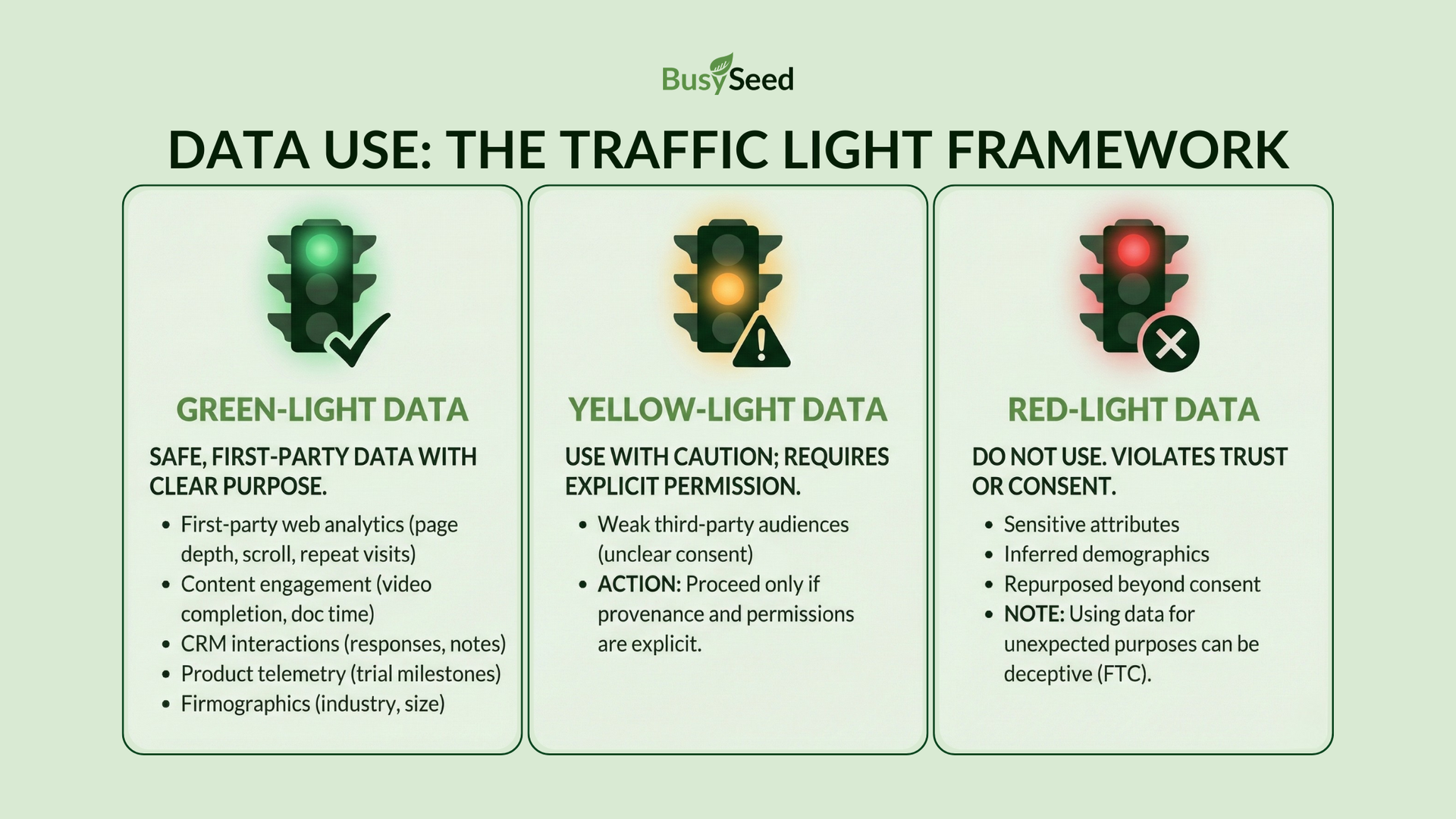
Use consented, business-relevant behavior and fit data; avoid repurposing personal data without explicit opt-in. The goal is accuracy with integrity while scoring leads against objective outcomes.
- Green-light data: First-party web analytics (page depth, scroll, repeat pricing visits), content engagement (video completion, doc time-on-page), CRM interactions (responses, meeting notes), product telemetry (trial milestones), and firmographics (industry, size).
- Yellow-light data: Weak third-party audiences without consent clarity; proceed only if provenance and permissions are explicit.
- Red-light data: Sensitive attributes, inferred demographics, or anything repurposed beyond the consent given. The U.S. Federal Trade Commission is blunt: using data for unexpected purposes without clear disclosure can be deceptive (FTC).
Trust pays off. IBM reports that 9 out of 10 consumers rank trust as the most important brand factor (IBM). Salesforce research cited by Berkeley shows that 92% are more likely to trust brands that clearly explain how they use data (Berkeley CMR). Practically, that means your scoring leads policy should include a
clean preference center,
explicit consent flows, and an
easy way to opt out of enrichment.
If you need a privacy-safe approach, consider AI lead scoring without personal data solutions. With the right architecture, you can weigh interactions, content depth, and account-level behavior while minimizing personal identifiers, reducing risk without giving up predictive power. This keeps you aligned with an ethical definition of lead generation while preserving performance in AI in marketing.
The essential guardrails for responsible AI
IAB research shows 50%+ of marketers use generative AI in marketing for content and targeting, most plan to expand next year, yet only about a third are increasing governance, while ~70% have seen glitches like bias or hallucinations. Bottom line: AI in marketing is potent, but you need an ethics spine that informs your definition of lead generation and your day-to-day process for scoring leads.
How to build an ethical, high-converting scoring program
Start with a collaborative blueprint, then iterate weekly. Here’s a seven-step playbook you can run now. It keeps your definition of lead generation honest and your scoring leads strategy sharp, without overreaching on data.
- Align on who you serve and where they struggle.
Define ICPs and buying committees by pain, not just persona. Connect these definitions to the definition of lead generation in your org: who enters the funnel, what actions qualify interest, and when a qualified lead merits human outreach. - Map consented intent signals.
Catalog high-, mid-, and low-intent actions across web, product, and CRM. Weight based on proximity to revenue. For example, pricing-page depth, ROI calculator completion, security-doc views, and trial activation beat a generic ebook download. This is the raw substrate for ethically scoring leads. - Implement transparent consent and preferences.
Add just-in-time disclosures where signals are captured, and centralize settings in a preference center. This strengthens AI in marketing outcomes, protects trust, and clarifies when someone is a qualified lead. - Choose and calibrate the model.
Start simple and explainable (logistic regression, gradient boosting with interpretable features) before you get fancy. Publish your feature list and fairness checks. This is where top-rated AI models for scoring leads based on intent signals shine, if they come with documentation, auditability, and the ability to remove sensitive attributes. - Agree on thresholds and handoffs.
Sales and marketing should co-own the definition of lead generation and a qualified lead. Decide what action scores justify outreach, what the SLA looks like, and the feedback loop. Then, A/B test thresholds to minimize false positives and negatives while scoring leads. - Personalize responsibly.
When you tailor content to intent, buyers notice. McKinsey reports that 71% expect personalization, and 76% get frustrated when they don’t receive it; one case showed that targeted AI messaging drove a +10% increase in engagement with privacy guardrails in place. Keep it value-first and consent-aligned within your AI in marketing playbook. - Monitor bias and drift.
Audit weekly. Track performance by segment. Build an “explain why” feature into the UI so ops and reps can see why a qualified lead scored the way it did. The IAB glitch rates underscore the need for continuous oversight in AI in marketing.
Want experienced hands to implement this backbone? Our team at BusySeed builds and monitors this end-to-end, from consent design to top-rated AI models for scoring leads based on intent signals to activation.
Start a conversation.
How do you measure lift without creeping out prospects?
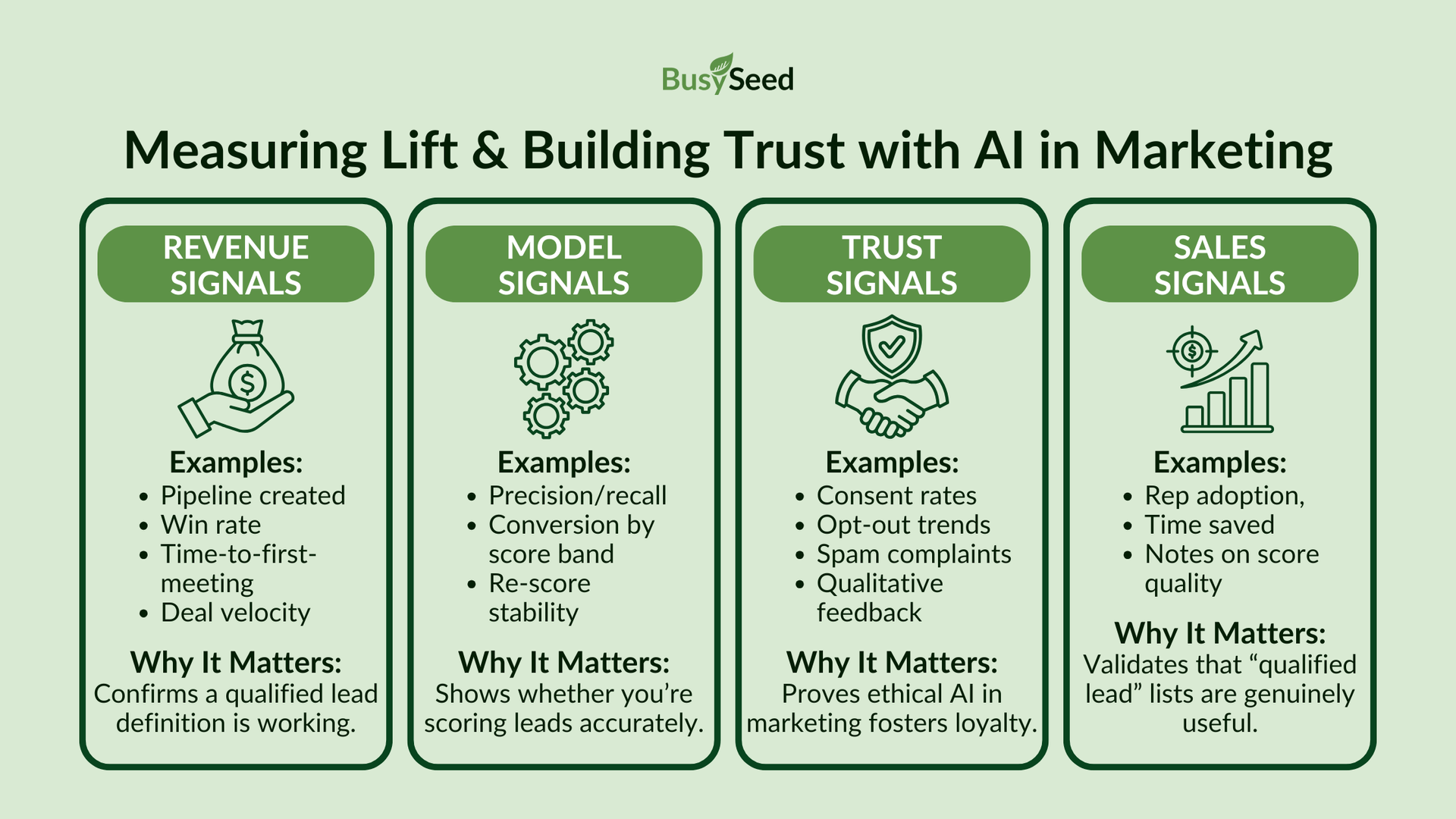
Pick business metrics and trust metrics, and report them together. That’s the balance you need in modern AI in marketing and in a transparent definition of lead generation.
Using AI in marketing doesn’t mean being opaque. Publish a one-page “How we use data” explainer. It builds confidence and reduces friction in privacy reviews while strengthening your public definition of lead generation.
Which tools and models actually work without risky data?
Prioritize transparency, explainability, and permissioned signals over black-box magic. You can get strong results with:
- Interpretable models for prioritization (logistic regression, gradient boosting with SHAP explanations) when scoring leads.
- LLMs for content classification (e.g., parsing sales notes, intent in free text) paired with red-team prompts and policy rails, guarded AI in marketing.
- Rules-based failsafes that cap volume or exclude sensitive cohorts before a qualified lead hits a rep’s queue.
When evaluating vendors, insist on demos of fairness testing, consent management, and exportable feature importance. If you want a curated list of the best AI tools for ethical lead qualification, we’ll tailor it to your tech stack and compliance needs. We also evaluate AI lead scoring without personal data solutions for clients who need safer defaults aligned to a modern definition of lead generation.
As you compare platforms, keep core questions front and center:
- Do they document the training data sources for their top-rated AI models for scoring leads based on intent signals?
- Can they support scoring leads with auditable features and reason codes?
- How do they handle data subject requests, data deletion, and model updates?
- Can they quantify the incremental lift in AI in marketing without expanding risk?
Want help pressure-testing vendors? Our strategists will sit with your team and assess trade-offs.
Book time with BusySeed.
How do new AI laws change your funnel math?
They make governance a revenue blocker or accelerant, your choice. Non-compliance risks fines and brand damage; compliant personalization wins trust and loyalty, and sharpens your definition of lead generation.
The EU AI Act sets strict rules and big penalties (up to €35M or 7% of turnover) for certain manipulative uses, while Brazil’s bill forbids exploiting user vulnerabilities (CMSWire). In the U.S., the FTC warns against opaque data repurposing (FTC). Practically, that means documenting data provenance, consent, and fairness tests, and being ready to show your work when scoring leads or declaring a qualified lead.
A counterintuitive benefit: organizations that invest in customer-centric privacy often see higher enterprise value and lower risk. A UVA Darden study found that stronger AI ethics correlated with better outcomes post-GDPR (UVA Darden). Ethical operations don’t just keep you safe, they make you sharper, especially when your AI in marketing stack is aligned to a clear and public-facing definition of lead generation.
What do “day-to-day” ethical operations look like?
It looks like structured routines that keep your models, data, and teams aligned, so your qualified lead criteria remain consistent, and your scoring leads process evolves with the market. In practice:
- Weekly: Review score distribution, segment performance, and rep feedback; update reason codes for edge cases tied to AI in marketing programs.
- Bi-weekly: Refresh lookback windows and top features; spot-test for drift in AI in marketing campaigns, and top-rated AI models for scoring leads based on intent signals.
- Monthly: Audit consent logs, review incident reports, and present a dashboard to Sales and Legal, showing how scoring leads correlates with revenue and trust.
- Quarterly: Re-baseline the definition of lead generation with updated buyer journeys; refresh your documentation to reflect reality and protect your qualified lead handoff.
On the customer side, be as transparent as you are accurate. Share your privacy page during onboarding, and keep it in plain language. It signals respect and competence and strengthens your overall AI in marketing narrative.
Mini-scenario: what “qualified” looks like now
A Director of Operations at a 500-person SaaS company has visited your site four times in two weeks, spending eight minutes on pricing and reading the security overview. They used your ROI calculator, then started a sandbox trial integrated with your API. They haven’t filled out a demo form.
In the old model, this buyer sits invisible and unqualified. In today’s model, they’re a qualified lead because your lead qualification system recognizes:
- Consent is logged from the calculator and trial.
- High-intent behaviors (pricing depth, security review, trial milestones) are weighted appropriately while scoring leads.
- A transparent outreach references the value they signaled interest in, no assumptions about their personal data, aligned with ethical AI in marketing.
That conversation starts faster and feels better (for everyone), and it aligns with a reality-based definition of lead generation.
The BusySeed difference
You want a partner who can pair rigor with results. BusySeed blends governance with growth, standing up top-rated AI models for scoring leads based on intent signals, a privacy-safe data architecture, and playbooks that keep your definition of lead generation honest. We’ll align stakeholders, implement AI lead scoring without personal data solutions where needed, and curate the Best AI tools for ethical lead qualification for your unique stack.
- Strategy and consent design that fits your brand and markets.
- Implementation of AI in marketing systems with explainable outcomes.
- Runbooks for reps so every qualified lead gets the right touch.
Curious where to start?
Talk to our team. We’ll make your funnel smarter, safer, and faster.
FAQ
Q1). What’s the simplest way to explain the definition of lead generation to my executive team?
It’s the process of attracting, capturing, and nurturing potential buyers who have explicitly or implicitly shown interest, measured by consented behaviors tied to business outcomes. Keep the definition of lead generation action-oriented: it’s about quality signals and readiness, not list size, and it’s the starting point for scoring leads into a true qualified lead.
Q2). Where does AI in marketing fit if our data is messy?
Use it to enrich structure, not to guess identities. Start by classifying content engagement, normalizing UTM and CRM notes, and summarizing calls, then layer predictive models. If AI in marketing is doing heavy lifting without clean input and consent, you’ll get fragile results and a brittle definition of lead generation. Clean inputs power accurate scoring leads.
Q3). How do we decide when someone becomes a qualified lead in our lead qualification process?
Co-define a threshold with Sales based on scored intent (e.g., repeated pricing visits, product milestones) and fit (ICP alignment). Publish the rules, test quarterly, and revisit after major product changes. Keep reason codes visible so reps understand why a qualified lead is prioritized, and ensure your AI marketing stack supports explainability in lead scoring.
Q4). Could we run AI lead scoring without personal data solutions if we sell to regulated industries?
Yes. You can prioritize accounts and sessions based on actions, channels, and content depth without storing sensitive identifiers. Ask vendors to demonstrate how they handle consent, retain data, and provide explanations for AI lead scoring without personal data solutions. This protects trust and upholds a privacy-first definition of lead generation while keeping AI in marketing productive.
Q5). What’s a practical first step if we’re starting from zero?
Document your current buyer signals, publish a one-page data-use explainer, and run a pilot that uses only consented, high-intent behaviors. Then present the results alongside trust metrics. This aligns your definition of lead generation with outcomes, demonstrates the value of AI in marketing, and sets the stage for adopting Top-rated AI models for scoring leads based on intent signals.
The takeaway (and your next move)
Ethical AI isn’t a constraint; it’s a competitive advantage. When you modernize qualification around transparent, consented intent signals, your teams stop chasing ghosts and start building a real pipeline. You’ll feel it in the calendar (better meetings), the forecast (cleaner commits), and the brand (more trust). If you’d like experienced hands to design your scoring, governance, and activation program, vet vendors, and shortlist the best AI tools for ethical lead qualification, or to implement AI lead scoring without personal data solutions, BusySeed is ready to help. Let’s build your next-generation funnel, responsibly and profitably: Connect with BusySeed.
Works Cited
- Berkeley Haas Center for Marketing and Research. “Balancing Personalized Marketing and Data Privacy in the Era of AI.” California Management Review, 2025, https://cmr.berkeley.edu/2025/02/balancing-personalized-marketing-and-data-privacy-in-the-era-of-ai/.
- Brixon Group. “Sales-Ready vs. Marketing-Qualified: Why This Distinction Can Sabotage Your Pipeline.” Brixon Group, 2025, https://brixongroup.com/en/sales-ready-vs-marketing-qualified-why-this-distinction-can-sabotage-your-pipeline/.
- CMSWire Staff. “Leveraging AI for Marketing While Protecting Customer Trust.” CMSWire, 2024, https://www.cmswire.com/digital-marketing/leveraging-ai-for-marketing-while-protecting-customer-trust/.
- Federal Trade Commission. “AI Companies: Uphold Your Privacy and Confidentiality Commitments.” FTC, 2024, https://www.ftc.gov/policy/advocacy-research/tech-at-ftc/2024/01/ai-companies-uphold-your-privacy-confidentiality-commitments.
- IAB (Interactive Advertising Bureau). “AI Adoption Is Surging in Advertising, But Is the Industry Prepared for Responsible AI?” IAB, 2024, https://www.iab.com/insights/ai-adoption-is-surging-in-advertising-but-is-the-industry-prepared-for-responsible-ai/.
- IBM Institute for Business Value. “Business Trends 2024.” IBM, 2024, https://www.ibm.com/thought-leadership/institute-business-value/en-us/report/business-trends-2024/.
- McKinsey & Company. “Unlocking the Next Frontier of Personalized Marketing.” McKinsey, 2023, https://www.mckinsey.com/capabilities/growth-marketing-and-sales/our-insights/unlocking-the-next-frontier-of-personalized-marketing.
- Venkatesan, Rajkumar. “AI in Marketing: What We Know and What We Don’t.” Ideas to Action (UVA Darden), 2024, https://ideas.darden.virginia.edu/ai-in-marketing.