Search engines prioritize content that demonstrates credibility, transparency, and proper sourcing. Ethical content strategies outperform manipulative tactics by building trust signals the algorithms favor.
TL;DR
- Trust is the strongest performance lever in SEO marketing: identity, evidence, and technical integrity drive sustainable SEO ranking and Google ranking.
- Google codified the shift: Policies penalize site reputation abuse, scaled content abuse, and shortcuts, making ethical SEO and ethical standards a competitive advantage (Google Developers).
- Backlinks from respected publications, visible author credentials, and airtight security are the trust signals that move revenue, not just vanity metrics (SEMrush).
- Utilize tools and operational checklists to scale trust, including governance, structured data, author verification, and performance monitoring.
- To achieve sustainable growth, align your content and engineering teams around trust. BusySeed can help you operationalize ethical SEO with precision.
Why are trust signals the deciding factor in 2026?
Because Google’s policies and real-world user behavior now favor credible content over manipulation. Trust acts as both a ranking input and a conversion multiplier. When you uphold ethical standards, invest in transparent authorship, and ship technically clean experiences, you accelerate SEO ranking and protect your Google ranking from volatility.
The shift is explicit. Google’s quality guidance emphasizes
people-first content and
trustworthiness, which raters treat as a core marker of top content. Helpful content without trust rarely wins. The updated site reputation abuse policy flags content designed to “exploit” a site’s signals as spam and emphasizes content “created to benefit people, not to gain search engine rankings” (Google Developers; see also a clear overview of trust cues from
SearchWorks).
Algorithms still use links and keywords, but their purpose is calibrated to reward ethical SEO, rigorous sourcing, and credible brands over noisy tactics. That’s the game now, and winning requires mature SEO marketing operations, not hacks.
How did Google make trust non-negotiable?
Manipulative tactics caused systemic search noise, prompting Google to tighten enforcement and clarify policy language. In 2024-2026, Google rolled out and enforced guidelines aimed at reducing low-value, scaled content and reputation arbitrage, thus reducing loopholes and making ethical standards the sustainable path.
- Site reputation abuse and scaled content abuse are enforced. Outsourced or spun content designed to exploit domain strength is tagged as spam (Google Developers).
- Expired domain abuse (buying old domains to pass “juice”) draws scrutiny and penalties (CMSWire).
- Helpful, original, well-sourced content is explicitly favored, content created to benefit people rather than to game the system (Google Developers).
Practically: Stop publishing for the crawler; write for the user, and prove credibility. This is the only route to durable SEO ranking and lasting Google ranking gains. That’s the essence of ethical SEO in modern SEO marketing.
How do algorithms evaluate trust across identity, evidence, and tech?
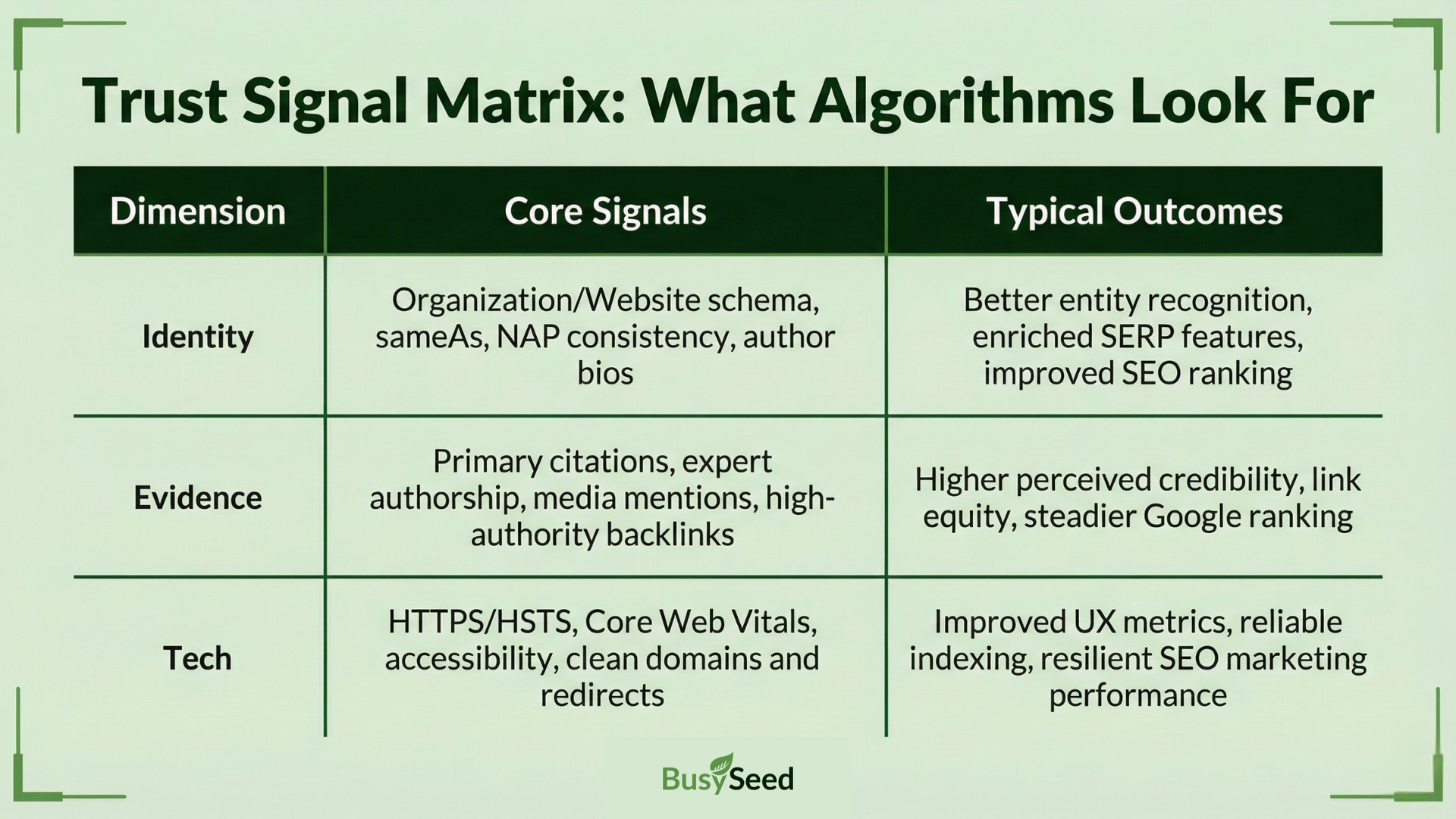
They triangulate brand identity, evidence of expertise, and technical reliability. Get all three right, and you become the default answer in your category.
- Identity: Clear brand architecture, Organization schema with sameAs links, consistent NAP, and verifiable authorship.
- Evidence: Credible citations, high-authority backlinks, expert authors, and media mentions that validate expertise.
- Tech: Page speed, security (HTTPS, no mixed content), clean domains, stable hosting, and accessibility; signals of legitimacy.
SEMrush frames trust signals in these three categories (SEMrush). Google’s quality guidance and industry benchmarking echo that expertise and verifiable sources are required in YMYL and beyond (Influencer Marketing Hub). When your identity is structured, your evidence is transparent, and your site is technically pristine, ethical SEO becomes a flywheel: stronger SEO ranking, higher engagement, and steadier Google ranking.
Trust Signal Matrix: What Algorithms Look For
What identity signals should you standardize this quarter?
Start with data that removes ambiguity. A clear identity makes your SEO marketing efforts easier to interpret algorithmically and strengthens ethical standards across the board.
- Implement Organization and Website schema with sameAs to authoritative profiles (LinkedIn, Crunchbase, GitHub, Wikipedia, if applicable). This is a foundational step in ethical standards.
- Publish complete About, Contact, and People pages. Include awards, certifications, and media logos; third-party proof builds trust for users and algorithms. See our approach on the BusySeed About page.
- Maintain consistent NAP across directories and knowledge panels. Consistency supports your Google ranking in local and non-local SERPs.
- Add verified author profiles to content templates. Include headshots, credentials, affiliations, and editorial roles. For YMYL content, credentials are non-negotiable; it’s ethical SEO and risk management combined.
Industry analysis shows well-known domains can rank beyond their core topics because their brand is trusted (Influencer Marketing Hub). Your job in modern SEO marketing is to ensure your brand is consistently recognized, verified, and coherent wherever it appears.
How should you present authorship and sourcing to pass the E-E-A-T sniff test?
Lead with expertise, then show your receipts. Every key page should make expertise and verification unmistakable.
- Feature a named author with credentials near the top and link to a complete bio.
- Add a “Reviewed by” section where appropriate. In YMYL content, a second expert review reinforces ethical standards and ethical SEO.
- Cite primary sources (e.g., .gov, .edu, recognized industry research). Use descriptive anchor text and explain why each source is authoritative.
- Provide published/updated dates. Freshness signals reduce doubt and support SEO ranking stability.
Example: A fintech guide authored by a CFA charterholder, reviewed by a CPA, citing IRS.gov and SEC.gov. That composition aligns with ethical SEO, elevates SEO marketing credibility, and tends to deliver headroom in Google ranking for high-stakes queries (Google Developers;
Influencer Marketing Hub).
Which backlinks and citations count as real endorsements?
Links from rigorous publishers and citations in trusted ecosystems. Not all links carry the same trust-weight.
- Government, academic, and major media (.gov, .edu, nationally recognized outlets). These scarce links meaningfully lift SEO ranking.
- Industry publications and trade associations. Byline contributions act as third-party proof, ethical standards verified by peers.
- Reputable Q&A and knowledge platforms. SEMrush found Quora highly cited in AI answers; a contribution to help the community, not to drop links (SEMrush).
- Authoritative directories and professional profiles. Curate the same as constellation: Crunchbase, BBB, standards bodies.
Strategic tip: Run quarterly backlink quality reviews. Remove spam, and replace quantity-chasing with relationship-led digital PR. Your Google ranking improves when your link graph looks like a serious brand, not a link farm. See how we approach digital PR in our
BusySeed case studies.
Why do manipulative tactics hurt your SEO ranking more than they help?
They leave fingerprints that models pick up on, and they teach users to mistrust you. Short-term spikes often lead to long-term suppression.
- Scaled content abuse: Mass-produced, thin content (often AI-spun). Google’s spam policy calls this out directly (Google Developers).
- Site reputation abuse: Bolting low-quality content onto a strong domain to “borrow” authority, explicitly spam by policy.
- Expired domain abuse: Buying domains for historical equity to publish unrelated content; a clear red flag (CMSWire).
If your approach isn’t anchored in ethical standards, you’re building instability into your SEO marketing. The upside of committing to ethical SEO is obvious: fewer ranking cliffs, healthier conversions, better brand equity, and compounding SEO ranking gains.
How do speed, security, and domain hygiene elevate your Google ranking?
They signal that you’re safe and reliable, and that users will have a smooth experience. Search favors reliability.
- HTTPS everywhere with HSTS and no mixed content. It’s table stakes for ethical standards and a fundamental factor in ethical SEO credibility (SearchWorks).
- Fast TTFB, low CLS, and stable LCP. Speed aligns with higher engagement and better SEO ranking performance.
- Consistent domains and clean redirects. Avoid spammy exact-match domains and unstable hosts. Stable domains correlate with better indexing and greater resilience to fluctuations in Google rankings (NameSilo).
- Hardening and observability: WAFs, bot filtering, uptime SLAs, structured logging. Rapid detection and resolution protect your SEO marketing outcomes.
Treat technical health like brand hygiene. It unlocks the full value of your content and supports ethical SEO in the long term.
What technical checklist should your team run monthly?
Use a concise, repeatable set of checks that reinforce ethical standards and catch drift early. Here’s a practical monthly “trust ops” pass:
- Security: Certificate validity, HSTS, mixed-content scans, CSP, dependency vulnerabilities.
- Performance: Core Web Vitals across mobile/desktop, cache hit ratios, image optimization, and preloading.
- Structured data: Organization, Website, Article, Person, Product, Review schemas validated and error-free.
- Content integrity: Authorship on new pages, expert reviewer tags on YMYL, primary-source citations, outbound link health.
- Crawl health: Index coverage, log anomalies, 4xx/5xx trendlines, robots, and sitemap alignment.
- Brand consistency: NAP checks, profile sync, press and awards modules updated, internal link freshness (start with your BusySeed blog hub).
- Backlink quality: New referring domains review, disavow queue (if needed), PR outreach health.
- Accessibility: ARIA roles, color contrast, keyboard navigation, and alt text coverage, ethical SEO includes inclusive design.
Run this consistently, and you’ll see steadier SEO ranking curves and fewer incidents threatening your Google ranking.
How do ethical standards translate into measurable SEO marketing ROI?
They reduce risk, improve conversion, and stabilize acquisition. Ethical SEO is not a moral luxury; it’s a performance framework.
- Lower volatility: Fewer algorithmic downgrades mean steadier pipeline forecasting, lifting the value of every top position in your SEO ranking.
- Higher conversion: Trust signals (authorship, badges, reviews) raise CTR and on-page conversion, more revenue per visit and stronger Google ranking outcomes.
- Better link economics: Quality PR and expert contributions yield compounding authority, less spend for stronger results in competitive SEO marketing categories.
- Team efficiency: Clear governance (style guides, sourcing rules, schema templates) creates reliable execution, minimizing rework and enabling ethical standards at speed.
Measure it with trust-weighted content velocity, link authority medians, SERP trust indicators, conversion lifts from trust UX, and incident-rate reductions. These metrics help leaders reallocate budget toward ethical SEO that compounds SEO ranking gains.
Which metrics prove that ethical SEO beats shortcuts?
- Post-update performance: Ethical SEO sites typically show smaller drawdowns and faster recoveries in Google ranking after core updates.
- Link longevity: Earned, high-authority links persist; purchased links decay.
- Content lifespan: Credible updates and expert edits extend shelf life and maintain SEO ranking.
- Complaint rate: Fewer policy warnings, spam flags, or deindexing events, healthier SEO marketing runway.
What are the best tools for evaluating content trust signals and building trust?
Tools don’t replace judgment, but they help you operationalize it at scale. For teams committed to ethical standards, the right stack streamlines validation and monitoring, protecting your SEO ranking without slowing content velocity.
What are the best tools for evaluating content trust signals?
- Schema and entity health: Google Rich Results Test, Schema.org validator, Knowledge Graph explorers for brand and author entities.
- Source verification: Link intelligence platforms and editorial SOPs to confirm reliance on primary sources.
- E-E-A-T coverage checks: CMS-embedded checklists to enforce authorship, reviewer roles, citations, and update cadence. Process is among the best tools for evaluating content trust signals.
- SERP feature auditing: Track rich results, knowledge panels, and news placements, trust-proxy indicators that impact Google ranking.
What are the best tools for building trust in SEO?
- Digital PR and outreach: Platforms for relevant bylines and mentions in top-tier publications, fuel for ethical SEO and sustained SEO marketing growth.
- Performance and security suites: CWV monitoring, WAFs, TLS validation, technical trust that stabilizes SEO ranking.
- Brand consistency monitors: Listings/profile sync to align your identity graph; vital for entity understanding and Google ranking.
- UGC and review management: Verified reviews and social proof bolster human trust alongside algorithmic signals.
If you want a practical package, ask for our
Top 2026 SEO trust signal checklists for websites. We’ll share the workflows we use at BusySeed to align content and engineering around ethical standards.
Where can you find the top 2026 SEO trust signal checklists for websites?
- BusySeed can tailor a set to your sector and stack. We’ve operationalized ethical SEO across SaaS, eCommerce, healthcare, and finance.
- Industry guides: SEMrush trust signal frameworks, Google’s people-first guidance, and SearchWorks technical trust pointers.
- Community resources: Professional associations publish checklists that dovetail with ethical standards (e.g., medical associations for healthcare YMYL). Align them to boost SEO credibility and protect Google rankings.
How do you roll this out across enterprise teams without slowing growth?
Start small, automate, and scale. Ethical standards shouldn’t create bureaucracy; they should become default behavior.
- Define the minimum viable trust standard: Authorship, citations, Organization schema, HTTPS, and CWV thresholds. Bake into CMS templates and CI.
- Align incentives: Make trust signals part of content acceptance criteria and engineering testing, no completion without schema and authorship.
- Centralize truth: Maintain a source of truth for author credentials, awards, and sameAs profiles.
- Measure relentlessly: Weekly dashboards for SEO ranking, Google ranking, link quality, and trust UX conversion.
- Train cross-functionally: Editorial, PR, product marketing, and DevOps share the same definitions and playbooks for ethical SEO.
What’s a 90-day plan BusySeed recommends?
We’ve implemented this at scale. Here’s a concise plan you can adopt now, or ask us to run for you.
90-Day Trust-First SEO Plan
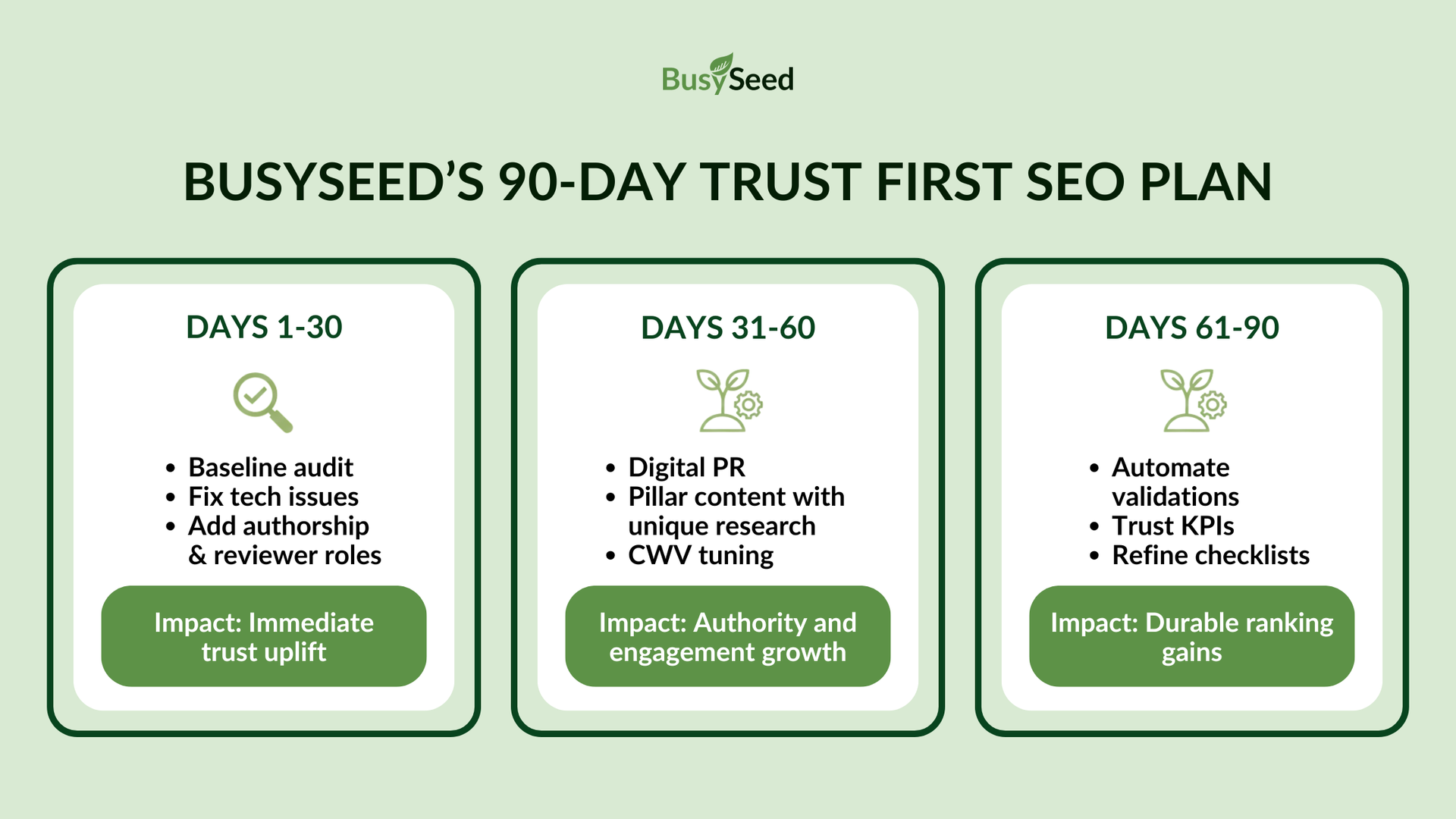
- Days 1-30: Baseline and fix the obvious
- Trust audit: Identity schema, authorship coverage, citation quality, CWV, HTTPS, and domain hygiene.
- Quick wins: Add Organization schema with sameAs, fix mixed content, publish author bios, set reviewer roles for YMYL, update About/Contact, surface awards, certifications, and reviews.
- Editorial governance: Add checklists to your CMS, define sourcing rules, and ban tertiary citations when primaries exist; ethical standards made tactical.
- Days 31-60: Build evidence and distribution
- Digital PR sprints: Secure 5-10 authoritative mentions or bylines, and focus on industry journals and standards bodies; ethical SEO that moves SEO ranking.
- Thought leadership: Commission expert-led pillar content with unique data. Publish methodologies to strengthen Google ranking.
- Technical smoothing: Tune CWV, set performance budgets in CI, SEO marketing gains that last.
- Days 61-90: Institutionalize and scale
- Tooling: Automate schema validation, link quality monitoring, CWV alerts.
- Measurement: Deploy trust-weighted content velocity, link authority medians, SERP trust indicators.
- Iterate: Refine checklists; map authors to topics by credentials, scale without entropy.
FAQ: Trust Signals, Policies, and Scalable Execution
Q1). What’s the fastest way to improve our Google ranking without risking a penalty?
Fix identity and tech first: Organization schema with sameAs, verified authorship on top pages, and HTTPS plus Core Web Vitals remediation. Then secure a small number of high-authority citations. This aligns with ethical standards, supports ethical SEO, and produces steady SEO ranking gains without volatility. It’s the smart path for modern SEO marketing teams.
Q2). Do author credentials really matter for non-YMYL content?
Yes. While YMYL requires stricter credentials, visible expertise, and transparent sourcing helps all content. Authorship clarity signals care and accountability, attributes that boost user trust, ethical SEO credibility, and ultimately your Google ranking. Expect incremental lifts in CTR and time on page, which ladder up to a stronger SEO ranking.
Q3). How many links do we need to outrank a competitor in 2026?
Fewer than you think, if they’re the right links. One strong industry journal citation can outweigh dozens of low-quality links. Focus on relevance and authority to align with ethical standards. This is the essence of ethical SEO: win with genuine endorsements that reinforce your SEO marketing narrative and strengthen your Google ranking over time.
Q4). Which weekly checklist should editors use to support E-E-A-T and entity trust?
Use our top 2026 SEO trust signal checklists for websites or build your own: authorship present, credentials verified, primary sources cited, dates updated, schema validated, accessibility reviewed, and internal links refreshed. This routine compounds SEO ranking gains, protects ethical standards, and supports ethical SEO across your entire SEO marketing cadence.
Q5). What are the best tools for building trust in SEO for a small team on a budget?
Start with schema validators, a Core Web Vitals monitor, a citations SOP baked into your CMS, and a lightweight PR outreach kit targeting 10 relevant publications. That foundational set accelerates ethical SEO, lifts SEO ranking, and protects your Google ranking without heavy overhead, making it perfect for streamlined SEO marketing teams. If you want a head start, contact BusySeed for a right-sized stack.
The bottom line: Trust is a growth strategy; execute it with intent
The winners in 2026 aren’t tricking algorithms, they’re partnering with them. When you operationalize ethical standards, showcase real expertise, and keep your house in technical order, your brand earns its place at the top. Ethical SEO is faster in the long run because you spend less time recovering from penalties and more time compounding gains. That’s the future of SEO marketing: efficient, credible, and aligned with user value.
If you’re ready to turn trust into your advantage, BusySeed is here to help. We’ll audit your trust signals, tune your technical stack, and build an editorial and PR engine that elevates your SEO ranking and Google ranking without shortcuts. Let’s make ethical SEO your competitive edge. Explore our
services, dive into
client results, or start a conversation on our
contact page. If you prefer, begin with a trust-focused growth plan here:
BusySeed.
Works Cited
- “Site reputation abuse and our approach to it.” Google Developers, 8 Nov. 2024, https://developers.google.com/search/blog/2024/11/site-reputation-abuse. Accessed 6 Jan. 2026.
- “Improving Trust Signals for Better SEO.” SearchWorks, https://searchworks.ph/improving-trust-signals-for-better-seo/. Accessed 6 Jan. 2026.
- “AI Search Trust Signals: Identity, Evidence, and Tech.” SEMrush Blog, https://www.semrush.com/blog/ai-search-trust-signals/. Accessed 6 Jan. 2026.
- “SEO Benchmark Report: E-E-A-T, Authorship, and Rankings.” Influencer Marketing Hub, https://influencermarketinghub.com/seo-benchmark-report/. Accessed 6 Jan. 2026.
- “Algorithmic Trust: How Search Engines Quantify Domain Credibility in 2025.” NameSilo Blog, https://www.namesilo.com/blog/en/seo/algorithmic-trust-how-search-engines-quantify-domain-credibility-in-2025/. Accessed 6 Jan. 2026.
- “Google’s Updated Spam Policies and Their Impact on SEO.” CMSWire, 2024, https://www.cmswire.com/the-wire/actual-seo-media-inc-highlights-impact-of-googles-updated-spam-policies-on-seo/. Accessed 6 Jan. 2026.