
Stop publishing content that AI already knows. This information shows you how to identify and replace generic content with unique, experience-driven narratives that only your brand can own.
TL;DR
- Audit and prune 30-50% of underperforming web content, then reinvest in marketing and content only your brand can credibly publish.
- Rebuild your marketing content strategy around proprietary data and narrative, not commoditized tutorials or listicles.
- Use AI to accelerate content creation and QA, not to replace your point of view or expertise.
- Design for Generative Engine Optimization so answer engines cite you: target real questions, show proofs, and earn mentions.
- Personalize journeys by role and intent to spark better content ideas and measurable lift across the pipeline.
Why is most content invisible today, and what changes by 2026?
Because most web content adds nothing new. One analysis found roughly 96.6% of pages get no Google traffic, signaling that generic, copyable posts are DOA (StudioID). That pressure intensifies as AI floods search with answer-style text. To win in 2026, you’ll need differentiated content creation and content ideas backed by experience, data, and tangible proof, and a marketing and content strategy that prioritizes originality.
AI doesn’t just create more noise; it raises the bar for what gets cited. Research points to a glut of low-value pieces and a growing premium on authentic storytelling and brand expertise (StudioID). Google underscores the same: E‑E‑A‑T (Experience, Expertise, Authoritativeness, Trust) and helpfulness come first, regardless of how a piece of web content is produced. The signal is clear: come up with content ideas, build a content strategy based on what only your team knows, then use AI to speed up the mechanics of content creation, not to replace your point of view.
How do you audit and prune obsolete assets without killing SEO?
Start by identifying pages that can’t be rescued. If a piece has thin insights, overlapping topics, or no differentiation, and it doesn’t serve a strategic purpose, retire it or consolidate it into a stronger page. A confident content strategy values quality over quantity and helps you develop focused content ideas that answer real questions with evidence.
Here’s a practical 5-step audit flow:
- Inventory everything. Pull a list of URLs with traffic, conversions, referring domains, and the last updated date. Include formats beyond blogs. Product docs, partner pages, and FAQs are also web content.
- Grade marketing and content uniqueness. Mark assets with proprietary data, first-person case studies, or a novel point of view. If it’s just a how-to that competitors also wrote, flag it as vulnerable to pruning by your content strategy.
- Map to intent and lifecycle. Tie each asset to a stage (problem, solution, selection, success) and to a real persona. If it doesn’t help a specific buyer at a specific moment, your content creation is better invested elsewhere.
- Update, consolidate, or remove. Update what’s salvageable with fresh insights; consolidate duplicates into a single definitive resource; remove dead weight to improve site quality and crawl efficiency for mission-critical web content.
- Add AEO elements. Create concise, citable definitions and snippets per page. Reference evidence and cite authoritative sources so that answer engines can trust and quote you. This is Answer Engine Optimization in action and a pillar of Generative Engine Optimization.
Why the intricate cuts? Because teams waste time trying to revive pieces that were never strategic. Shift those hours into a few anchor assets supported by distribution. Stakeholders will appreciate that your content strategy emphasizes outcomes rather than volume. Evidence backs the move: producing fewer, higher-value assets beats pumping out more of the same (StudioID). And Google’s guidance is consistent: helpful web content with E‑E‑A‑T wins (Google Search Central).
Data points that set your thresholds
- 96.6% of pages get zero Google traffic; generic topics rarely rise without unique insight (StudioID).
- Google ranks helpful web content rooted in E‑E‑A‑T, not “AI for AI’s sake” (Google Search Central).
- Social video is growing (accounting for over 10% of U.S. digital media time), and LinkedIn remains the top ROI channel for B2B distribution (StudioID).
Want a second set of eyes on your inventory? Our team can run a swift audit and ROI forecast for your top 100 URLs, an immediate upgrade to your content strategy and content creation roadmap.
Talk to BusySeed.
Build a 2026-ready program around proprietary insight
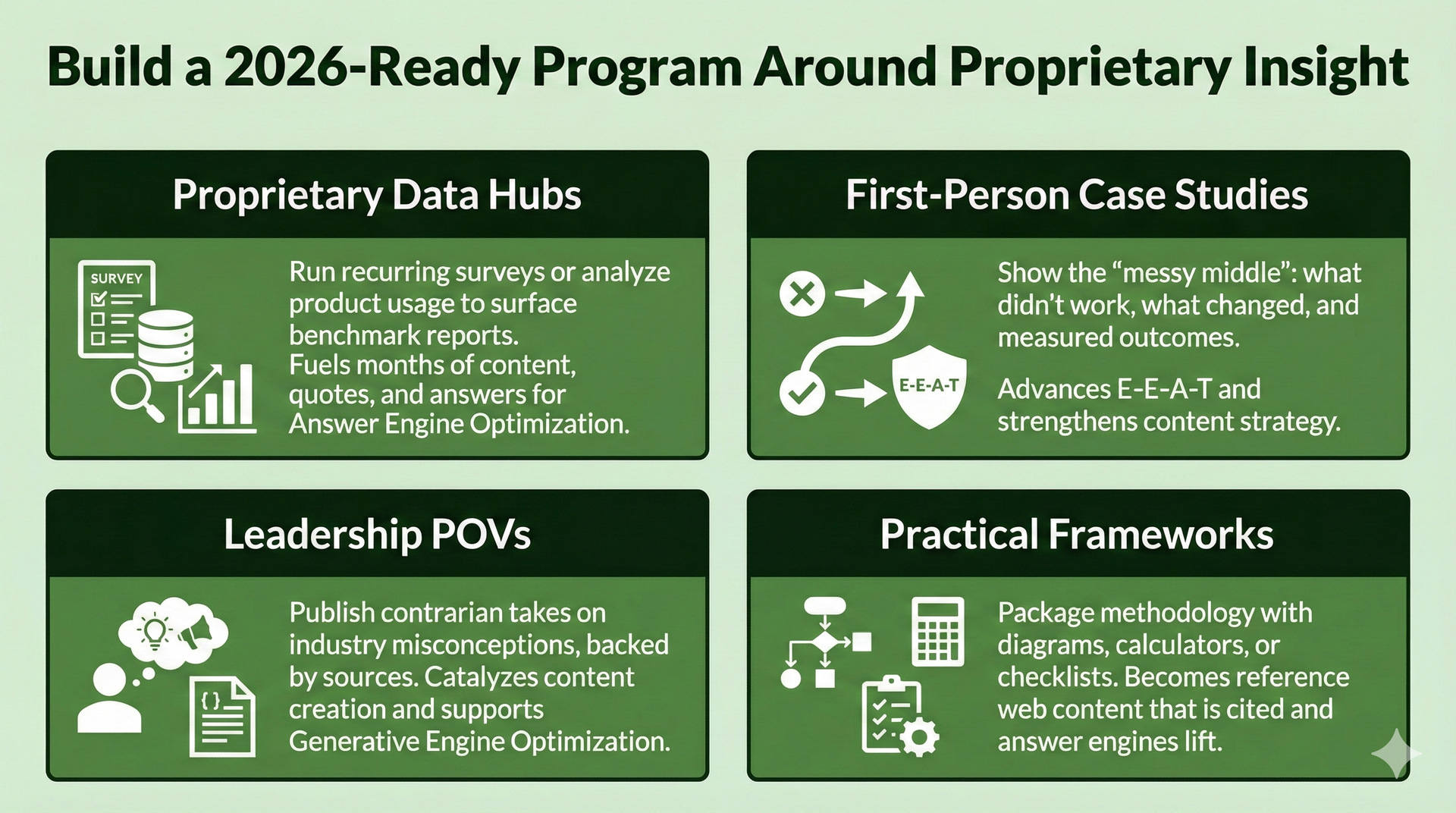
Anchor your marketing and content strategy to what only you can know or say. That’s the heart of durable content creation: your data, your customer results, your domain experience. This is the kind of web content that earns citations and links, and powers Generative Engine Optimization.
- Proprietary data hubs. Run recurring surveys or analyze product usage to surface benchmark reports. Each report can fuel months of content ideas, quotes, charts, and succinct answers for Answer Engine Optimization.
- First-person case studies. Show the messy middle: what didn’t work, what you changed, and the measured outcomes. This advances E‑E‑A‑T and strengthens your content strategy.
- Leadership POVs. Publish contrarian takes on industry misconceptions and back them with sources. These catalyze content creation across formats and support Generative Engine Optimization.
- Practical frameworks. Package your methodology with diagrams, calculators, or checklists. These become reference web content that other sites cite, and that answer engines lift.
This approach raises the floor and the ceiling. Your marketing and content creation no longer start from a blank page, and your output is harder to replicate. It also gives marketing and content stakeholders a shared source of truth, so there are no more random acts of web content. And it sets up your Generative Engine Optimization efforts for sustained wins.
Tell authentic stories that scale trust
Tell the truth, fast, and show your work. More than half of marketers say “telling more engaging stories” is a top priority (StudioID). Story is not fluff; it’s a precision tool that turns dense proofs into memorable, GEO‑friendly web content.
Use this simple frame in your content strategy:
- Context: the stakes and constraints in your buyer’s world
- Conflict: the blocker or risk they face
- Choice: the decision and tradeoffs
- Change: the measurable impact (before/after snapshots)
Back claims with citations and customer quotes. Add a short “What we’d do differently next time” coda to deepen authenticity. Google’s E‑E‑A‑T favors lived experience, and answer engines look for sources that sound first-hand and verifiable (Google Search Central). Stories built this way strengthen content creation, give your content strategy a compass, and fit the needs of Generative Engine Optimization.
Personalize in depth without creeping out your buyers
Use first-party data with consent, and personalize for context, not novelty. A global survey found that 80% of consumers are comfortable with personalized experiences when brands are transparent and helpful (Boston Consulting Group). Yet many teams still do only “basic” personalization (like a first-name token), which people ignore (Content Marketing Institute).
Three practical layers to fold into your marketing and content strategy:
- Industry layer: publish sector-specific web content with regulations, benchmarks, and tech stacks in mind.
- Role layer: translate benefits into the metrics that matter to the CFO, VP Ops, and technical buyers.
- Intent layer: recognize signals like pricing page visits or integration doc views and route to next-step content.
Effective personalization should feel like expertise applied to me, not surveillance of me. With progressive profiling, segmented nurture paths, and dynamic modules, your web content becomes useful, your content creation becomes targeted, and your Generative Engine Optimization signals become clearer.
Use AI as a creative tool without losing your voice
Let AI speed up the boring parts; keep humans on the meaningful ones. Over half of marketers use AI for text-based tasks such as outlines and quality checks, while only a tiny share let AI write full pieces (HubSpot). That is the right balance for a resilient content strategy and trustworthy content creation.
A pragmatic workflow that supports Answer Engine Optimization and Generative Engine Optimization:
- Research assist: prompt for sources, counterarguments, and topic gaps, then verify and add your perspective.
- Draft scaffolding: generate structures, headline variations, and meta descriptions; editors tune voice.
- QA guardrails: use AI for grammar checks, link checks, and style consistency; humans confirm accuracy and E‑E‑A‑T.
Google warns against web content produced primarily to manipulate search, regardless of the tool used (Google Search Central). Keep your content ideas grounded in proof. Make your content strategy explicit: voice, claims thresholds, and a minimum bar for original insight.
Optimize for the AI-driven search era (AEO and GEO)
Write to be cited, by people and by answer engines. SEMrush frames Answer Engine Optimization as designing web content to be included in AI-generated summaries: target real questions, offer concise, sourced answers, and earn mentions from reputable sites. This practice powers Generative Engine Optimization and helps your content creation get discovered in AI overviews.
- Question clusters: Build pages around 5-10 specific questions each persona actually asks. Create concise answer boxes with data points, then elaborate below, classic Answer Engine Optimization that supports Generative Engine Optimization.
- Evidence-first claims: Link to primary sources (.gov, .edu, peer-reviewed, or reputable industry studies) for credible web content.
- Unique, quotable assets: Publish original charts, definitions, and methodologies that answer engines can pull.
- Entity clarity: Use consistent names for products, industries, and problems; consider schema for extra context.
- Distribution to earn mentions: Pitch takeaways to newsletters, analysts, and partners so your content strategy earns citations beyond your site.
A senior Google executive recently reiterated that AI-enhanced search aims to expand discovery, not reduce it (Reuters). In other words, well-crafted web content still gets clicks, especially when your content creation aligns with Answer Engine Optimization and your broader Generative Engine Optimization strategy.
Formats and channels that matter most for 2026 performance
Go multi-format and meet buyers where they learn. Social video already claims over 10% of U.S. digital media time, and 84% of B2B marketers say LinkedIn delivers top ROI in distribution (StudioID). Use these signals to inform your content strategy and repurposing plan, so every piece of web content works harder.
- Executive briefs: 600-900 words with a one-paragraph “Answer Box” up top for Answer Engine Optimization.
- Interactive calculators: codify your methodology into inputs/outputs; excellent for content ideas that capture intent.
- Video explainers: 60-180 seconds with a single claim and a single proof, web content ready for social feeds.
- Podcast mini-episodes: 10-15 minutes on one research finding and its implications.
- Sales-ready one-pagers: role-specific distillations with metrics, primed for Generative Engine Optimization snippets.
Best tools for creating 2026 GEO-ready content
You don’t need 50 tools; you need the right stack for repeatability and trust. Here’s a lean lineup many expert teams use to come up with stronger content ideas and strengthen web content impact through Generative Engine Optimization and Answer Engine Optimization:
- Research and validation: SEMrush or Ahrefs for questions, SERP features, and gaps; manual source vetting for E‑E‑A‑T (SEMrush).
- Data storytelling: Looker Studio (or similar) for charts you can cite; always label sources.
- Editorial operations: a CMS with reusable components for “answer boxes,” FAQs, and citations, core building blocks of Answer Engine Optimization.
- AI assistance: tools for outlines, grammar QA, and summarization; configure brand prompts to keep content creation aligned to your content strategy.
- Measurement: dashboards that connect web content to revenue (URLs → assisted pipeline, not just traffic).
If your team wants help installing a right-sized stack, audit to activation, BusySeed can get you there without bloat.
Start here.
Top strategies for optimizing GEO ready content in 2026
Treat Generative Engine Optimization like a design system for answers. These moves make your web content irresistible to both buyers and answer engines, and they keep your content creation focused on outcomes aligned to your content strategy:
- Lead with the succinct answer, then show the receipts (citations, charts, first-party data).
- Build question trees for each persona and stage, and map each to a specific URL to strengthen Answer Engine Optimization.
- Standardize “evidence modules”: a stat, a quote, a customer example, and a link to primary research.
- Ensure entity clarity with consistent naming and schema where it adds context.
- Pursue mention-building: guest posts, analyst quotes, and partnerships that reference your unique definitions and data.
Top resources for 2026 GEO content marketing
Follow a small set of authoritative resources to keep your content strategy current and your content creation practices aligned to Answer Engine Optimization and Generative Engine Optimization:
- Google Search Central on AI, helpful content, E‑E‑A‑T, and spam policies.
- SEMrush on Answer Engine Optimization playbooks and experiments.
- StudioID on trends and distribution insights.
- HubSpot on AI adoption in marketing and content.
- Boston Consulting Group on consumer personalization thresholds.
- Content Marketing Institute on B2B content process benchmarks.
- Reuters on AI search and discovery patterns.
90-day plan to future-proof your program
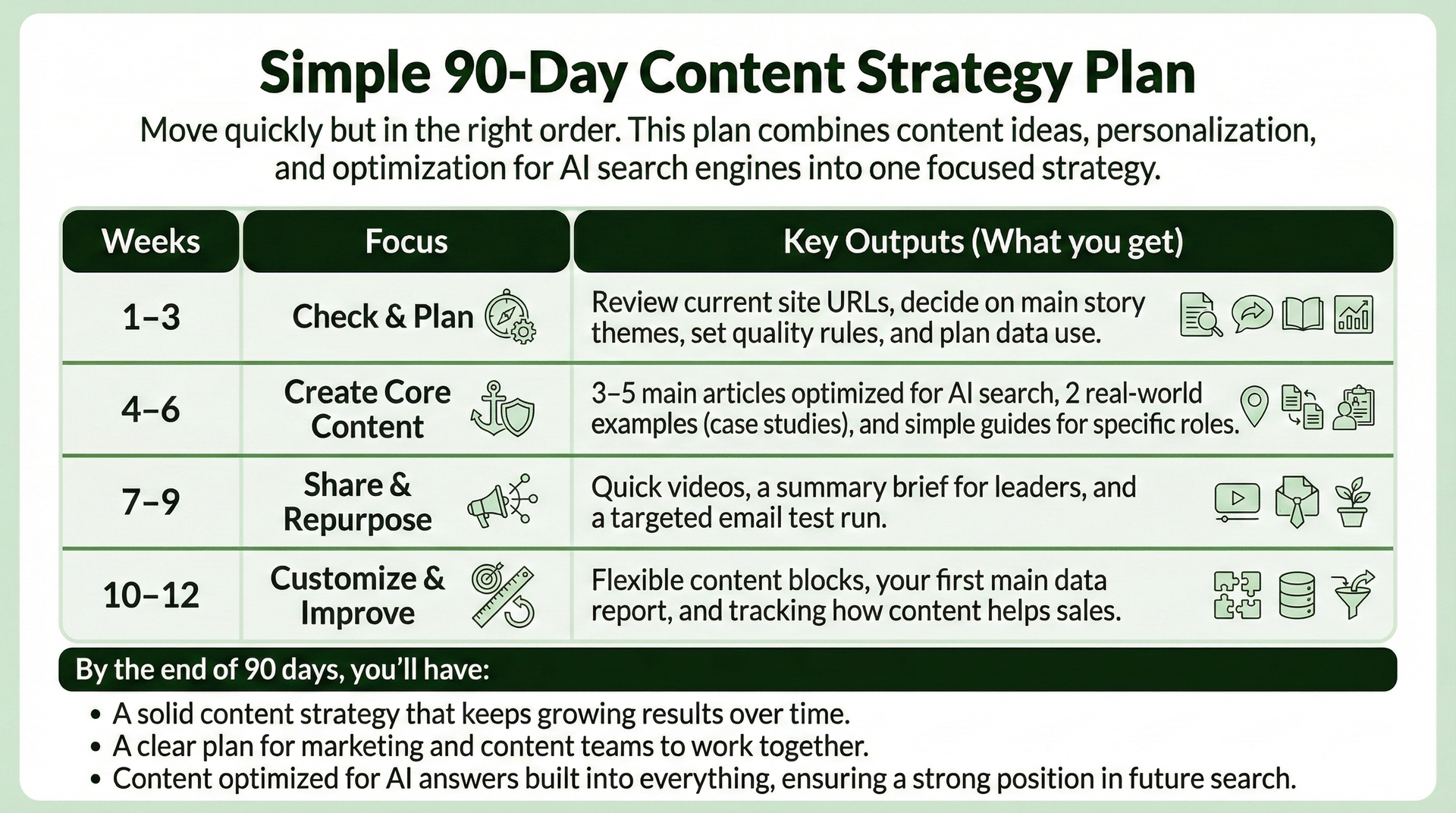
Move fast, but sequence well. This plan ties together content ideas, personalization, Answer Engine Optimization, and Generative Engine Optimization into a focused content strategy.
By the end of 90 days, you’ll have a working, defensible content strategy that produces compounding returns. You’ll also have a clear roadmap for how marketing and content collaborate, with Answer Engine Optimization patterns baked into every piece of web content and a strong Generative Engine Optimization posture.
Quick reference checklist
- Prune ruthlessly; consolidate overlapping web content.
- Center your content strategy on proprietary data, case studies, and POVs.
- Use AI for speed, not for voice; keep human editors in the loop for content ideas and content creation.
- Structure pages for Answer Engine Optimization; publish quotable assets for Generative Engine Optimization.
- Personalize with consent, by industry, role, and intent.
- Measure assisted pipeline, not just traffic.
- Refresh anchors quarterly with visible “last updated” notes.
FAQ
What’s the difference between Answer Engine Optimization and Generative Engine Optimization, and why should I care?
Answer Engine Optimization focuses on making specific answers easy to extract and cite by AI and search features, while Generative Engine Optimization covers the broader practice of structuring web content so generative systems can summarize, attribute, and link back. Together, they keep your content creation focused on verifiable, succinct insights and align your content strategy to how discovery works now (SEMrush; Google).
How often should I refresh high-value pages for Answer Engine Optimization and Generative Engine Optimization?
Quarterly for anchors, or when data, regulations, or product capabilities materially change. Include a “last updated” note and a short changelog. These refreshes reinforce E‑E‑A‑T and improve your chance of being cited, strengthening your content strategy and your ongoing content creation workflow (Google Search Central).
Do I need to gate proprietary reports to see ROI on web content?
Often, no. Use a mixed model: ungate the executive summary, data highlights, and methodology (great for Answer Engine Optimization and Generative Engine Optimization) while gating the workbook or templates. This sustains your content creation flywheel and aligns with a performance-minded content strategy.
What metrics prove my content strategy is working in 90 days?
Reasonable targets include: reducing low-value web content by 20-30% without losing traffic; increasing non-branded queries by 15-25% to anchor pages; earning 10-20 new referring domains citing your definitions or data; and lifting influenced opportunities by 10-15% tied to anchor assets. Set baselines up front and review weekly (StudioID).
How can small teams keep up with Generative Engine Optimization without burning out?
Narrow focus. Ship 3-4 answer-led anchor pieces around your strongest POV; then repurpose across formats. Use AI for outlines, research prompts, and QA; keep humans on voice and accuracy. This approach concentrates content creation and strengthens your content strategy while keeping your web content fresh and citable (HubSpot; CMI).
Summary: Your 2026 edge comes from what only you can say
The future favors the specific, not the generic. Audit ruthlessly, then rebuild around proprietary insights, first-person stories, and structured answers your market and answer engines can trust. Personalize with care, and let AI speed the mechanical parts of marketing and content while your experts set the bar for truth and clarity. With a thoughtful content strategy tuned for Answer Engine Optimization and Generative Engine Optimization, your web content won’t just survive the next wave; it will lead it.
If you want a partner who blends strategy with sleeves‑rolled‑up execution, BusySeed is ready. Let’s
audit your program, design GEO-ready standards, and ship the first 90 days of proof together. Connect with our team.
Works Cited
Boston Consulting Group. “What Consumers Want from Personalization.” 2024, https://www.bcg.com/publications/2024/what-consumers-want-from-personalization.
Content Marketing Institute. “B2B Content Marketing: Benchmarks, Budgets, and Trends.” 2024, https://contentmarketinginstitute.com/b2b-research/b2b-content-marketing-trends-research.
Google Search Central. “Google Search and AI Content.” 2023,
https://developers.google.com/search/blog/2023/02/google-search-and-ai-content.
HubSpot. “State of AI in Marketing.” 2024, https://blog.hubspot.com/marketing/state-of-ai-report.
Reuters. “Google Executive Sees AI Search Expanding the Web.” 4 Dec. 2025, https://www.reuters.com/business/media-telecom/google-executive-sees-ai-search-expansion-web-2025-12-04/.
SEMrush. “Answer Engine Optimization (AEO): What It Is and How to Do It.” 2024, https://www.semrush.com/blog/answer-engine-optimization/.
StudioID. “6 Vital Content Marketing Statistics You Need to Know for 2024.” 2024, https://www.studioid.com/springboard/trends/6-vital-content-marketing-statistics-you-need-to-know-for-2024/.