Learn to build a digital presence so robust that even a major algorithmic shift can't erase your brand from the user's mind or the AI's knowledge base. A true visibility resilience strategy.

TL;DR
- Generative search is rewiring discovery. AI answers and zero-click results are accelerating, so “rankings” alone won’t protect the pipeline; GEO gives you resilience.
- If you’re asking what does geo mean in 2025, it’s Generative Engine Optimization, how your brand gets cited in AI answers across ChatGPT, Gemini, Perplexity, and beyond.
- The quickest wins come from restructuring content into Q&A blocks, implementing schema, and deploying generative engine optimization tools to monitor AI citations.
- Expect smaller but higher-intent traffic from geo search and AI referrals; early adopters are reporting 23%+ conversion uplifts and triple-digit growth in AI-driven visits.
- BusySeed’s generative engine optimization services operationalize the playbook, technical fixes, content reformatting, and authority-building, to stabilize visibility when algorithms shift.
Why is GEO suddenly mission-critical?
Because buyers now get answers from AI first. Generative-AI traffic is growing 165× faster than organic search, according to a WebFX analysis of more than 1 billion sessions (WebFX). Semrush tracked 4.5 billion visits to ChatGPT in May 2025, with ~555 million unique users, up sharply from late 2024 (Semrush). In the U.S., around 15 million adults already use a GenAI tool as their primary search, projected to reach ~36 million by 2028 (Statista). If your brand isn’t cited in these answers, you’re invisible where the question starts.
What does GEO mean for leaders under pressure?
GEO stands for Generative Engine Optimization. If you’ve ever asked yourself what does geo mean in today’s search landscape, think “how my content gets quoted by AI answers,” not just “how my page ranks.” In practice, what is generative engine optimization? It’s the discipline of structuring content, data, and authority signals so that large language models (LLMs) and answer engines surface your brand as a trusted source.
The immediate goal isn’t only to climb classic blue links. It’s to appear, by name, in ChatGPT, Gemini, and Perplexity responses, in Google’s AI Overviews, and in geo search experiences where local or contextual intent matters. That’s why the smartest teams are investing in generative engine optimization services to build an “answer-ready” content system. Done right, GEO becomes your safety net when rankings wobble.
Reference points:
- Roughly 60% of Google searches ended without a click in 2024 (AI Page Ready). AI Overviews and similar features summarize first and link later (Kalicube).
- Authority wins. Semrush found ChatGPT referrals skew to strong brands, Oracle gets ~9.4% of its traffic from ChatGPT, while Google.com gets ~0.21% (Semrush).
- AI-discovered visitors convert ~23% better than typical organic traffic (WebFX). Early adopters report AI referrals jumping 1,400% in 28 days with GEO tactics (Relixir), with others seeing 800% YoY gains (RankNashville).
How is search changing under our feet?
Two sentences first: AI answer engines condense results into one coherent summary, not ten links. Your brand gets visibility when the model chooses you as a source, cited, quoted, or linked.
Consider the arc:
- Zero-click is normal. More than half of queries now end on the results page, especially when an AI overview provides a complete answer (AI Page Ready; Kalicube).
- Users are shifting time and trust. ChatGPT usage keeps rising (Semrush), and 44% of Americans have already used AI search to learn/explain concepts (Statista).
- Assistants are the new front door. Google continues to expand AI Overviews; Microsoft’s Copilot/Bing Chat is evolving weekly; and Apple is moving toward a ChatGPT-enhanced Siri (MacRumors). Voice and chat will increasingly rely on your structured, authoritative content.
This makes a crisp case for what is generative engine optimization: if you want your expertise to survive channel changes, engineer it to be “model-consumable,” not just “crawler-crawlable.”
How do you apply GEO in the real world, fast?
Short answer: Reformat content into question/answer blocks; add HowTo/FAQ schema; cite authoritative sources; and monitor how often AI mentions you. Then iterate.
1) Re-architect your content for LLMs
- Start every major page with 1-2 plain sentences that answer the primary question. If a PM asked for “Solutions for data-driven generative optimization?” your page should answer it in the first 40-60 words.
- Convert long paragraphs into Q&A sections and concise bullet points. This helps models extract answers cleanly.
- Roll out FAQ and HowTo schema on key pages, this is a staple in generative engine optimization tools playbooks because structured data makes your content easier for AI to understand (WebFX).
- Go deep. Cover adjacent questions and follow-up intent using content-centric intent mapping (APIMagic). In GEO, depth trumps density.
2) Build and signal authority
- Make sure your brand’s Wikipedia page (if eligible) and knowledge-graph entities are accurate; Wikipedia remains a premier trust indicator for AI (SurfGEO).
- Earn coverage and quotes in reputable publications; LLMs heavily weight recognized sources (Semrush). Publish exclusive data, calculators, benchmarks, or “micro-tools” that AI can cite.
- Secure high-quality backlinks, .edu, .gov, and mainstream media remain durable authority signals.
3) Validate and improve your AI presence
- Use generative engine optimization tools and run synthetic queries: ask ChatGPT, Gemini, and Perplexity your money questions, do they mention you? How? How often?
- Track an “AI Generative Appearance Score”: frequency and quality of mentions across answer engines (RankNashville).
- Watch tone and accuracy. If an AI explanation misstates your offering, fix your source pages and supporting citations.
4) Optimize for geo search and local context
- Many AI queries include location or context terms. Create local FAQs (e.g., “Solutions for data-driven generative optimization”). Populate Google Business Profile with rich details; maintain NAP consistency.
- Produce short-form videos and transcripts on YouTube, LinkedIn, and even TikTok, Gen Z already prefers social for certain searches (Search Engine Land). These assets feed LLM knowledge and lift your odds of being cited in geo search.
If you want a partner, BusySeed’s
generative engine optimization services help you deploy all four pillars quickly. We pair technical implementation with editorial muscle and authority outreach so your brand is citation-ready across channels.GEO: Your Safety Net When Rankings Drop
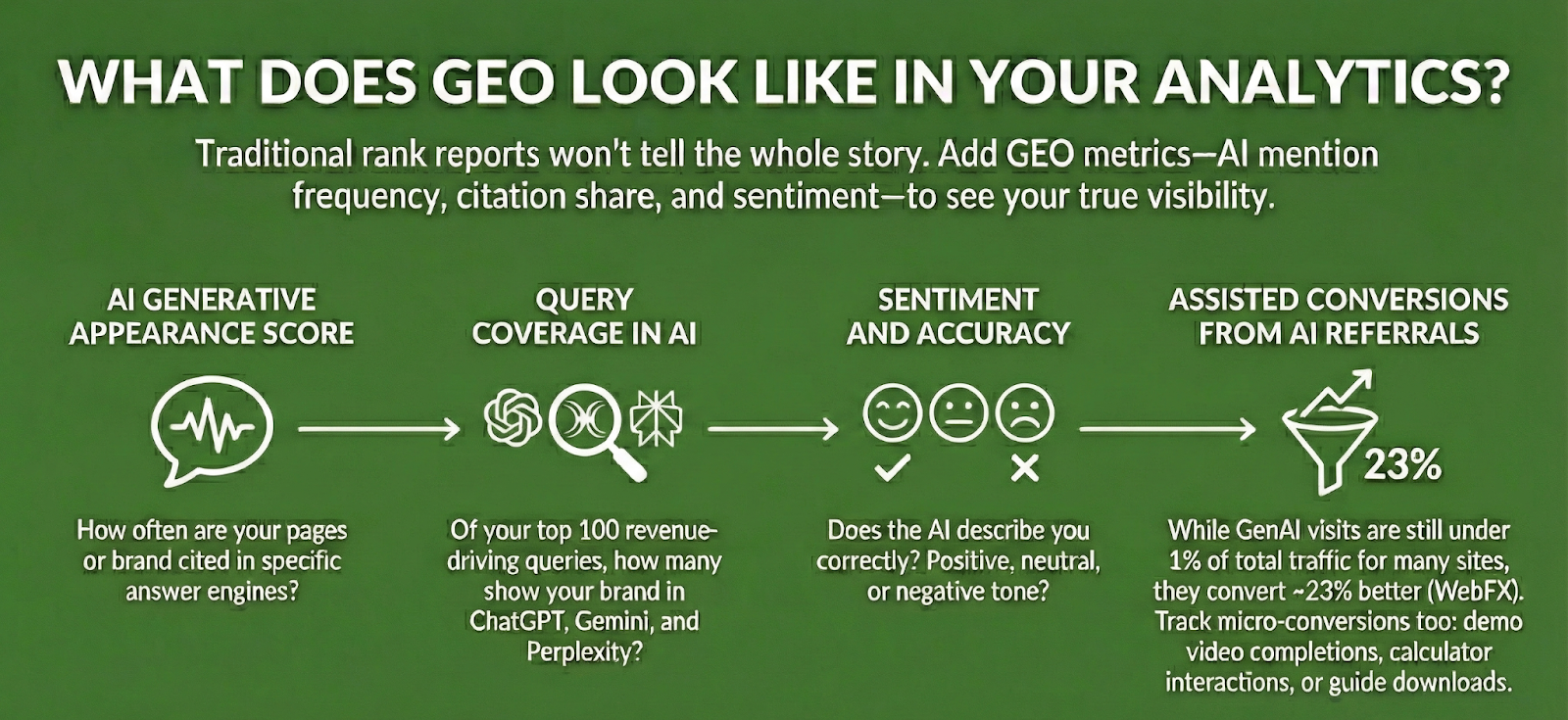
What does GEO look like in your analytics?
Two sentences first: Traditional rank reports won’t tell the whole story. Add GEO metrics, AI mention frequency, citation share, and sentiment, to see your true visibility.
Practical KPIs:
- AI Generative Appearance Score: How often are your pages or brand cited in specific answer engines?
- Query coverage in AI: of your top 100 revenue-driving queries, how many show your brand in ChatGPT, Gemini, and Perplexity?
- Sentiment and accuracy: does the AI describe you correctly? Positive, neutral, or negative tone?
- Assisted conversions from AI referrals: while GenAI visits are still under 1% of total traffic for many sites, they convert ~23% better (WebFX). Track micro-conversions too: demo video completions, calculator interactions, or guide downloads.
Use generative engine optimization toolsSemrush’s AI toolkit, Ahrefs Brand Radar with AI features, and new generative engine optimization platforms for startups like Profound, Goodie, and Daydream, to run synthetic checks and log appearances (RankNashville). Even manual prompting helps. As part of our generative engine optimization services, we automate this monitoring so teams have a live, shareable “AI radar.”
Where should you invest in the first 90 days?
Answer: Fix structure, ship authority assets, and instrument tracking. Here’s a sprint plan we run with clients.
- Weeks 1-2: Audit and instrumentation
- Benchmark your current AI presence with synthetic queries against your top 100 revenue terms. Note: what does geo mean to your market segments, localization, compliance, or industry vocabulary? Build a test matrix that includes geo search variants (“near me,” city names).
- Implement analytics to attribute AI referrals (UTMs, landing page tagging). Establish your AI Generative Appearance Score baseline.
- Weeks 3-6: Content re-architecture
- Rebuild 10-20 core pages using Q&A headers, bullet points, and crisp intros that answer the user’s question in two sentences. This is day-one “Solutions for data-driven generative optimization” blocking and tackling.
- Add FAQ/HowTo schema; update internal linking to cluster by intent. Include relevant BusySeed resources to guide readers along your funnel.
- Weeks 5-8: Authority and data assets
- Publish one proprietary data piece (survey, benchmark, or calculator). These are catnip for LLM citations.
- Pitch 2-3 expert quotes or guest posts to industry publications; ensure consistent company facts across Wikipedia and knowledge panels.
- Weeks 7-12: AI validation and iteration
- Re-run the synthetic query set using generative engine optimization tools. Did brand mentions increase? Are geo search queries picking you more often?
- Triage answers where AI missed you; build precise FAQs or explainer snippets that fill those gaps.
- Launch short-form explainer clips with transcripts for cross-platform reinforcement (YouTube, LinkedIn, TikTok).
This playbook is part of BusySeed’s generative engine optimization servicespackaged so busy teams can execute without guesswork.
How do multi-channel signals lift your GEO odds?
Short answer: LLMs pull from the whole web. The more corroborated your expertise across channels, the more likely AI answers will cite you.
What to prioritize:
- Video with strong transcripts. YouTube descriptions and chapters often rank in geo search and show up as cited sources in answer engines.
- LinkedIn articles and slide decks. Professional context helps LLMs align your brand with specific use cases.
- Podcasts and show notes. Transcripts expand your long-tail footprint, including “what does geo mean for…” narratives that AIs love to quote.
- Local data hygiene. Consistent NAP, rich categories, and service descriptions help AI local packs and geo search scenarios answer more confidently.
Why does GEO often produce higher-intent leads?
Two sentences first: People ask AI when they’re in research mode. The responses are personalized and specific, so the traffic is small but unusually qualified.
Backed by data:
- GenAI sessions convert ~23% better than organic on average (WebFX).
- Case studies show triple-digit growth in AI referrals when brands reformat content for answer engines (Relixir; RankNashville).
- As adoption grows, 15M U.S. adults use GenAI as their primary search today, projecting to 36M by 2028 (Statista), the absolute volume increases, but intent will likely stay high because AI questions skew specific.
If you’re wondering what is generative engine optimization doing differently, it’s aligning content to the way users ask nuanced questions, and the way AIs synthesize them. GEO meets the user where the decision happens, including during geo search moments that carry strong purchase intent.
What about technical pitfalls, what should teams avoid?
Short answer: Don’t hide key content behind scripts, don’t chase keyword density, and don’t ignore freshness.
- Avoid JS-heavy or stylistic elements that block LLM crawling of your primary answers and tables. If it’s “below a click,” assume a model might miss it.
- Resist keyword stuffing. AI models work semantically; thin repetition won’t help. Instead, use clear terminology, structured sections, and well-cited sources (APIMagic).
- Update stats regularly. AI systems prioritize recent, reliable numbers and authoritative citations. Cite industry-recognized sources like WebFX, Semrush, Statista, and academic work such as GEO research on arXiv.
If you need a partner to tune the stack, BusySeed’s generative engine optimization services include a crawlability review and a freshness plan.
How do you explain GEO to the CFO?
Two sentences first: GEO hedges risk. When an algorithm update dents your rankings, AI citations still keep you visible and converting.
- Reduced volatility: as Google, Bing, and assistants shift toward AI summaries, your brand remains in the results as a cited expert.
- Measurable upside: improved conversion rate from answer-engine sessions; increased share of voice in strategic queries; resilient pipeline even when “rank 1” no longer drives the same clicks.
- Cost control: by focusing on high-impact pages and intent clusters first, GEO delivers leverage fast, then scales to the rest of your catalog.
When they ask what is generative engine optimization in budget terms is, frame it as “insurance plus growth”, a line item that stabilizes demand while opening new, compounding channels. If a CFO asks, “what does geo mean to our P&L this quarter?” the honest answer is that geo search visibility and answer-engine citations diversify lead sources, protect your pipeline, and compound over time with relatively modest investment, especially when you deploy the right generative engine optimization tools and lean on generative engine optimization services to accelerate execution.
Quick visual breaks
FAQ: Your top GEO questions answered
What is generative engine optimization, and how is it different from SEO?
What is generative engine optimization? It’s the discipline of optimizing your content and authority so AI systems (ChatGPT, Gemini, Perplexity, AI Overviews) cite you in their answers. Unlike classic SEO, where the prize is a ranked link, GEO’s prize is being quoted or referenced by the model. Practically, that means Q&A formatting, schema, authoritative citations, and proactive monitoring with generative engine optimization tools. It also means adapting for geo search so location- and context-specific answers pick your brand.
What does GEO mean for local and B2B brands?
If you’ve ever wondered “what does geo mean beyond maps?”, it’s twofold: Generative Engine Optimization and geographic relevance. AI answers often combine both. For local and B2B, you’ll win when you create page-level FAQs that address local regulations, climate, or common objections, and when your business profiles are complete. In parallel, adopt generative engine optimization services to structure content that LLMs can reliably cite in geo search and industry-specific queries.
Which generative engine optimization tools should we start with?
Start with what your team can operationalize. Use Semrush’s AI SEO toolkit and Ahrefs Brand Radar to track AI citations, plus generative engine optimization platforms for startups like Profound, Goodie, or Daydream for synthetic query testing (RankNashville). Complement with lightweight internal dashboards to log “AI mentions by query.” These generative engine optimization tools make it easy to spot gaps. Pair with measurement frameworks so you can prioritize pages that will lift the most revenue.
How do startups approach GEO without boiling the ocean?
Scope narrowly. Build a mini-cluster of 10-15 questions that matter to buyers, answer them in two sentences up top, add FAQ schema, and publish one proprietary data point or calculator. Those fast wins show up in AI answers quickly. Consider an agency partner for generative engine optimization services to accelerate execution while you build internal muscle. Continue expanding into related queries and geo search variants as results grow.
Can GEO help during a core update or traffic dip?
Absolutely. When rankings dip, GEO ensures your brand still appears in the AI-shaped summaries users increasingly see first. If you’ve been asking about generative engine optimization solutions when the SERP is volatile, it means “failover visibility.” We’ve seen sites maintain steady leads thanks to answer-engine citations even as classic CTR fell. Pro tip: revisit “what is generative engine optimization” fundamentals, clear Q&A structure, schema, fresh stats, and robust internal links, on the pages that lost ground, then recheck AI citations a week later using your preferred generative engine optimization tools.
Putting it all together: your resilient path forward
You don’t control when an algorithm changes, but you do control whether your brand is easy for AI to understand, cite, and trust. That’s the heart of generative engine optimization solutions: building authoritative, structured, and up-to-date content that answer engines want to use across both traditional queries and geo search.
- Clarify your top 100 buyer questions, including geo search variants, and create two-sentence answers at the top of each page.
- Add FAQ/HowTo schema and strong internal links; cite authoritative sources like WebFX, Semrush, and Statista to reinforce credibility (WebFX; Semrush; Statista).
- Audit Wikipedia and knowledge-graph entries for accuracy (SurfGEO).
- Run synthetic checks weekly with generative engine optimization tools; log mentions and fix gaps quickly.
- Expand authority with unique data assets and short-form videos with transcripts, then validate improvements in geo search performance.
And if you’d rather not build this alone, BusySeed can help. Our generative engine optimization services deliver end-to-end execution, strategy, technical upgrades, content reformatting, authority development, and measurement, so you have coverage no matter how the SERP shifts. If you’re still wondering what does geo mean for your growth targets or generative engine optimization solutions in your context, we’ll walk you through a tailored plan and deploy the right generative engine optimization tools to make it real. Your customers are already asking AI. Let’s make sure the answer includes you.
Keyword glossary in context (reader-first definitions)
- What does geo mean: In this article, it refers to “Generative Engine Optimization,” and, secondarily, geographic context in AI answers and geo search.
- What are generative engine optimization solutions: A strategy to structure content and authority so AI systems cite your brand in synthesized answers.
- Generative engine optimization platforms for startups: Managed programs that implement GEO tactics end-to-end for faster, de-risked execution.
- Generative engine optimization tools: Platforms that monitor and improve your brand’s presence in AI answers (e.g., Semrush AI Toolkit, Ahrefs Brand Radar, Profound/Goodie/Daydream).
- Geo search: AI or traditional queries with location or local-intent qualifiers that change what an ideal answer looks like.
Works Cited
APIMagic. “Generative Engine Optimization: A Practical Guide from SEO to GEO.” APIMagic, 2025, https://apimagic.ai/blog/generative-engine-optimization-guide-seo-to-geo.
Kalicube. “The Evolving Search Landscape with Generative AI.” Kalicube, 2024, https://kalicube.com/learning-spaces/faq-list/generative-ai/the-evolving-search-landscape/.
MacRumors Staff. “Apple’s Siri to Integrate ChatGPT Features.” MacRumors, 17 Oct. 2024, https://www.macrumors.com/2024/10/17/apple-siri-chatgpt-integration/.
RankNashville. “The Rise of Generative Engine Optimization: How AI Search Is Reshaping Digital Marketing.” RankNashville, 2025, https://ranknashville.com/the-rise-of-generative-engine-optimization-how-ai-search-is-reshaping-digital-marketing/.
Relixir. “Zero to 1,400% AI Traffic: Winning Brands with GEO Strategies.” Relixir Blog, 2025, https://relixir.ai/blog/zero-to-1400-percent-ai-traffic-winning-brands-aio-rollout-geo-strategies/.
Search Engine Land Staff. “SEO 2023 Recap: What Changed and What’s Next.” Search Engine Land, 2023, https://searchengineland.com/seo-2023-recap-436035.
Semrush Newsroom. “Tech Giants vs. LLMs: Who’s Actually Visible in the Age of AI?” Semrush, 2025, https://www.semrush.com/news/405222-tech-giants-vs-llms-whos-actually-visible-in-the-age-of-ai/.
Statista Research Department. “Share of Adults in the U.S. Using Generative AI as Primary Online Search.” Statista, 2024, https://www.statista.com/statistics/1454204/united-states-generative-ai-primary-usage-online-search/.
Statista Research Department. “Generative AI Use Cases Among U.S. Adults.” Statista, 2024, https://www.statista.com/statistics/1610064/united-states-generative-ai-use-cases-search-engines/.
SurfGEO. “Does a Wikipedia Page Help ChatGPT Mention My Brand?” SurfGEO, 2025, https://surfgeo.com/blog/does-a-wikipedia-page-help-chat-gpt-mention-my-brand/.
WebFX. “Generative AI Search Trends: How AI Is Changing Search.” WebFX, 2025, https://www.webfx.com/blog/seo/gen-ai-search-trends/.
Wilson, Jason, et al. “GEO: Generative Engine Optimization for LLMs.” arXiv, 2023, https://arxiv.org/abs/2311.09735.
“Humans vs. LLMs: Why Zero-Click Is Rising.”
AI Page Ready, 2024,
https://aipageready.com/humans-vs-llms.