
AI-driven automation in emails, chatbots, and advertising can inadvertently collect or infer sensitive data, creating regulatory exposure. Identifying risk points and implementing privacy-conscious controls ensures ethical, compliant AI deployment.
TL;DR
- Most teams are shipping AI before strategy: only 22% of organizations have a formal plan, creating avoidable blind spots (Thomson Reuters).
- AI can infer sensitive traits from innocuous inputs; regulators expect you to treat those insights like directly disclosed data.
- New rules require explicit opt-in for “sensitive” categories and tighter justification for model training and targeted ads.
- Privacy-by-design is now table stakes: deploy PII detection, consent checks, redaction, and low-retention logs before rollout.
- Fastest path to safe scale: inventory the data collected, modernize consent, and choose vendors with rigorous data privacy and security guarantees.
At BusySeed, we love what AI can do for growth, but we’ll never trade trust for speed. If you want a warm, direct, and savvy partner to build AI the right way, we’re here to help. Start a conversation on our home base: BusySeed.
Why is AI automation creating invisible compliance risk right now?
Because it’s shipping faster than governance. A Thomson Reuters survey found that only 22% of organizations have a formal AI strategy, so AI automation often launches without clear guardrails, testing, or oversight (Thomson Reuters). When chatbots, recommendation engines, and email marketing automation go live with vague policies, they can capture, infer, and activate information your legal team never approved.
The stakes are rising. The U.S. Federal Trade Commission (FTC) has made it clear that providers must honor privacy promises and cannot quietly reuse inputs for training or advertising; doing so invites enforcement ( If your AI tools for marketing are analyzing “harmless” engagement signals, they may still infer health status, beliefs, or finances from the data collected, and regulators will expect you to treat those inferences like sensitive data.
How do we lose control once AI enters the stack?
The first sprints usually chase value, not governance. Teams connect CRMs, ad platforms, and analytics tools to hit growth goals; privacy controls come later, if at all. That flips the risk equation: the data collected starts feeding models and automations before you decide what you should keep, anonymize, or delete.
- Strategy gaps: Without a formal playbook for AI automation, teams enable features and let default settings dictate retention and sharing. That can include unnecessary log storage, third-party enrichment, and provider-side training. The Thomson Reuters research quantifies the strategy gap and the blind spots that follow.
- Hidden inferences: NIST notes that AI can link seemingly unrelated signals to re-identify people or infer protected traits (NIST). Run AI tools for marketing across channels, and you may unintentionally profile sensitive categories, especially with cross-site or historical context in the data collected.
- Vendor reuse: The FTC is explicit that model-as-a-service providers must not repurpose client inputs if they promised otherwise (FTC). If your AI automation tools quietly use prompts or uploads to train, you could violate your own commitments to data privacy and security.
The fix? Treat every new feature as a data product. Define the purpose of processing, limit the data collected to what’s necessary, and require controls across every pipeline, especially in email marketing automation.
Where do marketing teams face the highest risk today?
How can email marketing automation cross the line?
It crosses the line when personalization outpaces consent. Email marketing automation is phenomenal at segmentation, offers, and timing. But when templates, triggers, and send-time optimization incorporate behavioral attributes that reveal health status, religion, or other sensitive traits, without explicit opt-in, you’ve likely exceeded lawful purposes, especially under state privacy laws that regulate how the data collected may be used.
- Sensitive data and opt-in: Virginia, Colorado, and Connecticut require prior, explicit opt-in before processing “sensitive data,” including race, religion, and health information (AdExchanger). If email marketing automation infers any of these, especially when a precise location appears in the data collected, your consent model needs an upgrade.
- Training leakage: If your provider uses subscriber messages or uploads to train global models, you’re extending the data collected far beyond your relationship with that subscriber. The EDPB stresses that AI must justify data use and respect strict necessity and balancing tests under GDPR (EDPB).
A safer standard? Limit email marketing automation to declared preferences, minimize profile scope, and add dynamic consent prompts for any new predictive attribute in the data collected. If you want guidance on how to do this well, our team is ready to help: BusySeed.
How do chatbots and support assistants mishandle data?
They falter when prompts include personal or regulated information that the vendor can view or store. About 90% of users hesitate to share personal info with chatbots, and they’re right to be cautious (CXScoop). In healthcare, dropping patient transcripts into a general-purpose chatbot without a business associate agreement can illegally disclose PHI to the vendor (TechTarget/JAMA).
- Prevent staff from pasting payment details, health narratives, or IDs into AI automation tools.
- Mask or tokenize PII before analysis; keep the data collected to the minimum needed.
- Turn off chat retention where possible; set minimal logging windows to strengthen data privacy and security.
- Audit vendor docs to confirm data privacy and security commitments, including regional processing and “no-training” guarantees.
Why is AI-powered advertising under a microscope?
Because it’s easy to accidentally share sensitive identifiers. The FTC fined BetterHelp $7.8M for using email addresses and mental-health questionnaire details to target ads via Facebook and Snapchat, violating its privacy promises (FTC case). Ad pixels and lookalike audiences can quietly match or enrich the data collected beyond your intent.
- Confirm lawful basis covers disclosure risks and aligns with data privacy and security expectations.
- Exclude sensitive data unless you have explicit opt-in recorded in the data collected.
- Contractually forbid platform-side training on your CRM uploads from AI tools for marketing.
- De-identify or aggregate before activation whenever possible.
What do new privacy rules mean for your stack?
How should consent and sensitive-data opt-ins work?
They should be explicit, granular, and revocable. Consumers expect easy visibility and deletion. Deloitte reports that roughly 90% want simple ways to view or delete what companies know about them, and 84% want tech firms to do more to protect user data (Deloitte). Consent for AI automation should reflect this reality: clear purposes, tight scopes, and a direct path to change preferences stored in the data collected.
- Separate consent for analytics, personalization, and advertising in your AI tools for marketing.
- Provide toggles for “sensitive inferences” and explain what that means in context.
- Capture consent logs tied to the exact version of your disclosures and keep them with the data collected.
- Treat inferred sensitive categories as if users disclosed them directly to honor data privacy and security obligations.
What does privacy by design look like in AI tools for marketing?
It looks like controls are embedded in the pipeline, not bolted on later. Industry surveys show that 60%+ of enterprises plan to deploy privacy-enhancing technologies, including masking, federated learning, and differential privacy, by 2025 (Protecto). Upcoming laws (EU AI Act and multiple U.S. bills) will nudge teams toward continuous risk monitoring, data minimization, and stronger data privacy and security baselines.
- Ingestion: Automatically classify the data collected; detect PII/PHI/PCI before it touches models used for AI automation.
- Processing: Redact, tokenize, or pseudonymize; enforce need-to-know joins inside your AI tools for marketing.
- Storage: Set minimal retention; avoid keeping raw inputs when derived insights suffice for email marketing automation.
- Output: Filter sensitive inference use unless an explicit opt-in exists within the data collected.
- Vendors: Require guarantees on data privacy and security, and audit API settings for “no training” flags.
How do you operationalize compliant AI automation fast?
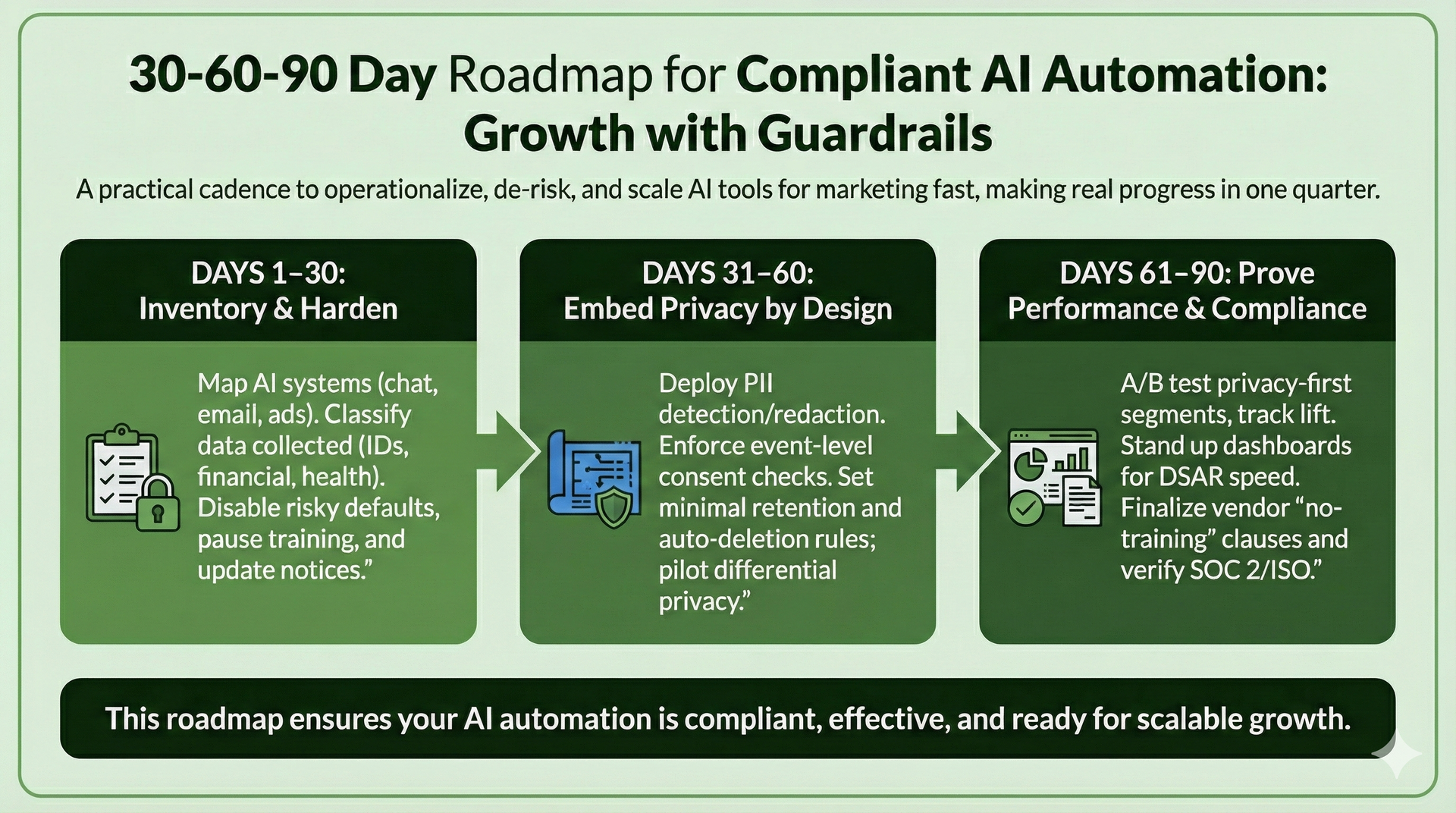
What’s the 30-60-90 day roadmap to de-risk and scale?
You can make real progress in one quarter. Here’s a practical cadence our clients use when they want growth and guardrails from their AI tools for marketing.
Need a partner to accelerate the roadmap? We’ve done this end-to-end, from discovery to deployment and training. Say hello at BusySeed.
Which metrics prove both growth and compliance?
- Growth: Conversion rate lift, CAC change, LTV/CAC, incremental revenue from email marketing automation and paid channels.
- Trust: Consent coverage rate, share of campaigns with sensitive-inference disabled, median DSAR completion time, and deletion SLA adherence.
- Risk: Inventory accuracy for the data collected, vendor “no-training” coverage, retention distribution, and incident rate.
- Efficiency: Time-to-publish after privacy reviews, prompt/asset reuse with zero PII leakage, proof that AI automation can be fast and responsible.
What should you ask vendors before you deploy?
How do you separate privacy-first AI automation tools from risky ones?
- Will you use our prompts, uploads, or event streams to train your models? If yes, can we opt out globally in your AI tools for marketing?
- Do you offer regionally pinned processing and single-tenant keys to strengthen data privacy and security?
- What’s the default retention for chat logs, inference logs, and raw payloads? Can we set it to zero so the data collected isn’t over-retained?
- Do you provide PII detection and prompt redaction pre-call?
- How do you handle inferred sensitive attributes from AI automation? Are they stored, and can we disable them?
- Are you certified (SOC 2 Type II/ISO 27001), and can you share pen test summaries?
- Do you document subprocessors and model providers, and support DPIAs/TRAs?
Use this lens especially when evaluating the top AI tools for marketing used for email marketing automation, ensuring the data collected flows are controlled, and your data privacy and security posture is strong.
How can AI infer sensitive traits from seemingly benign signals?
Because correlation is powerful. NIST explains that AI systems can link disparate points to re-identify people or expose training data (NIST). Late-night browsing behavior, content categories, zip code, and purchase cadence may correlate with health conditions or financial distress, attributes you never intentionally added to the data collected. If email marketing automation or ad engines use these inferences for personalization without consent, you may be processing sensitive data unlawfully.
- Strip high-risk features from the data collected when you don’t have opt-in.
- Limit location granularity to reduce privacy exposure.
- Apply differential privacy to analyses that inform strategy without targeting individuals via AI automation.
What does trust and transparency look like in practice?
It looks like clear control where customers interact. Deloitte’s research shows overwhelming demand for easy ways to view and delete personal data, plus clear explanations of how AI tools for marketing personalize experiences (Deloitte). Put privacy links in emails, chat windows, and account pages. Offer plain-language explanations, keep the data collected minimal and relevant, and make opting out simple. When people see your data privacy and security measures, engagement follows.
Case-in-point scenarios that marketers can learn from:
- Healthcare-adjacent publisher
Situation:
A wellness publisher used AI automation to predict content interests, then fed those categories into email marketing automation to promote supplements.Risk:
The system inferred potential health conditions from reading patterns within the data collected. Without explicit opt-in to process sensitive inferences, the personalization exceeded the lawful purpose.Fix:
Shifted to declared preferences; added on-site prompts to request opt-in for “health inferences,” aggregated analytics; cut raw event retention. Result: Competitive CTR, lower unsubscribes, stronger data privacy and security. - B2C fintech app
Situation:
The support chatbot shared conversation logs by default with a generative model vendor “to improve service.”Risk:
Agents pasted partial account numbers and employer info; the vendor could retain logs, expanding the data collected beyond policy.Fix:
Implemented input redaction and no-retention settings across AI tools for marketing; trained staff; moved sensitive workflows to an internal model. Result: Faster resolutions and zero PII leaks, which is a win for data privacy and security. - Direct-to-consumer brand
Situation:
CRM uploads were matched to ad platforms for lookalikes; hidden fields included lifestyle attributes implying religion and politics.Risk:
Sensitive inferences flowed into ad audiences as part of the data collected; the privacy notice didn’t cover this use.Fix:
Stripped sensitive fields, instituted consent gating in email marketing automation and ads, and leaned on contextual segments. Result: Slightly lower match rate but higher ROAS with compliant targeting and better data privacy and security.
Five quick wins to de-risk this quarter
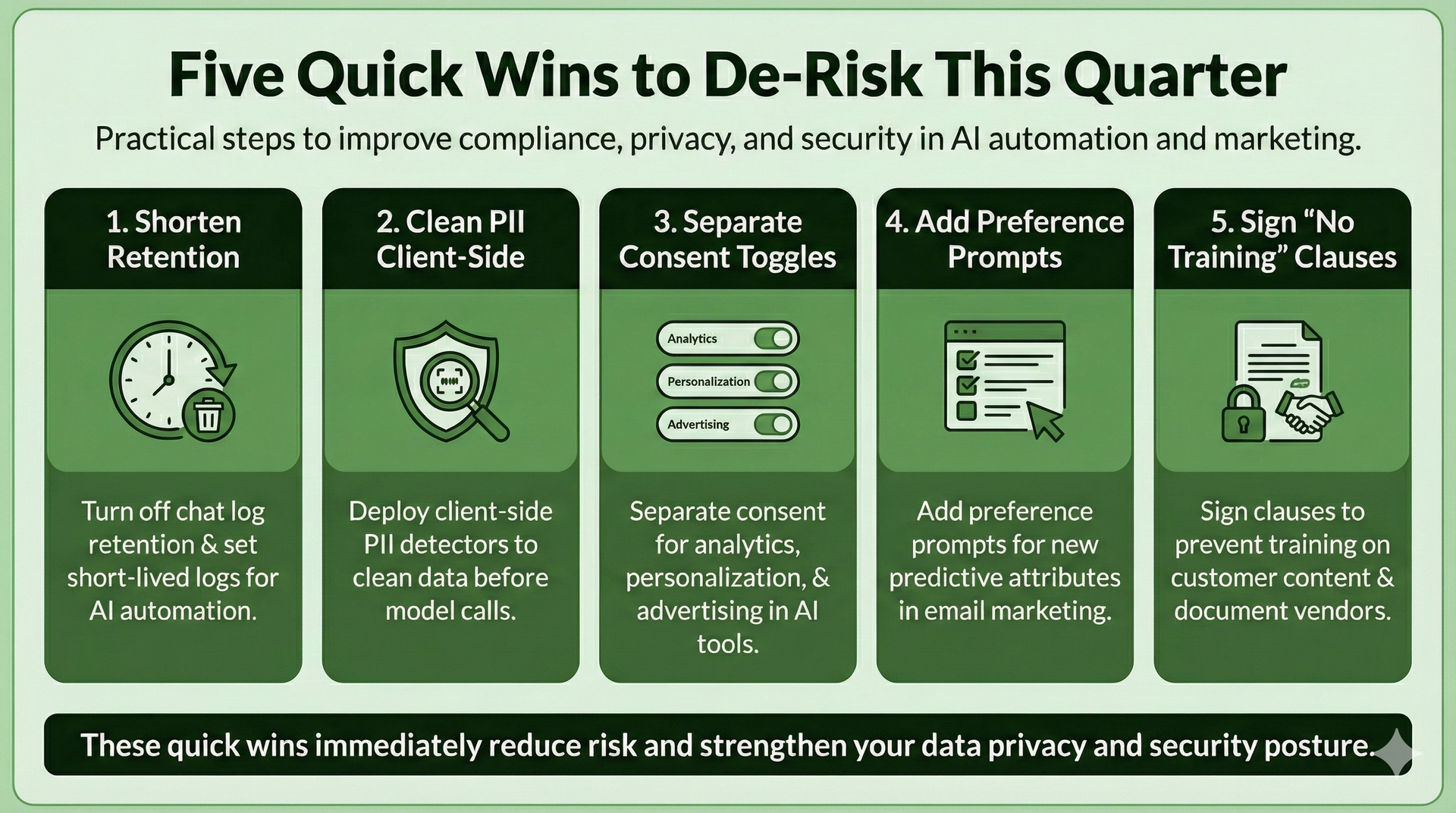
- Turn off chat log retention and set short-lived inference logs across AI automation.
- Deploy client-side PII detectors to keep the data collected clean before model calls.
- Separate consent toggles for analytics, personalization, and advertising in AI tools for marketing.
- Add preference-center prompts for any new predictive attribute in email marketing automation.
- Sign “no training on customer content” clauses and document vendor subprocessors to protect data privacy and security.
FAQ: Practical answers for privacy-first growth
Q1) What are the best ethical AI automation tools for businesses that need compliance-ready marketing?
Look for a pattern more than a single platform: no-training-by-default on customer inputs; configurable zero-retention logs; built-in PII detection and masking; regional processing; and granular consent enforcement inside your AI tools for marketing. This blend keeps the data collected lean and your data privacy and security posture strong while delivering impact.
Q2) How do I choose the top AI tools for email marketing automation with strong privacy protections?
Prioritize platforms that suppress sensitive inferences, integrate preference centers, enforce purpose limitation per campaign, and automate subject access/export. Ask how the data collected (forms, clicks, model outputs) is minimized and deleted, and how those controls uphold data privacy and security end-to-end.
Q3) What are the best AI automation tools that prioritize privacy for small teams?
Any modern vendors ship “privacy by default” toggles. The right AI tools for marketing include consent gates, clear retention settings, and no data reuse for training. Validate with a short DPIA and a security questionnaire focused on data privacy and security, so the data collected doesn’t sprawl.
Q4) Do we need to update our privacy notice if we add AI tools for marketing?
Generally yes. If you use the data collected for profiling, personalization, or automated decisions, your notice should explain data types, purposes, retention, opt-outs/opt-ins, and how email marketing automation uses that information. Align disclosures with reality and maintain data privacy and security throughout.
Q5) How can we prevent staff from pasting sensitive info into prompts?
Pair coaching with controls: DLP/PII detection at the interface layer, automatic redaction before calls, and blocked submissions for regulated data. Clear guidance in playbooks for AI automation and a friendly UX all help protect the data collected while supporting data privacy and security.
Your next best move
AI can deliver step-change performance, but it only compounds over time if customers trust your approach. The market standard is shifting to privacy-by-design. If you’re running AI automation, this is the moment to audit your stack, minimize the data collected, and implement safeguards across email marketing automation, chat, and ads. You earn the right to personalize when you protect first.
If you want a partner who blends performance with principled privacy, let’s talk. BusySeed can help you operationalize AI tools for marketing, from strategy and vendor selection to implementation and training, without sacrificing data privacy and security. Start here: BusySeed.
Works Cited
Deloitte. “Increasing Consumer Privacy and Security Concerns in the Generative AI Era.” Deloitte, 2024, www.deloitte.com/us/en/about/press-room/increasing-consumer-privacy-and-security-concerns-in-the-generative-ai-era.html. Accessed 6 Jan. 2026.
European Data Protection Board (EDPB). “Opinion on the Application of GDPR Principles to AI Models.” EDPB, 2024, www.edpb.europa.eu/news/news/2024/edpb-opinion-ai-models-gdpr-principles-support-responsible-ai_en. Accessed 6 Jan. 2026.
Federal Trade Commission. “AI Companies: Uphold Your Privacy and Confidentiality Commitments.” FTC, 2024, www.ftc.gov/policy/advocacy-research/tech-at-ftc/2024/01/ai-companies-uphold-your-privacy-confidentiality-commitments. Accessed 6 Jan. 2026.
Federal Trade Commission. “FTC to Ban BetterHelp from Revealing Consumers’ Data, Including Sensitive Mental Health Information, to Facebook.” FTC, 2023, www.ftc.gov/news-events/news/press-releases/2023/03/ftc-ban-betterhelp-revealing-consumers-data-including-sensitive-mental-health-information-facebook. Accessed 6 Jan. 2026.
National Institute of Standards and Technology (NIST). “Managing Cybersecurity and Privacy Risks in the Age of AI.” NIST, 2024, www.nist.gov/blogs/cybersecurity-insights/managing-cybersecurity-and-privacy-risks-age-artificial-intelligence. Accessed 6 Jan. 2026.
Protecto. “AI Privacy Issues & Statistics: PET Adoption Goes Mainstream.” Protecto, 2024, www.protecto.ai/blog/ai-privacy-issues-statistics. Accessed 6 Jan. 2026.
TechTarget. “Examining Health Data Privacy & HIPAA Compliance Risks of AI Chatbots.” TechTarget, 2024, www.techtarget.com/healthtechsecurity/news/366594256/Examining-Health-Data-Privacy-HIPAA-Compliance-Risks-of-AI-Chatbots. Accessed 6 Jan. 2026.
Thomson Reuters. “Future of Professionals: AI Readiness and Strategy.” Thomson Reuters, 2024, www.thomsonreuters.com/en/c/future-of-professionals. Accessed 6 Jan. 2026.
AdExchanger. “New U.S. Privacy Rules for Sensitive Data: Key Items to Consider.” AdExchanger, 2023, www.adexchanger.com/data-driven-thinking/new-us-privacy-rules-for-sensitive-data-key-items-to-consider-for-the-rest-of-2023. Accessed 6 Jan. 2026.
CXScoop. “People Are Wary of Sharing Personal Info with Chatbots.” CXScoop, 2024, cxscoop.com/latest-news/people-are-wary-of-sharing-personal-info-with-chatbots/. Accessed 6 Jan. 2026.