
Privacy restrictions and ethical concerns are limiting hyper-targeted campaigns on platforms like Meta, Google, and LinkedIn. Contextual targeting, aggregated intent modeling, and consent-driven segmentation provide privacy-respecting alternatives that still reach relevant audiences
TL;DR
- Privacy laws and platform changes make targeted ads risky, expensive, and less effective than they used to be.
- Contextual, cohort, and predictive approaches are now the backbone of high-performing paid media without intrusive tracking.
- Moving from personal ads to consented, group-level strategies keeps you compliant and drives scalable growth.
- Replacing cookies in internet ads with AI models, clean first-party data, and zero-party preferences delivers measurable ROI.
- Committing to ethical standards for AI, transparency, fairness checks, and human oversight builds user trust and brand equity.
If you need a partner who’s been building this future for years, our team at
BusySeed is here to help you modernize paid media quickly and responsibly.
Why is hyper-targeting ending in 2026?
Because the rulebook, the tech stack, and user expectations have changed. Regulators are restricting the data collection that fuels targeted ads, browsers are deprecating the identifiers they rely on, and consumers have lost patience with invasive tracking. In the EU, the Digital Services Act bans ad targeting based on sensitive traits, pressuring platforms like LinkedIn to pull LGBTQ and political segments for EU users (EDRi).
In the U.S., the FTC warns that platforms have amassed “enormous” surveillance datasets with opaque data practices
(FTC). Gartner projected that roughly 75% of the global population would be covered by modern privacy laws by 2024
(CMSWire). That puts legacy methods for paid media on notice.
Public sentiment mirrors the legal reality. Only about one-third of Americans say they trust companies with their personal data
(Piwik PRO), and three in four actively distrust current ad-data collection regimes
(Twilio Segment). That’s why brands that cling to hyper-narrow and targeted ads are paying more for less. If you own performance, budget discipline, or governance, it’s time to evolve your paid media approach, meet regulators where they are, and re-earn user trust.
There’s also mounting operational risk: teams juggle opt-out flows, deletion requests, and data audits. Even when you win permission, the ecosystem that used to power internet ads, third-party cookies, and cross-app IDs, has fractured. The takeaway is simple: align targeting with ethical standards and today’s platform reality, or watch costs climb while reach shrinks. The winners are replacing personal ads with privacy-first intelligence that scales across paid media and protects brand equity.
How do you build performance without PII?
Make relevance a property of the moment, not the person. The strongest 2026 playbooks couple three pillars: contextual intelligence, cohort-based activation, and predictive modeling, with consented data and clear disclosures. Done right, this mix sustains paid media performance, modernizes internet ads, and strengthens your ethical standards in one move.
What can contextual AI do now?
It can “read” the page, the video, and even the image to place your message where it naturally fits, no user dossiers required.
Modern NLP and computer vision understand topics, tone, and safety signals far beyond old-school keyword matching
(Piwik PRO).
In controlled studies, contextually aligned creative drove 32% higher action than standard demographic targeting, with audiences 85% more open to future ads and 60% less irritated
(ExchangeWire: Seedtag/Nielsen). It’s a practical way to keep paid media relevant while protecting privacy.
That’s precisely why targeted ads reliant on identifiers are giving way to contextual signals. You’re matching to intent-rich environments instead of following people around the web, and because contextual models operate on content and context, they travel cleanly across inventory and formats in internet ads, from CTV to publisher direct. If your brand has strict brand-safety rules or a regulated compliance posture, these controls map naturally to ethical standards while preserving reach and performance in paid media.
How do cohorts outperform micro-targeting?
Cohorts strike the balance between precision and privacy. Group-level segments, like “people who engaged with product X this quarter,” “frequent viewers of how-to content,” or “new subscribers who read three or more pricing pages”, let you reach high-value audiences without stitching identities across sites. You aim media at groups that exhibit intent patterns; you never store or trade PII (WarRoom). This reduces the risk inherent in personal ads while improving the efficiency of paid media.
The performance upside is real. Procter & Gamble famously broadened Facebook's parameters after hyper-narrow filters (such as “families with pets”) stalled growth. A broader, one-to-many approach outperformed the micro-cuts
(ExchangeWire). Industry leaders also note that probabilistic signals can outperform overly precise tactics because they scale across inventory while respecting ethical standards. That’s why many teams are migrating targeted ads to cohort-based deals, with fewer privacy headaches, more durable reach, and steady CPAs in paid media.
Cohorts also plug seamlessly into programmatic. You bid on traffic that aligns with a cluster; you don’t target by identity. As WarRoom notes, these setups keep your internet ads future-proof because browsers can’t block aggregate math
(WarRoom). It’s precise enough for performance, flexible enough for scale, and aligned to ethical standards, all while reducing the need for personal ads in your paid media mix.
Where does predictive modeling fit?
Right in the middle of the funnel, replacing brittle, ID-heavy tactics with learning systems trained on aggregate signals. Think of predicting the likelihood that an anonymous session belongs to a price-sensitive shopper, or that a stream viewer is in-market for home improvement content, no direct identity needed. AI can impute missing attributes and forecast intent from pattern-level data (Trilogy Analytics), and platforms increasingly support privacy-first techniques like federated learning (CMSWire). As these tools get better, they supercharge paid media without reverting to invasive targeted ads.
Practically, that means replacing some targeted ads with probabilistic scoring and suppressions, upping bids when a session matches a high-intent cohort, or suppressing impressions that models score as low-propensity. When done well, it beats brittle filters and aligns with ethical standards without leaning on personal ads. Your paid media plan becomes less about IDs and more about signals, incremental lift, and efficient frequency, improving the quality of your internet ads while protecting trust.
How should you use first- and zero-party data without crossing the line?
Get explicit consent, ask for preferences clearly, and use the data sparingly and transparently. Zero-party data, what users willingly share via quizzes, surveys, or onboarding, paired with first-party behavior (site, app, CRM), gives you durable, compliant signals
(Twilio Segment). Modern tools even manage consent workflows at scale; Twilio Segment processed about 23 million deletion/opt-out requests in 2022 alone to uphold privacy
Use this data to personalize lifecycle and retention, not to recreate the old surveillance playbook for targeted ads. For performance acquisition in paid media, apply consented cohorts (e.g., lookalikes built from opted-in customers) and contextual creative aligned to declared interests. In internet ads, use transparent value exchanges, preference centers, clear opt-ins, and honest disclosures. You can still run personal ads to those who have opted in. Make that the exception: powered by consent, not the default, powered by hidden trackers. This blend respects ethical standards and keeps your paid media future-safe.
What ethical AI guardrails are non negotiable?
You need transparency, bias checks, and human oversight. Ethical AI in advertising isn’t just a compliance checkbox; it’s how you earn durable customer trust and protect your brand. Industry groups like the IAPP recommend common sense steps: disclose data use, audit training data, stress-test models for disparate impact, and put humans in the loop for sensitive decisions (IAPP).
Consumers consistently favor brands that are open about how they use data and AI
(IAPP). These practices should be codified as ethical standards and applied across your paid media stack.
When adopting new measurement or targeting models, document your intended use cases, data sources, and model limitations. Update your privacy notices in plain language. Be clear about what’s contextual, what’s cohort-level, and what’s consented. If an approach conflicts with your ethical standards, park it. There’s enough evidence, both from studies and platform performance, that you can hit the same or better outcomes without compromising.
Users who experience contextually relevant creative report feeling less “creeped out” and more receptive (ExchangeWire: Seedtag/Nielsen), which also aligns with the FTC’s concerns about opaque surveillance in advertising (FTC). This is how paid media stays both effective and principled, without overreliance on personal ads or outdated targeted ads.
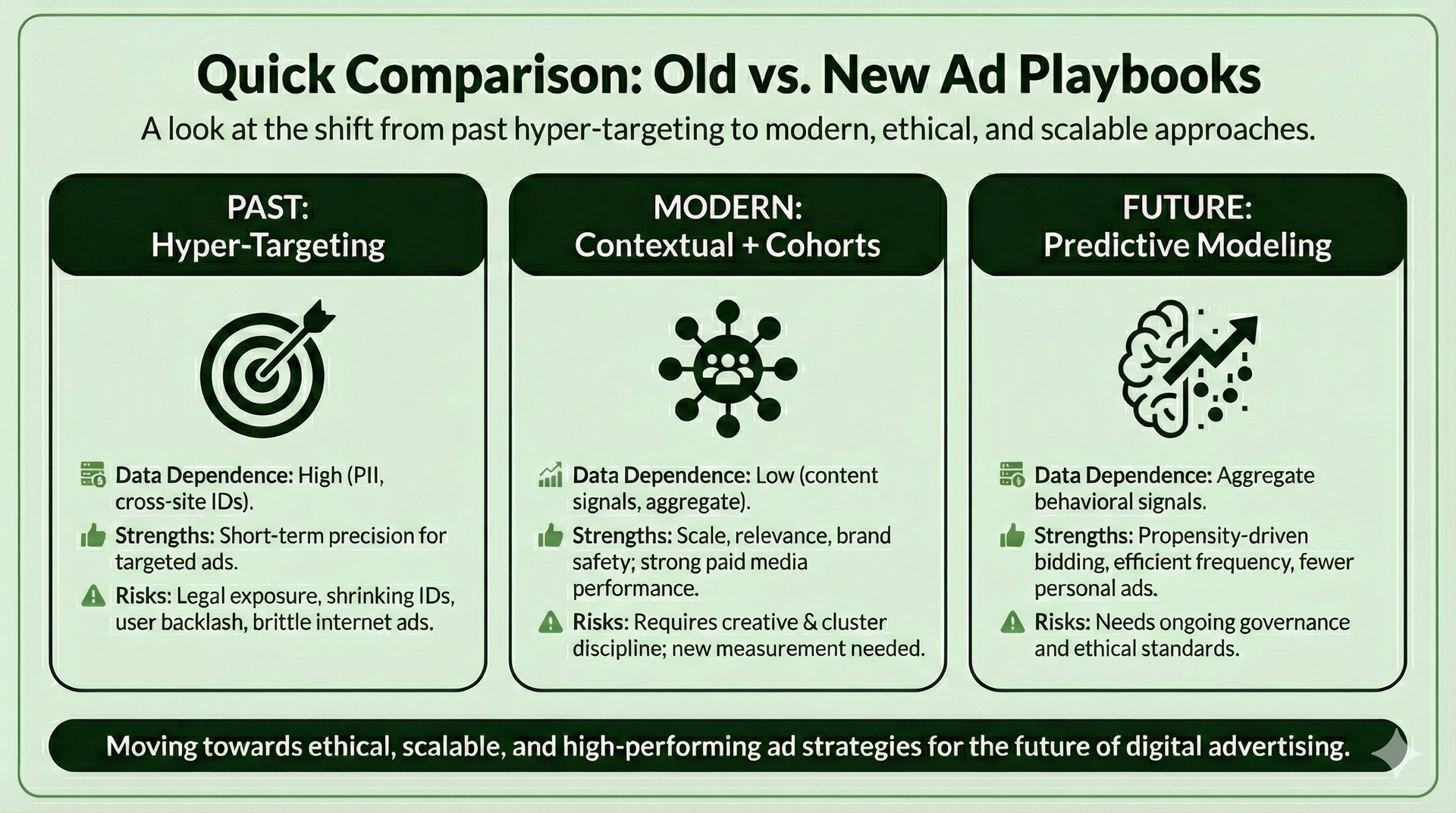
Quick Comparison: Old vs. New Ad Playbooks
How do you measure success in a post-hyper-targeting world?
Start with business outcomes, then instrument your funnel with privacy-safe proxies. Instead of obsessing over ID match rates, re-center on revenue efficiency, reach quality, and incremental lift. This mindset works across paid media channels and stabilizes internet ads as identifiers fade.
- Build a clean control/holdout discipline. When you shift budget from targeted ads to contextual and cohorts, keep a test cell untouched and measure the delta.
- Track reach in on-target environments. Because paid media is less about identity and more about intent clusters, measure the share of impressions landing in content and cohorts that match your ICP’s needs.
- Use frequency governance. Without cross-app IDs, frequency can drift. Calibrate by channel, creative, and context to ensure internet ads hit cumulative reach targets without fatigue.
- Audit fairness and accuracy regularly. Add model drift checks to your ethical standards review. Validate that suppression rules aren’t unintentionally excluding qualified subgroups.
- Align personalization with consent. Segment by consent status so personal ads only activate when permission exists, safeguarding ethical standards and paid media trust.
What practical playbook can you deploy in 90 days?
Here’s a field-tested sequence. It’s simple, scalable, and tuned to the realities of paid media in 2026.
1) Rebase your data strategy in two weeks
- Map identity dependencies across channels. Flag every use of targeted ads, data broker feeds, and cookie-based retargeting in your internet ads.
- Stand up a consent-first preference center. Capture declared interests via short, value-add experiences. Tag records by consent status to enable personal ads responsibly.
- Define your ethical standards rubric. Document model/data rules and escalation procedures.
2) Turn on contextual and cohorts in weeks 2-4
- Deploy contextual AI across core channels. Align creative to 6-10 topic clusters; use sentiment and safety filters to protect brand equity in paid media.
- Create 5-8 cohorts from first-party behavior (e.g., “repeat category viewers,” “seasonal buyers,” “recent product page viewers”). Activate as group-level segments, no PII, no personal ads beyond consent.
- Shift a defined percentage from legacy internet ads into these cohorts and contextual line items. Keep a holdout to measure lift.
3) Layer predictive models in weeks 4-6
- Add propensity scoring to bid and budget logic. Bid up when a session signals high intent; suppress low-propensity traffic across paid media.
- Replace narrow filters with probabilistic inclusion to reduce reliance on targeted ads and strengthen ethical standards.
- Validate performance weekly. Track revenue, CPA, lift, viewability, and qualitative relevance feedback from internet ads.
4) Optimize and scale in weeks 6-12
- Expand topic clusters and refine cohorts based on response. Keep rotating creatives to match the context in paid media.
- Harden governance: schedule quarterly model and bias reviews against your ethical standards.
- Lock frequency by channel to avoid overlap and fatigue, primarily where internet ads still rely on limited IDs.
5) Communicate transparently
- Update your privacy notices and campaign disclosures. Explain, in plain language, what you use and why.
- Publish a short summary of your AI and data commitments on your site. Transparency turns skeptics into advocates and strengthens paid media outcomes without risky personal ads.
When you’re ready to accelerate, our team at
BusySeed can pressure-test your plan, deploy best-in-class execution, and tune your stack for top-decile efficiency.
Which AI investments should you prioritize in 2026?
Focus on tools that strengthen signal, consent, and explainability. These choices future-proof paid media, modernize internet ads, and reinforce ethical standards without defaulting to personal ads.
- Contextual intelligence that integrates NLP, vision, and brand-safety layers.
- Cohort orchestration that exports group-level segments to your buying stack without PII.
- Predictive modeling that supports on-device or federated learning and offers transparent feature attributions.
- Consent orchestration integrated with your CRM/CDP so personalization and personal ads stay aligned to user choice.
Signals from the industry
IAB Europe reports that agencies identify AI and privacy-first addressability as key growth levers for 2024 and beyond, with programmatic investment continuing to rise alongside evolving channel strategies (IAB Europe) (IAB Europe).
The message is clear: the shift from targeted ads to contextual, cohort, and predictive approaches is not a theory; high-performing teams are already winning with this approach in paid media while reducing dependence on personal ads and strengthening ethical standards across their internet ads.
Mini checklist: fundamentals to keep you compliant and effective
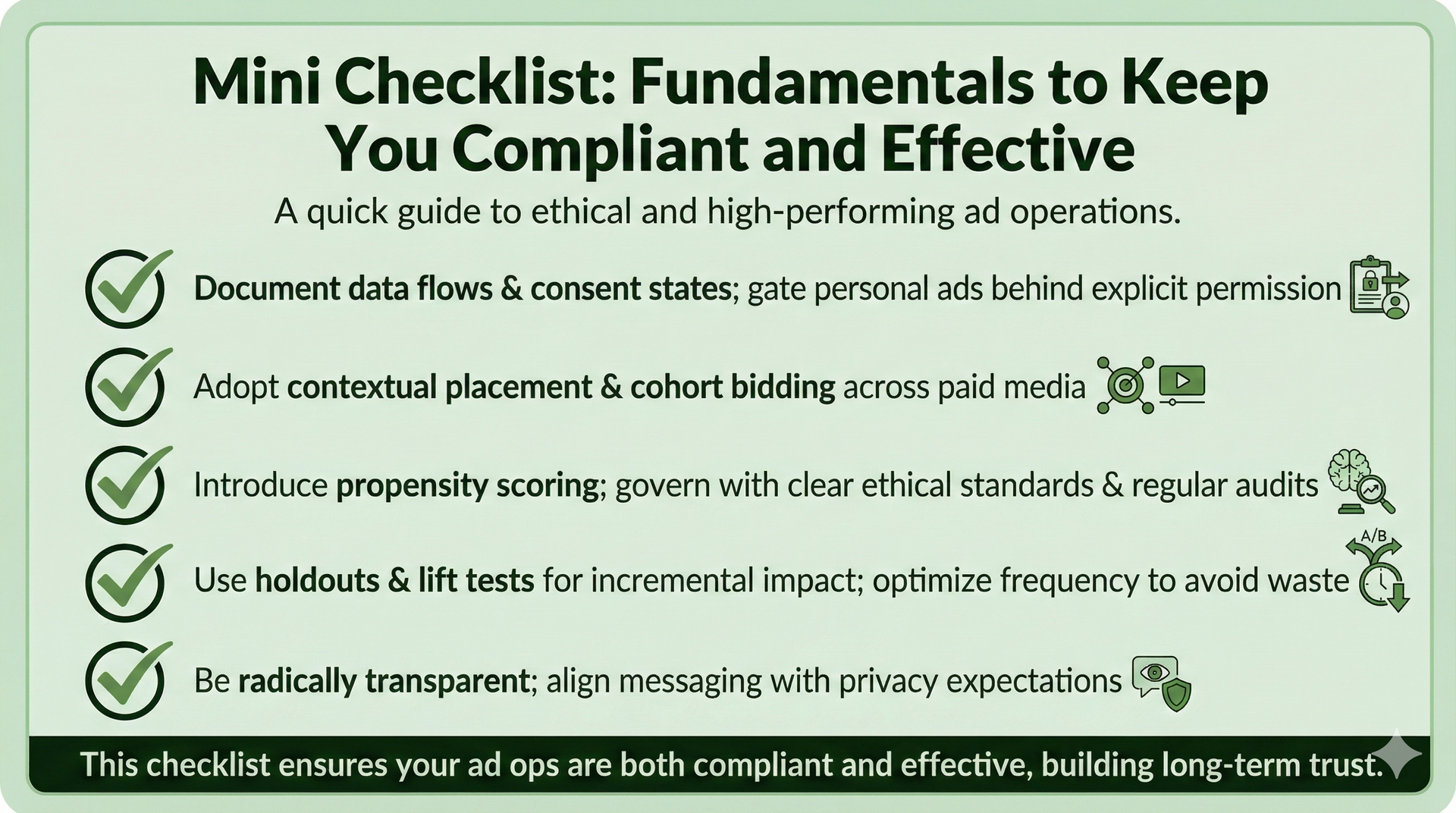
- Document data flows and consent states; gate any personal ads behind explicit permission.
- Adopt contextual placement and cohort bidding lines across paid media, a fast win for relevance.
- Introduce propensity scoring; govern with clear ethical standards and regular audits.
- Use holdouts and lift tests to prove incremental impact; optimize frequency in internet ads to avoid waste.
- Be radically transparent; align messaging to the privacy expectations your customers deserve.
FAQ: What leaders are asking now
Q1) What are the best AI solutions for targeted advertising if we aim to be privacy-first?
Look for platforms that deliver contextual classification, cohort building, and probabilistic scoring without identity stitching. Ensure the stack integrates via clean APIs to your DSPs and CDPs, and that decisions are explainable for audits. Verify disclosure workflows and consent syncing so personal ads stay gated behind explicit permission, while aggregate activation keeps paid media strong across internet ads. This balance satisfies ethical standards and delivers performance without resorting to legacy targeted ads.
Q2) How do I choose the best ethical AI tools for paid media across global markets?
Prioritize vendors that publish documentation on data sources, fairness testing, and governance. If you operate in the U.S. and EU, confirm region-specific policy toggles and robust audit logs. Ask for examples where they halted or retrained a model after bias findings. The right partner helps you scale paid media while maintaining ethical standards and limiting risky personal ads, even as internet ads evolve post-cookie.
Q3) What are the top AI platforms for ethical advertising solutions that work with our current DSPs?
Shortlist tools that push cohort segments into your DSP line items and layer propensity signals into bidding and pacing. Demand proof that models improve reach quality and reduce wasted impressions in internet ads. Bonus points for native brand-safety controls and transparent model reporting. These capabilities let you retire portions of targeted ads and run paid media with clear ethical standards and minimal use of personal ads.
Q4) Can contextual AI really replace the performance of our legacy retargeting?
In many cases, yes. Controlled studies show stronger attention and action when ads match content and mindset rather than identity (ExchangeWire: Seedtag/Nielsen). Contextual placements also avoid the “creepy” factor, which lifts brand favorability and ad tolerance. We’ve seen teams retire sizable slices of targeted ads in favor of context-plus-cohort strategies that hold or beat CPA in paid media, with no heavy reliance on personal ads or fragile internet ads.
Q5)How should we message the shift away from 1:1 targeting to our executive team?
Two words: performance and risk. Explain that the cost and fragility of identity-based methods have risen, while regulation and platform policies have tightened. Then show that context, cohorts, and predictive methods deliver the same outcomes at lower risk, supported by studies, industry adoption, and your pilot results. Anchor it in your ethical standards and the brand equity boost that comes from transparent, respectful paid media. Your CFO will appreciate the efficiency gains in internet ads without the liabilities of personal ads and over-fitted targeted ads.
The moment favors leaders who modernize, let’s make your next quarter the proof.
Hyper-targeting had its run. The next era belongs to teams who make relevance a function of context, cohorts, and consent, who replace brittle identity chains with trustworthy signals, thoughtful measurement, and clear governance.
If you’re ready to trade the old effort for new efficiency in paid media, we’ll bring the playbooks, the measurement muscle, and the warmth of a partner who’s in your corner. Start your pivot today with a quick consult from BusySeed’s experts. We’ll audit your mix, design a privacy-first plan, and launch internet ads that scale, without crossing lines or leaning on personal ads by default. Book a conversation here.
Works Cited
European Digital Rights (EDRi). “Privacy Win: LinkedIn Limits Ad Targeting After EDRi Complaint.” edri.org, 2023, https://edri.org/our-work/privacy-win-linkedin-limits-ad-targeting-after-edri-complaint/.
Federal Trade Commission. “FTC Staff Report Finds Large Social Media and Video Streaming Companies Have Engaged in Vast Surveillance.” ftc.gov, 2024, https://www.ftc.gov/news-events/news/press-releases/2024/09/ftc-staff-report-finds-large-social-media-video-streaming-companies-have-engaged-vast-surveillance.
Gesenhues, Amy. “Will Targeted Advertising Survive Privacy Legislation?” CMSWire, 2023, https://www.cmswire.com/digital-marketing/will-targeted-advertising-survive-privacy-legislation/.
Piwik PRO. “Contextual Targeting: A Privacy-Friendly Alternative to Invasive Ad Tracking.” piwik.pro, 2023, https://piwik.pro/blog/contextual-targeting-a-privacy-friendly-alternative-to-invasive-ad-tracking/.
Twilio Segment. “Zero-Party Data: What It Is and Why It Matters.” segment.com, 2023, https://segment.com/blog/zero-party-data/.
Twilio Segment. “From Cookies to Consent: How to Prepare for a Privacy-First Future.” segment.com, 2023, https://segment.com/blog/from-cookies-to-consent/.
ExchangeWire. “Seedtag/Nielsen Research Finds Contextual Targeting Boosts Consumer Interest in Advertising by 32%.” exchangewire.com, 2022, https://www.exchangewire.com/blog/2022/05/11/seedtag-nielsen-research-finds-contextual-targeting-boosts-consumer-interest-in-advertising-by-32/.
ExchangeWire. “Privacy and Efficacy: A Case for Returning to One-to-Many Targeting.” exchangewire.com, 2023, https://www.exchangewire.com/deep-dive/privacy-and-efficacy-a-case-for-returning-to-one-to-many-targeting/.
WarRoom. “Cohort-Based Advertising: What It Is and Why It Matters.” warroominc.com, 2022, https://www.warroominc.com/blog/cohort-based-advertising/.
Trilogy Analytics. “Predictive Modeling and Privacy: Imputation Without Tracking.” trilogyanalytics.com, 2022, https://www.trilogyanalytics.com/blog/predictive-modeling-privacy/.
International Association of Privacy Professionals (IAPP). “The Ethical Use of AI in Advertising.” iapp.org, 2023, https://iapp.org/news/a/the-ethical-use-of-ai-in-advertising/.
IAB Europe. “10th Annual Attitudes to Programmatic Advertising Report: Market Insights and Trends.” iabeurope.eu, 2024, https://iabeurope.eu/iab-europes-10th-annual-attitudes-to-programmatic-advertising-report-unveils-latest-market-insights-and-trends/.