
AI can enhance email relevance through first-party signals, behavioral context, and consent-based personalization, but overuse or opaque automation risks alienating recipients. Balancing AI insights with privacy and transparency ensures both trust and engagement.
TL;DR
- Personalization pays when it’s grounded in consent and context. Expect meaningful lifts in opens, clicks, and revenue when you respect boundaries.
- Overly invasive tactics backfire. Steer toward “active” preference-led personalization, not data guesses that feel spooky.
- Build around first-party data and transparency. It’s the durable, privacy-safe fuel for scalable relevance.
- Use AI to scale, humans to steer. Keep a human-in-the-loop to guard tone, accuracy, and customer comfort.
- Test for trust, not just clicks. Watch unsubscribes, complaints, and regret alongside revenue.
Why does personalization work, and where does it cross the line?
Personalization works because people want relevant help, not generic noise. It fails when brands infer too much, too fast, without clear consent. When you use email marketing personalization thoughtfully, anchored in consent, clarity, and value, it becomes a service, not surveillance.
The numbers are compelling: personalized campaigns can drive roughly 40% higher revenue when implemented with care, and marketers routinely see 5×- 6× higher transaction rates than generic sends (ScienceDirect). Multiple analyses and experiments also note that AI can adjust subject lines, offers, and send times based on engagement, bringing those “you get me” moments to scale.
Salesforce-linked research shows about 73% of consumers now expect brands to anticipate needs (Marketing Insider). But there's a line: Gartner reports 53% of customers had a negative experience when personalization felt intrusive; those customers were 3.2× more likely to regret a purchase and 44% less likely to buy again (Gartner).
At BusySeed, we see this play out in real programs. Clients who adopt AI email with clear guardrails often achieve 10-20% lifts in open and click rates within a few iterations, without triggering unsubscribes. If you’d like a partner who blends empathy with performance, connect with us at
BusySeed. We’ll help you design an email marketing strategy that’s
relevant,
resilient, and
human.
How much lift can you expect from doing it right?
When context meets restraint, email marketing personalization improves opens, clicks, and transactions. The upside typically comes from compounding wins: subject line testing, timing optimization, and dynamic content personalization in your AI email stack. Academic reviews indicate roughly 40% revenue gains from targeted approaches, and marketers report 5×, 6× higher transaction rates when personalization is on-point (ScienceDirect).
Expect diminishing returns if you push too hard. If unsubscribes spike after adding hyper-granular merge fields, your email automation is telling the wrong story. A simple rule of thumb: when your email marketing strategy makes messages feel like a helpful concierge, you win; when it feels like a surveillance camera, you lose.
When do customers feel creeped out?
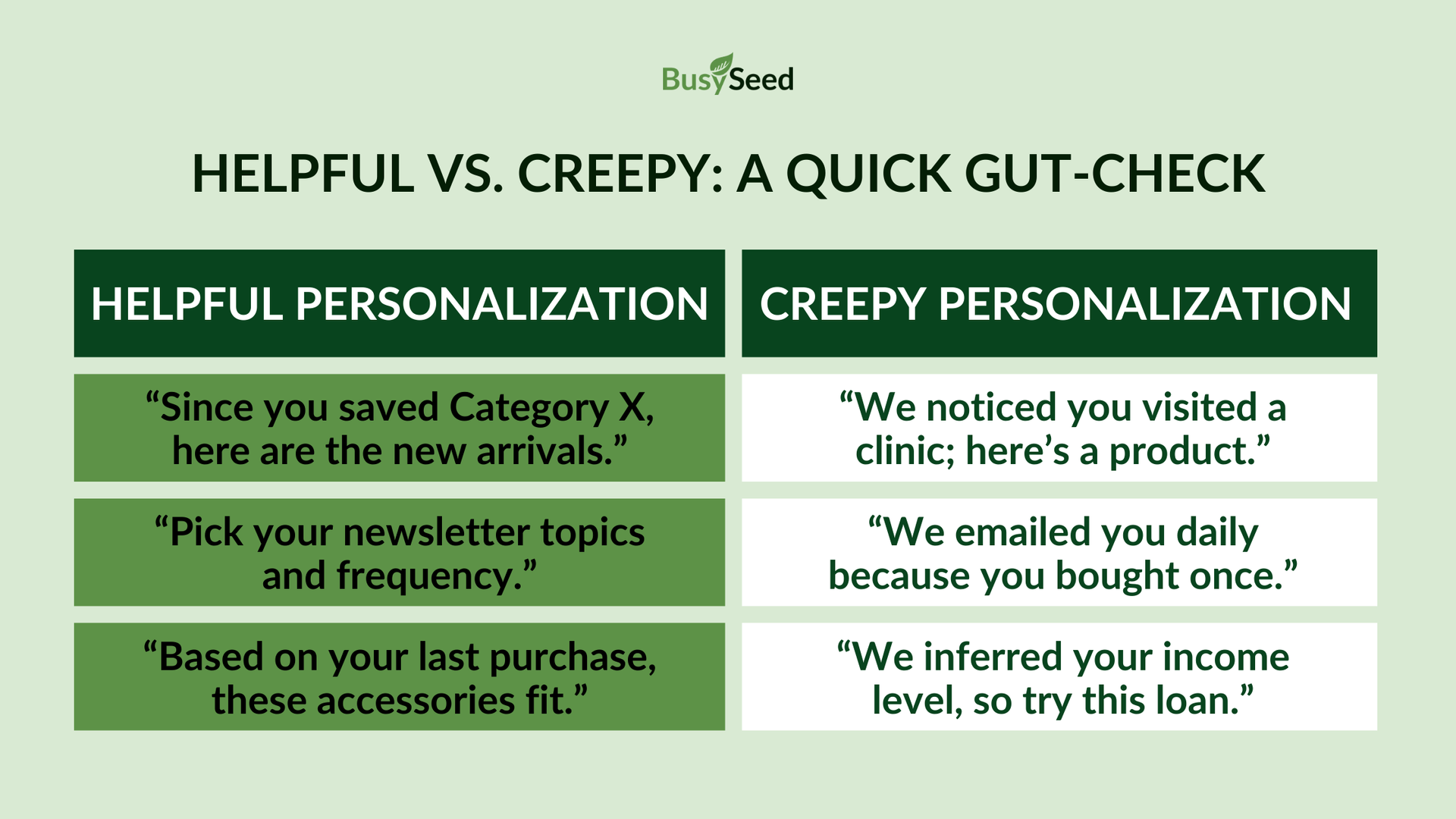
People get uncomfortable when you reveal data they didn’t knowingly share or when a message implies sensitive inferences about health, finances, or precise location. Gartner’s 2025 findings confirm that over-personalization triggers regret and lowers repurchase (Gartner). The fix: use contextual cues subscribers expect (“since you browsed category X” or “based on your last purchase”) and avoid sensitive assumptions. Always provide a visible unsubscribe, frequency caps, and an easy preference center, your trust anchors in email automation.
How do you center consent with first-party data?
Start with what customers choose to share and do within your owned channels. In the post-cookie era, high-growth brands are doubling down on first-party data. Deloitte highlights that many high-growth companies now base most campaigns on consented signals, with CMOs increasing budgets for in-house collection (Marketing Insider; Marketing Insider). Deloitte also reports that consumers who trust a brand with their data spend significantly more (Deloitte).
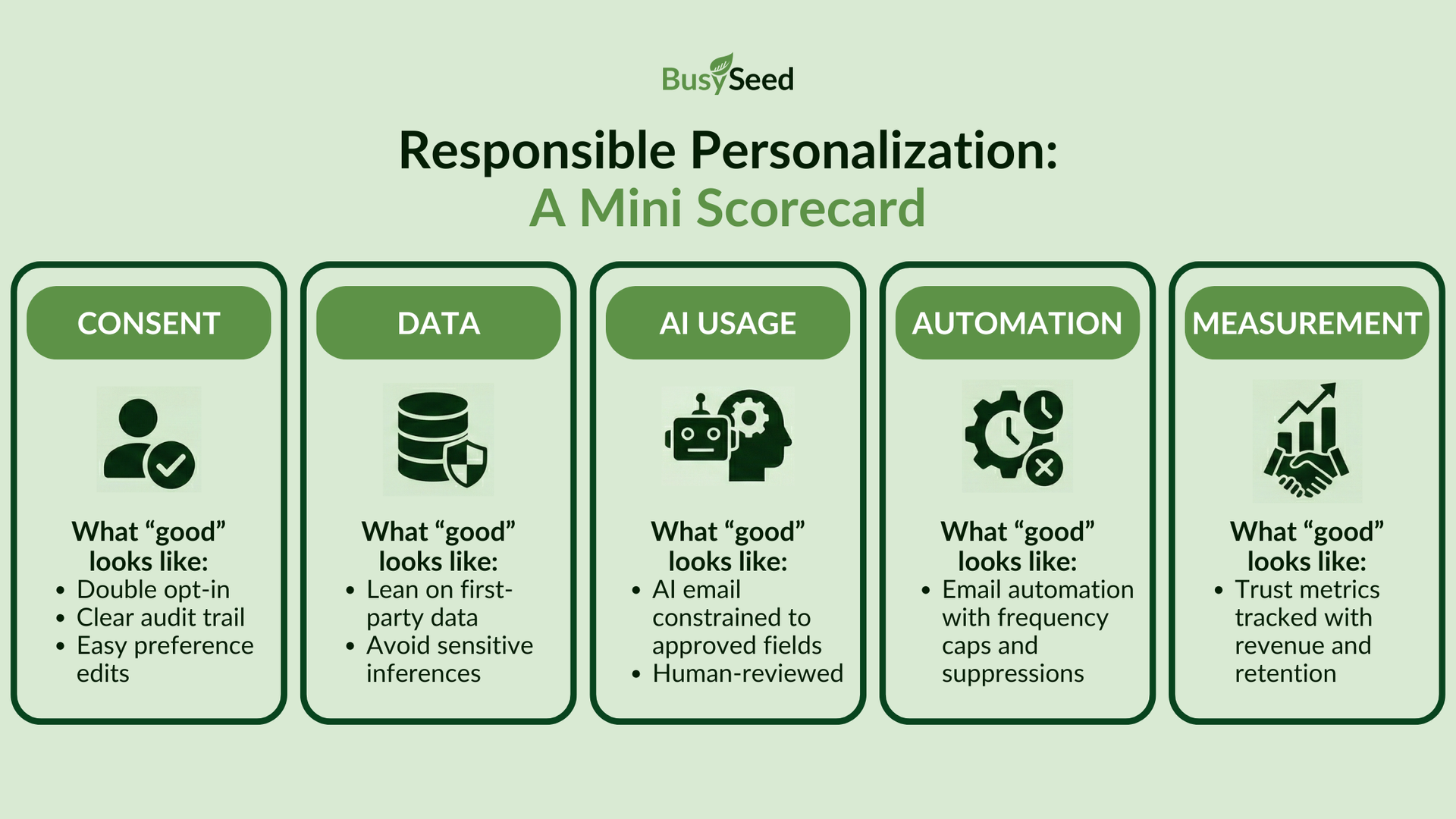
- Offer double opt-in and store timestamps of consent.
- Explain the “why” for each data point you request.
- Provide an always-on preference center with frequency control.
- Keep your privacy policy straightforward and scannable.
These practices make email marketing personalization durable and help your AI email and email automation stay privacy-first. If you want a blueprint tailored to your brand, we’d love to help at
BusySeed.
What data belongs in your stack, and what doesn’t?
- Keep: Explicit preferences, engagement data, purchase history, browsing on your site/app, support interactions (all consented first-party data).
- Avoid: Sensitive inferences (health, finances), third-party “mystery” segments, precise location unless it’s truly necessary, and consented.
A consent-forward data map strengthens email marketing personalization and keeps your email marketing strategy compliant worldwide. Use progressive profiling to let subscribers build their profiles over time, as these are clean signals your AI email models can rely on.
How do you explain the value exchange?
Tell people exactly how their data improves their experience. When you do, first-party data collection feels respectful and useful, and email automation becomes a service.
- “Choose your topics, and we’ll only send what you care about.”
- “Set your frequency to decide how often we land in your inbox.”
That clarity builds trust in your email marketing strategy and reduces “creepy” vibes in email marketing personalization.
How can AI scale relevance without feeling robotic?
Start small, target high-impact components, and keep humans in the loop. Roughly half of marketers now use AI to optimize copy, timing, and targeting (SurveyMonkey). Use AI email for subject line variants, dynamic content, and send-time optimization, then make space for human judgment to ensure quality and tone.
- Subject line generation with human review.
- Send-time optimization feeding your email automation engine.
- Dynamic modules that adapt to preference tags and first-party data.
- “Next best action” nudges grounded in consented behavior.
The goal: AI email that feels like thoughtful assistance, never a hard sell.
Helpful vs. Creepy: A quick gut-check
What guardrails keep AI from misfiring?
Define scope, enforce tone, and constrain data inputs. Clear guardrails let AI email shine inside your email marketing strategy without overstepping.
- Content policies: Words to avoid and lines you won’t cross.
- Tone templates: Write like a helpful advisor, not a bot.
- Data whitelist: Only consented first-party data fields.
- QA workflow: Human approval until performance stabilizes.
Monitor unsubscribes, complaints, and blocklist incidents. These metrics will tell you when email marketing personalization needs adjustment.
How should humans stay in the loop?
Use AI for speed; rely on humans for judgment. In practice, that means AI drafts and organizes, while people steer the narrative.
- Humans set strategy frameworks; AI email generates options.
- Humans review edge cases; email automation handles routine variants.
- Humans run tests and interpret nuance; AI proposes optimizations.
This pairing protects brand trust and sharpens your email marketing strategy over time.
Which tactics deliver “active” personalization?
Ask, don’t assume, then deliver what people tell you. Gartner associates “active” personalization (customers choosing preferences) with higher purchase confidence and reduced creepiness (Gartner). Embed preference-led flows, choose-your-own content modules, and quick quizzes. This approach powers email marketing personalization while strengthening your first-party data foundation.
How do preference centers lower creepiness?
They grant control and align expectations. Your preference center is one of the unsung heroes of email automation and a central touchstone in your email marketing strategy.
- Topics and categories
- Product use-cases
- Email frequency
- Channel choices (email/SMS/in-app)
Publish your preference center link in your footer and onboarding flow. It strengthens email marketing personalization and gives your AI email cleaner signals from explicit choices, not risky inferences.
How do quizzes or surveys drive segmentation?
Short, respectful surveys create high-signal tags you can use immediately. Two or three questions in your welcome flow can separate beginners from pros, budget from premium, and content seekers from product shoppers. With that, email automation routes people down the right journey, AI email adapts copy, and your first-party data graph gets stronger with every interaction.
What does a safe, high-performance lifecycle look like?
Think of your email marketing strategy as a lifecycle system powered by explicit signals, with AI in supporting roles and weekly testing for fit. Each stage should leverage first-party data and preference cues to drive relevant email marketing personalization.
- Onboarding: Preference capture and early value delivery.
- Engage: Educational content and tailored recommendations.
- Convert: Timely offers based on declared interests.
- Expand: Post-purchase guidance and need-based cross-sell.
- Retain: Winbacks and loyalty tied to satisfaction and usage signals.
Across all stages, AI email helps tailor modules and timing; email automation orchestrates paths; humans govern the playbook. If you’d like a roadmap customized to your growth stage, our team at
BusySeed is here to help.
How should you structure journeys?
Start with the jobs your emails need to perform; then map triggers and success criteria. This is where email marketing personalization and first-party data shine together.
- Welcome: Collect preferences in the first two sends; set expectations on cadence and content.
- Education: Topic-led series based on declared interests; mix content and light CTAs.
- Conversion: Eligibility rules keyed to engagement; suppress if signals show disinterest.
- Post-purchase: Setup tips and product-specific checklists; invite feedback.
- Loyalty: Recognize milestones; offer owners-only content or previews.
Each journey benefits from AI email subject line ideas and send-time optimization, all governed by email automation with frequency caps. Consistent reporting lets you iterate on your email marketing strategy with confidence.
How can you test without risking trust?
Use small, controlled experiments and watch human signals, not just click math. In other words, optimize email marketing personalization without eroding goodwill.
- Test dynamic content in a 10% segment before global rollout.
- Add one data-driven module at a time.
- Track unsubscribes, complaint rates, and “Was this helpful?” polls alongside revenue.
- If CTR improves but unsubscribes rise, prioritize long-term trust.
This steady cadence keeps email automation sharp and gives your AI email models a clean feedback loop, grounded in first-party data.
Which marketing tools help avoid creepy personalization?
Choose platforms that support explicit consent, robust preference centers, and explainable decisions. These are the hallmarks of a privacy-first email marketing strategy.
- Native preference-center components.
- Clear consent capture and audit trails.
- Data governance features (field-level permissions, PII controls).
- Explainable AI or transparent rule-based personalization.
- Strong CRM/CDP integration to unify first-party data.
When your tools respect boundaries, email marketing personalization becomes a brand asset. Want help selecting or implementing your stack?
Talk with BusySeed, we’ll align your tools with your goals.
What are the top-rated platforms for privacy-friendly personalization?
Favor providers that make it easy to use first-party data while giving subscribers visible controls. This keeps AI email honest and effective and supports sustainable email marketing personalization.
- Consent-first data collection flows.
- Segmentation tied to declared preferences.
- No default use of third-party lookalikes without explicit opt-in.
- Frequency caps and built-in governance.
- AI features constrained to approved fields.
What tools help humanize automated emails?
Instead of giving you a list of recommended tools for humanizing automated emails, focus on picking tools that blend design systems, tone controls, and feedback loops. They’ll help your email automation feel like a person who cares, not a machine that nags.
- Template systems with brand voice guardrails.
- AI writing assistants trained on your tone.
- A/B and multivariate testing that are built into email automation.
- Simple “thumbs up/down” feedback modules inside emails.
- Preference-center APIs that allow users to update their interests from the inbox.
How do you measure trust, not just clicks?
Track regret, discomfort, and satisfaction alongside revenue and retention. Healthy email marketing personalization improves outcomes without causing fatigue.
- Unsubscribe and complaint rates by campaign.
- Spam-folder placement and blocklist incidents.
- Post-campaign surveys on comfort and relevance.
- Repeat purchase and expansion within exposed cohorts.
- Time-to-next-open as a proxy for affinity.
Which KPIs expose creepiness?
- Sharp rises in unsubscribe rate by segment.
- Increased spam complaints after a personalization change.
- Negative sentiment in replies or survey verbatims.
- Lower open rates in subsequent sends despite short-term clicks.
- Frequency-cap breaches indicate fatigue.
Use these signals to adjust email automation, simplify AI email rules, and reinforce preference-led content powered by first-party data. That’s how you protect your long-term email marketing strategy.
How do you build an executive dashboard?
Show revenue impact and risk side-by-side. Leaders need to see both the upside of email marketing personalization and the trust signals your team monitors.
- Revenue per email and per subscriber
- Conversion rate by journey stage
- Unsubscribe and complaint trends
- Preference adoption rate and profile completeness
- First-party data growth and consent coverage
- AI contribution: lift from AI email subject lines or send-time optimization
Mini scorecard for responsible personalization
FAQ: AI-personalized email, privacy, and performance
Q1). How do I balance personalization and privacy in a GDPR/CCPA environment?
Rely on consented first-party data, explain how it’s used, and give subscribers meaningful control. Build a preference center, honor frequency caps in your email automation, and constrain AI email to approved fields. This protects trust and keeps your email marketing strategy compliant while still delivering effective email marketing personalization.
Q2). What’s the quickest win if we’re new to AI email?
Start with subject line generation and send-time optimization. They fit neatly into most email automation platforms and often deliver clean lifts without extra data collection. Then, layer dynamic modules that reflect declared interests, simple, high-signal inputs harvested through your first-party data program. This sequence strengthens your email marketing strategy without risking creepy vibes.
Q3). How do I tell if my personalization is “creepy” before a full rollout?
Run small A/B pilots and monitor unsubscribes, complaints, and a one-question poll (“Was this helpful and relevant?”). If signals degrade, simplify your email marketing personalization and revert to preference-led content. Keep new AI email components under human review until quality stabilizes. This lowers risk while improving your long-term email marketing strategy.
Q4). What are the best marketing tools for avoiding creepy personalization for a lean team?
Choose tools with built-in preference centers, robust consent logs, and explainable targeting. Avoid platforms that depend on opaque third-party profiles by default. Integrate with your CRM/CDP so first-party data remains your source of truth, and confirm your email automation supports frequency caps and suppressions. This stack will make AI email safer and your email marketing personalization more reliable.
Q5). How do we bake AI into our email marketing strategy without losing our brand voice?
Train AI on approved copy, enforce tone rules, and require human review for new modules. Use templates and style guides that reflect your brand’s personality. Then let AI email handle variants and testing while humans own the narrative, ethics, and final decisions. This keeps your email marketing strategy consistent while scaling email marketing personalization.
Bringing it all together
If you remember one thing, make it this: personalization is a relationship, not a hack. Lead with consented first-party data, let customers shape their experience, and use AI email to scale what works, without guessing what shouldn’t be guessed. Build an email marketing strategy that treats every inbox like a privilege, not an entitlement, and your email automation will pay compounding dividends. Ready to personalize without the creep factor, and grow faster because of it? Partner with the team that blends empathy with performance. Connect with BusySeed for a privacy-first plan tailored to your goals.
Works Cited
- “AI Marketing Statistics.” SurveyMonkey, www.surveymonkey.com/mp/ai-marketing-statistics/. Accessed 6 Jan. 2026.
- Deloitte. “Increasing Consumer Privacy and Security Concerns in the Generative AI Era.” Deloitte Press Release, www2.deloitte.com/us/en/pages/about-deloitte/articles/press-releases/increasing-consumer-privacy-and-security-concerns-in-the-generative-ai-era.html. Accessed 6 Jan. 2026.
- Gartner, Inc. “Gartner Survey Reveals Personalization Can Triple the Likelihood of Customer Regret at Key Journey Points.” Gartner Newsroom, 3 June 2025, www.gartner.com/en/newsroom/press-releases/2025-06-03-gartner-survey-reveals-personalization-can-triple-the-likelihood-of-customer-regret-at-key-journey-points. Accessed 6 Jan. 2026.
- “AI-Driven Personalization Shifts from Futuristic Hype to Revenue Reality.” Marketing Insider, www.marketing-insider.eu/marketing/ai-driven-personalization-shifts-from-futuristic-hype-to-revenue-reality/. Accessed 6 Jan. 2026.
- “Ditch the Cookies: Master First-Party Data and Thrive.” Marketing Insider, www.marketing-insider.eu/marketing/ditch-the-cookies-master-first-party-data-and-thrive/. Accessed 6 Jan. 2026.
- “First-Party Data Strategy: Marketers’ Secret Weapon in the Post-Cookie Era.” Marketing Insider, www.marketing-insider.eu/business/first-party-data-strategy-marketers-secret-weapon-in-the-post-cookie-era/. Accessed 6 Jan. 2026.
- ScienceDirect. “Research on the Outcomes of Personalized Marketing.” Elsevier, www.sciencedirect.com/science/article/pii/S2666954423000066. Accessed 6 Jan. 2026.