As LLM platforms limit tracking, optimization focuses on first-party signals, contextual relevance, and ethical content design rather than click-level data. Understanding AI inference and intent prediction becomes critical to effective performance.
TL;DR
- Zero-click is the new normal. Your playbook must shift from chasing CTR to shaping answers, citations, and visibility in AI-driven results.
- First-party data is your richest signal layer. Use it to steer topics, structure, and measurement when external click data disappears.
- Structure wins. Schema, consistent facts, and clear context make your pages machine-readable and more likely to be cited in AI answers.
- Measure differently. Track AI visibility, on-site engagement, and conversions. Use new tools and set up disciplined experiments.
- Build trust with original, expert-led SEO content. AI systems prefer authoritative sources backed by evidence, not generic fluff.
BusySeed’s approach to AI search engine optimization is warm, direct, and savvy. We help you design for answers, not just links, so you win visibility even when the click never happens. If you want hands-on support, visit ourhomepage, explore our
services, browse
case studies, or reach out via our
contact page.
Why are clicks disappearing in search, and what should you optimize for instead?
Clicks are disappearing because AI answers and SERP features satisfy the query before anyone visits your site. Optimize to be the answer that’s cited, not just the link that ranks. Multiple studies confirm the zero-click reality: roughly 58.5% of U.S. Google searches now end without a click, largely due to SERP features and AI overlays that answer the question instantly (Search Engine Land). BrightEdge also noted that click-through rates dropped nearly 30% after Google introduced AI answer boxes, a trend covered by the AP (AP News).
What matters now is a consistent AI ranking in the answer layer and the credibility to be cited. That means treating AI SEO as Answer Engine Optimization. You’re designing SEO content that LLMs can scan, extract, verify, and cite. It also means shifting your reporting from sessions to visibility, engagement, and conversions, measurable outcomes that actually impact the pipeline.
- Target terms and intents where your expertise can genuinely win an AI ranking citation.
- Craft SEO content with clear Q&A, data-backed insights, and concise takeaways so AI systems can lift clean snippets.
- Track on-page engagement and conversions using first-party data to validate business impact without relying on visible clicks.
In short, this isn’t a retreat from search; it’s modern AI search engine optimization that meets users where they already get answers.
How do you align your strategy with AI search engine optimization realities?
Start by designing for machine understanding and human trust. Generative models lean on credible, well-structured, and consistent sources. An Axios/Muck Rack analysis found that GPT models prefer mainstream media, while Claude leans toward academic or government information, and promotional copy gets minimal traction (Axios). Google’s guidance echoes this: emphasize accuracy, quality, and relevance in how you produce and present SEO content (Google Developers).
Strategic moves for stronger AI ranking and holistic AI SEO:
- Document your facts. Maintain a single source of truth for names, dates, product specs, and definitions. Keep those facts consistent across your site, LinkedIn, partner sites, and Wikipedia.
- Use schema everywhere it fits. Product, FAQ, How To, Organization, and Article schema help LLMs parse context. TechRadar specifically recommends schema and knowledge-graph alignment for better AI discoverability (TechRadar).
- Build content hubs. Create interconnected pages around flagship topics with pillar pages and supporting articles. Interlink so that semantic relationships are obvious to both users and machines.
- Be explicit with answers. Include short answers up top and deeper context below. FAQs with schema often help you win AI ranking citations and strengthen AI search engine optimization.
This is AI SEO in practice: design your SEO content as structured, verifiable knowledge so models see a cohesive, trustworthy body of work that’s ready to quote.
How can first-party data reshape your roadmap when third-party signals fade?
Use first-party data to choose what to publish, how to present it, and how to measure its impact. As third-party cookies and cross-site tracking erode, first-party data becomes the engine for decision-making. It’s proprietary insight that helps you design SEO content around real behavior, not guesswork. Search Engine Land calls this data a “gold mine,” especially when it’s clean and tied to business outcomes (Search Engine Land). Feeding accurate first-party data into personalization and planning improves AI search engine optimization by reflecting real users and their intent (Search Engine Land).
Practical ways to operationalize first-party data:
- On-site search. Catalog queries and follow-up clicks. These are unfiltered intent signals for AI SEO planning and AI ranking improvements.
- Scroll depth and dwell time. Identify sections that hold attention and replicate those structural patterns in your SEO content.
- Conversion paths. Tie content consumption to demo requests, trials, purchases, or MQLs, your highest-signal indicators for AI search engine optimization refinement.
- Logged-in behavior. For SaaS, monitor knowledge base usage to inform self-serve resources that LLMs can cite, supporting AI ranking gains.
If you’re mapping tool stacks, look up “best tools for analyzing webpage first-party signals” and prioritize solutions that unify behavioral analytics with form fills and CRM outcomes. Your goal is a feedback loop: first-party data shapes what you publish next, and every new piece of SEO content collects more first-party data, strengthening your AI SEO foundation and AI ranking footprint.
How should you structure pages for machine understanding and AI ranking citations?
Use schema, tight information architecture, and consistent language across platforms. Large models operate like probabilistic knowledge graphs. They reward pages with clear headings, crisp claims, and structured metadata. TechRadar advises brands to build schema-backed knowledge systems so AI can index and reuse your facts (TechRadar). Keep details consistent everywhere: product names, prices, and release dates, because even small mismatches can weaken trust and hurt AI ranking. Insight Partners similarly notes the shrinking real estate for blue links and the need for structured clarity (Insight Partners).
Implementation checklist for stronger AI search engine optimization and AI SEO:
- JSON-LD schema: Organization, Website, Product/Service, FAQ, How To, Article, and Breadcrumbs, where applicable.
- Q&A patterns: Start sections with a direct, 1-2 sentence answer. Expand below. This gives models clean, cite-ready snippets to improve AI ranking.
- Glossaries and definitions: Anchor your topic vocabulary. Use internal links across your SEO content to keep context tight.
- Fact labels: Tables and bullet lists for specs, features, and pricing. Models reliably extract labeled facts, which helps AI SEO.
- Evidence links: Cite primary research, .edu/.gov sources, and recognized industry studies (Google Developers).
How do you design SEO content that AI trusts and humans love?
Publish original, expert-driven content with verifiable sources, real data, and transparent methodology. Avoid thin, derivative copy. Google warns against mass-produced, low-value text and encourages transparency about generative assistance (Google Developers). In practice, your AI SEO should be fueled by human insight. Build articles around your own case studies, customer interviews, proprietary benchmarks, or experiments, then add citations and make claims falsifiable. That’s how you earn trust, citations, and a stronger AI ranking.
Practical guidance for AI search engine optimization and durable SEO content:
- Lead with a thesis, back it with data, then teach a repeatable process, show your work to support AI SEO.
- Use screenshots, charts, and labeled tables. These improve human comprehension and machine extraction, leading to better AI ranking.
- Include “how we measured this” sections. LLMs prefer sources with explicit methods, which strengthens AI search engine optimization.
- Add FAQs with schema. They’re perfect for concise answers and can power citations in your SEO content.
- Refresh regularly. Mark “updated on” and list changes. This signals quality for AI SEO and helps maintain AI ranking.
What should you measure when you can’t track the clicks?
Measure AI visibility, on-site engagement, and conversion quality. Traditional CTR is a lagging indicator. Instead, track how often you appear in AI answer surfaces (your de facto AI ranking) and whether the visitors who do land on your site convert efficiently. Tools are evolving quickly: Semrush introduced AI visibility analytics and reported internal tests where users tripled their AI-search visibility in a month (TechRadar). HubSpot launched an AEO Grader to estimate your presence in chatbot results (TechRadar). For macro context, revisit the zero-click findings (Search Engine Land) and CTR declines (AP News).
Recommended measurement stack for advanced AI search engine optimization:
- AI visibility: Track frequency and context of citations in AI answers. Maintain a weekly query set to test AI ranking across topics; this is core to AI SEO.
- First-party data engagement: Scroll depth, time-on-section, on-page interactions, downloads, sign-ups, demo requests.
- Conversion quality: Pipeline stage, deal size, velocity. Tie content to CRM outcomes with first-party data.
- Effectiveness without visible clicks: Evaluate assisted conversions and brand search lift. Explore “Top tools for scoring content effectiveness without visible clicks”.
Build a dashboard combining AI visibility (your practical AI ranking measure), key first-party data events, and conversion quality indicators. Whether traffic goes up or down, this framework keeps your AI SEO anchored to business impact and your SEO content aligned to outcomes.
How do you run practical experiments for AI SEO improvements in 30 days?
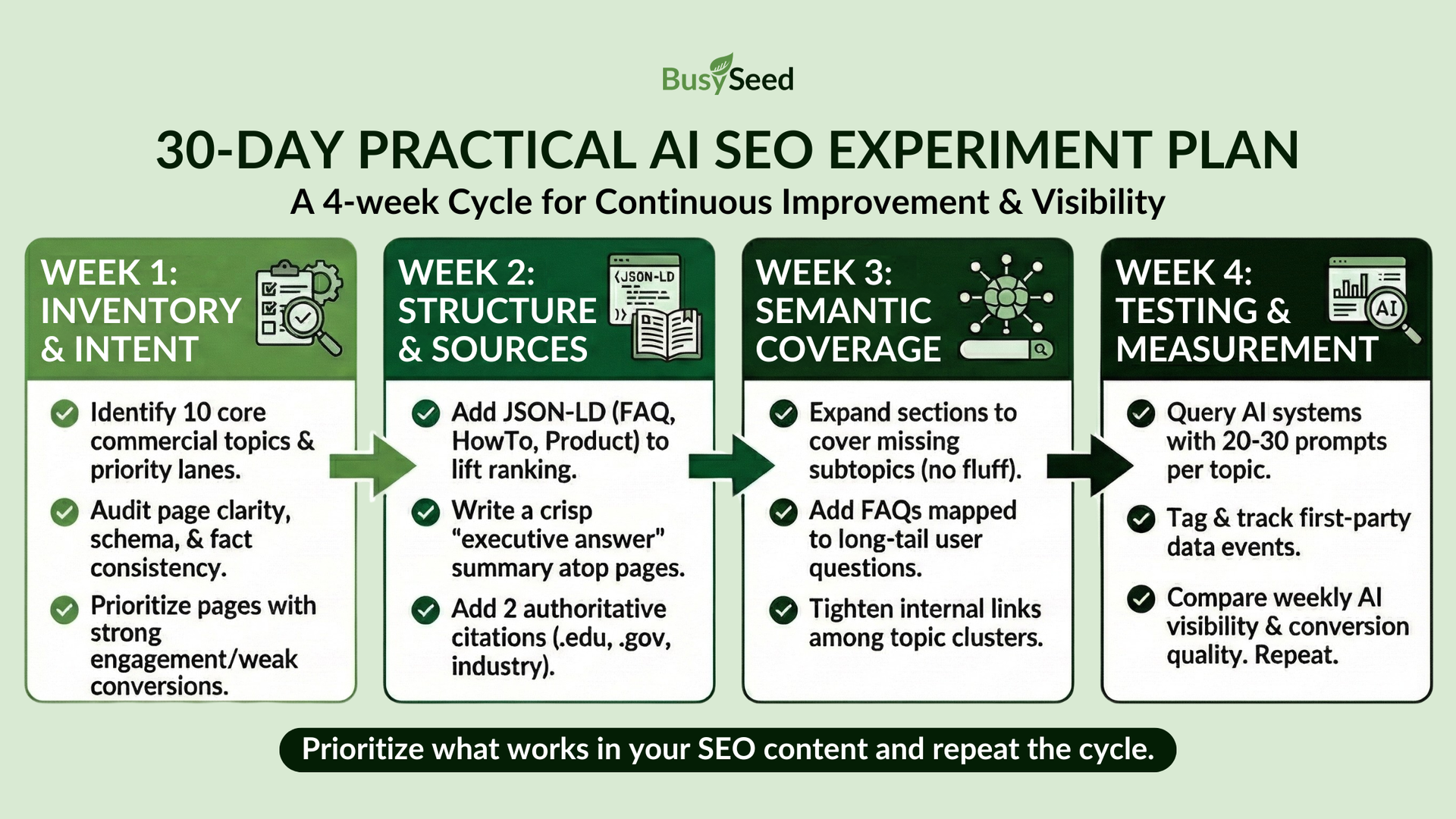
Pick high-intent topics, harden the structure, and run weekly tests against AI systems to track citation movement. Here’s a focused sprint that consistently improves AI ranking and strengthens AI search engine optimization:
Week 1: Inventory and intent
- Identify 10 core commercial or critical information topics and your priority lanes for AI SEO.
- For each, audit your top page against Q&A clarity, schema presence, and fact consistency in your SEO content.
- Pull first-party data to prioritize pages with strong engagement but weak conversions.
Week 2: Structure and sources
- Add JSON-LD (FAQ, How To, Product/Service) to lift AI ranking.
- Write a crisp “executive answer” in 1-2 sentences atop each page for better AI search engine optimization.
- Add two authoritative citations per page from industry, .edu, or .gov sources to fortify your SEO content.
- Ensure cross-platform consistency of names, specs, and dates.
Week 3: Semantic coverage
- Expand sections to cover missing subtopics. Search “Best tools to identify semantic gaps for AI ranking” and use one to fill gaps without fluff.
- Add FAQs mapped to long-tail questions people actually ask; this reinforces AI SEO.
- Tighten internal links among the topic clusters to clarify relationships in AI search engine optimization.
Week 4: Testing and measurement
- Query leading AI systems with 20-30 prompts per topic. Record where your page appears, how it’s cited, and what excerpts are used, your living AI ranking tracker.
- Tag and track first-party data events tied to these pages.
- Compare week-over-week AI SEO visibility and conversion quality. Prioritize what works in your SEO content and repeat.
Which tools help you find opportunities and semantic gaps?
Use a blend of topic modeling, SERP feature tracking, and AI visibility analysis to focus your effort where it counts. If you’re assembling a stack, start with these categories aligned to AI search engine optimization:
- Semantic gap analysis: Investigate “Best tools to identify semantic gaps for AI ranking” to map entities, questions, and related topics.
- First-party data analytics: Prioritize “Best tools for analyzing webpage first-party signals” so you can tie behavior to content decisions.
- Visibility scoring: Choose platforms offering AI answer visibility metrics. Pair them with “Top tools for scoring content effectiveness without visible clicks.”
- Schema validation: Use validators to ensure your structured data is error-free and comprehensive for resilient AI SEO.
This tooling supports AI ranking gains by showing where your SEO content underserves a topic and where AI systems already prefer your competitors. The aim isn’t a giant stack; it’s a deliberate one that closes the loop from insight to impact using first-party data.
How can B2B teams apply this when sales cycles are long?
Build content for each buying job, enable AI citations on thought leadership, and measure pipeline influence using first-party data. B2B journeys are complex, but the principles don’t change:
- Map buying committees to topic clusters. Create SEO content for each role’s top questions, and format it for AI extraction to boost your AI ranking.
- Offer calculators, frameworks, checklists, and implementation guides; assets that AI can summarize and that decision-makers will save, strengthening AI search engine optimization.
- Gate strategically. Use ungated executive summaries atop gated reports so AI can cite the core findings, while your team captures leads from first-party data.
- Attribute with rigor. Connect content touches to MQLs, opportunities, and revenue from first-party data; proof that your AI SEO is working.
How do you build an internal AI SEO operating system?
Codify your standards, data, and workflows so the work is consistent and compounding. This is how AI search engine optimization becomes a durable advantage:
- Fact library: A maintained document with canonical definitions, pricing, SKUs, product specs, bios, and timelines. Keep it synced across the web, sales decks, and PR to stabilize AI ranking.
- Content design rules: Q&A-first intros, evidence-first claims, schema requirements, citation style. Bake these into briefs/templates so your SEO content is consistently “answer-ready.”
- Review loop: Editorial review for accuracy, SEO review for structure, and legal/brand checks. Measure with first-party data and publish improvements quarterly as part of your AI SEO cadence.
- Experiment cadence: Monthly sprints focused on a single topic cluster. Track AI search engine optimization movement, AI visibility, and conversion quality.
- Training: Cross-train content, SEO, and analytics teams on schema, entity coverage, and measurement for better AI ranking.
Quick-reference checklist: turning strategy into execution
- Define priority topics and intents to earn citations and elevate AI ranking.
- Add schema and Q&A structures to all key pages for robust AI SEO.
- Use first-party data to select next content updates and validate impact.
- Refresh and cite. Keep SEO content current, cite authoritative sources, and log methods.
- Measure AI visibility, engagement, and conversions, pillars of AI search engine optimization.
FAQ
Q1). What’s the difference between traditional SEO content and AI search engine optimization?
Traditional SEO content is often optimized for keywords and blue-link rankings. AI search engine optimization optimizes for inclusion and citation in AI-generated answers. That means structuring your pages for machine parsing, emphasizing facts and E-E-A-T, and measuring AI ranking and visibility alongside conversions. You still need great SEO content, but success shifts from clicks to outcomes captured via first-party data as part of your broader AI SEO practice.
Q2). How can I measure AI ranking if I can’t see clicks or referrers?
Use tools that track AI answer visibility and citations, then correlate to first-party data on your site. Run weekly prompts against leading AI systems for your priority topics, log where and how your brand appears, and map any uplift to engagement and conversions. Pair this with “Top tools for scoring content effectiveness without visible clicks” to keep your AI search engine optimization grounded in business impact and to guide your next SEO content update.
Q3). What are the “Best tools for analyzing webpage first-party signals” for content teams?
Look for platforms that unify behavioral metrics (scroll depth, time on section), events (downloads, shares), and CRM outcomes. The ideal stack supports experimentation: edit structured elements in SEO content, republish, then watch how first-party data shifts. This helps you prioritize AI SEO updates and quantify AI ranking wins; core to sustaining AI search engine optimization.
Q4). How does schema markup improve AI SEO in practice?
Schema clarifies entities, relationships, and context. FAQ, How To, Product, Organization, and Article markup give LLMs a reliable map of your SEO content. This boosts AI ranking by making it easier for models to extract precise answers and attribute them correctly. A valid, comprehensive schema is often the difference between being quoted or ignored in AI search engine optimization.
Q5). What are the “Best tools to identify semantic gaps for AI ranking” in my space?
Choose tools that reveal missing entities, questions, and subtopics for your core themes. Your goal is to expand SEO content to cover those gaps with original examples, data, and clear answers. This approach boosts AI SEO by favoring sources with complete, coherent coverage, improving both AI rankings and the outcomes of your AI search engine optimization efforts.
Bringing it together: You can win in zero clicks, and we can help
The playbook is clear:
- Design for answers, not just links; this is the heart of AI SEO.
- Let first-party data guide your roadmap.
- Structure for machine understanding and human trust so your SEO content earns citations and AI ranking.
- Measure visibility, engagement, and conversions, the foundation of AI search engine optimization.
If you’d like a partner to operationalize this, from schema to sprint planning to dashboards, BusySeed is ready to help. We build AI SEO systems that earn citations, improve AI ranking, and tie outcomes to revenue with first-party data. Let’s turn your best expertise into the SEO content that AI cites and buyers trust. Start your AI search engine optimization plan with us today:
BusySeed. Or learn more on our
services page and see the results in our
case studies. We’re here, with a smile, and a plan.
Works Cited
- “A Majority of Google Searches End Without a Click, Study Finds.” Search Engine Land, 2024, https://searchengineland.com/google-search-zero-click-study-2024-443869. Accessed 7 Jan. 2026.
- “First-Party Data: Why It Matters and How to Use It.” Search Engine Land, https://searchengineland.com/guide/first-party-data. Accessed 7 Jan. 2026.
- Goodin, Dan. “Semrush Has a New Tool to Help Marketers Win in the AI Age, Make Sure Your Business Doesn’t Get Hidden.” TechRadar Pro, 2024, https://www.techradar.com/pro/semrush-has-a-new-tool-to-help-marketers-win-in-the-ai-age-make-sure-your-business-doesnt-get-hidden. Accessed 7 Jan. 2026.
- Green, Matthew. “Humans and AI Will Coexist, and They’ll Super-Power Each Other: Are You Ready for the AEO Revolution?” TechRadar Pro, 2024, https://www.techradar.com/pro/humans-and-ai-will-coexist-and-theyll-super-power-each-other-are-you-ready-for-the-aeo-revolution. Accessed 7 Jan. 2026.
- Hern, Alex. “Future-Proofing Brands’ Search Strategies: Harnessing LLMs for Enhanced Discoverability.” TechRadar Pro, 2024, https://www.techradar.com/pro/future-proofing-brands-search-strategies-harnessing-llms-for-enhanced-discoverability. Accessed 7 Jan. 2026.
- “Google Search Essentials: Creating Helpful, Reliable, People-First Content (and Using Generative AI).” Google Developers, 2024, https://developers.google.com/search/docs/fundamentals/using-gen-ai-content. Accessed 7 Jan. 2026.
- Insight Partners. “Generative AI, SEO, and Zero-Click Searches.” Insight Partners, 2024, https://www.insightpartners.com/ideas/generative-ai-seo-zero-click-searches/. Accessed 7 Jan. 2026.
- Ortutay, Barbara. “As AI Answers Spread, Publishers See Big Drops in Click-Through Rates.” AP News, 2024, https://apnews.com/article/5b0cdc59870508dab856227185cb8e23. Accessed 7 Jan. 2026.
- Vazquez, Sara. “How LLMs Choose Sources.” Axios Communicators, 2024,
https://www.axios.com/newsletters/axios-communicators-7d6cc9e0-63d9-11f0-8adf-19d79be43450. Accessed 7 Jan. 2026.