
A forward-looking analysis of the core factors (E-E-A-T, citation quality, entity integrity) Google is expected to rely on most heavily to rank content in the post-Gemini landscape.
TL;DR
- Google will reward content that blends entity trust, clear answers, and local relevance, not just clever prompts or shortcuts.
- Page-one rankings still drive AI visibility; nearly half of AI Overviews cite top-10 results, so fundamentals remain non-negotiable.
- Verified citations and expert bylines are rising trust signals that help your content get pulled into AI answer boxes.
- Local intent is intensifying; tune your geo search and brand signals to win “near me” and service-area queries at scale.
- Prepare a dual track: nail the basics and adopt modern GEO, the blend of generative engine optimization, Google, and location-aware SEO.
How is Google defining “GEO” in 2026, and why should you care?
It means two things at once: the rise of generative engine optimization Google and a renewed emphasis on geographic relevance. You’ll need to optimize for both to earn visibility in AI answers and region-specific intent. Despite the buzz around AI, user behavior still starts with Google; even heavy AI users “often default to old habits: starting with Google,” Search Engine Land. Meanwhile, AI Overviews have become a visible layer on top of results, by late 2024, around 18-19% of queries included an AI Overview SE Ranking. In practice, your content must satisfy two realities: perform in classic rankings and be “answer-ready” for AI. That dual approach is the essence of modern GEO.
- Generative answerability: Structure content so AI can lift clean, scannable answers and supporting evidence. That’s the crux of AI search engine optimization in 2026.
- Local precision: Geo-personalization is intensifying. Google’s quality rater guidelines highlight “user location” as a query signal. Search Engine Land: your geo search coverage needs to be deep, consistent, and accurate.
- Brand entities: As Google’s knowledge graph expands, your brand’s expertise, supported by credible authorship, becomes a durable advantage that lifts both generative engine optimization Google outcomes and local pack visibility.
BusySeed can help you unify both tracks with a pragmatic roadmap. Start here: BusySeed.
Why will entity trust (and authors) matter more than ever?
Because Google is scaling entity signals and rewarding recognizable expertise. Expect the author and brand authority to influence both SERP rankings and AI answer inclusion. Google’s investment in its knowledge graph is accelerating: person profiles in Google’s facts database grew by 17% in March 2024, focusing on academics, writers, and journalists, and the count had already tripled in mid-2023 Search Engine Land. Google is even labeling certain authors as “Content Creators” in the SERPs, effectively granting trust signals to topic-specific experts. For teams building E-E-A-T strategies, that’s a clear directive: tie key content to visible, verifiable expertise.
How to operationalize:
- Author blueprints: Publish clear bylines, detailed bios, and credentials for every strategic article. This is fuel for E-E-A-T strategies and entity recognition, boosting AI search engine optimization and helping AI models cite your work.
- Consistent identity: Maintain consistent brand details across your site, press mentions, and knowledge panels. Consistency strengthens the generative engine optimization of Google outcomes.
- Expert footprint: Pitch your SMEs to reputable outlets. Citations and mentions on respected sites reinforce entity integrity, especially helpful in geo search.
- Agency stack: Digital agencies seeking the Best generative SEO solutions for digital agencies should systematize authorship governance, schema, and editorial workflows that showcase real expertise at scale, a cornerstone in E-E-A-T strategies.
When AI looks for a consensus-backed answer, recognizable experts win the tie. That’s why entity trust intersects with AI search engine optimization and why your E-E-A-T strategies need a measurable roadmap.
How do citations and verifiable sources influence AI Overviews?
They’re decisive. AI models are more likely to include or trust content with credible references that they can verify. Independent reviews show that AI can hallucinate when sources are thin; a recent analysis of leading chatbots found they sometimes fabricated links and confidently gave incorrect answers, Forbes. Conversely, adding genuine references boosts performance; one SEO experiment documented ~30-40% higher visibility in generative results when pages added citations, quotes, and stats from reliable sources, Seer Interactive.
Practical moves:
- Source quality over volume: Link to authoritative .gov, .edu, and respected industry publications. These are the types of sources that strengthen the generative engine optimization Google outcomes, and geo search credibility.
- In-line attribution: Cite claims where they’re made, not just at the bottom. Inline context makes it trivial for models to lift your passage and keep the citation attached, a simple but potent AI search engine optimization habit.
- Evidence clusters: Surround key statements with corroborating data, related stats, and a short quote. These are high-yield engine optimization tips that double as “evidence blocks” models prefer.
- Editorial hygiene: Use standardized citation formats, consistent anchors, and accessible link titles. A clear structure helps AI search engine optimization tools parse your references correctly.
Want repeatable sourcing processes? BusySeed has systematized editorial workflows that make citations second nature. Work with us.
Do old-school rankings still drive AI citations, and how much?
Yes, significantly. Data indicates that top organic rankings increase your odds of being cited in AI Overviews. Across more than a million AI answer boxes, roughly 40.6% of cited links came from pages already ranking in Google’s top 10, and 81.1% of AI answers included at least one top-10 result Xseek. Google has also stated there’s “no special markup” required to be included in AI answers, great fundamentals still win Xseek. Your generative engine optimization Google Play doesn’t replace core SEO; it builds on it.
Foundational engine optimization tips to prioritize:
- Technical excellence: Mobile speed, clean architecture, and indexable templates. Baseline ai search engine optimization depends on it.
- Intent-aligned content: Complete topical coverage, not just keywords. Modern ai search engine optimization rewards comprehensive, well-structured pages.
- Authoritative links: Earned, relevant backlinks remain a durable ranking signal that also reinforces E-E-A-T strategies.
- UX signals: Improve engagement to reduce pogo-sticking, part of Google’s “credibility layer” Search Engine Land.
Win page one, and you improve your chances of fueling AI answers and geo search outcomes. The best way to influence AI is to first be the best traditional result, it’s smart ai search engine optimization and smart business.
Where will local and brand signals tip the scales in 2026?
They’ll shape both rankings and personalization logic, especially for commerce, services, and time-sensitive results. Google’s guidelines explicitly mention “user location” as a signal Search Engine Land, and 81% of consumers use Google for local reviews, according to BrightLocal. That means geo search is a default pathway for many buying journeys. Meanwhile, AI systems weigh brand credibility and user behavior before trusting a source Search Engine Land, which means recognizable entities will earn more citations across generative engine optimization Google experiences.
Actionable local engine optimization tips:
- Business profile mastery: Keep Google Business Profile categories, hours, services, and attributes accurate and city-specific, the basics underpin geo search and AI search engine optimization for location intent.
- Localized content at scale: Build city/service pages with unique value (FAQs, pricing ranges, timelines, regulations), not boilerplate. This supports E-E-A-T strategies and funnels better local links.
- Reviews + response: Encourage Google reviews, respond fast, and cite real outcomes. Reviews are a behavioral trust signal that feeds geo search and AI search engine optimization relevance.
- Local links and mentions: Sponsor community organizations, contribute expert commentary to regional outlets, and pursue chamber/association links, practical engine optimization tips when “user location” is in play.
Result: a compounding flywheel. Strong local signals drive rankings, which increase your odds of being cited in AI answers for nearby users, reinforcing brand presence in both geo search and generative layers. If you want a partner to accelerate that loop, BusySeed has your back.
How should experts structure pages to be “answer-ready” for AI and users?
Lead with the answer, then expand with evidence and steps. Use clear headings, scannable bullets, and question-based subheads. Google’s AI is tuned to pull in the “best answer” and looks for consensus across reputable sources Search Engine Land. Pages that map directly to the user’s question, with structured sections and corroborating citations, are more likely to be excerpted. This is applied AI search engine optimization.
- Start with the direct answer (1-2 sentences).
- Expand with proof (stats, quotes, external links).
- Add “how-to” steps and checklists (clean bullets).
- Include FAQs that mirror long-tail queries.
- Use schema appropriately, but ensure the text itself carries the answer.
Concrete engine optimization tips you can ship this quarter:
- Create “evidence blocks” around critical claims with links to high-authority sources (e.g., Seer Interactive, Forbes, government, or academic sources where appropriate). This supports E-E-A-T strategies and AI search engine optimization.
- Make answers modular. H2/H3 in question format (like this article) improves generative engine optimization Google alignment, and geo search discoverability.
- Map every page to a single dominant intent; don’t force unrelated intents together.
- Add localized FAQ sections on city/service pages to improve geo search breadth and ai search engine optimization signals.
Finally, apply E-E-A-T strategies at the template level: every key article should have a visible author, a date, revision notes, and references. Treat authorship like a product feature, not an afterthought, especially in generative engine optimization Google contexts.
Quick reference: Core KPI map
Which metrics prove your GEO strategy is working?
Track both classic SEO and generative indicators, and tie them to revenue. Key measurements to align with Improving generative engine performance:
- Share of AI citations: Monitor how often your URLs appear in AI Overviews for target queries (directionally, not just absolute counts).
- Snippet presence: Track FAQs, featured snippets, and “People also ask” inclusions, precursors to AI search engine optimization visibility.
- Entity coverage: Benchmark brand and author presence in knowledge panels and news/industry mentions; these reflect E-E-A-T strategies progress and generative engine optimization Google momentum.
- Local KPIs: Calls, directions, and messages from Google Business Profile, plus localized rankings across primary cities. These map to the geo search lift.
- Engagement metrics: Dwell time, scroll depth, and conversion rates on answer-driven pages. If the structure is right, engagement rises.
Tooling and resourcing:
- Generative optimization tools for startups should combine rank tracking, AI Overview monitoring, and entity/knowledge-graph audits in a lightweight stack.
- Larger teams and agencies may require content intelligence, editorial QA, and link-earning programs, the Best generative SEO solutions for digital agencies integrate author governance and evidence workflows.
- For in-house marketers balancing capacity, consider partnering with a specialized team. At BusySeed, we operationalize these dashboards and workflows end-to-end:
BusySeed.
How do you build a 2026-ready playbook that blends GEO, entity trust, and fundamentals?
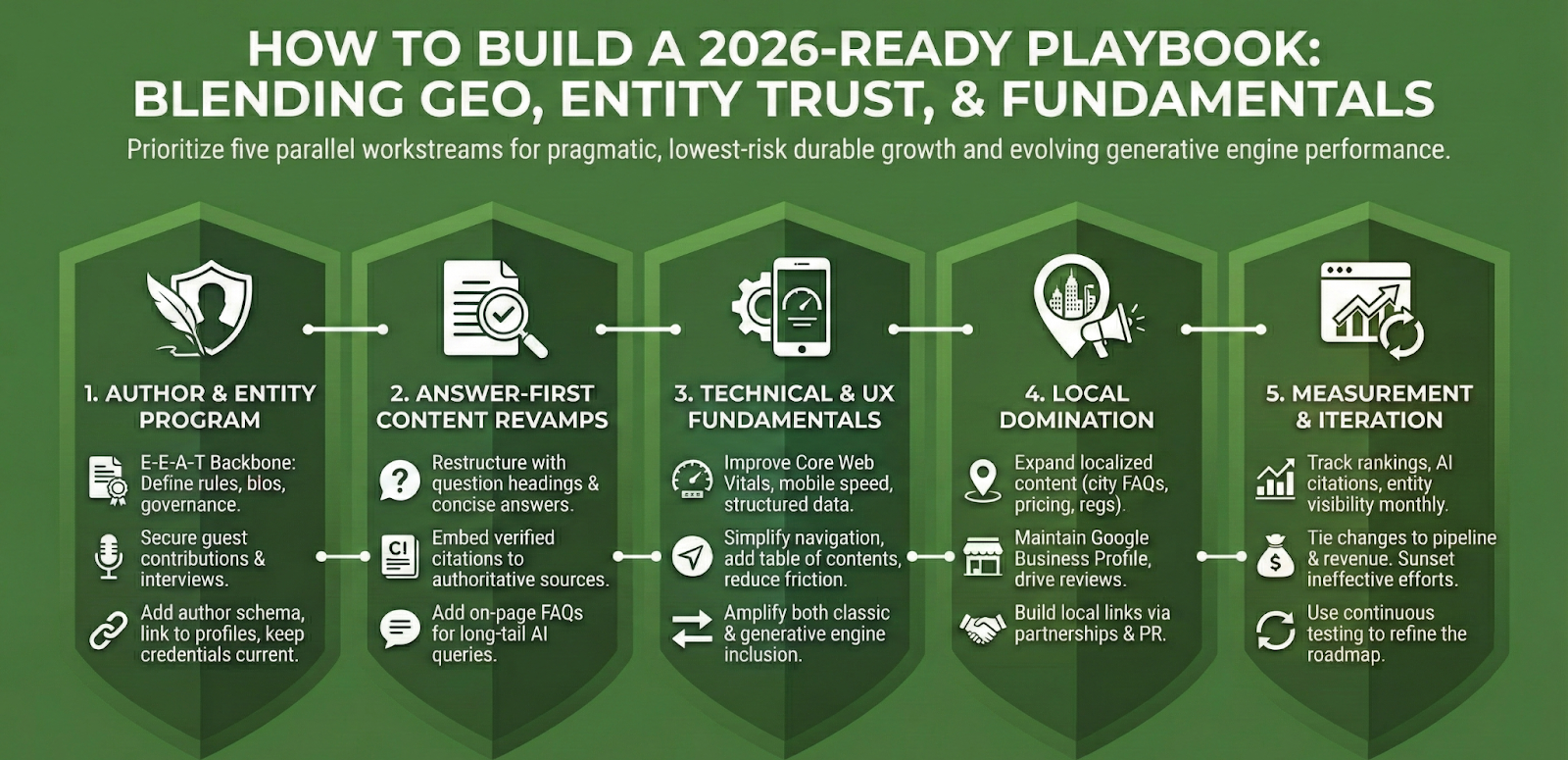
Prioritize five workstreams and run them in parallel. That’s the pragmatic, lowest-risk path to durable growth, and it’s how you’ll keep improving generative engine performance as algorithms evolve.
1. Author and entity program
- Define authorship rules, bios, qualifications, and editorial governance, the backbone of E-E-A-T strategies.
- Secure guest contributions and interviews to build entity mentions on authoritative domains.
- Add author schema and link to profiles; keep credentials current to support AI search engine optimization.
2. Answer-first content revamps
- Restructure top revenue pages with question-based headings and concise first-sentence answers.
- Embed citations to authoritative sources; verify every claim.
- Add on-page FAQs targeting long-tail queries aligned to ai search engine optimization.
3. Technical and UX fundamentals
- Improve Core Web Vitals, mobile speed, and structured data hygiene, essential engine optimization tips.
- Simplify navigation, add table of contents modules, and reduce friction.
- These improvements amplify both classic rankings and generative engine optimization Google inclusion.
4. Local domination
- Expand localized content beyond boilerplate. Include city-specific FAQs, pricing ranges, timelines, regulations, and testimonials, powerful for geo search and AI search engine optimization.
- Maintain Google Business Profile rigorously. Drive more reviews and respond fast.
- Build local links via partnerships, PR, and associations to improve geo search signals.
5. Measurement and iteration
- Track rankings, AI citations, and entity visibility monthly to keep improving generative engine performance.
- Tie changes to pipeline and revenue. Sunset efforts that don’t move the needle.
- Use continuous testing to refine your engine optimization tips roadmap.
Need help deploying this? This is exactly what we implement for growth-focused teams. Book a working session with BusySeed: Schedule now.
What research-backed truths should guide your 2026 bets?
- AI hasn’t killed search. Users still start in Google, even heavy AI users, which means AI search engine optimization complements fundamental Search Engine Land.
- AI Overviews are a layer, not the whole page. Around 18-19% of queries included AI Overviews by late 2024 SE Ranking; write to be excerptable while still winning organic.
- Page one still rules. 40.6% of citations in AI answers came from top-10 organic results; 81.1% of AI answers included at least one top-10 result Xseek.
- Trust is earned and verified. Google is scaling entities Search Engine Land, and pages with proper citations see ~30-40% higher visibility in AI contexts, Seer Interactive.
- Location is a primary signal. Guidelines highlight user location, Search Engine Land, and 81% rely on Google for local reviews, BrightLocal, making geo search a must-have.
Mini checklist: ship this month
- Add author bylines, bios, and credentials to revenue-driving pages (E-E-A-T strategies).
- Refactor the top 10 pages to answer-first format with inline citations (AI search engine optimization).
- Audit and update Google Business Profile for every location (geo search foundation).
- Set up dashboards for AI Overview citations and snippets (Improving generative engine performance).
- Kick off a 2-site guest posting sprint for expert authors (entity building + engine optimization tips).
FAQ: Advanced, long-tail questions we hear from expert teams
How do E-E-A-T strategies translate into measurable gains in ai search engine optimization?
Start by mapping authors to clusters where they have real credentials. Add detailed bios, citations, and revision histories across those pages. Track gains in featured snippets, AI citation frequency, and entity recognition (knowledge panels, author panels). As you scale these practices, the generative engine optimization Google visibility rises because models can verify claims and associate content with known experts. Tie this to revenue by monitoring conversion rates on those pages and calls or messages triggered via geo search pages. This is one of the most reliable engine optimization tips for improving generative engine performance.
Which engine optimization tips matter most for AI Overviews when resources are tight?
Prioritize answer-first structuring, authoritative citations, and mobile performance. These steps maximize your odds of being excerpted and cited with minimal engineering lift. For small teams, Generative optimization tools for startups that aggregate AI Overview monitoring, rank tracking, and citation audits can streamline execution. Over time, add local content depth and author governance to sustain gains in geo search and AI search engine optimization. If you need help, the Best generative SEO solutions for digital agencies often include playbooks you can adapt in-house.
We’re a multi-location brand. How do we balance geo search and generative engine optimization, Google?
Create a repeatable template: localized service pages, city-specific FAQs, review highlights, and distinct value props per market. Pair that with company-level thought leadership anchored by recognized authors and robust citations. This two-tier model supports E-E-A-T strategies at the brand level while winning proximity and relevance signals locally. To scale efficiently, consider the Best generative SEO solutions for digital agencies or partner with a specialist like BusySeed.
What signals tell us we’re improving generative engine performance quarter over quarter?
Look for increased inclusion in AI Overviews on target queries, higher snippet/PAA capture, stronger author/entity presence in SERPs, and rising engagement metrics (scroll depth, time on page) on answer-structured content. When these climb alongside local actions (calls, directions) and organic conversions, your AI search engine optimization is compounding. Use these as north-star metrics to guide your engine optimization tips and geo search roadmap. Tools in the category of Generative optimization tools for startups can automate much of this tracking.
Does link building still matter if we’re focused on AI and entities?
Yes. High-quality, relevant links are still core ranking inputs and act as external validation that supports E-E-A-T strategies and generative engine optimization Google outcomes. Prioritize links from reputable industry sources and local/regional outlets to boost both domain authority and geo search strength. Pair this with answer-first content to maximize AI search engine optimization benefits.
Key terms we use (and why they matter)
To keep our language clear and consistent, and to avoid keyword stuffing, here’s how we use the following terms across this guide:
- AI search engine optimization: The practice of structuring content so AI systems can extract accurate, citation-ready answers. It spans formatting, evidence, and author credibility.
- Generative engine optimization Google: How to align content with Google’s AI summarization layer and underlying SERP logic, not just “AI,” but Google’s specific generative context.
- Geo search: Optimization for location-aware queries, from “near me” to city-service pages and map pack visibility.
- E-E-A-T strategies: Repeatable methods to prove experience, expertise, authoritativeness, and trustworthiness through bios, citations, and consistent identities.
- Engine optimization tips: Practical, testable tactics that move rankings and AI inclusion, from internal link structure to evidence blocks.
- Improving generative engine performance: A measurement mindset focused on more citations, better snippets, and stronger entity presence over time.
- Best generative SEO solutions for digital agencies: Tools, processes, and partner models agencies can use to scale author governance, QA, and sourcing.
- Generative optimization tools for startups: Lightweight platforms that track AI citations, rankings, and entity health without heavy overhead.
Why act now, and how BusySeed can help you win 2026’s GEO
Google’s playbook is increasingly clear: recognizable experts, verifiable sources, strong fundamentals, and local precision. Those who align to this reality will own more of the SERP and more of the AI Overview real estate. Those who don’t will watch competitors become the “default” answers. Here’s your next move:
- Commit to answer-first, citation-backed content that models consensus, the heartbeat of ai search engine optimization.
- Operationalize E-E-A-T strategies (authorship, bios, editorial standards) to strengthen generative engine optimization Google results.
- Fortify technical SEO and UX, proven engine optimization tips for page-one visibility.
- Scale localized content and review velocity to dominate geo search.
- Measure relentlessly and iterate, always Improving generative engine performance.
If you want a partner who brings warmth, clarity, and operator-level rigor, we’d love to help. BusySeed builds and runs the systems that make ai search engine optimization practical, weaving entity trust, generative engine optimization Google alignment, and local excellence into one growth engine. Let’s plan your 2026 GEO roadmap together. Start here.
Works Cited
- BrightLocal. “Local Consumer Review Survey 2024.” BrightLocal, 2024, www.brightlocal.com/research/local-consumer-review-survey-2024.
- Constantino, Tor. “Can You Trust AI Search? New Study Reveals The Shocking Truth.” Forbes, 28 Mar. 2025, www.forbes.com.
- SE Ranking. “AI Overviews 2024 Recap and Research.” SE Ranking, 2024, seranking.com.
- Search Engine Land. “AI Hasn’t Killed Search: Study.” Search Engine Land, 2024, searchengineland.com.
- Search Engine Land. “Unpacking Google’s 2024 E-E-A-T Knowledge Graph Update.” Search Engine Land, 2024, searchengineland.com.
- Search Engine Land. “Google 2023 E-E-A-T Knowledge Graph Update.” Search Engine Land, 2023, searchengineland.com.
- Search Engine Land. “Google Recognizes Content Creators: A Breakthrough for E-E-A-T and SEO.” Search Engine Land, 2024, searchengineland.com.
- Search Engine Land. “Does Schema Matter in AI Search?” Search Engine Land, 2024, searchengineland.com.
- Search Engine Land. “Google’s 2023 Search Quality Rater Guidelines Update: Changes.” Search Engine Land, 2023, searchengineland.com.
- Seer Interactive. “Optimizing Content for Generative Search Engines.” Seer Interactive, 2024, www.seerinteractive.com.
- Xseek. “Do Top Google Rankings Drive More AI Overview Citations?” Xseek, 2024, www.xseek.io.