
Collecting less data doesn’t reduce lead quality; instead, it encourages better systems, faster follow-up, and more human judgment in evaluating prospects. Ethical data practices shift the focus from surveillance to execution, improving both compliance and the effectiveness of lead scoring.
TL;DR
- Data minimization increases conversions and speeds up follow-up, which improves revenue far more than adding extra form fields.
- Modern lead scoring and lead qualification thrive on quality over quantity and on intent-rich signals, not on bloated profiles.
- First-party data outperforms third-party lists on both ROI and compliance.
- AI lead generation works best with lean, consented inputs and clear human validation.
- Teams that prioritize trust and speed-to-lead win more meetings, faster, with less waste.
Why does less data lead to better conversion and stronger pipelines?
Because every extra field creates friction. Reducing the number of form fields encourages more prospects to convert, and the leads you get are no less qualified. Put plainly, data minimization clears the path for momentum; your buyer moves faster, and so do you.
A recent analysis found that each additional field in a lead form can reduce conversion rates by about 4.1%. That’s a material hit to volume with questionable upside for lead quality (Brixon Group referencing a HubSpot study). Instead of chasing more fields, use progressive profiling, enriching later when there’s context and rapport. This preserves momentum early, while keeping lead qualification accurate and defensible. This also keeps your funnel flowing, while preserving the integrity of lead qualification and protecting first-party data, the foundation of effective AI lead generation.
The bigger advantage is operational. By capturing only what you need now, your team can route faster and respond instantly, before interest cools. That speed compounds gains across your funnel, which is exactly where AI lead generation delivers its biggest advantage: acting on intent before it cools and feeding smarter lead scoring models in real time. This aligns your go-to-market motions with the consent-first expectations of modern buyers. When data minimization is your default, lead quality tends to rise because buyers experience less friction and more relevance, strengthening lead qualification without slowing speed-to-lead.
How does speed-to-lead outperform lengthy forms for revenue?
Contacting a new inquiry within minutes is a conversion superpower. Long forms steal time you could use to engage, and engagement wins the deal. Speed-to-lead is not just a metric; it’s a promise to your buyers that you respect their time.
You’ve seen the numbers: engaging a prospect within five minutes can lift conversion by roughly 85%; wait a day, and you’re in the single digits (LeadHero.ai). Shorter forms mean fewer distractions in routing, faster notifications, and quicker first touches. If your SDRs or automation can start a relevant dialogue immediately, your probability of booking a meeting soars, especially when AI lead generation is routing and prioritizing inquiries in real time.
Speed-to-lead gives your reps more at-bats, allowing them to refine messaging and learn patterns faster, ultimately improving lead quality, reinforcing lead qualification, and providing richer data for more accurate lead scoring.
A pragmatic play:
pair short forms with an automated first reply that confirms intent, offers value, and invites a specific next step. Then let your humans take over. This is where AI lead generation supports the moment, initiating, qualifying, and routing, without replacing human judgment. It takes advantage of the moment when attention is at its peak and reduces reliance on lengthy discovery forms. In other words, data minimization naturally aligns with your speed-to-lead motion and pays dividends in lead quality.
What first-party data matters most when form fields are minimal?
Consent, context, and intent. You need less information up front, but it must be the right information, because AI lead generation depends on signal quality, not data volume.
When you embrace data minimization, you preserve trust, while still capturing the essentials that lift lead quality.
Focus on:
- Identity basics: Name and business email are sufficient to start a conversation, and verify persona.
- Self-declared intent: A single dropdown on “What brought you here?” or “What problem are you solving?” is gold.
- Engagement context: The page, asset, or campaign that generated the response offers a precise starting point for outreach.
- Primary behavior: Visit depth, return frequency, and specific content paths are high-signal and require no intrusive profiling.
Shifting budgets to these owned signals pays off. Brands that moved 30% of spend to programs rooted in consented audiences saw a 2.9× ROI improvement within six months (Marketing Insider/IAB). When teams link owned touchpoints to offline conversions, incremental revenue can double, and cost efficiency can climb 1.5× (Google/BCG). The takeaway: the right small signals from first-party data beat big, third-party dossiers. This is the heart of data minimization and a reliable path to better lead quality.
How should teams rethink lead scoring and lead qualification with fewer fields?
By weighting observed behavior and explicit intent more heavily than demographic trivia. Effective lead qualification depends on what buyers do, not how much data you force them to submit. Lead scoring thrives when you prioritize first-party data collected through data minimization, because AI lead generation models are fueled by signals buyers actually give you.
Here’s a modern blueprint:
- Re-balance your model: Heavily weight last-touch content and recency/frequency patterns. Lower emphasis on firmographic placeholders that often mislead early in the journey.
- Prioritize engagement velocity: Fast repeat visits and multi-asset sequences often predict meetings better than job titles alone.
- Use intent hierarchy: Product pages, pricing, and solution comparisons should outrank generic blog reads.
- Add a human layer for edge cases: Give SDRs discretion to bump promising signals even when the model is uncertain.
This approach keeps your engine sharp without over-collection, allowing lead qualification to stay fast, explainable, and aligned with real buyer intent. When you apply this discipline, you’ll find your team spends more time on the right accounts and the right conversations. It reduces the “false negatives” caused by incomplete profiles and lets you refine quickly as feedback loops grow. With data minimization as a principle, lead scoring becomes clearer, lead quality improves, and speed-to-lead remains a core driver of outcomes.
Which KPIs change when you minimize inputs?
Expect your metrics to tilt toward speed, intent, and revenue clarity. When you champion data minimization, you see lead quality reflected in cleaner dashboards and tighter cycles. Your first-party data becomes a strategic asset that elevates measurement and drives accountability.
- Conversion rate per form view (after trimming fields).
- First touch response time (median and P90) and qualified meeting rate.
- Sales-accepted rate and stage-to-stage conversion.
- Pipeline per 100 inbound form fills.
- Revenue per lead and cost per qualified opportunity.
- Opt-out rate and complaint rate after the first outreach.
Tie these to your lead scoring thresholds and lead qualification criteria. As you shorten forms, your volume should rise; your goal is to keep or improve downstream conversion. If your sales-accepted rate holds while overall form conversion climbs, you’ve created real business leverage. If it dips, review your signals and thresholds, not just data capture. Done right, data minimization strengthens your speed-to-lead, preserves lead quality, and gets more mileage from your first-party data.
Short forms vs. long forms: What actually changes?

How can you run progressive profiling and value exchange without hurting trust?
Offer value in exchange for every additional detail, and earn at each step. Data minimization doesn’t mean “never ask,” it means “ask only when useful,” and connect each question to clear value, so lead qualification improves as trust deepens. This protects first-party data quality and enhances lead quality.
A practical progression:
- Entry: Name, business email. Instant value (confirmation, curated resources).
- First follow-up: One question aligned with the buyer's problem. Share a relevant checklist or calculator in return.
- Post-meeting or POC: Role-specific details that directly improve the experience (e.g., integration requirements, timeline). Deliver something they can use immediately.
This mirrors how most people want to share information, voluntarily, when it helps them. Leaders design interactions that reward customers for the information they choose to share (BCG). That builds durable, opt-in signals you can reuse across the lifecycle.
Operationally, document your rules of the road in a short policy that the team actually reads. Make it crystal clear what you collect, why, and how it benefits the buyer. Then enforce it in your systems (required fields, suppression rules, and audit logs). The result is a smoother process, better replies, and fewer escalations. If you want help building a value exchange that respects data minimization, our team at
BusySeed can guide you end-to-end.
What tools and workflows support a minimal-data strategy without losing precision?
The right stack helps you act fast, personalize lightly, and measure what matters, key requirements for scalable AI lead generation. With data minimization, the goal is to use first-party data more intelligently rather than collecting more. That’s how you elevate lead quality and maintain a strong speed-to-lead, while keeping lead qualification grounded in first-party signals.
- CRM and MAP with strong routing: Ensure your systems push new inquiries to the right rep in real time, with just enough context to personalize. Add calendar links or instant chat handoffs in the first automated reply. This boosts speed-to-lead and protects data minimization.
- Intelligence from owned touchpoints: Track page clusters and micro-conversions (e.g., pricing page + solution sheet). These are powerful signals available without invasive profiling, strengthening first-party data and lifting lead quality.
- Ethical modeling: Teams report conversion lifts around 25% and acquisition cost reductions near 15% when they apply advanced models responsibly, with human oversight and clear fairness controls (CRMExpertsOnline). Use this capability in your lead scoring to rank interest and route fast within your AI lead generation workflows, not to justify collecting more than you need.
- Clean handoffs: SDR <> AE processes that log outreach context and key signals. The goal is continuity, not more fields. Data minimization stays intact while lead quality improves.
- Reporting that closes the loop: Tie meetings and deals back to the handful of intent cues that started everything, so your model can keep learning. First-party data gets smarter, and speed-to-lead spikes become predictable wins.
If you want a partner that sets this up end-to-end and keeps it humming, the team at
BusySeed does this every day.
Why does a privacy-first approach increase trust and revenue?
Because buyers reward brands that respect boundaries, and regulators punish those that don’t. Data minimization ensures you collect less and earn more, elevating lead quality while safeguarding your first-party data practices.
Cisco reported that 94% of consumers would abandon a company that mishandles their data (IAPP, summarizing Cisco research). Meanwhile, GDPR enforcement remains a real risk, with fines still measured in billions over time, even as totals fluctuate year to year (CSO Online). Industry analysts also note that indiscriminate surveillance targeting mostly yields irrelevant noise for consumers (EPIC).
Net effect: collect less, earn more. Keep your communications useful, your permissions clear, and your storage disciplined. You’ll see higher engagement, fewer unsubscribes, and better commercial outcomes. That’s the compounding benefit of data minimization: higher lead quality, stronger first-party data, and faster speed-to-lead.
What does a 90-day plan look like for retooling around minimal inputs?
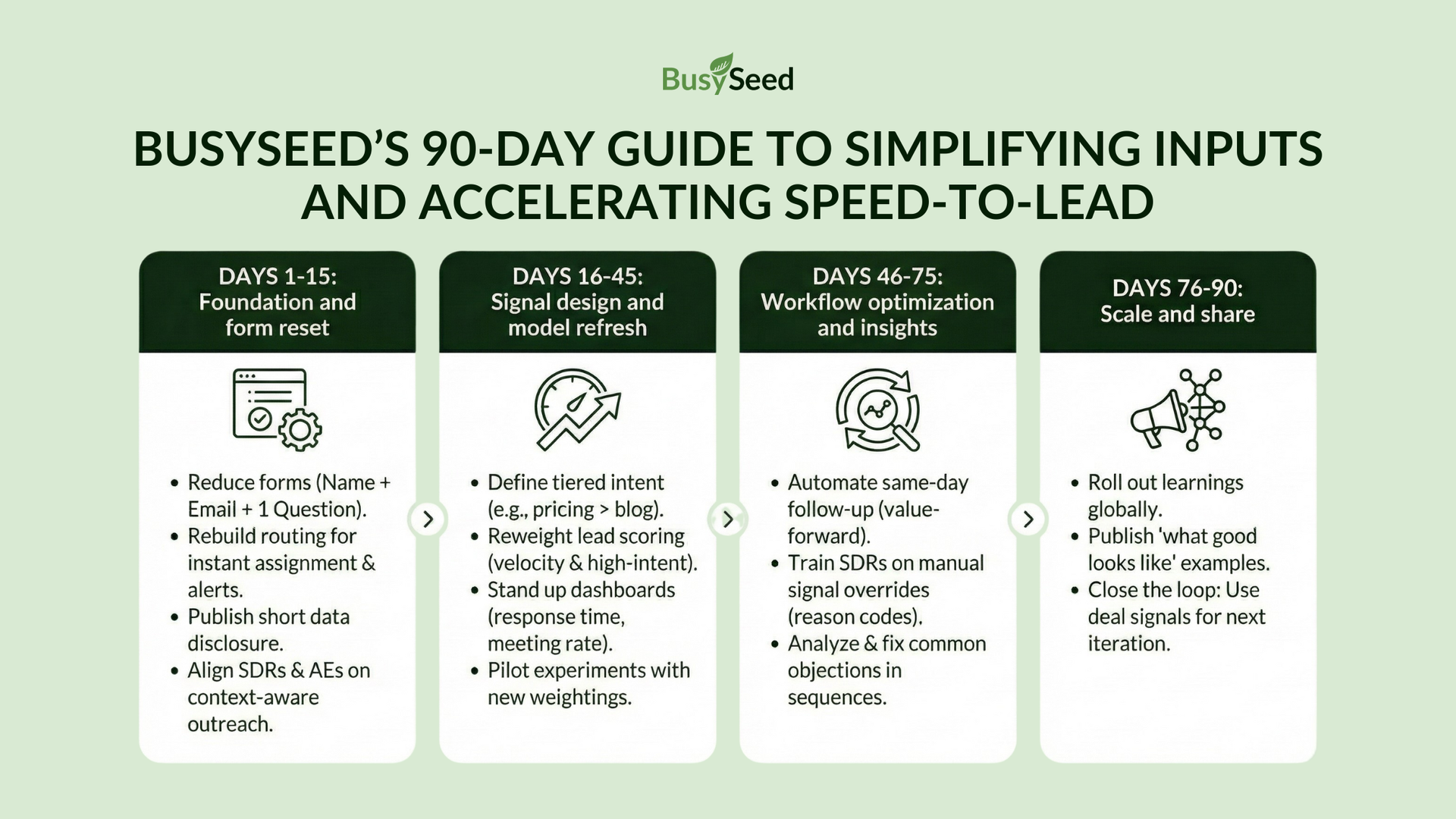
Here’s a concrete, high-velocity roadmap you can run now. It aligns data minimization, lead quality, AI lead generation, speed-to-lead discipline, and first-party data activation into one cohesive plan.
Days 1-15: Foundation and form reset
- Reduce forms to name + business email and one intent question.
- Rebuild routing rules for instant assignment and alerts to increase speed-to-lead.
- Draft and publish a short, plain-language disclosure: what you collect and why (data minimization in action).
- Align SDRs and AEs on outreach messaging that references the visitor’s context (e.g., “pricing page + feature sheet”) to improve lead quality.
Days 16-45: Signal design and model refresh
- Define tiered intent (e.g., pricing page visit > product video > blog view) using first-party data.
- Reweight lead scoring so behavioral velocity and high-intent content matter most.
- Stand up dashboards: response time, meeting rate, pipeline per 100 form fills, each tied to speed-to-lead.
- Pilot controlled experiments with new weightings and measure downstream effects on lead quality.
Days 46-75: Workflow optimization and insights
- Automate same-day follow-up for no-reply scenarios with short, value-forward messaging.
- Train SDRs to log manual signal overrides with a quick reason code for learning (data minimization plus human judgment).
- Capture and analyze common objections tied to initial outreach. Bake fixes into sequences to lift lead quality.
Days 76-90: Scale and share
- Roll out learnings across regions and segments.
- Publish internal “what good looks like” examples with talk tracks.
- Close the loop on deals: which early signals predicted wins, specifically? Use those first-party data cues to inform your next iteration and speed-to-lead playbook.
If you’d like help designing, implementing, and operating this plan, talk to
BusySeed, and we’ll tailor the build to your stack and market.
Quick KPI scorecard to keep your team honest
FAQs
Q1). What is the best way to design lead scoring with data minimization and first-party data?
Start by centering your model on behavior: recency, frequency, and critical path engagement (e.g., pricing, product comparisons, demos). Use page clusters and content depth from first-party data to determine intent rather than collecting extra firmographic details. Calibrate with weekly win/loss feedback so lead scoring reflects reality, not assumptions. This approach usually improves lead quality while preserving speed-to-lead, because reps focus on what buyers actually did, not what a long form claimed. For extra lift, add a modest human override process and audit it monthly to keep the model honest.
Q2). How can we improve speed-to-lead without sacrificing lead quality or privacy?
Automate alerts and round-robin routing to deliver sub-five-minute replies. Use one personalized sentence tied to the page or asset that sparked the inquiry, and include a calendar link. Keep the entry form minimal to enable data minimization, while leaning on first-party data from your analytics to tailor follow-up. This formula improves lead quality by meeting buyers in the moment with relevant context rather than generic scripts. It also ensures your speed-to-lead remains a consistent competitive edge.
Q3). What are the top tactics for converting leads with just a name and email?
- Reference the exact page or asset they engaged with in your first reply.
- Offer a clear next step (a calendar link, a short diagnostic, or a relevant case study).
- Ask one question that advances their goal; reciprocate with a high-value resource.
- Follow up within 24 hours if no reply; two lines, one value add, one call to action.
These steps leverage data minimization and first-party data together to increase lead quality without adding friction, while keeping your speed-to-lead strong.
Q4). How do we demonstrate ROI from data minimization to stakeholders?
Run an A/B test: trim forms on half your traffic for 30-45 days. Track conversion rate, median speed-to-lead, sales-accepted rate, pipeline per 100 form fills, and revenue per lead. Attribute meetings and deals to early intent signals from first-party data. You’ll often find that fewer fields mean more qualified conversations and more pipeline, clear proof that data minimization upgrades lead quality.
Q5). What compliance practices keep data minimization sustainable as we scale?
Adopt a “minimum necessary” collection policy and publish it in plain language. Centralize consent management and enforce instant suppression of opt-outs. Set retention limits, document processor obligations, and run quarterly access audits. When privacy is table stakes, first-party data gets cleaner, lead quality improves, and speed-to-lead remains efficient because your systems aren’t bogged down by unnecessary data.
The bottom line
Collect less. Respond faster. Personalize lightly with consented signals. That’s how data minimization reduces friction, increases trust, and converts more of the right people. It’s how first-party data becomes a growth engine, how lead scoring and lead qualification get sharper, and how speed-to-lead turns into booked meetings at scale.
If you want a partner that can implement this front-to-back and prove the lift with real numbers,
BusySeed is ready. Let’s build your faster, cleaner, higher-converting funnel together.
Works Cited
- Brixon Group. “Lead Forms in B2B: The Perfect Balancing Act between Data Depth and Conversion Rate.” Brixon Group, 2024, https://brixongroup.com/en/lead-forms-in-b2b-the-perfect-balancing-act-between-data-depth-and-conversion-rate/.
- CRMExpertsOnline. “AI Lead Scoring: Balancing Ethics and Accuracy.” CRMExpertsOnline, 2024, https://crmexpertsonline.com/ai-lead-scoring-balancing-ethics-and-accuracy/.
- EPIC. “Data Minimization: Regulating the Ineffective, Irrelevant, and Invasive Practice of Surveillance Advertising.” Electronic Privacy Information Center, 2023, https://epic.org/data-minimization-regulating-the-ineffective-irrelevant-and-invasive-practice-of-surveillance-advertising/.
- Google/BCG. “How First-Party Data Supercharges AI Lead Generation.” Think with Google, 2024, https://business.google.com/in/think/marketing-strategies/ai-lead-generation-first-party-data/.
- IAPP. “Study: Privacy Is a Key to Customer Trust.” International Association of Privacy Professionals, 2022, https://iapp.org/news/a/study-privacy-is-a-key-to-customer-trust.
- LeadHero.ai. “Why Fast Follow-Ups Convert More Leads.” LeadHeroai, 2025, https://leadhero.ai/why-fast-follow-ups-convert-more-leads/.
- Marketing Insider. “First-Party Data Marketing Unlocks Bigger Returns in a Cookieless World.” Marketing Insider, 2024, https://www.marketing-insider.eu/marketing/first-party-data-marketing-unlocks-bigger-returns-in-a-cookieless-world/.
- O’Flaherty, Kate. “GDPR Fines Reduced in 2024: Why the Decline?” CSO Online, 2024, https://www.csoonline.com/article/3808871/gdpr-fines-reduced-in-2024.html.
- Varoquaux, Arthur, et al. “Creating a Data Advantage in Marketing.” Boston Consulting Group, 2024, https://www.bcg.com/publications/2024/creating-a-data-advantage-in-marketing.