
AI-powered email acquisition and enrichment tools like Apollo and ZoomInfo can infer sensitive information from user inputs, raising ethical concerns. Transparent consent practices and minimal data collection help maintain audience trust and compliance while building quality lists.
TL;DR
- AI supercharges list growth, but risky data collection methods erode trust and attract regulators.
- Transparent consent and data minimization consistently outperform shady scraping for long-term email marketing campaign performance.
- Customers want clarity on what an AI email is: tell them when you automate, what you collect, and why it boosts engagement and reduces complaints.
- Modern compliance goes beyond checkboxes; it’s a trust strategy. Ethical concerns aren’t just legal issues; they’re brand and revenue risks.
- You can use AI tools for marketing without crossing ethical lines by auditing vendors, documenting consent, and keeping humans in the loop.
What changed in email list building with AI, and why does it matter?
AI fundamentally accelerated how companies identify and contact prospects, but it also raised new ethical concerns. The biggest shift is that data collection methods now infer and enrich data at scale, often without clear consent, which introduces risk for the integrity of email marketing campaigns.
- Consider the 16TB exposure of scraped business data tied to LinkedIn/Apollo sources, 4.3 billion records with emails, phone numbers, and more, per a TechRadar investigation. That scope of collection and enrichment shows how AI-driven data collection methods can jump from “public” to “personal” without people realizing it, triggering obvious ethical concerns around transparency and consent.
- Tools increasingly “guess” missing attributes from minimal inputs. As Smartlead explains, many AI tools for marketing scrape public sources and infer email formats or roles, blurring the line of informed permission (Smartlead).
The takeaway for leaders: AI email outreach can be powerful when it’s grounded in consent and clarity, but a liability when built on unclear pipelines. If you want expert help aligning performance and privacy, our team at BusySeed can guide you.
How do AI-driven data collection methods work today?
They aggregate, enrich, and infer. Most systems start with publicly available profiles or company pages, then apply pattern-matching to fill gaps. That means data collection methods can transform a single LinkedIn profile into a full contact record someone never explicitly provided, which raises ethical concerns.
- Scrape and stitch: AI parses bios, corporate pages, and social signals to assemble contact details. This can rapidly fuel email marketing campaigns but often lacks explicit opt-in.
- Infer and validate: From a domain and naming convention, many AI tools for marketing can guess an address (e.g., first.last@company.com). Validation pings ensure deliverability without consent.
- Auto-personalize: AI email engines personalize intros using scraped facts, making messages feel human, unless you disclose automation.
This approach improves short-term reach but invites long-term risk. It’s effective in a vacuum; it’s costly if you trigger regulatory scrutiny or damage trust.
Why are regulators scrutinizing list building more closely?
Because the line between “public” and “permissible” has moved. Privacy authorities now treat a wider range of behavioral and contact data as sensitive, and they’re enforcing it. That means email marketing campaigns built on unvetted data collection methods are exposed to penalties, not just spam complaints.
- EU regulators fined LinkedIn €310 million in 2024 for improper processing (AP News). The lesson: even sophisticated platforms can overstep.
- ZoomInfo agreed to a ~$30M class-action settlement related to the use of professional personas without explicit consent (Top Class Actions; Bloomberg Law).
- The US FTC has signaled that data like browsing and location may be considered “sensitive” by default, raising the stakes for AI tools for marketing that depend on behavioral datasets (Koley Jessen).
Bottom line: If your email marketing campaigns depend on third-party enrichment, you need to document lawful basis and consent, maintain an auditable trail, and give people easy opt-out. Otherwise, ethical concerns can quickly become legal consequences.
What are the biggest ethical concerns with AI email list building?
The core ethical concerns are consent, transparency, and data minimization. If your data collection methods harvest or infer data people didn’t knowingly provide for marketing, you risk violating expectations, even if you’re technically compliant in one jurisdiction.
- Consent ambiguity: Many AI tools for marketing compile contact data from disparate public sources. That may not meet the standard of informed consent for email marketing campaigns. This is one of the most common ethical concerns we see in audits.
- Opaque automation: Customers want to know when they receive an AI email. Salesforce reports 89% want to be told whether they’re interacting with AI or a human; only 57% trust brands to use AI ethically (Salesforce).
- Over-collection: Requesting irrelevant fields violates the principle of data minimization, a flashpoint for ethical concerns and a red flag in privacy reviews.
Treat ethical concerns as product requirements, not nice-to-haves. Trust is a growth lever.
Which data collection methods respect consent and still deliver performance?
Ask for the minimum, articulate value clearly, then earn more data over time. The most effective email marketing campaigns begin with transparent opt-in and build progressively.
- Single-field starts: Start with an email. Expand via progressive profiling after you’ve demonstrated value. This approach honors data collection methods rooted in minimization and reduces ethical concerns.
- Incentive clarity: Offer assets that align with intent, e.g., a technical benchmark report for engineers and a vendor comparison for procurement. When the value is obvious, opt-in rates rise, and AI email deliverability improves.
- Explicit disclosures: State how you’ll use the email, how often you’ll contact, and which AI tools for marketing power personalization. People reward honesty with engagement.
According to Piwik PRO’s EU survey, 92% of marketing leaders believe companies must respect online privacy, and two-thirds say they can do so while driving results (Piwik PRO). The data is clear: compliant data collection methods and strong email marketing campaigns can coexist.
How should we disclose automation in AI email without dampening response?
Be direct. Label automated touches and explain their benefits, such as speed, accuracy, and relevance. When customers know how their data informs outreach, ethical concerns decline, and response improves.
- Include AI labels: A footer line like “This outreach uses AI email to match your role with resources; learn more about our data practices.” Link to your privacy center.
- Clarify inputs: Briefly describe the data collection methods (e.g., “You opted in on our webinar registration page”). It addresses ethical concerns upfront.
- Offer choice: Provide simple preference controls: frequency, topics, channels. That’s how modern AI tools for marketing win trust.
Salesforce found that 75% of customers worry about AI’s ethical use, yet transparency reduces friction (Salesforce). Disclosure isn’t a penalty; it’s a differentiator.
How do you blend AI tools for marketing with human oversight the right way?
Use AI to remove drudgery, then add human judgment where nuance matters. AI email can personalize at scale, but humans safeguard tone, timing, and fit.
- Human-in-the-loop: Have reps review messages, at least for tier 1 accounts. This reduces ethical concerns and improves relevance in email marketing campaigns.
- Bias audits: Periodically review your AI tools for marketing to ensure segments don’t inadvertently exclude or over-target groups.
- QA workflows: Implement sampling and qualitative reviews of AI email outputs weekly. Flag drift early before it affects deliverability or reputation.
One sales study cited by Intelemark suggests AI-assisted prospecting can double reply rates when filtered thoughtfully (Intelemark). That upside compounds when it’s paired with strong guardrails.
What does the framework of compliant email marketing campaigns look like?
In practice, it’s a living system: consent-first capture, principled data collection methods, explicit policies, and fast unsubscribe handling.
Direct answer: document lawful basis, minimize fields, store consent proofs, label AI email, and automate suppression lists. Then test and iterate.
- Capture and consent: Integrate checkboxes with plain language. Log timestamp, source, and version of your policy at capture. This reduces ethical concerns later.
- Data minimization: Start lean. Add fields only when necessary for segmentation or service. Privacy laws and customer expectations both favor this.
- Explain AI: If AI tools for marketing personalize messaging or cadence, say so. Include an “About Our Data” page that explains your data collection methods in customer terms.
- Rights handling: Automate access, correction, deletion, and opt-out. Fast response is good service and prevents compliance overload for your team.
As Koley Jessen notes, US regulators increasingly treat specific data as sensitive by default. Don’t leave AI email practices ambiguous (Koley Jessen).
Conversion-safe data minimization: progressive profiling in action
Keep initial friction low, then earn depth through value exchanges. These data collection methods are both ethical and effective.
Direct answer: request email-only at first; later, ask for role, industry, or budget when context makes it clearly beneficial. That’s how high-performing email marketing campaigns build rich, accurate profiles.
- Stage your asks: After a webinar, ask for a role to tailor AI email follow-ups. After a visit to the pricing page, ask for the company size to route them to the right rep.
- Reward the detail: Offer context-specific resources in return, templates for operators, and ROI calculators for finance. Ethical concerns drop when the “why” is obvious.
- Validate organically: Let engagement tell you something, too. Open rates, clicks, and on-site behavior can inform segments without additional form fields.
Consumers notice restraint. Validity reports ~87% of consumers say it’s important that companies safeguard their data, which includes asking only for what’s needed (Validity).
Where should you draw the line on third-party enrichment and purchased lists?
If you can’t explain the provenance and consent status of each contact, don’t use it. The safest path for AI email is opt-in, with highly selective enrichment that you can defend.
Direct answer: avoid purchased lists; restrict enrichment to fields customers expect you to use; disclose enrichment in your privacy notice to reduce ethical concerns.
- Provenance checks: Require vendors of AI tools for marketing to warrant the quality of consent and provide sample logs. Audit quarterly.
- Purpose limitation: Only enrich attributes essential for segmentation or service, not curiosity. These disciplined data collection methods will serve you in any jurisdiction.
- “Next best action” vs. spamming: Use AI to determine relevance, not to force volume. Your email marketing campaigns should prioritize signal over send frequency.
If you need a clean, scalable way forward, talk to our team about building opt-in pipelines that convert. We advise on compliant data collection methods and AI email frameworks that move the needle. Start here: BusySeed.
How do you vet vendors, platforms, and AI tools for marketing?
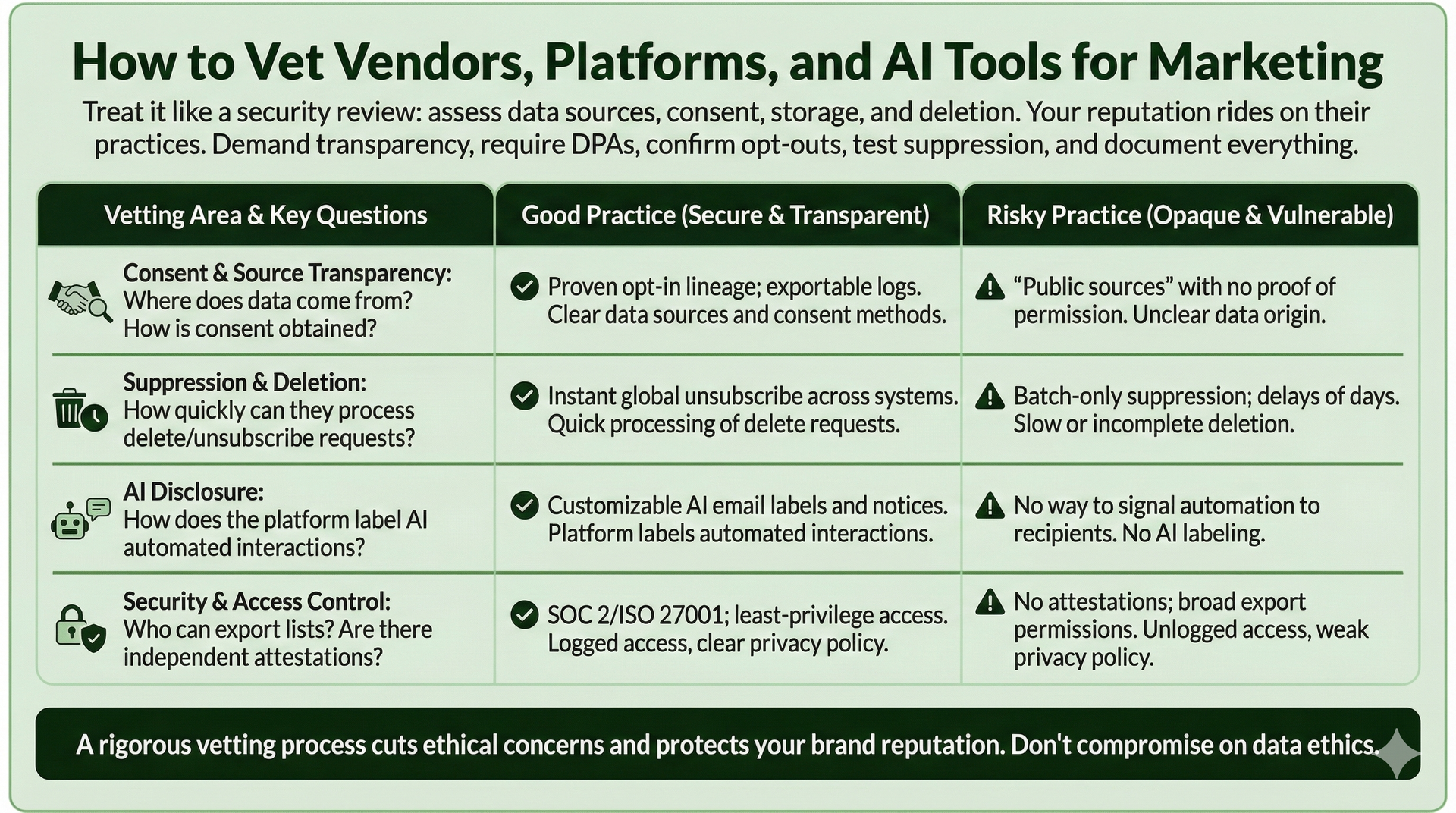
Treat it like a security review: assess data sources, consent posture, storage, and deletion logistics. Your reputation rides on their practices.
Direct answer: demand transparency on data collection methods, require DPAs, confirm opt-out mechanics, test suppression, and document everything. This cuts ethical concerns substantially.
Vendor Vetting Snapshot: What “Good” vs. “Risky” Looks Like
- Source transparency: Where does the data come from? How is consent obtained?
- Data mapping: Which fields are stored, why, and for how long?
- Access controls: Who can export lists, and how is access logged?
- Deletion and suppression: How quickly can they process a delete request across all systems?
- AI disclosures: How does the platform label AI email or automated interactions, and can you customize messaging?
- Independent attestations: SOC 2, ISO 27001, or equivalent, plus a privacy policy that aligns with your standards.
For a guided vendor review, we can help you evaluate top AI tools for marketing and platforms used in email marketing campaigns against your compliance and growth objectives: BusySeed.
How do you measure trust and ROI in ethical email marketing campaigns?
Go beyond opens and clicks. Add trust indicators to your dashboard: complaint rate, unsubscribe latency, privacy requests fulfilled on time, and net promoter score for subscribers.
Direct answer: track engagement quality alongside consent health, and you’ll see why ethical concerns and ROI are tightly linked.
- Subscriber “health”: % of list with explicit consent and last consent date.
- Complaint rate: Post-send spam complaints per thousand emails, lower in transparent AI email programs.
- Preference adoption: % of subscribers setting content or frequency preferences (a proxy for trust).
- Deliverability lift: Domain reputation improvements as your data collection methods shift to opt-in and pared-down enrichment.
- Conversion quality: Sales cycle length and win rate from AI email touches vs. generic blasts.
As Piwik PRO notes, 69.5% cite trust-building, not fines, as the top motivation for compliance. The market already understands the ROI of doing this right (Piwik PRO).
How do you operationalize consent, logging, and easy opt-out?
Build it into your architecture. Consent status should be a first-class field in your CDP/CRM, and suppression should be automatic across all AI tools for marketing and email marketing campaigns.
Direct answer: centralize consent, propagate to channels, log every change, and make unsubscribing undeniable. Doing so reduces ethical concerns and service friction.
- Central consent ledger: Store consent source, timestamp, policy version, and context. Every integration reads from it.
- Real-time suppression: When someone unsubscribes, every AI email system updates immediately without any batch delays.
- Preference portals: Give subscribers the ability to choose topics and cadence; link from every send.
- Incident readiness: If a breach occurs, have a comms plan that explains your data collection methods and the steps you took. Trust is won in challenging moments.
A Quick Scenario: What “Good” Looks Like
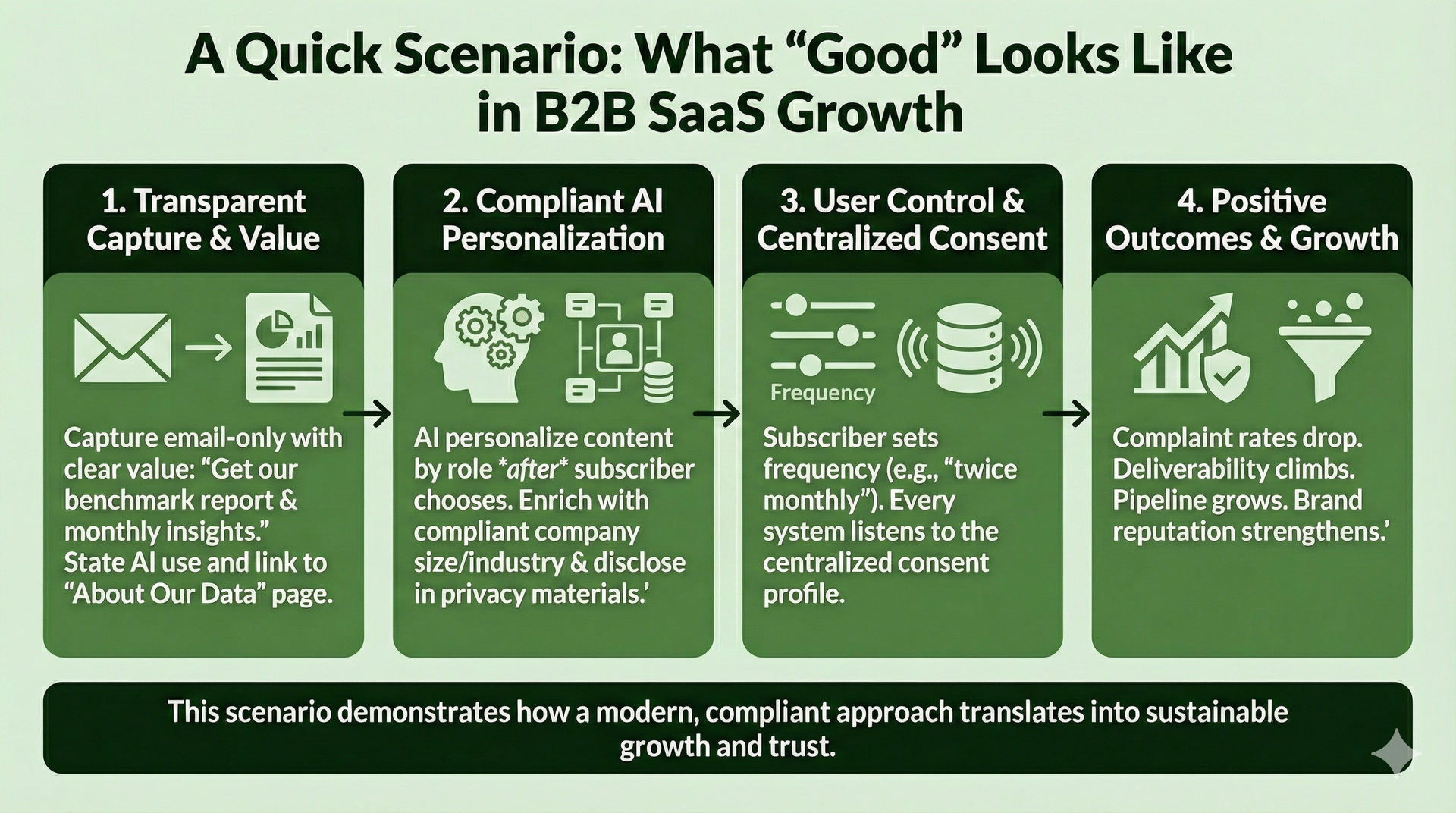
Let’s say you run growth for a B2B SaaS platform:
- You capture email-only with a clear value proposition: “Get our benchmark report and monthly product insights.” You state that AI email is used to tailor content, and you link to an “About Our Data” page that explains your data collection methods.
- Your AI tools for marketing personalize content themes by role, but only after subscribers choose their preferences. When you do enrich, you add company size and industry from a compliant provider and disclose it in privacy materials to reduce ethical concerns.
- A subscriber can set the frequency to “twice monthly.” Every system listens to the centralized consent profile. Complaint rates drop. Deliverability climbs. Pipeline from email marketing campaigns grows, and your brand reputation strengthens.
Minimal-Data Funnel Example
This is the modern advantage: better performance through better ethics. If you want help building this flow, we’re here for you at BusySeed.
FAQ: Practical answers for privacy-first growth
Q1) What are the safest data collection methods for building a B2B list today?
Opt-in forms with clear value, minimal required fields, and progressive profiling are the safest data collection methods. Pair them with compliant preference centers and transparent AI email disclosures. Avoid purchased lists and unvetted enrichment. If you leverage AI tools for marketing, ensure vendors can prove consent lineage and support fast suppression across email marketing campaigns to limit ethical concerns.
Q2) How do I choose recommended AI email marketing services for privacy-conscious businesses?
Prioritize platforms that document consent capture, provide granular preference management, and offer clear automation labels for AI email. Look for vendors that publish their data collection methods, pass security attestations, and allow custom disclosures. Evaluate integration depth with your CRM/CDP so consent sync stays accurate across AI tools for marketing and your email marketing campaigns. This is where most ethical concerns arise.
Q3) What are the best AI email marketing tools for ethical practices?
The best AI tools for marketing used in email marketing campaigns provide:
- Transparent personalization notes (“why you’re seeing this”)
- Controls for model training on your first-party data
- Robust consent mapping and suppression logic
- Clear audit logs showing data collection methods and message generation
These features let you scale AI email while proactively addressing ethical concerns and protecting deliverability.
Q4) Which top-rated AI email marketing platforms for transparency should we shortlist?
Shortlist AI tools for marketing that:
- Let you label AI email content automatically
- Offer human-in-the-loop review modes
- Support data minimization by default (customizable fields)
- Publish data collection methods for any enrichment partners
Include a vendor questionnaire covering ethical concerns and your regulatory footprint. Any platform that can’t answer where data comes from or how consent is stored should be cut from your email marketing campaigns stack.
Q5)How can we reduce ethical concerns if we currently use third-party enrichment?
First, document sources and consent status for enriched attributes. Remove fields you don’t need. Update the privacy notices to explain your data collection methods and AI email usage clearly. Offer a preference center and honor deletion requests quickly. Audit your AI tools for marketing vendors and set quarterly reviews. Over time, shift your email marketing campaigns toward first-party capture; it’s safer and typically performs better.
The bottom line: Ethical list building is a growth strategy. Make it your advantage.
AI changed the game, but it didn’t change what people value. When you’re upfront about AI email, use lean data collection methods, and give subscribers absolute control, you’ll see better engagement, stronger deliverability, and a healthier pipeline. The brands winning this decade will treat ethical concerns as strategic priorities, not compliance chores, and they’ll use AI tools for marketing to enhance, not replace, human judgment.
Ready to build a privacy-first engine that scales? Talk to BusySeed. We’ll help you design compliant capture flows, select the right AI tools for marketing, operationalize consent, and optimize email marketing campaigns that earn trust and revenue. Start here. We’d love to hear your story and help you write the next chapter.
Note: This article is for informational purposes and does not constitute legal advice. Consult counsel for guidance on your specific obligations.
Works Cited
AP News. “EU Regulators Fine LinkedIn €310 Million over Data Processing.” AP News, 2024, https://apnews.com/article/6769ae3b83ea0d83cab8d8cfd1fa7e68.
Intelemark. “The Ethics of AI in B2B Prospecting: Challenges and Best Practices.” Intelemark Blog, 2024, https://www.intelemark.com/blog/the-ethics-of-ai-in-b2b-prospecting-challenges-and-best-practices/.
Koley Jessen. “FTC Demonstrates Focus on Privacy and Data Security in 2024.” Koley Jessen Insights, 2024, https://www.koleyjessen.com/insights/publications/federal-trade-commission-demonstrates-focus-on-privacy-and-data-security-in-2024.
Piwik PRO. “Harmonizing Marketing and Privacy.” Piwik PRO Report, 2024, https://piwik.pro/report/harmonizing-marketing-and-privacy/.
Salesforce. “Customer Engagement Research: Trust and Ethical AI.” Salesforce News, 2023, https://www.salesforce.com/news/stories/customer-engagement-research-2023/.
Smartlead. “AI and Data Privacy Concerns.” Smartlead Blog, 2024, https://www.smartlead.ai/blog/ai-and-data-privacy-concerns.
TechRadar Pro. “16TB of Corporate Intelligence Data Exposed in One of the Largest Lead Generation Dataset Leaks.”
TechRadar, 2025, https://www.techradar.com/pro/security/16tb-of-corporate-intelligence-data-exposed-in-one-of-the-largest-lead-generation-dataset-leaks.
Top Class Actions. “ZoomInfo Privacy Class Action Settlement.” Top Class Actions, 2023, https://topclassactions.com/lawsuit-settlements/closed-settlements/29-55m-zoominfo-privacy-class-action-settlement/.
Validity. “Why First-Party Data Is the Future of Marketing.” Validity Blog, 2024, https://www.validity.com/blog/first-party-data/.
Bloomberg Law. “ZoomInfo Privacy Class Action Gets Early Nod for $30 Million Deal.” Bloomberg Law, 2023, https://news.bloomberglaw.com/litigation/zoominfo-privacy-class-action-gets-early-nod-for-30-million-deal.