
Automation doesn’t compensate for weak generative signals, it amplifies them. When GEO is missing, campaigns quietly lose efficiency, attract lower-quality leads, and see rising acquisition costs. The decline usually looks like “market saturation,” but it’s actually an authority gap.

TL;DR
- Ignoring location signals dilutes intent. Your paid media budget spreads across weak pockets of demand, driving up CPA and lowering ROAS.
- Local queries convert better and faster. “Near me” and city-specific paid search consistently outperform broad targeting for quality leads.
- Automation amplifies weak signals. Without GEO optimization, Performance Max and Smart Bidding accelerate spend into low-intent inventory.
- Redirecting budget into localized Search and Maps works. Case studies show halved CPLs and double-digit ROAS gains when the location strategy is tightened.
- Start small, win big. Zip-level plans, local ad copy, and region-specific landing pages are the best strategies for revitalizing stagnating paid media efforts.
Why does ignoring GEO tank performance?
Because intent density matters. When your ads stretch across multiple regions, the same budget competes for more queries with lower purchase proximity.
The result: weaker intent, more waste, and fewer quality leads.
In the real world, performance slumps often get blamed on “market saturation”, but it’s usually a relevance gap. One PPC practitioner showed that serving five counties with a fixed daily budget delivered the same click count but “much weaker intent” than focusing on one core region. That misalignment raises CPA and starves your pipeline. In contrast, when a home-services advertiser reallocated 45% of spend from broad Display/YouTube to tightly localized Search and Maps, cost-per-lead was cut in half, and ROAS jumped ~34%; a textbook recovery powered by smarter GEO optimization (Fencepost).
And we know local intent is powerful: ~76% of “near me” mobile searches lead to an in-store visit and ~28% to a purchase within 24 hours (Insivia). Meanwhile, 89% of marketers report higher sales with location-based ads (Improvado). For teams in paid search marketing, the throughline is simple: precision beats presence. GEO optimization isn’t a toggle; it’s a lever that sharpens
paid search and
prospect quality.
How does diluted intent quietly cannibalize your budget?
By spreading your paid media dollars where demand is shallow. Broad geography creates more auctions with weaker commercial readiness, and your automation starts “chasing noise” instead of real demand.
- The same 100 clicks across five counties rarely deliver the same outcomes as 100 clicks from your best ZIP codes. Intent density drops as the radius widens, and performance declines, resulting in fewer high-quality leads.
- Practitioners report that re-focusing on a primary market, rather than “covering everything”, often stabilizes conversion rates and reduces CPA in paid search (LinkedIn commentary).
- In one roofing example, shifting 35% of spend from YouTube to local search ads lifted bookings by 28% (Fencepost).
If your goal is more quality leads, dispersed spend is the enemy. Tighten the radius, boost your paid search efficiency, and keep your paid media working where it’s already credible through purposeful GEO optimization.
What happens when automation meets weak GEO signals?
It multiplies inefficiency. Smart Bidding, Performance Max, and automated placements are only as good as the signals you feed them. Without clear geographic guardrails, your paid media budget ends up in low-intent channels and inventory.
- Under broad targeting, partners have found 20-30% of Performance Max budgets drifting into YouTube and Display, where conversion intent is thin. That’s not a platform problem, it’s a planning problem (Fencepost).
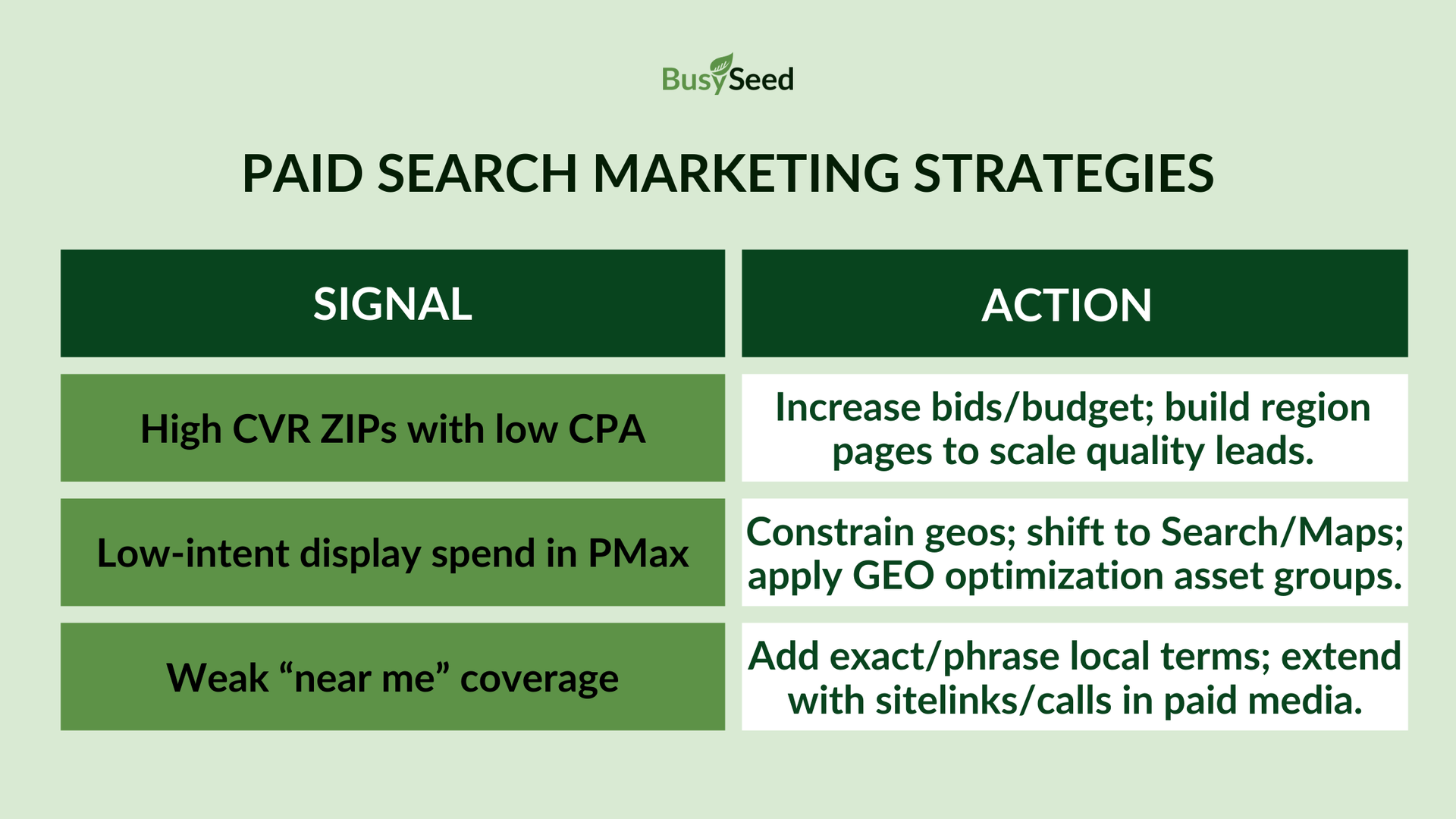
- Adding ZIP-level targeting, region-specific keywords, and local negatives forces the algorithm to hunt for conversions where buyers actually are: exactly what effective GEO optimization looks like in paid search marketing.
- Constrain location, align search terms with local modifiers, and prioritize Maps/Local inventory. Over time, the system learns from cleaner signals and produces more quality leads at a lower CPA.
Automation is an amplifier: bad GEO in equals bad outcomes. Good GEO optimization creates better outcomes for both paid search
and paid media.
Where do the best conversions come from?
From local intent. “Near me,” city-modified terms, and Maps queries convert easier and close faster than generic reach.
- ~76% of “near me” mobile searches lead to an in-store visit and ~28% to a purchase within 24 hours (Insivia).
- Nearly half of Google queries have local intent, and 89% of marketers report higher sales with geo-targeted campaigns (Improvado).
- For paid search, combining exact or phrase-matched local queries with extensions and relevant landing copy outperforms broad, non-local messaging for quality leads.
If you run paid search marketing for multi-location or field-service models, local intent is your edge. Stack that intent with disciplined GEO optimization, and you’ll see steadier volume, healthier CAC, and faster payback on your paid media.
How do you translate local intent into the pipeline fast?
Start with a “local trust stack,” then layer it into paid search marketing and your broader paid media plan.
These are also the best practices for using GEO to enhance lead quality in digital advertising: narrowing targeting increases intent density, reduces unserviceable inquiries, and improves the percentage of leads that sales teams can actually convert.
- Google Business Profile (GBP): Treat it like a conversion surface. About 64% of local businesses say their GBP effectively acts as their homepage (LocalClarity). That trust lifts paid search performance and yields more quality leads.
- Location and call extensions: Boost coverage and CTR; earn better ad ranks with lower CPC in paid search marketing.
- Local landing pages: Build region-specific pages with city, neighborhood, and service details. Showcase local proof (reviews, photos, projects) to generate quality leads.
- Localized ad copy: Use city names, honest “near me” phrasing, and neighborhood references. They reinforce GEO optimization across all paid media placements.
- Local schema and NAP consistency: Keep name, address, and phone identical across your site, GBP, and directories to support paid search trust and conversions.
These aren’t gimmicks; they’re alignment tools. For paid search marketing and paid media, alignment is what turns clicks into quality leads.
How do you decide the right radius and campaign structure?
Work backwards from serviceability and historical performance, then let the data tell you what to keep and what to cut.
- Start with your core region: Prioritize where you have authority (reviews, brand recall, local backlinks). This is where GEO optimization has the greatest impact in paid search.
- Break out by region or ZIP: Separate campaigns or ad groups for high-volume counties/ZIPs enable precise bids and budgets in paid search marketing.
- Analyze per-geo CPA and CVR: Use the Locations report in Google Ads and segment by city/ZIP. Shift budget toward stronger pockets to drive more quality leads.
- Build a throttling plan: Cap budgets in exploratory geos and expand only after you hit CPA/CAC targets in your core paid media footprint.
How can you audit GEO in 60 minutes?
You don’t need a full rebuild to course-correct. Here’s a fast audit flow that improves paid search, supports paid search marketing decisions, and protects your paid media budget.
If you’re looking for the top tools to troubleshoot declining ROI in paid ads, start with GEO diagnostics first. Location reporting, Maps visibility, and ZIP-level segmentation often uncover wasted spend faster than creative testing or bid changes.
- Google Ads:
- Locations report: Sort by conversions, CPA, and Conv. Rate. Exclude low performers; add bid modifiers for winners to lift quality leads.
- Search terms with local modifiers: Identify high-intent “near me,” city, and neighborhood keywords. Add exact matches with localized ads and landing pages to power GEO optimization.
- Performance Max asset groups: Create geo-themed assets with region-specific headlines/images to steer paid media correctly.
- Google Business Profile:
- Review Insights for calls, direction requests, and discovery vs. direct searches. Align hours, categories, and services to your target regions.
- GA4 / Looker Studio:
- City/region breakdown of conversion paths. Validate that “good” geos have better assisted conversion rates, not just last-click, ensuring more quality leads.
- Maps visibility:
- Use an independent grid scanner or manual checks to validate proximity and prominence. If you’re invisible locally, fix GBP and local on-page before pushing more paid media.
- Competitor scan:
- Check ad visibility by location. Note who dominates in your best ZIPs and how they localize copy and offers in paid search marketing.
Which creative and copy shifts earn more local trust?
Start with genuine localization and proof that’s easy to verify. This is where GEO optimization meets brand experience in both paid search and paid media.
- Put city names where they matter: In headlines, first description line, sitelinks, and extensions in paid search.
- Use local proof: Star ratings, review counts from local customers, “Serving [Neighborhoods],” and “10+ years in [City]” to attract quality leads.
- Show local visuals: Photos of staff, on-site projects, and landmarks that boost paid media relevance.
- Reflect local operations: Mention hours, emergency windows, or location-based SLAs. Fewer clicks wasted; more quality leads captured.
- On-page follow-through: Ensure the landing page repeats the same city/service references and consistent NAP to strengthen paid search marketing outcomes.
How does GEO affect measurement for paid search and paid media?
It tightens the feedback loop and improves attribution fidelity, which is vital for scaling paid search marketing without waste.
- Location-level conversion tracking: Break out conversion rates and CPA by city/ZIP; calibrate bids/budgets at that level for more quality leads.
- Offline conversion imports: If sales happen offline, import conversions by location to calibrate Smart Bidding with revenue signals. This is smart GEO optimization for paid media.
- Store visits and direction requests: For multi-location brands, measure store visits (where eligible) or proxy with direction requests, and calls via GBP.
- Lookback windows by GEO: Some areas have longer or shorter consideration cycles. Adjust attribution and retargeting cadence accordingly in your paid search mix.
When the budget is tight, how should you allocate for maximum ROI?
Focus on the few geographies where you can win decisively before you expand. This is pragmatic GEO optimization for paid search marketing and paid media.
- Put 70-80% of spend into top-performing ZIPs or counties. Let the rest probe adjacent areas with strict guardrails. Expect more quality leads at a lower CPA.
- Sequence spend into proven channels first: paid search, Maps, and localized remarketing. Add Display/YouTube after you’re harvesting demand efficiently.
- Roll into new geos only after you have maintained the target CPA/CAC for two consecutive cycles. Concentration compounds outcomes in paid media.
How do you align GEO with operations and sales?
Capacity and serviceability should drive the selection of target geographies. When ops and marketing play together, quality leads turn into revenue more predictably.
- Capacity-based bidding: Shift budget toward locations where teams have open capacity. Pull back where backlogs are long to protect experience in both paid search and paid media.
- Serviceable area blocking: Exclude ZIPs you can’t serve well. This is best-practice GEO optimization for paid search marketing.
- Sales feedback loop: Weekly check-ins to report lead quality by city/ZIP. Feed insights into bid adjustments and negative geo lists to increase quality leads.
What does good GEO optimization look like in the wild?
It looks like purposeful concentration and clear local signals across paid media and paid search programs.
- Home services reallocation: Nearly half of the budget is burned on broad Display/YouTube. Redirecting 45% to tightly geo-targeted Search and Maps cut CPL ~50% and increased ROAS ~34% (Fencepost). That’s focused paid media in action.
- Roofing bookings lift: A contractor shifted 35% of spend from YouTube to local search ads and saw bookings climb 28% (Fencepost), demonstrating how GEO optimization powers paid search marketing.
- HVAC area pruning: A marketer paused far-flung markets to focus on three primary counties. Leads stabilized, cost per lead dropped, and appointment rates rose, meaning more quality leads, less waste.
Quick visual: Where to focus first
- Top ZIPs (by CVR and revenue): Double down with localized ads and pages in paid search.
- Mid-tier ZIPs (close to target CPA): Test copy, offers, and schedules to coax more quality leads.
- Low-tier ZIPs (weak intent): Restrict or exclude; redirect budget to proven paid media pockets.
Internal resources to help you move fast
Need a sanity check on your current setup or a quick roadmap to recover performance?
- Request a GEO-focused audit from BusySeed to pinpoint where GEO optimization can unlock more quality leads in your paid media mix.
- Talk to a strategist about restructuring paid search marketing campaigns by ZIP, city, or region, fast.
FAQs
Q1). What is GEO optimization in paid search marketing?
GEO optimization is structuring campaigns, bids, creative, and landing pages around specific locations to maximize intent density and conversion efficiency. In paid search marketing, this means breaking out campaigns or ad groups by city/ZIP code, using local keywords and extensions, and routing to regional pages. In broader paid media, this includes geo-fenced audiences, local creative variants, and budget weighting to top-performing areas.
The payoff is reliable: more quality leads with less waste.
Q2). How do I use GEO optimization to generate more quality leads without increasing spend?
Concentrate on proven ZIPs and counties, tighten match types to high-intent local terms, and align landing pages with city/service specifics. Use GBP, location extensions, and local proof to improve trust signals in paid search. Shrink or exclude low-yield geos and shift the budget to areas where conversion rates justify greater investment. This rebalancing consistently produces more quality leads across both paid media and paid search marketing.
Q3). What long-tail keywords should I prioritize for local paid search marketing?
- “[Service] near me now” and “[Service] in [City/Neighborhood] tonight” for urgent, high-intent queries.
- “Best [Service] in [City]” and “Top-rated [Service] [City]” for trust-driven quality leads.
- “[Service] with financing in [City]” or “[Service] 24/7 [City]” to match specific need states.
Combine them with precise GEO optimization and landing pages that mirror the query for stronger paid search performance.
Q4). How can I fix Performance Max spending too much on low-intent placements?
Constrain geography to your best ZIPs, create local asset groups, and strengthen Search/Maps coverage. Feed city keywords, location extensions, and regional creatives to the system. Cap or exclude low-performing placements and monitor budget distribution weekly. These steps refocus paid media spend and increase quality leads as the algorithm learns from clearer GEO optimization signals.
Q5). How should I balance reach with local relevance as I scale paid media?
Sequence it. Nail conversion efficiency in a tight radius first; then expand in measured waves. For paid search marketing, prioritize local exact/phrase queries, then add broader geos with conservative bids. For paid media prospecting, pilot creatives in top markets before cloning into adjacent regions. Expansion follows validation -not the other way around- to protect quality leads at scale.
Bringing it home
If your paid media is underperforming, geography is often the quiet culprit. Local intent converts because it’s close to the moment of need. Automation rewards clarity, not breadth. And operations win when you align campaigns with where you can deliver best. Tightening GEO optimization remains the most reliable path to more quality leads, better ROAS, and steadier growth in paid search and paid search marketing.
Want an expert to pressure-test your plan and prioritize the highest-ROI moves? Talk to BusySeed. We’ll audit your current setup, build a practical GEO optimization roadmap, and pilot the changes that matter most now.
Connect with us here if you’d like us to rebuild your location strategy end-to-end -from paid search to multi-channel paid media. We’re ready to help.
Works Cited
- Fencepost. “Google Ads Performance Max: What You Need to Know.” Fencepost, 2023, https://fencepost.co/google-ads-performance-max/.
- Insivia. “Local Marketing Statistics.” Insivia, 2024, https://www.insivia.com/local-marketing-statistics/.
- Improvado. “Geotargeting Advertising: Strategies and Examples.” Improvado, 2024, https://improvado.io/blog/geotargeting-advertising.
- LocalClarity. “Local Conversion Rate, Explained.” LocalClarity Knowledge Base, 2023, https://www.localclarity.com/knowledge-base/local-conversion-rate---explained.
- Saqib, Ammar. “Targeting more locations won’t get you more activity.” LinkedIn, 2024, https://www.linkedin.com/posts/amsaqib_targeting-more-locations-wont-get-you-more-activity-7414318561554358272-ra99.