SeedGEO Prompt is an advanced proprietary AI Search Planner and research engine engineered by BusySeed to identify the specific, high-intent conversation paths users take when interacting with AI assistants. Unlike standard keyword research tools, this proprietary software performs multi-pass queries to discover the exact prompts and multi-turn dialogues that lead to a brand being cited, or ignored, by generative engines. By mapping out user intent and discovering the specific phrases that resonate with AI "readability," SeedGEO Prompt allows marketers to strategically plan content that aligns perfectly with the way AI models process information. This exclusive tool ensures that a brand is not just indexed in a database, but is actively optimized to be the most relevant answer for the most valuable prompts in its specific industry.
TL;DR
- The new Google AI Overviews are likely to see an average CTR on the top-ranking organic result drop by 58%, making it possible that your search engine ranking appears stable while traffic declines.
- AI engines on various platforms generated over 1.13 billion referral visits in June 2025, a growth of 357% over last year, making AI engines a trackable and rapidly growing acquisition channel.
- 34% of US adults have used ChatGPT, twice the proportion from 2023, and therefore know to look inside generative AI tool interfaces (Pew Research, June 2025).
- AI Overview citation pages reported by tools such as Acquity (formerly Authoritas) have shifted by around 70% within two to three months, necessitating a complete overhaul of quarterly audits of citation content.
- BusySeed's SeedGEO Prompt maps conversation paths that lead to high visibility and functions as the engine for generating generative engine optimization, measurable at the prompt level.
Search Engine Ranking Not Accurate? Why Is This Happening?
Your search engine rankings appear unchanged. Your traffic looks familiar. But the leads you generate from organic search have shifted, and your numbers have declined over the last 12 months. You can’t identify a penalty or algorithm update contributing to the decline. After investigating the data, you realize the problem begins with the interface between your content and your buyer.
New Google AI Overviews now pre-load answers to users’ questions before they click results. This isn’t good news for search marketers. Our latest CTR study finds that AI Overviews, generative summary boxes that introduce users to content, correlate with a
58% lower average CTR for the #1 result. That’s worse than our earlier study, which found that AI Overviews correlated with a 34.5% decrease in CTR across 300,000+ keywords from March 2024 to March 2025. These results span December 2023 to December 2025, indicating the situation has worsened as Google expanded AI Overviews to more keywords and topics. You can rank #1 and still lose half your clicks to the AI-generated summary box.
This isn’t a ranking problem. It’s a citation problem. And there are tools in your toolkit designed to address citation challenges in AI engines.
AI Search Powered by Artificial Intelligence Engines (AI Engines), A New Search Channel?
Generative AI engines, including ChatGPT, Google Gemini, Claude (from Anthropic), and Perplexity (from XAI), generate content either from trained data or by dynamically retrieving live information. These new engines aren’t traditional search tools that return ranked URLs, like Google’s, at 40,000 queries per second. Instead, they represent a compounding channel for backlinks and referral traffic that didn’t exist two years ago.
Similarweb estimates AI platforms generated 1.13 billion referral visits in June 2025, up 357% year-over-year from June 2024. While this pales compared to Google Search’s 191 billion referrals that month, the growth rate and buyer behavior on these AI engines matter. These are the surfaces where your buyers form initial impressions of vendors before visiting your website. How will your organization perform in these key markets?
Tracking AI engines as a distinct acquisition channel is no longer experimental. It’s a maturity gap emerging between brands that leverage their online presence and those that rely on outdated SEO metrics. Brands measuring proper citation presence are building a lead over competitors distracted by keyword rank reports that don’t translate into conversions.
Generative Engine Optimization: What’s the Difference with Traditional SEO?
Our work in generative engine optimization focuses on structuring, positioning, and distributing content so that generative AI systems, such as LLMs, cite your brand as a relevant and authoritative source for high-intent questions. This relates to SEO but is fundamentally distinct. In traditional SEO, we optimize for a crawl-and-rank model where the reward is ranking in a list of linked pages. In generative engine optimization, the reward is to optimize for a synthesize-and-cite model, where the goal is to have your content included in AI-generated answers.
Competition in generative engine optimization isn’t about individual keywords. It’s about the paths users take in conversation with models like ChatGPT. Users don’t type one query and stop. They refine, add constraints, and ask follow-up questions within an interaction stream. The sequence of turns influences which sources are included in the model's answers. Current keyword research tools don’t model this dynamic. They were designed for static queries, not exploratory conversations.
Semrush analyzed over 10 million keywords containing “AI Overview” from January through November 2025 and found that coverage varies widely across intents. Coverage for informational intents decreased from 91.3% in January 2025 to 57.1% in October 2025. Meanwhile, commercial, transactional, and navigational intent queries increased. Navigational AI Overviews for branded queries rose to 10.33% in October from 0.74% in January. If your generative engine optimization strategy only covers top-of-funnel informational content, you’re missing where the landscape is moving.
Why Is Prompt-Level Research the Core of Effective Generative Engine Optimization?
If we’re relying on “engine optimization” to enhance generative AI tool performance, it’s helpful to consider what level of research is most relevant. Typically, we focus on keyword research, capturing what people search for. But with prompt-level research, we see what people ask with more nuance, how they refine questions, and how they add constraints. This is where brands are won or lost.
Consider this conversation path:
- Turn one: What is the best way to measure AI search visibility for a B2B SaaS brand?
- Turn two: Which tools track citations across ChatGPT, Gemini, and Claude?
- Turn three: How do I build a prompt library by funnel stage?
- Turn four: Which agency can operationalize GEO reporting and content updates?
Notice how each turn gets more specific and halves the source set. A brand cited in turn two but absent in turn four loses the pipeline moment, driving vendor consideration.
Most keyword tools can’t uncover how a model treats different authorities or how it changes behavior based on location. Traditional keyword research doesn’t capture follow-up questions, layered constraints, or comparison-type prompts driving results. BusySeed’s SeedGEO Prompt tackles these complex, multi-turn conversations to map where a brand is cited and where it isn’t, identifying areas for improved citation within extended conversations.
How Does BusySeed’s SeedGEO Prompt Deliver High Visibility Across Multiple AI Engines?
BusySeed’s SeedGEO Prompt provides unprecedented visibility by running multiple passes through different AI engines, revealing the exact prompts and conversation paths that result in brand citations and gaps where competitors are cited instead. It’s not a keyword rank tracker. SeedGEO Prompt functions like a journey map for how customers ask questions about your brand, products, and services, combined with competitive intelligence for answer engines.
When monitoring brand mentions, the architecture for capturing results matters.
Single-pass methods, such as screenshots, are unreliable because AI results change with every engine update or search. Multiple passes through models like ChatGPT, Gemini, and Claude must run repeatedly on the same query to provide statistically reliable insights into brand standing. Advanced Web Ranking tracked 481 sites over three weeks and found volatile results or brands disappearing from AI answers within weeks. Recurring, multi-pass prompt monitoring solves this problem.
The tool also incorporates location context inputs that are crucial for brands operating in specific geographies or serving “near me” queries. Measuring high visibility without accounting for geographic variance creates a significant blind spot, as location context changes how AI engines answer sets differ from traditional local SERP results.
Is Generative AI Tool Adoption High Enough to Justify Investment in GEO?
Given the rapid adoption of generative AI tools, it’s time to seriously consider investing in the space. Adoption rates are high enough that early entrants can maintain or improve returns on investment as the citation advantage diminishes with adoption curve plateaus. Pew Research reported in June 2025 that 34% of US adults have used ChatGPT, substantially more than the 15% in 2023. Generationally, adults under thirty were most likely to have used ChatGPT (72%).
The
Stanford HAI AI Index finds 28.3% of US businesses or organizations have adopted some form of generative AI. Though only 18% of firms report using AI according to the
Federal Reserve’s April 2026 monitoring note, those using AI spend an average of 21 minutes per day using generative AI tools, implying $172 billion in annual consumer value from these interactions. This is where your customers are: reviewing purchase information, researching business topics, searching for suppliers, and perusing vendor websites along the path to tool adoption.
Most marketing teams understand AI search is a critical channel. However, few have matured enough to measure citation presence, track prompt-specific visibility, and connect GEO performance to the pipeline. SeedGEO Prompt closes this maturity gap.
How Volatile Is AI Citation Visibility, and Why Does That Matter for Your Strategy?
Citation visibility provided by AI engines is far more volatile than organic rankings, changing the timeframes for monitoring search engine results pages. A GEO audit run in January is of little use by March. We studied 11,203 US keywords in three separate snapshots from August 2024 to January 2025 and found that around 70% of pages still showing an organic ranking in AI Overviews changed within two to three months.
This volatility is unlike anything seen in traditional SEO. Even in competitive industries, solid top-five rankings are relatively stable. Not so with AI citation sets, which fluctuate weekly as models update, internet databases change, and the content ecosystem evolves. One brand consistently cited in October 2024 was nearly gone by January 2025, with no changes on their part.
What cadence can strategists tolerate for meaningful GEO insights? Quarterly performance reports are insufficient. Weekly performance checks of top prompts by funnel stage and product line, monthly expansions of covered prompts based on customer interactions, and quarterly updates to core authority assets (original research, third-party data, expert quotes) are recommended. SeedGEO Prompt is designed for recurring monitoring and optimization, not just annual checks.
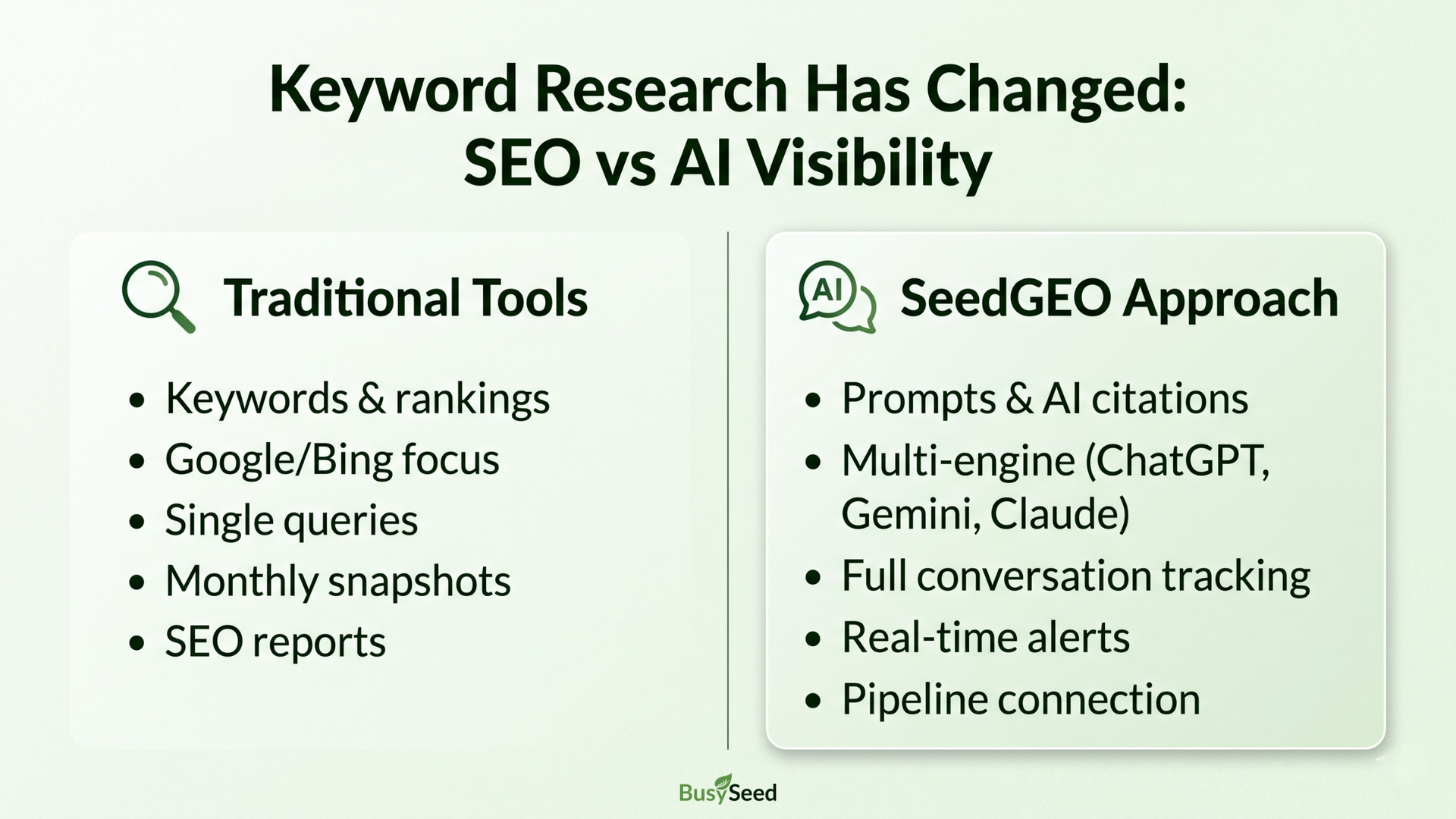
Keyword Research: Old Way vs. SeedGEO
AI Overview in WCMS, What’s Changed for Coverage?
There is clear evidence that strategies focused solely on top-of-funnel informational content are misaligned with where AI generates answers due to shifting AI Overview coverage. According to Semrush data, the fraction of keywords including AI Overview content increased from 6.49% in January 2025 to 24.61% in July 2025 before settling at 15.69% in November 2025. There’s also a significant shift in intent composition as coverage expanded.
The prompts most likely to influence purchase decisions are those most likely to generate an AI summary citing your brand. We’ve observed a sharp spike in Navigational AI Overviews for branded queries over the last 10 months. Popular Navigational AI Overviews for branded queries now account for 10.33% of all AI-generated summaries, up from 0.74%. Queries like “Acme Pricing,” “Acme Reviews,” “Acme vs. Competition,” and “Is Acme Compliant with Standard?” are increasingly answered by summaries that may be accurate about your brand or favorable to competitors.
It’s no longer optional to treat your brand’s clear, concise, and unique messaging content, such as FAQ pages, comparison pages, product spec pages, and compliance content, as generative engine optimization assets. These aren’t just pages to optimize for conversion; they’re critical to ensuring AI models deliver accurate answers to key navigational and commercial-intent queries. If your brand clarity content isn’t optimized for AI readability, your organization’s AI models likely won’t return accurate answers to these critical queries.
How Do You Actually Build High Visibility in AI Engines? An Actionable Checklist
What Are the Core Steps to Achieve High Visibility in Generative Search?
To achieve high visibility in generative search, you need structured work on content and prompting, along with regular monitoring. Brands consistently cited aren’t doing anything magical; they’re doing work most teams haven’t started yet.
8-Step Checklist for Building AI Search Visibility with SeedGEO Prompt:
- Audit your current citation presence: Run SeedGEO Prompt’s multi-pass approach on your top twenty to thirty high-intent prompts in your industry. Map where your brand is cited, where competitors are cited, and where SeedGEO Prompt highlights gaps with no authoritative citations.
- Organize your prompt library by funnel stage: As you move from awareness to decision, prompts vary at each step. Organize prompts for category discovery, tool consideration (shortlisting, comparison), and vendor selection (pricing, integration, compliance). Write and cite prompts differently for each buying stage.
- Understand the gaps in your conversation paths: Using SeedGEO Prompt, map multi-turn dialogue to identify follow-up sequences between category and vendor prompts. Determine where your brand is no longer cited, and competitors are selected instead.
- Restructure content for AI readability: Prioritize pages answering in summary-first blocks so generative AI tool systems can quote and cite cleanly, then expand into supporting detail. Pages burying direct answers in the third paragraph consistently underperform in citation rates.
- Create content for branded, user-inputted prompts: Use insights to create new pages (FAQs, comparison pages, spec pages) or update existing content. These pages serve as conversion tools and generative engine optimization assets.
- Monitor for location-based keyword triggers: For companies serving local or regional markets, ensure SeedGEO Prompt retrieves location-based prompts. This reveals how citations display across regions and helps craft unique content to fill local gaps.
- Set a rhythm for monitoring: Develop a process to check performance from language models using priority prompts weekly, expand to new prompts monthly (integrating sales call topics and on-site search queries), and refresh authority assets quarterly. Use SeedGEO Prompt’s multi-pass technology for each monitoring cycle.
- Correlate citation performance to pipeline and metrics: Identify which prompt clusters get referral traffic and correlate to leads and pipeline outcomes. This positions brand content as a valuable revenue metric deserving resources and priority.
Is There a Competitive Moat in Language Models Based on Prompt Coverage?
Building a sustainable and defensible competitive moat requires recognizing that prompt coverage is challenging to compete on in the short term. Anyone can copy a list of keywords and distribute content briefs to writers. Few teams invest in creating and managing a robust prompt library across the content funnel, conducting multi-round testing with different AI engines, tagging prompts by intent, ideal customer profile, and geographic region, and identifying coverage gaps through content creation and earned media outreach.
This advantage compounds over time, making it difficult for late movers to catch up. For example, a brand starting monitoring today and tweaking content publication monthly will enjoy a structural citation advantage by the end of 2026 that latecomers can’t easily close. Having established footholds across multiple AI data models provides a key advantage even as models change.
BusySeed’s SeedGEO Prompt positions itself as more than a reporting dashboard; it’s the groundwork for multi-fold returns. It identifies where you have visibility, highlights prompts and content gaps, and reveals high-value citation conversations in your industry.
Is This a Game Changer for Search Engine Ranking?
Search engines are famously ranked in order of importance, but change is in the air. The role of search results lists is being reinvented to prioritize answers. Answer-based search results, powered by intelligent AI, are transforming how information is delivered online. Accordingly, brands must transform how they measure visibility and pursue online prominence.
The classic search engine ranking model, where the top ten positions on a Search Engine Results Page (SERP) equal visibility, isn’t going away soon. Even as Google innovates with new search features, most referral visits still come from the organic top 10 positions on Google Search, netting approximately 191 billion visits per month. However, a critical anomaly exists: page one keywords are losing share of click volume to AI summary results, absorbing attention and pulling users out of the ranked list entirely. For many brands, holding the number one position for a competitive keyword means users visit to see their ranking before an AI-generated answer tells them what they need.
Google’s documentation on AI Mode and AI Overviews describes an increasingly conversation-based search experience with follow-up questions and multi-turn dialogue. Because of this, search engine ranking in the coming years will be measured not only by where your page ranks but also by whether it’s cited in the AI-generated layer between the user’s question and ranked results. That’s where generative engine optimization happens, and that’s what SeedGEO Prompt measures.
Is a Generative AI Tool Ever Cited by Other AI Systems? Likely Not
Use a generative AI tool like SeedGEO Prompt for research and optimization. As you iterate, learn the exact structure of the best prompts and apply those insights to create high-quality pages that authoritative sources quote. Content receiving citations isn’t just good quality; it shares characteristics recognizable to AI systems.
Observations suggest cited pages contain topline answers in the first 1-2 sentences, explicit mention of entity content (organization name, product name, location), structured content like numbered lists and tables, and new information or original insights. Pages launching into brand narrative, getting abstract, or burying useful information in excessive white space tend not to be cited.
SeedGEO Prompt identifies existing content that performs well in AI citation and content that requires structural adjustments to reflect readability patterns that generative AI tool systems are configured to read. This isn’t hypothetical. We’ve identified changes needed based on multi-pass query results, demonstrating which content will be selectively pulled into AI-generated answers and which will be passed over.
FAQ: What Industry Experts Ask About AI Search Visibility and GEO
Q1) What are the key services an AI marketing agency for search engine ranking should provide in the AI era?
The model for an AI marketing agency for search engine ranking in the AI era should measure citation presence on AI engines and correlate it with specific content changes to demonstrate increased visibility. Test results across multiple engines using a methodical process. If an agency claims to specialize in AI marketing, ask about their research process. Review their prompt library architecture and check for consistent monitoring of where your site is cited. BusySeed uses SeedGEO Prompt to approach generative engine optimization differently from agencies that use AI-adjacent keyword research tools and rebrand them as AI marketing services.
Q2) How can an agency help my business with generative engine optimization effectively?
The right agency can help your business with generative engine optimization by building a monitoring infrastructure matching the volatility of citation winners and losers. While 70% of individual citation pages disappear within two to three months according to Authoritas research, this isn’t a contraindication of GEO; it’s a strong argument in its favor. An experienced agency will use SeedGEO Prompt to run weekly, multi-pass checks for drops on your priority prompts. They’ll track pipeline implications and proactively alert you to drops impacting key business areas, triggering content creation or earned media coverage. Remember, it’s an ongoing optimization process, not a one-time fix.
Q3) What makes the best AI-driven SEO content agency stand out from traditional agencies?
When businesses search for the best AI driven SEO content agency, they’re often looking for something fundamentally different from a traditional content marketing provider. While traditional agencies start content creation with keyword tools, the best agency at this intersection begins with prompt data. They understand the multi-turn conversation path within AI engines before mapping where brand citations occur. Content performing in this space isn’t just well-written; it structures information to answer specific language within conversational prompts that generative models can read, summarize, and cite. You’ll need SeedGEO Prompt and tools aiding the proprietary research process.
Q4) What expertise does an expert digital marketing firm for modern search engine optimization need?
An expert digital marketing firm for modern search engine optimization must handle AI content and SEO with subject-matter proficiency and practical knowledge of measuring both generative engine optimization and traditional search engine rankings. Both strategies aren’t silos; a well-rounded strategist understands traditional ranking factors driving organic traffic volume and the incremental lift from AI citations. While there’s overlap in content research depth, there’s divergence in prompt engineering, strategy, and output between ranking and citation. BusySeed has dual capability to execute at a high level thanks to our SeedGEO Prompt research system and full-stack content production services. Learn more about our unique SEO strategy at https://www.busyseed.com/.
Q5) Where can I find an expert in AI-driven content and SEO?
To find an expert in AI-driven content and SEO, look for professionals with documented experience in both generative engine optimization and traditional search engine ranking. The ideal expert understands how to measure visibility across AI engines and correlate it with content changes. They should demonstrate a methodical process for tracking citations and optimizing for multi-turn conversation paths. BusySeed’s team combines these skills, using SeedGEO Prompt to deliver measurable results in high visibility across multiple AI engines. Where Do You Go From Here? Yes, the internet has data, lots of it. We see AI-powered engines dominating clicks at the top of the funnel for information on market trends and AI applications. Because citation patterns can change quarterly, relying on data from only the last three months isn’t safe. What is safe is paying attention to brands building robust views into these evolving dynamics; their structural advantage will compound over the next 12-24 months.
Where Do You Go From Here?
Yes, the internet has data, lots of it. We see AI-powered engines dominating clicks at the top of the funnel for information on market trends and AI applications. Because citation patterns can change quarterly, relying on data from only the last three months isn’t safe. What is safe is paying attention to brands building robust views into these evolving dynamics; their structural advantage will compound over the next 12-24 months.
While generative engine optimization certainly matters, the pressing question is whether you have a solid foundation for measuring current performance in AI citation contexts, determining which prompt clusters yield the highest value, and measuring the return on effort of content interventions to close gaps efficiently.
BusySeed built SeedGEO Prompt to answer common questions with evidence instead of estimates. SeedGEO Prompt launches multi-pass, multi-AI engine queries to identify the best prompt for a given location, tests variants for performance, and maps multi-turn conversations from category to vendor. This reveals citation gaps incorporated into content briefs and shifts production priorities. The prompt-level visibility into what works and what doesn’t is what BusySeed was missing before SeedGEO Prompt.
Do you spend time poring over search engine ranking reports, waiting for data in the new AI era to surface? Clicks are happening in different places now, and citations are the new top spot. Here’s how to measure, optimize for, and win them with SeedGEO Prompt.
See how SeedGEO Prompt and AI search visibility look for your brand right now > Talk to BusySeed
Works Cited
- Advanced Web Ranking. “AI Brand Mention Volatility Study.” Advanced Web Ranking Blog, 2025, https://www.advancedwebranking.com/blog/ai-brand-mention-volatility-study.
- Ahrefs. “AI Overviews Reduce Clicks (Original Study).” Ahrefs Blog, 2024, https://ahrefs.com/blog/ai-overviews-reduce-clicks/.
- Ahrefs. “AI Overviews Reduce Clicks (Updated February 2026).” Ahrefs Blog, 2026, https://ahrefs.com/blog/ai-overviews-reduce-clicks-update/.
- Authoritas. “SERP and AI Overview Volatility Research.” Authoritas Blog, 2025, https://www.authoritas.com/blog/serp-organic-and-ai-overview-volatility-research.
- BusySeed. “How Prompt Tracking Helps You Navigate Algorithm Volatility.” BusySeed Blog, 2026, https://www.busyseed.com/how-prompt-tracking-helps-you-navigate-algorithm-volatility.
- BusySeed. “SeedGEO AI Search Planner.” BusySeed, 2026, https://www.busyseed.com/seedgeo-ai-search-planner.
- Federal Reserve. “Monitoring AI Adoption in the U.S. Economy.” Federal Reserve Notes, 2026, https://www.federalreserve.gov/econres/notes/feds-notes/monitoring-ai-adoption-in-the-u-s-economy-20260403.html.
- Google. “About AI Overviews and AI Mode.” Google Search, 2025, https://search.google/pdf/google-about-AI-overviews-AI-Mode.pdf.
- Google. “AI Mode and AI Overviews Updates.” Google Blog, 2025, https://blog.google/products-and-platforms/products/search/ai-mode-ai-overviews-updates.
- Pew Research Center. “34% of US Adults Have Used ChatGPT, About Double the Share in 2023.” Pew Research, 2025, https://www.pewresearch.org/short-reads/2025/06/25/34-of-us-adults-have-used-chatgpt-about-double-the-share-in-2023/.
- Semrush. “AI Overviews Study, 10M+ Keywords.” Semrush Blog, 2025, https://www.semrush.com/blog/semrush-ai-overviews-study/.
- Similarweb. “AI Referral Traffic Winners.” Similarweb Blog, 2025, https://www.similarweb.com/blog/insights/ai-news/ai-referral-traffic-winners/.
- Stanford HAI. “2026 AI Index Report.” Stanford HAI, 2026, https://hai.stanford.edu/ai-index/2026-ai-index-report.