
Stop panicking over ranking reports. This content reveals the strategic advantage of tracking how generative AI models view your content, providing reliable performance data regardless of SERP turbulence.

TL;DR
- Google’s results are shaking more than ever, so relying on static rankings alone is risky. Prompt tracking gives you a steadier signal when Google algorithm volatility hits.
- “Share of voice” in AI answers is now mission-critical. Generative AI prompt tracking shows whether ChatGPT, Gemini, and Perplexity mention you, regardless of what Google does this week.
- Automate it. A rank tracking tool, LLM, plus a tagging workflow, turns scattered prompts into dashboards that guide edits, PR, and technical fixes via LLM seo tracking.
- LLM rank tracking and LLM seo tracking help you catch dips fast, validate your updates, and prove ROI with a new KPI: citations in AI answers.
- Use a Google algorithm update volatility tracker alongside AI visibility to course-correct quickly, protect the pipeline, and focus on content improvements that win in both SERPs and AI.
Want a turnkey setup and reporting pack? BusySeed can implement, train, and tie the insights to your pipeline. Talk to us here.
Why is algorithm volatility the new normal, and why should you care?
Because Google keeps changing, and user behavior is changing faster. In 2024-2025, Google algorithm volatility reached levels we haven’t seen in years. Data providers reported the August 2024 core update produced more than double the volatility of March 2024 (see coverage in Search Engine Land). Analysts even labeled February 2024 “massive volatility” (SERoundtable). And the instability isn’t just classic blue links. Authoritas found that roughly 70% of pages shown in AI-generated overviews changed over a few months (Authoritas).
That’s the “what.” The “so what” is this: if your reporting hinges only on rank, your picture of performance can swing wildly, and often misleadingly. This is exactly why combining a Google algorithm update volatility tracker with generative AI prompt tracking is now table stakes. When Google algorithm volatility shakes positions, your AI “share of voice” can remain stable enough to keep your strategy grounded.
What is prompt tracking, in plain English?
Prompt tracking is the practice of logging key user questions into LLMs (think ChatGPT, Gemini/Google AI Mode, Perplexity), saving the responses, and monitoring whether your brand or content is cited over time. In other words, generative AI prompt tracking shifts your focus from “What position did we hold on a SERP?” to “Do AI answers recommend us?” That’s valuable when Google algorithm volatility renders rank charts jittery.
- With LLM rank tracking, you enter queries like “Best [your solution] for [use case]” and see whether the model mentions your site or brand.
- With LLM seo tracking, you segment prompts by intent (informational vs. commercial), topic cluster, and campaign, so you can pinpoint where content and authority lift AI citations fastest.
- Pairing a rank tracking tool LLM with your SEO stack lets you watch changes weekly or even daily, catching losses before they cascade into pipeline problems.
Semrush’s AI Visibility approach is a strong example. You load prompts, and it highlights every query that cites your domain and those where competitors appear, but you do not, your “Opportunities” (Semrush). It’s a practical way to defuse Google algorithm volatility while building a durable AI “share of voice.”
How is user behavior forcing this shift now?
People are starting their “search” inside LLMs. Gartner forecasts that traditional search queries will drop around 25% by 2026 as chatbots replace them (Gartner). Semrush projects AI-driven answers will generate more traffic than organic search by 2028 (Semrush), and ChatGPT weekly users surged to ~800M into early 2025 (Semrush). If your reporting ignores generative AI prompt tracking and LLM seo tracking, you’re missing where decisions are increasingly made.
How does prompt tracking reduce your risk when rankings swing?
It adds a second, steadier dimension to your visibility. Even though AI answers fluctuate, tracking citations is typically less sensitive to daily SERP tremors. In a 2025 analysis, Advanced Web Ranking found only ~49% of brands stayed visible week-over-week in AI answers, but 58% of brands on Google’s first page also showed up in AI responses (Advanced Web Ranking). The overlap proves two things:
- Your strongest content often wins both SERP ranking and AI mentions.
- If an update takes your positions down, LLM rank tracking can confirm that the content is still credible to LLMs, your north star while you recover.
When you tie a Google algorithm update volatility tracker to your LLM seo tracking, you can tell whether a drop is algorithmic noise or a deeper content relevance issue. That distinction matters when Google algorithm volatility spikes for days or weeks.
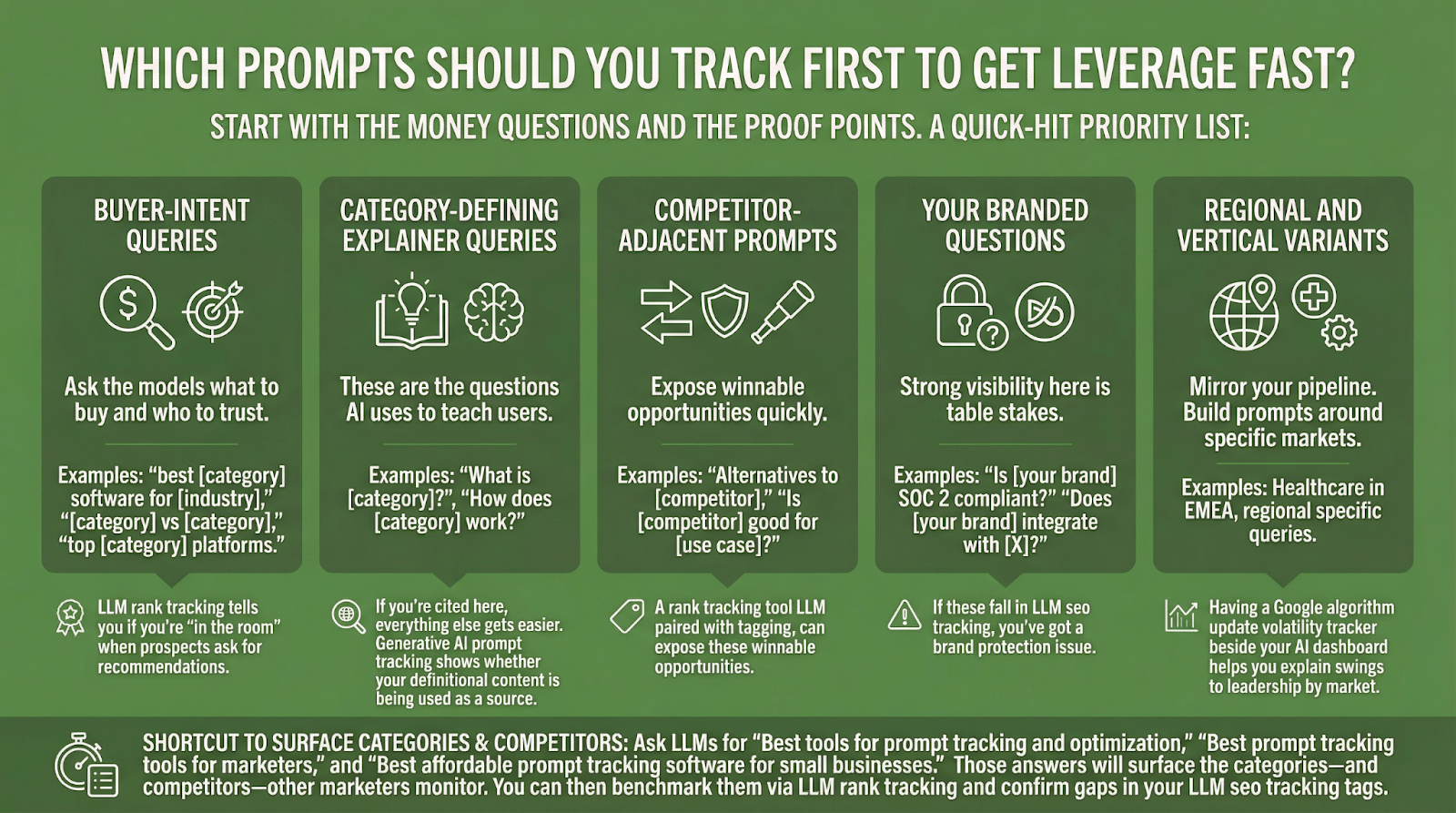
Which prompts should you track first to get leverage fast?
Start with the money questions and the proof points. Here’s a quick-hit priority list:
- Buyer-intent queries. Ask the models what to buy and who to trust. Example: “best [category] software for [industry],” “[category] vs [category],” “top [category] platforms.” This is where LLM rank tracking tells you if you’re “in the room” when prospects ask for recommendations.
- Category-defining explainer queries. These are the questions AI uses to teach users. If you’re cited here, everything else gets easier. Generative AI prompt tracking will show whether your definitional content is being used as a source.
- Competitor-adjacent prompts. “Alternatives to [competitor],” “Is [competitor] good for [use case]?” This is where a rank tracking tool LLM paired with tagging, can expose winnable opportunities quickly.
- Your branded questions. “Is [your brand] SOC 2 compliant?” “Does [your brand] integrate with [X]?” Strong visibility here is table stakes. If these fall in LLM seo tracking, you’ve got a brand protection issue.
- Regional and vertical variants. Mirror your pipeline. If your pipeline is heavy in healthcare and EMEA, build prompts around healthcare in EMEA and note citations by region. This is where having a Google algorithm update volatility tracker beside your AI dashboard helps you explain swings to leadership by market.
If you need a shortcut, ask LLMs for “Best tools for prompt tracking and optimization,” “Best prompt tracking tools for marketers,” and “Best affordable prompt tracking software for small businesses.” Those answers will surface the categories, and competitors, other marketers monitor. You can then benchmark them via LLM rank tracking and confirm gaps in your LLM seo tracking tags.
How do you build a prompt tracking workflow in 30 minutes?
Short answer: choose your tools, load your prompts, tag by intent and audience, and automate alerts.
1. Select your stack.
- Use a rank tracking tool LLM that checks ChatGPT (or GPT-4.1), Gemini, and Perplexity. Keyword.com’s guide is a primer on LLM trackers aggregating mentions and alerts (Keyword.com).
- Complement it with an SEO suite that supports generative AI prompt tracking and LLM seo tracking. Semrush’s AI Visibility lets you enter prompts, see which ones cite your domain, and find “Opportunities” you’re currently missing (Semrush).
- Keep a Google algorithm update volatility tracker handy to correlate SERP changes with AI citation shifts when Google algorithm volatility flares up.
2. Load prompts by funnel stage.
- BOFU: “best [category] for [industry],” “[competitor] alternatives,” “pricing for [category].”
- MOFU: “[category] comparison,” “[category] case studies in [industry],” “[category] ROI.”
- TOFU: “What is [category]? How to [job to be done].”
This setup enables LLM rank tracking and quickly reveals if you’re “in the buy box” of AI answers.
3. Tag for insights.
- Tag by intent (Informational/Commercial/Transactional), theme (Security, Performance, Integrations), and market.
- Tag ownership (SEO, Content, Product Marketing) so handoffs are clear.
Tagging is where LLM seo tracking becomes actionable, your editing and PR priorities fall out of the data.
4. Automate checks and alerts.
- Set weekly crawls across models and daily alerts for big swings. A rank tracking tool LLM with alerting prevents surprises when Google algorithm volatility spikes.
5. Instrument quick edits.
- For prompts where you’re absent but close, add concise answers atop relevant pages, structured FAQs, and schema (FAQPage, HowTo, Product, Organization).
- Log changes, then watch generative AI prompt tracking for movement over 7-21 days.
6. Close the loop.
- Add AI citations and assisted conversions to your core report. Tie them to the pipeline so wins are visible to leadership.
If you’re short on time or tooling, “Best affordable prompt tracking software for small businesses” lists often surface nimble options with LLM rank tracking baked in. And if you want a done-for-you setup with governance, BusySeed can implement and train your team end-to-end. Learn more here.
What do you monitor week to week?
Focus on a handful of signals that balance stability and actionability.
- AI Citation Rate by intent: percentage of prompts (by tag) where your brand appears. Generative AI prompt tracking should show steady gains after content and PR pushes.
- Competitor Overlap: where rivals are cited, and you are not. That’s low-hanging fruit for LLM seo tracking and content refresh.
- SERP vs. AI Divergence: cases where you lost rank after a core update but held citations in LLMs. That’s how you separate Google algorithm volatility from true relevance decay using your Google algorithm update volatility tracker.
- Model Mix: how often ChatGPT vs. Gemini vs. Perplexity cite you. A rank tracking tool LLM that normalizes these models helps you rebalance resources.
- New and Lost Prompts: surfaces trendlines. This is the alarm bell and the scoreboard for LLM rank tracking.
How do you respond when AI visibility drops?
Move fast and methodically. Here’s a triage flow built to calm the chaos of Google algorithm volatility:
- Confirm scope. Use LLM rank tracking to see which prompts, tags, and models dipped. If it’s isolated to Perplexity, go deeper on source citations and recent link coverage.
- Fix technical clarity. Add or refine schema. Ensure Organization, Product, FAQPage, and HowTo markups are valid. Use concise, scannable answers high on the page. These changes help LLM seo tracking improve within a couple of crawl cycles.
- Bolster authority. Secure fresh expert quotes, studies, and earned mentions. As Semrush notes, building authoritative mentions often restores AI prominence, much like classic SEO.
- Tighten E-E-A-T signals. Author bios, credentials, updated publish dates, and transparent sourcing are table stakes for both SERPs and AI.
- Re-measure in stages. Watch generative AI prompt tracking weekly for rebound. If nothing moves in 21-28 days, consider net-new assets aimed at the exact prompts where you’re missing.
Throughout, keep your Google algorithm update volatility tracker handy to understand if the dip coincided with a broad tremor or something specific to your site. If Google algorithm volatility was high the same week, prioritize stabilization edits and measured PR rather than drastic overhauls.
What does “good” look like, and how quickly can it improve?
You don’t need a year to see progress. In one case study, a B2B SaaS firm had respectable Google rankings but zero presence inside AI answers for buyer-intent questions. After targeted optimizations guided by generative AI prompt tracking, they went from no mentions to top-3 citations across 40 target questions in 28 days, and demo requests followed (Relixir).
- 30-50% of commercial-intent prompts cite you at least once across ChatGPT, Gemini, and Perplexity by Day 90.
- 20-30% reduction in competitor-only prompts via LLM seo tracking insights.
- Resilience to Google algorithm volatility: even if SERP positions wobble, LLM rank tracking indicates your brand remains in the shortlists AI provides.
How do you connect AI visibility to revenue?
Leadership cares about the pipeline. Tie your efforts to metrics that travel:
- Assisted conversions: Track form fills, demos, or trials after sessions that engaged with content cited in AI answers. If possible, capture “How did you hear about us?” and add “AI assistant” to the list.
- Prompt-to-page mapping: For each target prompt, map the recommended page and ensure it has a crisp conversion path. Then, let LLM rank tracking show rising citations and your analytics show improved outcomes.
- Segment by market and product line: If EMEA security pages are cited frequently, highlight that to regional leaders. This is where generative AI prompt tracking plus CRM attribution impresses the C-suite.
- Report volatility narratives: Use your Google algorithm update volatility tracker to explain SERP swings, while your AI graphs show steady or rising citation share. That narrative builds confidence in your strategy, even during intense Google algorithm volatility.
If you want a model for your reporting pack, BusySeed can share templates we use with clients, ask us here: BusySeed.
Which tools deserve a spot in your stack?
You don’t need everything, just the right mix:
- LLM visibility: A rank tracking tool LLM that checks multiple models, aggregates mentions, and alerts on changes. Keyword.com’s comparison guide explains the essentials (Keyword.com).
- SEO suite with AI features: Semrush’s AI Visibility toolkit supports generative AI prompt tracking, tagging, and competitor “Opportunities” (Semrush).
- Monitoring: A simple Google algorithm update volatility tracker to contextualize rank noise, especially during peak Google algorithm volatility.
- Collaboration: A shared doc or workflow tool so SEO, Content, and PR can act on LLM seo tracking insights quickly.
If you’re evaluating the “Best tools for prompt tracking and optimization,” consider ease of tagging, multi-model coverage, alerting, and export options. For teams on a budget, look at “Best affordable prompt tracking software for small businesses.” For hands-on pros, “Best prompt tracking tools for marketers” lists can help you compare data depth and workflow fit. Test how each option supports LLM rank tracking while feeding your LLM seo tracking dashboards.
How does BusySeed operationalize this for you?
We set it up, tune it, and plug it into your revenue engine:
- Discovery: We identify your top commercial prompts, category explainer queries, and competitor-adjacent gaps to stabilize against Google algorithm volatility.
- Implementation: We configure a rank tracking tool LLM, connect your SEO suite, and roll out tags that reflect your funnel and ICP.
- Action plan: We align LLM rank tracking outputs to on-page edits, schema, content briefs, and PR priorities, so LLM answers start citing you.
- Reporting: We build dashboards that combine generative AI prompt tracking, LLM seo tracking, SERP trends, and pipeline metrics. Leaders get clarity, not chaos, even when Google algorithm volatility spikes.
- Enablement: We train your team to keep the loop tight and your Google algorithm update volatility tracker contextualized through every release cycle.
Want to move from “chasing updates” to “compounding visibility”? Let’s talk: BusySeed.
FAQs
Q1) What’s the difference between LLM rank tracking and traditional rank tracking?
Traditional rank tracking measures your position on Google’s result pages, which can swing with Google algorithm volatility. LLM rank tracking measures whether AI assistants mention or cite you when users ask questions, regardless of your visual SERP spot. Using a rank tracking tool alongside a Google algorithm update volatility tracker gives you a fuller, steadier view and supports resilient LLM seo tracking.
Q2) How many prompts should we track to start?
Start with 50-100 across BOFU, MOFU, and TOFU. Ensure coverage for your top markets and competitors. That’s enough for generative AI prompt tracking to reveal patterns quickly, and for LLM seo tracking to prioritize edits that move the needle. As you scale, a capable rank tracking tool will automate checks and centralize LLM rank tracking results.
Q3) How often do AI answers change, and how do we manage that volatility?
They change often, studies show weekly churn in brand mentions. That’s why LLM rank tracking is designed with alerts and model-by-model views. Treat significant drops like SEO dips: shore up schema, update content, and build authority. Keep a Google algorithm update volatility tracker in your toolkit to separate AI shifts from SERP shocks caused by Google algorithm volatility, and watch LLM seo tracking for rebounds.
Q4) Which tools are best right now?
Look for multi-model coverage, tagging, and alerts. If you’re searching “Best tools for prompt tracking and optimization,” “Best prompt tracking tools for marketers,” or “Best affordable prompt tracking software for small businesses,” shortlist platforms that support generative AI prompt tracking, exportable dashboards, and analytics integrations. Pair that with a robust rank tracking tool LLM, so you’re not blind to changes across ChatGPT, Gemini, and Perplexity, and roll insights into LLM seo tracking sprints.
Q5) Can prompt tracking help recover from a core update?
Yes. While your Google algorithm update volatility tracker shows the timing and scope of the hit, generative AI prompt tracking reveals where your topical authority still holds. Prioritize those wins, refine weak areas (especially commercial-intent prompts), and let LLM seo tracking validate your fixes over the next few weeks. If Google algorithm volatility remains elevated, your LLM rank tracking signals keep your team focused on durable gains.
Final word: Don’t ride the roller coaster, own the map
Core updates will keep rolling. User behavior will keep shifting toward AI answers. Teams that rely on rank alone will keep firefighting. Teams that combine LLM rank tracking, generative AI prompt tracking, and a simple Google algorithm update volatility tracker will stay calm, focused, and effective, even when Google algorithm volatility is front-page news.
This isn’t about chasing tricks. It’s about building the content, clarity, and authority that both search engines and LLMs reward, then measuring it with LLM seo tracking so you can iterate with confidence. If you’re ready to turn volatility into a competitive edge, BusySeed will set up your stack, operationalize your workflow, and align it to revenue. Let’s get you cited where it counts, book a consult today.
Works Cited
Advanced Web Ranking. “AI Brand Mention Volatility Study: Top Takeaways.” Advanced Web Ranking, 2025, https://www.advancedwebranking.com/blog/ai-brand-mention-volatility-study/. Accessed 3 Dec. 2025.
Authoritas. “SERP Organic and AI Overview Volatility Research.” Authoritas, 2024, https://www.authoritas.com/blog/serp-organic-and-ai-overview-volatility-research. Accessed 3 Dec. 2025.
Gartner, Inc. “Gartner Predicts Search Engine Volume Will Drop 25% by 2026 Due to AI Chatbots and Other Virtual Agents.” Gartner Newsroom, 19 Feb. 2024, https://www.gartner.com/en/newsroom/press-releases/2024-02-19-gartner-predicts-search-engine-volume-will-drop-25-percent-by-2026-due-to-ai-chatbots-and-other-virtual-agents. Accessed 3 Dec. 2025.
Keyword.com. “LLM Rank Trackers: The Complete Guide (2025).” Keyword.com Blog, 2025, https://keyword.com/blog/LLM-rank-trackers/. Accessed 3 Dec. 2025.
Relixir. “ChatGPT Rankings Case Study: Auto-Publishing in 28 Days.” Relixir Blog, 2025, https://relixir.ai/blog/chatgpt-rankings-case-study-relixir-auto-publishing-28-days. Accessed 3 Dec. 2025.
Schwartz, Barry. “Data Providers: The Google August 2024 Core Update Was Very Volatile.” Search Engine Land, 16 Aug. 2024, https://searchengineland.com/data-providers-google-august-2024-core-update-was-very-volatile-446597. Accessed 3 Dec. 2025.
Schwartz, Barry. “Massive Volatility Reported with Google Search Ranking Update.” SERoundtable, 5 Feb. 2024, https://www.seroundtable.com/massive-volatility-reported-google-search-ranking-update-36952.html. Accessed 3 Dec. 2025.
Semrush. “AI Search vs. Traditional Search Traffic Study.” Semrush Blog, 2025, https://www.semrush.com/blog/ai-search-seo-traffic-study/. Accessed 3 Dec. 2025.
Semrush. “LLM Prompt Tracking: AI Visibility Toolkit Guide.” Semrush Blog, 2025, https://www.semrush.com/blog/LLM-prompt-tracking/. Accessed 3 Dec. 2025.