
Posting frequency can have a major impact on reach and engagement. Small businesses that maintain a consistent schedule of 3-5 posts per week often see faster follower growth and stronger audience interactions compared to irregular posting. Platform-specific timing also plays a role in maximizing visibility.
TL;DR
If you’re a small business owner, posting on social media isn’t just about being present. It’s about being consistent. Businesses that post 3-5 times per week often see stronger engagement and faster growth compared to irregular posting. The right social media posting frequency depends on the platform and your audience, but maintaining a steady schedule matters more than hitting a magic number. Quality content that aligns with your brand voice will outperform daily filler posts every time.
📅 Updated August 2026 Platform expectations are diverging in 2026. Buffer's analysis of 52M+ posts confirms that 3-5x per week remains the right baseline for most small businesses, but the optimal cadence now varies sharply by platform. TikTok rewards daily posting: creators who publish every day grow followers 3.5x faster than those posting 2-3x per week. Instagram Reels now drive 36% more reach than carousels, making short-form video the priority format for feed growth. On LinkedIn, PDF carousel posts generate a 21.77% median engagement rateroughly three times higher than images or video. And across all platforms, Wednesday at 7-10 AM in your audience's local timezone has emerged as the single strongest posting window of the week. The core advice here still stands; what's shifted is how aggressively each platform rewards consistency.
Introduction: The Posting Dilemma
Every small business owner has asked the same question at some point: “How often should I be posting on social media?” It’s a tricky balance. Post too little, and your audience forgets you. Post too often, and you risk overwhelming followers or burning through content ideas. Many also wonder, does posting every day help businesses grow, or is it smarter to focus on quality over quantity?
The truth is, there isn’t a single answer. The right cadence depends on your business type, resources, and which platforms you’re active on. What matters most is consistent posting on social media, showing up at a pace you can sustain. A predictable rhythm builds trust with your audience and signals to algorithms that your account is active and worth showing to more people.
Timing adds another layer. Understanding the best times to post on social media helps ensure that your content appears when your audience is most engaged. Pairing a steady frequency with smart timing is where results start to compound.
Effective social media management gives small businesses the tools to make this balance achievable. By planning, scheduling, and tracking performance, you avoid the burnout of daily posting while still maintaining visibility and growth.
Does Posting Every Day Help Businesses Grow?
Think of your social media presence like a conversation. If you show up every day, your community knows what to expect. If you disappear for weeks, they stop listening.
Consistency does three things for small businesses:
- Improves Algorithm Favorability Social platforms are designed to reward regular activity. Accounts that post consistently are more likely to have their content pushed into followers’ feeds and discovery pages. This means consistent posting doesn’t just keep you visible to your current audience, it increases the chances of reaching new people who haven’t interacted with your business before.
- Builds Brand Trust A predictable posting schedule signals reliability. When followers see you show up week after week, it communicates that your business is active, engaged, and committed. Over time, this consistency builds credibility, making audiences more likely to pay attention to your content, recommend your brand, or convert into paying customers.
- Supports Compounding Growth Social media growth happens through momentum. Each post creates a new touchpoint, and each touchpoint has the potential to generate engagement. When you post consistently, these interactions stack on top of each other, comments, shares, and likes from one post help lift the next. The result is steady growth that compounds over time, rather than short bursts of visibility followed by silence.
Research shows that posting 3-5 times per week is a reliable sweet spot for many small businesses. It’s frequent enough to stay top-of-mind but not so frequent that it drains resources or feels spammy.
How Often Should You Post on Social Media?
Different platforms have different audience behaviors and algorithm dynamics. According to Sprout Social’s 2025 research, here’s how often small businesses should post to maximize reach and engagement:
Source: Sprout Social, 2025
These numbers aren’t rules, they’re starting points. What matters most is testing with your own audience to see where engagement peaks.
What Matters More: Posting Frequency or Content Quality?
One of the biggest mistakes small businesses make is obsessing over social media posting frequency while sacrificing content quality. Many owners ask, “does posting every day help businesses grow?” The truth is that daily posting can work, but without a strategy it often leads to burnout and low-value updates. What matters more is consistent posting on social media that your team can sustain.
Timing also plays a role. Knowing the best times to post on social media helps maximize visibility, but even perfectly timed posts won’t perform if the content lacks value. Pairing strong ideas with steady, reliable scheduling delivers better long-term results than volume alone.
The key to balance is effective social media management. Planning ahead, scheduling posts, and repurposing content make it easier to stay consistent without overwhelming your resources. Businesses that build these processes are far more likely to keep growing steadily.
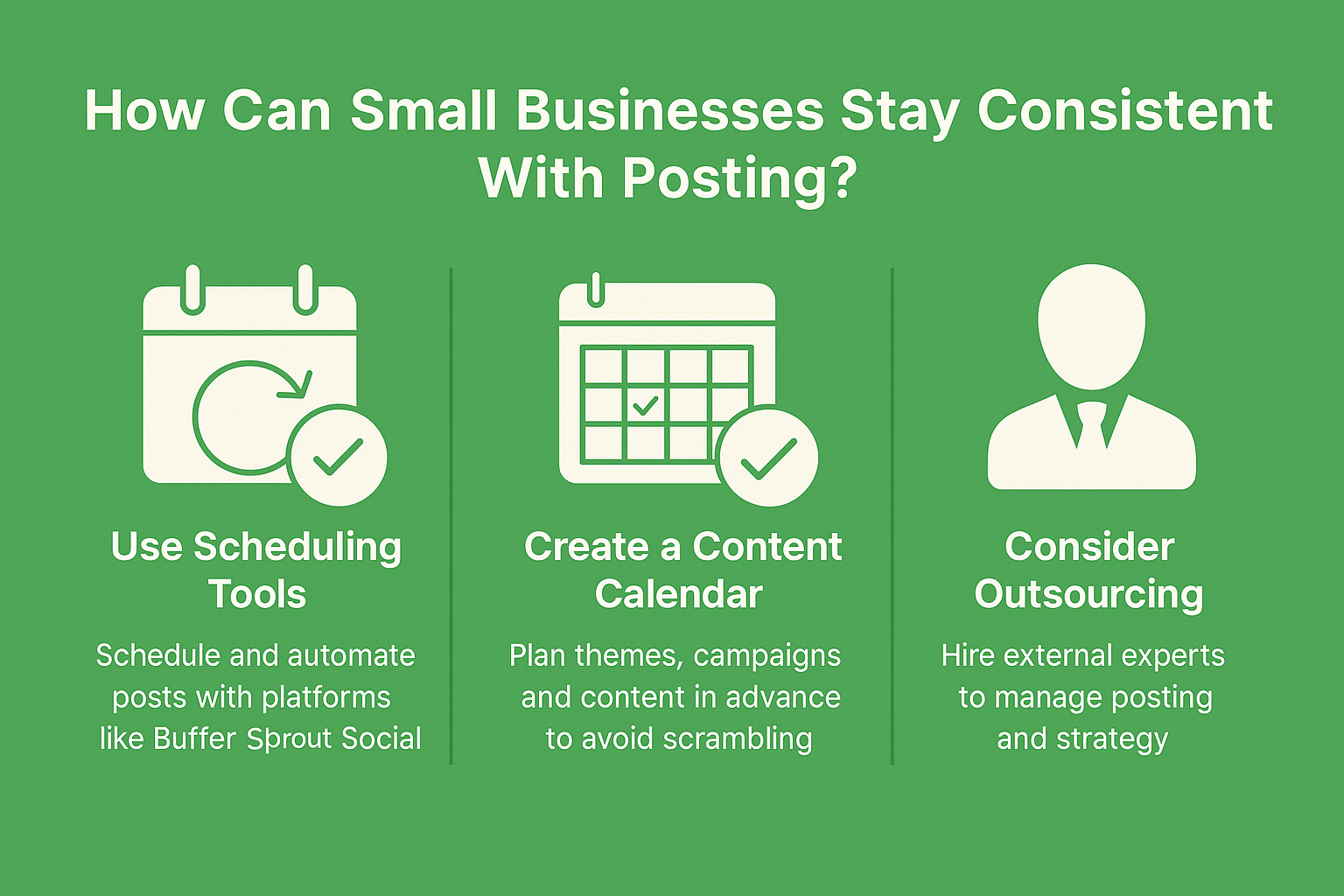
How Can Small Businesses Stay Consistent With Posting?
Many small business owners juggle operations, sales, and customer service, social media often becomes an afterthought. Here are three ways to keep posting consistently without burning out:
- Use Scheduling Tools
Manually posting in real time is stressful and inefficient. Scheduling platforms like Buffer, Later, or Sprout Social allow you to create a week’s worth of posts at once, then automatically publish them at the best times to post on social media. This ensures your audience sees fresh content even when you’re busy running the day-to-day. Scheduling also lets you test different posting times, compare engagement rates, and refine your strategy based on performance. - Create a Content Calendar
Consistency improves when you can see your content plan at a glance. A content calendar helps you map out themes, campaigns, and seasonal opportunities in advance. Even a simple spreadsheet with columns for dates, platforms, and post ideas can remove the guesswork. Planning ahead ensures you’re never scrambling at the last minute and makes it easier to repurpose content across channels. A calendar also helps you align with your business goals, for example, promoting sales around holidays or sharing thought leadership at industry events. - Consider Outsourcing
For many owners, outsourcing social media management is the most efficient way to maintain consistency without stretching internal resources too thin. External support can include strategy development, content creation, and community management. Outsourcing is often more cost-effective than hiring a full-time in-house employee, especially for small businesses. It also ensures that your posting frequency, content quality, and timing are handled by specialists who understand how to keep your brand visible and relevant.
Why Consistency Is Important
In today’s crowded digital landscape, small businesses often compete with larger brands for attention. But the companies that succeed online aren’t always the ones posting the most, they’re the ones posting the most consistently.
Starting with a manageable cadence, like three posts per week, allows businesses to build momentum without overextending resources. Once that rhythm becomes second nature, scaling up is easier and more sustainable.
Paired with thoughtful audience targeting and content strategy, consistent posting forms the foundation for measurable growth on any platform.
FAQ
Q1: Is posting every day too much for a small business?
Not always, but it depends on your resources. Daily posting can work if you have the time and content library to maintain quality storytelling across every post. For many small businesses, however, posting every day can lead to rushed, repetitive, or low-value updates that actually reduce engagement over time. If you’re just starting out, it’s smarter to post 3-5 times per week with thoughtful content and then scale up once you have a consistent process in place (Hootsuite, 2024).
Q2: What’s better, consistency or high volume?
Consistency almost always wins. Posting a few times per week on a predictable schedule builds trust with both your audience and the platform’s algorithm. High volume without strategy can overwhelm your audience, dilute your message, and exhaust your team. HubSpot research notes that posting 2-5 times per week typically outperforms daily posting for many small businesses (HubSpot, 2024), and Sprout Social highlights that sustainable posting drives better engagement long-term (Sprout Social, 2025).
Q3: Do posting times matter?
Yes. Timing plays a major role in visibility because social algorithms often prioritize content that receives quick engagement after it’s published. Research from Sprout Social shows that mid-morning hours (around 9 a.m. to 11 a.m.) on weekdays are often best across platforms, though LinkedIn tends to peak Tuesday through Thursday (Sprout Social, 2025). The most effective approach is to experiment with posting at different times, track performance, and then adjust based on when your followers are most active.
Q4: Should I post the same content on all platforms?
Repurposing content is smart, but it should always be adapted to fit the platform. A TikTok video might work as a short Reel on Instagram, but LinkedIn will likely require a text-based insight or a professional case study drawn from the same idea. Audiences use each platform differently:
- Instagram: Visual storytelling and brand lifestyle
- LinkedIn: Thought leadership and professional insights
- TikTok: Short, entertaining, trend-driven clips
- Facebook: Community building and local updates
Hootsuite emphasizes the value of repurposing content while tailoring it to each platform’s audience expectations (Hootsuite, 2024).
Q5: When should I consider hiring help?
If social media feels overwhelming, inconsistent, or isn’t generating results, it may be time to get support. Signs include:
- You’re missing posting deadlines or going weeks without updates.
- Engagement is stagnant even though you’re posting regularly.
- You don’t have time to track analytics or adjust your strategy.
- You want to expand to new platforms but lack the expertise.
Industry surveys show that many small businesses struggle to balance social media with day-to-day operations, which is why outsourcing or hiring dedicated support becomes necessary (Content Marketing Institute, 2024).
Final Takeaway
Overall, finding the right social media posting frequency can feel like guesswork for many small businesses, but the data shows that posting consistently between 3 and 5 times per week on major platforms is the most reliable benchmark for growth. Businesses that maintain this rhythm see stronger audience engagement, improved visibility in social algorithms, and steadier growth compared to those that post sporadically.
It’s easy to assume that posting every day is necessary, but the data tells a different story. Businesses that prioritize quality, strategic content at moderate frequency outperform those that post daily without focus. Daily posting is not required for growth. Consistency paired with intentional content planning creates better long-term outcomes than sheer volume.
Timing also matters. Research shows that weekday mornings, particularly Tuesday through Thursday, between 9 a.m. and 11 a.m. generate higher engagement across multiple platforms. This reflects audience behavior patterns, where mid-morning scrolling leads to faster interactions and algorithmic boosts.
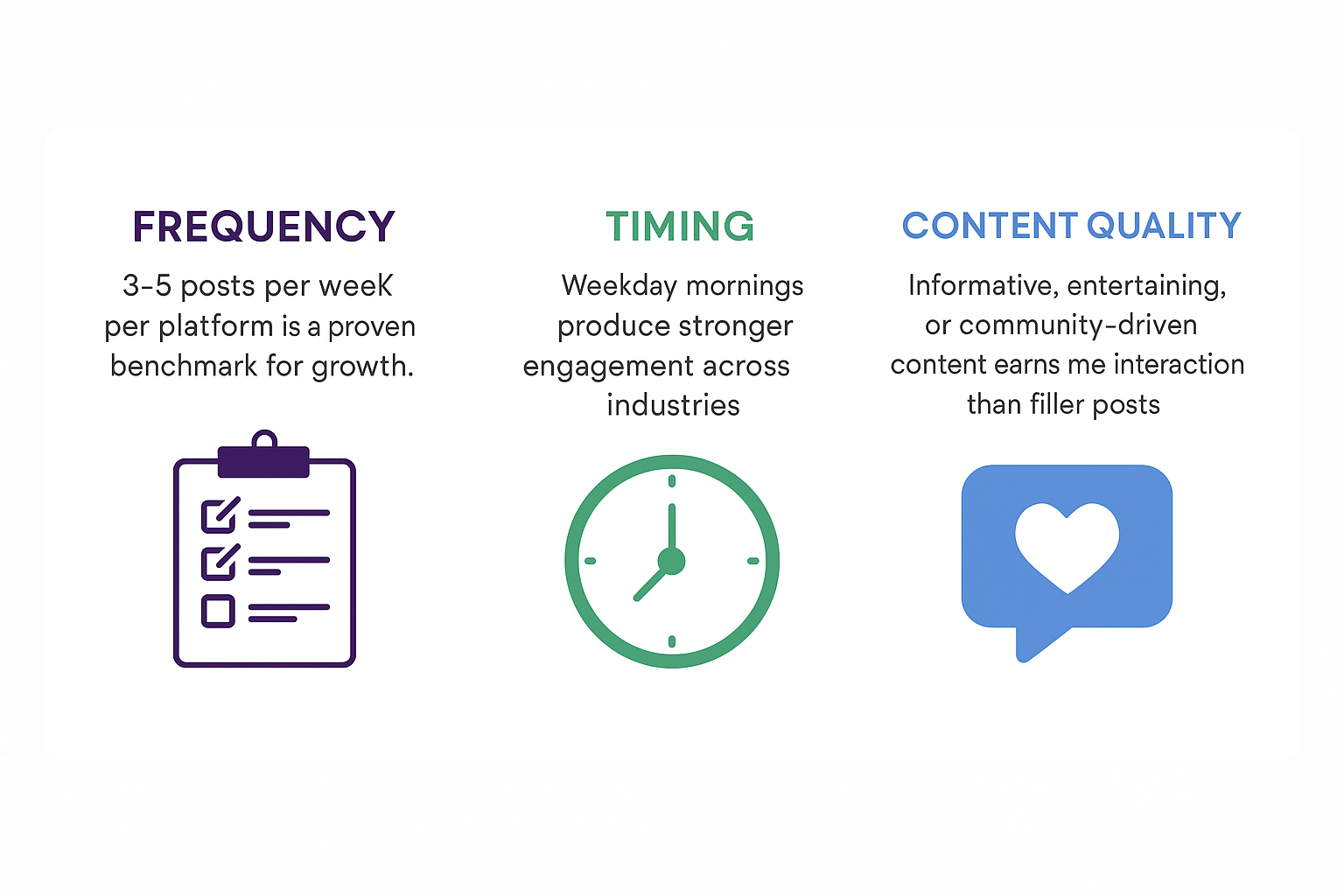
The most effective strategies for small businesses combine three elements:
- Frequency: Posting 3-5 times per week per platform is a proven benchmark for growth. This pace keeps your brand present in your audience’s feed without overwhelming them or draining your resources. It’s enough to build momentum and stay top-of-mind, while still leaving room to focus on quality content creation. Businesses that stick to this rhythm often see steadier engagement and healthier long-term growth than those posting in bursts.
- Timing: Weekday mornings, especially between 9 a.m. and 11 a.m., tend to produce stronger engagement across industries. This is when audiences are most active, checking feeds before or during their workday. Posting at these peak times increases the likelihood that your content will be seen and interacted with quickly, which helps algorithms push it further. Fine-tuning timing for your specific audience through testing and analytics can make each post more effective.
- Content quality: Consistency is only powerful when paired with value. Informative posts that teach, entertaining updates that spark emotion, or community-driven stories that invite participation all outperform filler content. High-quality content keeps audiences engaged, encourages sharing, and strengthens your brand’s reputation. In practice, this means investing more energy in posts that align with your brand voice and audience needs rather than rushing to hit a number.
When executed consistently, this approach builds momentum. Over time, businesses that align social media posting frequency, timing, and quality see stronger ROI from social media. In competitive markets like New York City, where visibility directly impacts customer acquisition, a structured posting strategy can make the difference between flat growth and measurable success.
Citations
Sprout Social. (2025). How often to post on social media: 2025 success guide. Retrieved from https://sproutsocial.com/insights/how-often-to-post-on-social-media/
HubSpot Community. (2022). When to post on Instagram. Retrieved from https://community.hubspot.com/t5/Social-Media/When-to-Post-on-Instagram/td-p/650370
Hootsuite. (2024). How often to post on social media in 2024. Retrieved from https://blog.hootsuite.com/how-often-to-post-on-social-media/
Content Marketing Institute. (2024). How to decide the ideal publishing frequency for social media, blogs, emails, and more. Retrieved from https://contentmarketinginstitute.com/content-marketing-strategy/how-to-decide-the-ideal-publishing-frequency-for-social-media-blogs-emails-and-more/
Sprout Social. (2025). Best times to post on social media. Retrieved from https://sproutsocial.com/insights/best-times-to-post-on-social-media/