Engineering Cross-Channel Visibility on a Lean Ad Budget in 2026
Maintaining strong digital visibility on a restricted advertising budget requires tactical precision and continuous asset optimization. Brands with lean expenditures cannot afford broad-match testing or scattergun channel allocation, which leads to high click costs and wasted spend. Instead, maximizing a lean budget demands a disciplined approach focused entirely on hyper-targeted placements and highly efficient, platform-specific keyword selections. By implementing rigorous bid optimization loops and eliminating underperforming ad variations, organizations can squeeze maximum exposure out of limited resources. This focused execution ensures that paid media budgets are strictly funneled into high-yield avenues, building an active market presence and scaling operations without increasing top-line overhead.
Case Study: Generating a 970% Return on Ad Spend (ROAS) in 30 Days.
Many e-commerce sellers struggle to maintain online market presence due to rising click costs and poor budget management. To build highly cost-effective cross-channel visibility for a retail client, BusySeed took over their sales pipeline using precision-targeted campaign frameworks. Through intense keyword targeting and strict bid optimization over a 30-day period, the strategy generated over $970 in digital sales from a minimal $100 ad spend. This precision-engineered deployment delivered a massive 970% Return on Ad Spend (ROAS), demonstrating that lean budgets can drive highly profitable visibility when optimized correctly.
TL;DR
- U.S. internet ad revenue hit a new high of $294.6B in 2025, marking a 13.9% increase year over year, resulting in (IAB, 2026)
- Paid search CPCs have reached a 6-year high, up 9% year-over-year average cost per click (Skai, 2025). A scattergun approach to ad spend allocation, with a broad-match experiment, will only result in spending money that won’t close sales for you.
- U.S. e-commerce crossed $1.2337T in 2025 (U.S. Census Bureau, 2025). The demand pool is still growing, so the winning move isn’t to spend more; it’s to waste less.
- BusySeed achieved a 970% ROAS from $100 in ad spend on Amazon using highly targeted campaigns with precisely engineered keyword structures within a 30-day period.
- Social media ad revenue reached $117.7B for the year in 2025, growing by 32.6% YoY from the previous year (IAB, 2026); Engineer presence in social discovery loops to keep up with competitors.
How to Get Cross-Channel Visibility on a Lean Budget in 2026?
So how do you create cross-channel visibility on a lean ad budget in 2026? By building a system that delivers results. In simple terms, a paid media strategy that reaches customers at the right time in their buyer journey.
On very lean budgets, the best marketing organizations will follow the customer through every phase of the customer journey, make decisions at every stage, and drive results. That’s how they treat ‘diversification’ across all customer acquisition channels as a cost, ensuring that
every dollar of ad spend allocation is maximized in every phase of the customer’s journey for every customer.
The same holds for this year, as U.S. internet ad revenue reached a new record high of
$294.6B in 2025 (IAB, 2026), making the auctions very crowded. Thus, a paid search ad campaign on the Internet can easily cost a lot of money, rather than simply failing, which is where proper PPC management services become critical.
Partnering with experts like BusySeed ensures your budget is strictly funneled into high-yield avenues rather than disappearing into crowded auctions.
On the demand side, US e-commerce continued its ascent, reaching
$1.2337 trillion in
spending in the latest full year for which data are available,
16.4% of total retail spending, and still growing (U.S. Census Bureau, 2025). That there is demand and that it can be captured by ad spend engineered to meet it in the moments that matter is good news for struggling spenders in online marketing ecommerce.
What is the Danger of Scattergun Paid Media right now?
The floor on wasted ad spend allocation just got higher. Scattergun ad spend allocation was always a bit inefficient, but now it is actively punishing.
Google brand text ad CPCs are up
19% YoY (Tinuiti, 2025), and Instagram CPMs are up 14% YoY. Meanwhile, overall paid search CPCs have hit a six-year high, rising 9% across the broader market (Skai, 2025). Therefore, a brand with a $3,000 monthly budget, spread across 5 different channels, will not get 5 separate ad campaigns with partial wins.
Instead, the brand will get 5 different ad campaigns with insufficient signal to draw conclusions, no statistical significance to determine whether the campaigns are performing well or poorly, and poorly performing algorithms that haven’t had enough data to optimize correctly.
Below is an example of how one might allocate a
$3,000-per-month budget across 5 different channels in a scattergun manner. This approach causes several critical issues:
- No Optimization: None of the individual ad campaigns have generated enough conversion data to reach the end of the learning phase (the “optimized” stage).
- Wasted Spend: Each ad campaign is instead being held in the “auditing” phase, where automated bidding is essentially throwing money at search queries in order to accumulate as much data as possible as quickly as possible.
- Fierce Competition: Meanwhile, the brand ad campaigns on Google are competing with every other brand in the space for the same branded search terms.
- Blind Reporting: At the end of the month, a report is generated stating that all the various channels have “underperformed” for the month, but it provides no further explanation of what went wrong with our online marketing ecommerce efforts.
That’s not a budget problem. That’s a strategy problem. And the fix isn’t more money; it’s better architecture for our paid media strategy and the use of disciplined PPC management services.
Allocation in the Absence of a Budget.
A real paid media strategy for a lean budget starts with one thing: an intent map we can actually execute against.
Not a channel checklist: a written-down plan of the fewest number of channels to reach customers at each decision-making point along the pipeline for our business. Here’s a simple way to map out our pipeline and how we here at
BusySeed implement it for each of our clients in order to increase their conversion rates:
1. First Stage: Capture.
The buyer knows they want something. They're searching. This is where Search exact/phrase match, Shopping, and retail media live. High intent, high conversion probability, non-negotiable for most brands.
2. Second Stage: Validate.
The buyer found us. Now they’re asking “but are you legit?” This is where social proof surfaces: YouTube, creator content, review snippets, comparison pages. We don’t need a massive budget here. We need the right asset.
3. Third Stage: Close.
The buyer’s been to our site, our product page, our cart. They didn’t convert yet. This is retargeting, and it’s the highest-efficiency ad spend on most platforms when done correctly.
We see this 3-stage framework applied incorrectly. Most brands focus on capturing intent and do not give enough attention to validating and then closing the sale on lean budgets. The result is that increased Search and Shopping ad spend allocation to capture more intent hits a ceiling because of poor Site and Retargeting performance.
Is Search Still Worth It When CPCs Keep Climbing?
Search is still worth it. But it demands more selectivity than it did three years ago.
Search revenue was
$114.2B in 2025, or 38.8% of total internet ad revenue, and isn’t going anywhere (IAB, 2026). However, the cost of poorly executed paid search advertising has risen dramatically over the last 3 years. Brand keyword average cost per click (CPC) went up
19% YoY in Q1 2025 (Tinuiti, 2025). Meanwhile, overall paid search CPCs -encompassing broader non-brand listings- are at their highest in 6 years, reflecting a 9% YoY average increase across search networks (Skai, 2025). There's also the AI Overview question, which deserves a straight answer, especially for those seeking expert PPC management services.
Another thing worth noting is how AIOs (Google AI Overviews) work. These can appear above, below, and even within search results. Here is what we need to know:
- No Direct Targeting: Although there are ads in these AIOs, we cannot target these placements.
- Zero Segmented Reporting: Even when they are served, there is currently no way to report on them in a segmented basis (e.g., “ads shown inside AIOs”).
- The Real Focus: Thus, the big question that many are asking is not how to get ads into AI Overviews. The big question is: How do we ensure our Search and Shopping ad campaign setup is well-structured so that our best-performing ads show up in all eligible places?
The answer to that big question relies on three core pillars for our paid media strategy:
- Query-level management
- A very solid, well-maintained set of negative keywords
- High-quality ad assets
This is the correct approach to Search on a lean budget, and search on any budget for that matter. Proper ad spend allocation requires strict rules:
- Keyword Selection: Use exact and phrase match for the highest-intent, highest-margin keywords.
- Campaign Structure: Brand and non-brand are separated out right from the start.
- Budget Control: Ad group ad spend is capped hard.
- Proactive Filtering: Negative keyword list built out before launch, not after the ad spend has occurred and found its way into irrelevant queries.
- Vigilant Reporting: Review the search term report weekly, not monthly.
Is Commerce Media a Channel Online Marketing Ecommerce Brands Should Invest in Right Now?
Commerce media is growing fast in online marketing and e-commerce, and many brands on tight budgets treat it as an afterthought. That’s a mistake.
Commerce media hit
$63.4B
in 2025, up
18% YoY. Amazon’s advertising services revenue grew from
$56.214B
in 2024 to $68.635B
in 2025 (Amazon.com, Inc., 2026). These platforms aren’t “another channel”. They’re search engines with a checkout button. When someone searches on Amazon, they’re not in discovery mode; they’re in purchase mode. That’s the highest-intent traffic available in online marketing ecommerce, and the click efficiency is often better than branded search on Google.
The Amazon ads account for a
BusySeed retail client looked normal enough on the surface. It was publishing ads, getting impressions, and spending money. But it was wasting money on search terms that didn’t drive conversions. The keyword structure was too broad; there was no conversion threshold governing bids, and the ad campaign had never been audited for search-term waste.
After reviewing the accounts, we realized the account was being eaten alive by suboptimal search terms. The ad campaign was being auctioned off based on auction health rather than the client’s specific business goals. To fix this, our team implemented the following changes:
- Tight Keyword Groupings: Created exact-match keyword groupings for high-intent product queries.
- Aggressive Filtering: Implemented aggressive negative matching to remove our research-intent terms.
- Strategic Bidding: Made bid adjustments by time of day to prioritize hours in which historical conversion data showed the greatest likelihood of success.
In the end, after fine-tuning the account over the first 30 days, we saw a
970% ROAS. In other words, for every
$100 spent in the account,
$970 in sales were generated. This is not a fluke; this is what can happen to our ROI when we have a solid advertiser working within a solid structure for our paid media strategy.
What are the differences between the services offered by Lean PPC Management and Full-Scale PPC Management Services?
On the other hand, lean PPC management is much more challenging than full-scale PPC management services. With full-scale PPC management services, we can run a wide range of tests and learn from failures. But with lean PPC management, we have to engineer the failure out of the ad campaign before it even launches.
One common pitfall for many in online marketing ecommerce today is overthinking what needs to happen before launching an ad campaign. This is why teams turn to
BusySeed to deploy a simple, proven framework to govern an ad campaign’s ad spend allocation and activity from day one. As a result, nothing is launched, and instead of putting forth a simple framework to govern an ad campaign’s ad spend allocation and activity, the marketing team spends its time engineering an ad campaign to fail.
Finally, for those of us providing Lean PPC management services to small ecommerce budgets, a crucial point to note is that measurement gaps are NOT just bad for reporting (e.g., ROI, ROAS, etc.), but also VERY bad for our paid media. This is because the data Google Ads uses to price our clicks and ‘optimize’ for the best conversions on our behalf is only as good as the data we bring to the table. Here is how we address this:
- Google Ads Enhanced Conversions: This allows us to ‘pass’ hashed first-party customer data into Google Ads for use in paid media in a fully privacy-safe manner.
- Meta Conversions API (CAPI): Similarly, on Facebook, the Conversions API does a much better job of connecting up the first-party data that we collect on the client (i.e., our ecommerce site) with the paid media optimization that is served out by Meta on the server (i.e., after they have processed our ad submissions, etc.).
This is why we set up the former and the latter before we even start spending paid media dollars for the account.
Social Media for Online Marketing E-commerce on a Tight Budget.
Social media marketing for ecommerce can be highly successful; what can be achieved is vital to understand. The digital marketing industry as a whole saw internet advertising revenues increase by 32.6% year-on-year to $117.7bn in 2025, with social advertising accounting for the majority of this growth (IAB, 2026).
Social media ad revenue hit
$117.7B in 2025, up
32.6% YoY (IAB, 2026). That growth is driven by performance ads, creator content, and AI-assisted creative production. But Instagram CPMs are up
14% YoY (Tinuiti, 2025), which means broad-audience awareness ad campaigns on Meta are quietly becoming lean-budget killers. The play isn’t awareness. It’s validation and retargeting.
For online marketing ecommerce on a tight budget, social can work for awareness (for example, as part of Stage 1), but is better used for validation and retargeting (as part of Stages 2 and 3).
- Leveraging UGC: User-generated content is one of the most cost-efficient ways to reach new users and answer the question ‘Is this brand legit?’ faster than a typical brand video.
- Handling Compliance: However, the brand must treat usage rights, whitelisting, and disclosure requirements as deployment requirements, not as afterthoughts to be addressed after the ad campaign launches on the platform.
AI is advancing rapidly across the creative and operational tasks typically performed by humans. As the
Stanford HAI’s 2026 AI Index Report states, there is a growing use of AI for tasks that are typically completed by humans. This opens up major opportunities:
- High-Volume Testing: A very lean team can set up a process to test a very large number of creative variations.
- Agile Optimization: Copy on a landing page can be tweaked and tested frequently, meaning results of changes to an ad campaign can be optimized very quickly.
Therefore, if we are manually creating all the creative variations being tested, we are likely leaving considerable efficiency gains on the table by not automating more of the work we currently do in our paid media strategy.
Case Study: BusySeed Transformed An Ad Campaign And Got 35x ROAS (Here’s Why It Worked)
BusySeed increased an e-commerce brand's ROAS from 15x to 35.17x on Google Ads in 30 days. This BusySeed case study yielded a 35x ROAS on Google Ads after moving an e-commerce client from another ad provider that offered less effective PPC management services.
BusySeed itself details how it increased this client's metrics on Google Ads so dramatically:
- ROAS (Return on Ad Spend): Improved from 15x to 35.17x in just 30 days.
- Cost Per Click (CPC): Decreased by 28%.
- Conversion Rate: Increased by 37%.
- Bounce Rate: Reduced by 43%.
The improvements were due to the
BusySeed team optimizing the ad campaign and landing pages to create the most efficient post-click experience possible. If we can’t afford more clicks, then we have to afford fewer wasted clicks. Online marketing ecommerce on a tight budget requires the optimal ad spend allocation to achieve the greatest returns.
In terms of optimization, the post-click landing page experience is far more important than the ad campaign experience. Thus, on a lean budget, we cannot afford to send clicks to a poor-performing post-click experience; it would only reduce return on investment and derail our overall paid media strategy.
Each business will have varying degrees of improvement depending on the amount of waste that’s currently in its account. So, for instance, if an account is already being run very efficiently, then BusySeed wouldn’t be able to squeeze as much additional improvement out of the account as it would from an account that’s currently running “blindly” on autopilot.
How to split your budget between different channels.
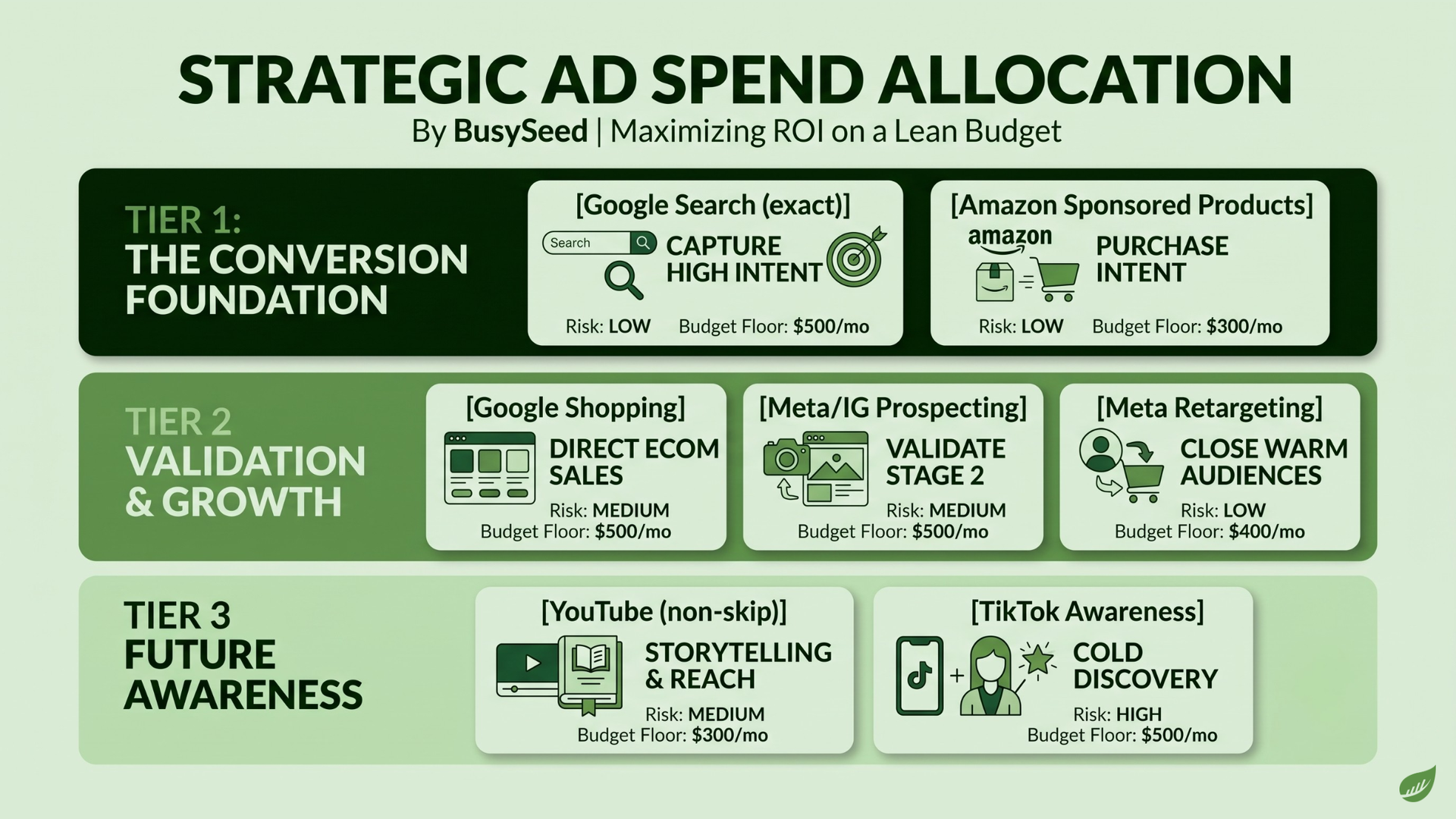
So, to answer the first part of our question, here’s a rough guide to allocating our ad spend to the channels that deliver the greatest ROI within our current marketing budget. We've used a rough estimate of the “budget floor” for the recommended channels in our advertising efforts.
| Channel | Best Use for Lean Budgets | Risk Level | Recommended Budget Floor | Primary KPI |
|---|---|---|---|---|
| Google Search (exact/phrase) | Capture high-intent, high-margin queries | Low. If negatives are managed | $500/mo | CPA / ROAS |
| Google Shopping / PMax | Product-feed-driven capture for ecom | Medium. Feed quality dependency | $500/mo | ROAS |
| Amazon Sponsored Products | Purchase-intent capture; owned search engine | Low. If the keyword structure is tight | $300/mo | ROAS |
| Meta Retargeting | Close warm audiences; Stage 3 | Low. If audience sizes are sufficient | $400/mo | ROAS / CVR |
| Meta/IG Prospecting | Stage 2 validation; UGC/creator-driven | Medium. CPMs rising | $500/mo | CPC / VTR |
| YouTube (non-skip) | Stage 2 validation; proof of content | Medium. Requires strong creative | $300/mo | CPV / brand lift |
| TikTok Awareness | Discovery; cold audiences; creator-driven | High for lean budgets | $500/mo | CPM / reach |
The table below provides a closer look at a lean budget for online marketing ad spend allocation by listing out the various online marketing channels. Here is what it covers:
- The best use of each channel for a lean budget.
- The risk level for each channel.
- The various recommended budget floors for each of the online marketing channels listed above.
- The primary metric to track for each online marketing channel to measure the success of a business's online marketing efforts.
Cross-Channel Visibility on a Lean Budget: Checklist for Actionable Steps
Actionable Steps You Can Take Right Now:
- Build our intent map before touching any platform. Define Stage 1 (capture), Stage 2 (validate), and Stage 3 (close) and assign every channel to one of those stages. Don’t let any channel serve two stages simultaneously on a lean budget in online marketing ecommerce.
- Split brand from non-brand in search ad campaigns. For many advertisers, brand search is increasing by 19% YoY (Tinuiti, 2025). Running brand and non-brand in the same search ad campaign will prevent us from properly optimizing for and spending efficiently on both.
- Kill switches. Set up so we can easily cut off underperforming ad campaigns. Whether handled internally or through external PPC management services, this should be a rule of thumb for all advertising. Set up our kill switches before we start running our ads, and make sure to communicate our rules to the rest of the team.
- Implement Enhanced Conversions and audit our Consent Mode v2 setup. If we've implemented Enhanced Conversions correctly for our advertisers, this will improve the quality of the data used in our bidding strategies. On the other hand, our Consent Mode v2 setup could be causing issues with our tracking and modeling of user behavior. If this is the case, then make sure to audit the configuration and make any necessary changes.
- Connect Meta's Conversions API if we're running any Meta ad spend. CAPI closes the measurement gap left by browser-based pixel tracking. This isn’t optional in 2026; it’s table stakes for accurate optimization.
- Build and deploy a master negative keyword list before launching any Search ad spend. Don’t wait for the search term report to tell us what not to buy. Pre-populate negatives based on query intent signals that won’t convert for our product category.
- Weekly Waste Ledger: Search terms, products, placements, and audiences wasting money with zero incremental business results need to be tracked and paused weekly.
- Evaluating our landing page is key to improving our paid media strategy. If we're seeing conversion rates under 2% at a cost per click over $1.50, then we've got a post-click problem, not a traffic problem. Make sure we're optimizing our landing pages to achieve the highest possible conversion rate.
- Treat commerce/retail media as a primary channel if we sell physical products. As reported in Amazon’s annual report, Amazon’s advertising revenue for 2025 hit a record $68.635B (Amazon.com, Inc., 2026). For sellers of physical products, the largest audience with purchase intent for our products is on Amazon. Our paid media strategy should focus on finding ways to be visible to this audience.
- Run a monthly cross-channel attribution review. Don’t let our lean ad spend allocation decisions be undermined by a last-click data model that will always undervalue our upper-funnel channels and overvalue closed deals that other channels assisted with.
If mapping out these technical steps feels overwhelming, the team at
BusySeed can step in to orchestrate your cross-channel visibility from setup to launch.
The Bottom Line: Precision Beats Volume
When operating on a restricted budget, waste is your biggest enemy. Scaling cross-channel visibility does not require outspending the competition; it requires outsmarting them. By anchoring your approach in intent architecture, ruthlessly cutting underperforming terms, and setting strict governance over every dollar, you transform your paid media strategy from a scattergun experiment into a predictable revenue engine. In online marketing ecommerce, precision always beats volume.
If you want an expert team to pressure-test your current ad campaign structure and prioritize the highest-ROI moves, let’s talk.
BusySeed can audit your setup, build a practical ad spend allocation roadmap, and implement the tracking necessary to prove real business lift. Whether you need to fix a leaky funnel or want end-to-end PPC management services, BusySeed is ready to build your lean, high-converting growth engine. By providing specialized digital marketing services designed for lean budgets, we ensure every dollar works harder for your business.
Connect with us today to start scaling smarter.
FAQs: What Experts Actually Ask About Lean-Budget Paid Media in 2026
1. How do I find an expert in ecommerce PPC advertising who understands lean budgets specifically?
Finding the right expert is challenging because most practitioners were trained in environments where testing is cheap and budgets are forgiving. A disciplined expert in online marketing ecommerce will always begin with pre-optimization practices, making sure all necessary tracking is set up and product groups are perfectly organized.
Next, they will structure our ad campaign with an appropriate keyword and testing strategy before launching. Finally, they will implement an initial ad spend allocation plan that waits for sufficient data to materialize, establishing a clear decision-making framework for our overall paid media strategy.
2. What should I look for when trying to hire a digital marketing agency in New York for ecommerce PPC in 2026?
When you prepare to hire digital marketing agency New York 2026 experts, while a great reputation is important, we should prioritize agencies that can provide case studies featuring real ROAS percentages and accurate attribution numbers. The ideal partner should have extensive experience with retail media platforms such as Amazon and Walmart, as well as standard Google and Meta channels.
Most importantly, we need to evaluate how they approach our measurement and conversion tracking setup during the initial audits. If an agency does not prioritize our tracking infrastructure before onboarding us to a new paid media strategy, they will struggle to provide effective PPC management services regardless of their pitch.
3. Are there marketing agencies in New York City that specialize in paid media for small e-commerce budgets?
Yes, and this is exactly how we organize our work at BusySeed. While many teams claim to be the best digital marketing agency in NYC, our disciplined approach is why we can generate a 970 percent ROAS on Amazon for a client with a very small budget, while delivering the same scale of results for much larger clients.
We achieve this by organizing our workflows around strict methodologies and proprietary tools. By relying on predefined spend caps, structured waste audits, and an intent-mapped ad spend allocation model, our PPC management services ensure that every dollar is maximized before any budget increases occur.
4. What does a disciplined paid media strategy actually look like for online marketing in ecommerce in 2026?
A disciplined paid media strategy for online marketing ecommerce in 2026 must start with intent architecture. We have to know exactly where we are finding high-value intent before we spend any money, matching that intent with exact- and phrase-match keywords while applying an extremely aggressive negative keyword list.
On top of that, we must establish a governance structure featuring strict spend caps, kill switches, and a weekly waste ledger to audit what is not working. Since recent data show that the top 10 companies capture the vast majority of internet ad revenue, we have to operate efficiently in select ecosystems with flawless measurement and tracking.
5. How do I evaluate whether my current ad campaign structure is wasting money?
The best way to audit for waste is to start with the end results in mind. Begin by pulling our paid search term report for the past 30 days, then sort by cost to identify which terms yielded zero sales. Next, pull our paid social placement and audience reports to see if our high-cost-per-click audiences are actually delivering business outcomes.
By calculating the exact percentage of our ad spend allocated to terms and placements that yielded zero conversions, we can determine the recoverable budget for our current ad campaign before attempting to scale up.
Works Cited
- IAB. Internet Advertising Revenue Report: Full Year 2025. IAB, Apr. 2026.
- Skai. Q1 2025 Digital Marketing Quarterly Trends Report. Skai, 2025.
- Stanford HAI. 2026 AI Index Report. Stanford University, 2026.
- Tinuiti. Q1 2025 Digital Benchmark Report. Tinuiti, 2025.
- U.S. Census Bureau. Quarterly Retail E-Commerce Sales, 4th Quarter 2025. U.S. Census Bureau, 2025.
- Amazon.com, Inc. Form 10-K for the Fiscal Year Ended December 31, 2025. SEC EDGAR, 2026.

About the Author
Omar Jenblat is a powerhouse in the digital marketing landscape, renowned as the Founder and CEO of BusySeed, an award-winning agency that has scaled over $1B revenue for 550+ businesses through high-performance growth strategies. With a technical foundation in computer engineering, Jenblat bridges the gap between complex data analytics and creative marketing, specializing in aggressive revenue scaling, SEO, and multi-channel lead generation. As a member of the Forbes Agency Council, The Org, and a visionary entrepreneur behind ventures like LeadChaser.ai, The Honest Agency, and Zeed Agency, he has established a global footprint by leveraging a "human-led, AI-assisted" philosophy to drive measurable ROI for major brands and startups alike. His expertise is characterized by a focus on digital automation and performance-driven results, consistently positioning his firms at the forefront of the evolving technological landscape.