
Budgets move based on performance signals that aren’t always visible in dashboards. AI reallocates spend toward perceived efficiency, not business outcomes. Understanding those incentives is the difference between scale and silent bleed.
Budgets are tight, expectations are sky-high, and the AI learning curve is steep. In 2024, CMOs reported the average marketing budget fell to 7.7% of company revenue even as they accelerated AI adoption, a signal that smarter allocation, not bigger checks, will drive the next wave of growth. According to Gartner, leaders continue to rebalance their media mix toward digital and automation to maintain performance amid constraints. See the data in Gartner’s latest CMO survey and budget report for context and benchmarks here and the GenAI adoption outlook here.
In this guide, we’ll show you what autonomous allocation actually does under the hood, what inputs it needs to protect performance, and how to keep the machine’s exploration from burning cash. If you want a partner that blends creative instincts with quant rigor, we’d love to help. Start at our homepage (BusySeed) or see how we work to approach our
Services and
Case Studies pages.
TL;DR
- Leaders are stretching every dollar of the marketing budget with AI as budgets tighten and ROI pressure mounts. Gartner reports an average of 7.7% of revenue in 2024, (Gartner).
- Paid ads take a growing share of total spend, and platforms now let AI reallocate across channels, so guard exploration with strong budget management, especially in early learning phases (Fluency).
- The biggest gains come from real conversion data: feed sales and LTV back into platforms to power truly targeted ads, rather than optimizing to soft proxies.
- Automation can add 20%+ efficiency and save time, yet poor signals cause silent leaks; the fix is closed-loop measurement and value-based bidding (Octoboard).
- AI advertising needs transparency; ethical disclosure builds trust as you test conversational ad formats and emerging inventory (BCG).
Why does autonomous budget optimization matter right now?
Fiscal reality and growth ambition are on a collision course. When the marketing budget is shrinking, and expectations keep rising, autonomous allocation becomes less about experimentation and more about survival. Gartner’s 2024 CMO survey shows the average marketing budget has fallen to 7.7% of revenue, while marketing leaders continue to shift investment toward AI and automation to counter rising performance expectations (Gartner; Gartner). The punchline: smarter allocation is the growth lever within your control.
At the same time, paid ads account for a large share of the media mix and are increasingly automated, which means the system can move dollars faster than humans can react. Your job is to make sure those moves are intelligent and that the machine can “see” the difference between activity and revenue.
How does AI decide where your ad spend goes?
Because paid ads are now deeply automated, spend can shift across channels in minutes rather than days. Modern algorithms predict which impressions will drive your highest-value outcomes and dynamically shift money toward those opportunities. In practice, they ingest signals such as bids, budgets, creative, audience segments, and conversion data, then rebalance spend across campaigns, channels, geos, and placements, sometimes minute by minute. That’s why many teams consolidate paid ads into automated units like Google’s Performance Max and Meta’s Advantage+, because the algorithm can reallocate in-flight to chase value.
These systems optimize against declared goals (conversions, conversion value, CPA, ROAS). If your goals and inputs are misaligned, your budget management goes off course, efficiently. Google’s updates in late 2023, such as Seasonality Adjustments and refinements to Quality Score, were meant to sharpen predictions when promotions occur or demand shifts (Yieldbird).
Why it matters: When platforms can shift at will across Search, Shopping, Display, and Video, small signal mistakes compound into large allocation errors. And with paid ads already commanding a sizable slice of spend, those mistakes have real P&L consequences.
Why can autonomous budget systems boost ROI, or burn it?
They multiply whatever you feed them. With strong signals and guardrails, you’ll see better auction outcomes and faster learning; with weak signals, you’ll amplify waste. In an automated environment, weak signals don’t just cause inefficiency; they break budget management at scale. Automation can lift ROI by roughly 20% compared to manual methods, and teams reclaim hours by letting the system handle drudgery while they focus on strategy (Octoboard; Fluency).
The flip side is data blindness. If your “conversions” aren’t tied to revenue, the algorithm will optimize toward false positives. Rogers Communications fixed this by connecting call outcomes to ad platforms; once the machine saw real sales, cost per acquisition fell by 82% (Invoca). Bottom line: autonomous AI advertising magnifies your measurement quality. Treat measurement as part of budget management, not an afterthought. This is the double-edged reality of AI advertising: it accelerates whatever logic you give it, good or bad.
How do algorithms actually allocate across channels and campaigns?
They test, learn, and pour spend into segments with the best predicted value, sometimes aggressively in early learning. That’s where smart budget management and governance matter most.
- Exploration can be costly. One PMax test burned $10,000 in 48 hours for only three conversions. Analyses of 4,000+ PMax campaigns found 40-70% of spend can flow to low-value traffic if you skip negative keyword safeguards (Negator.io). Google’s docs also note that learning phases trigger redistribution across channels until enough data accrues (Google).
- Guardrails are improving. Google added campaign-level negative keywords in Performance Max (as of early 2025), creating more control for practitioners (Negator.io). Still, set rules and exclusions up front to keep spend from drifting into low-intent inventory.
For leaders orchestrating significant allocations, the lesson is straightforward: get your rails in place before you scale. Smart exclusions and precise conversion values help the machine deliver targeted ads to the right people at the right moments. Without clean inputs, the model may still optimize aggressively, but the result is a broader reach rather than truly targeted ads.
What inputs should you feed into the AI so the budget flows toward profit?
When revenue-verified conversions are in place, the system naturally prioritizes targeted ads that reflect real purchase intent. Give it first-party, revenue-verified conversions and the relative value of each conversion type. That alignment lets the system bid in proportion to true outcomes, unlocking more targeted ads over time.
- Move to value-based bidding. Instead of optimizing to a simple form submit, assign revenue or LTV proxies and use Target ROAS or Maximize Conversion Value. Feed back sales from your CRM, subscription upgrades, and phone outcomes so the platform’s “eyes” see profit, not just volume (Invoca).
- Upgrade your conversion taxonomy. Distinguish micro conversions from revenue events. If a phone call is a conversion, count only qualified calls that close, not wrong numbers.
- Lean into first-party data. Google emphasized deeper first-party integration in late 2023 as cookies faded, and the industry is shifting that way (Yieldbird; Octoboard).
When you do this well, platforms naturally deliver more productive paid ads and lift the share of spend that actually produces revenue.
How do you operationalize value-based bidding without breaking everything?
Start small, calibrate values, then scale. Here’s a practical path forward that teams can run in parallel to protect learning.
- Map conversions to value. Assign dollar values (or tiers) for demo, MQL, SQL, opportunity, and closed-won. Weight phone or chat conversions by close rates. Import values via offline conversions or enhanced conversions for leads.
- Run a controlled holdout. Keep one campaign on Target CPA while another runs Target ROAS. If value-based bidding outperforms on actual revenue, increase the budget.
- Protect your marketing budget during learning. Cap daily spend on new campaigns; widen only as modeled ROAS stabilizes. Use shared budgets or portfolio strategies to pool signals.
Value-based signals turn AI advertising into a profit engine and take the guesswork out of budget management.
Which controls keep AI exploration from burning cash?
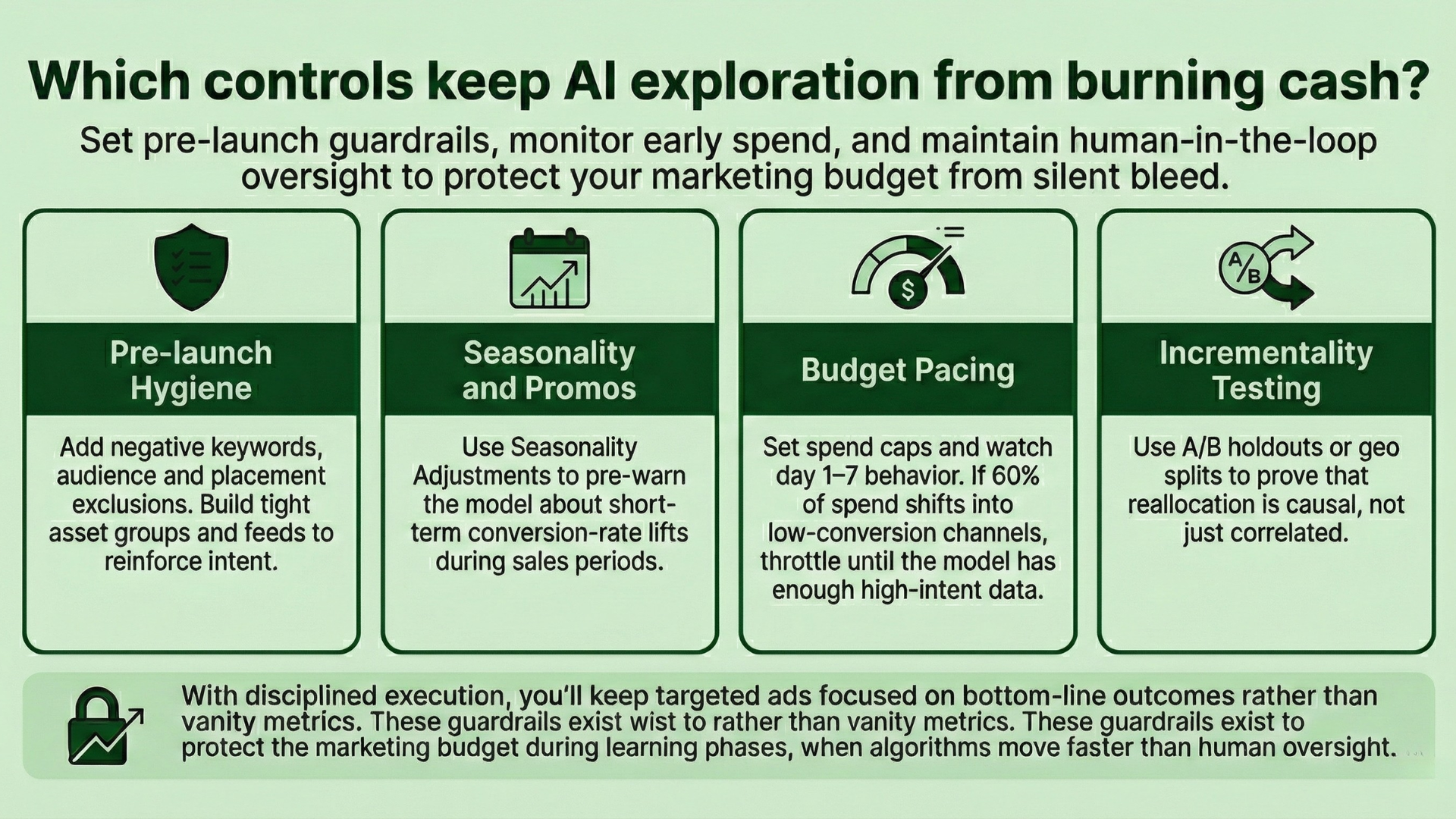
Set pre-launch guardrails, monitor early spend, and maintain human-in-the-loop oversight. That keeps early exploration focused and protects your marketing budget from silent bleed.
- Pre-launch hygiene: add negative keywords, audience and placement exclusions, and build tight asset groups and feeds to reinforce intent.
- Seasonality and promos: use Seasonality Adjustments to pre-warn the model about short-term conversion-rate lifts during sales periods (Yieldbird).
- Budget pacing: set spend caps and watch day 1-7 behavior. If 60% of spend shifts into low-conversion channels during learning, throttle until the model has enough high-intent data (Negator.io).
- Incrementality testing: A/B holdouts or geo splits prove that reallocation is causal, not just correlated.
With disciplined execution, you’ll keep targeted ads focused on bottom-line outcomes rather than vanity metrics. These guardrails exist to protect the marketing budget during learning phases, when algorithms move faster than human oversight.
Quick guardrail matrix
How should you audit AI decision-making every week?
Review allocation, efficiency, and outcome alignment, not just platform green checks. A crisp weekly checklist keeps your marketing budget on track, guided by facts, not wishful thinking.
- Spend concentration: Identify campaigns, geos, and audiences receiving the bulk of spend. If one segment siphons money without profit, tighten targeting or exclude it.
- Bid strategy diagnostics: Use Bid Simulator and portfolio reports to understand trade-offs and elasticity (Google).
- Creative and feed audits: Ensure assets and product data aren’t nudging the algorithm toward low-value clicks.
- Conversion integrity: Check match rates for offline conversions, deduplicate events, and ensure your conversion window aligns with your sales cycle.
This kind of weekly discipline turns budget management into a repeatable process instead of a reactive fire drill. This cadence also keeps your AI advertising honest when platform-reported “improvements” don’t appear in your P&L.
What stack gives you an edge for autonomous allocation?
Modern AI advertising stacks rely on continuous feedback loops, allowing spend decisions to evolve in real time rather than in quarterly cycles. The right stack ensures paid ads are guided by revenue signals, not just platform-reported efficiency. Use a stack that connects sales truth to bidding truth. The best results come from integrating wiring platforms, analytics, and offline signals into a single, coherent loop.
1. Core stack:
- Ad platforms with automation: Google Ads (PMax, Seasonality Adjustments), Meta Advantage+. These are the engines moving your paid ads budget.
- Analytics and modeling: GA4 or equivalent, plus a warehouse (BigQuery, Snowflake) to model LTV and incrementality.
- Attribution and call analytics: tools like Invoca to feed real call outcomes back to bidding (Rogers saw 82% CPA reduction: source).
- CRM/CDP: to activate first-party audiences and revenue outcomes.
2. Workflow enablers: pacing monitors, alerting on spend anomalies, and A/B or geo-testing frameworks.
3. Decision support: the best tools for budget optimization analysis surface where marginal dollars earn the best return across search, shopping, video, and social, and quantify uncertainty so you scale prudently.
When your stack is wired this way, targeted ads become increasingly precise, and your budget management scales without losing control. If you’d like a tour of the stacks we deploy for clients, reach out via our
Contact page.
How are consumer trust and disclosure shaping AI’s next wave?
The brands winning with AI advertising are those that combine automation with human judgment, rather than treating algorithms as a set-and-forget solution. As AI advertising expands into new formats and surfaces, transparency becomes a performance lever, not just a compliance checkbox. Transparent labeling and respectful use of data are now table stakes. BCG found that 69% of consumers feel manipulated when brands use undisclosed AI-powered ads. Meanwhile, more than half of brands have already reserved a budget to test conversational placements in assistants, and many plan to ramp up rapidly, according to BCG.
That means your playbook should include clear disclosure when creative or targeting is AI-assisted, thoughtful frequency control, and consent-first use of first-party data. Trust builds the runway for your marketing budget to work harder as paid ads expand into new surfaces.
Case study recap: Why closing the loop fixed the algorithm
Here’s the story in one paragraph: a telecom optimized for calls, not sales. Smart Bidding chased cheap calls, many of which were information-only or misdials. After implementing AI-enabled call analytics and sending actual sale outcomes back to Google, the algorithm flipped its allocations toward profit, and CPA fell by 82% (source).
- Identify every conversion path (forms, calls, chats, store visits).
- Qualify each path with outcome labels and revenue values.
- Import those values back into the platform.
- Shift to value-based bidding with guardrails.
- Audit weekly and re-qualify often.
This approach moves your marketing budget from “efficient clicks” to efficient cash flow, and it makes targeted ads measurably smarter.
Example: conversion value tiers
FAQs
Q1) What is autonomous budget optimization in practice?
It’s continuous reallocation driven by predictive models that look across channels and placements to maximize your chosen outcome. In mature setups, it connects first-party data and offline revenue, so the system prioritizes targeted ads that generate profit. Many teams consolidate paid ads into automated campaign types, and the most successful programs treat AI advertising as accountable to revenue, not just platform metrics.
Q2) How do I align autonomous allocation with CFO-level ROI?
Use value-based bidding, tie conversions to real revenue (and LTV), and run holdout tests to prove incrementality. Close the loop by importing offline outcomes from your CRM and call analytics, then calibrate targets to your margins. Executive teams increasingly expect clear, auditable links between investment and outcomes, and your budget management should reflect that rigor. For more on the enterprise mindset shift, see this summary of finance leaders’ expectations here.
Q3) What are the top AI solutions for maximizing ad ROI without losing control over budget decisions?
The most effective systems combine performance-based automation with human-defined constraints. AI can optimize for efficiency signals such as CPA and conversion probability, but marketers still need to define success metrics tied to real business outcomes. The strongest setups use AI to reallocate spend dynamically while humans oversee budget caps, audience exclusions, and creative intent, ensuring ROI gains don’t come at the cost of strategy or brand integrity.
Q4) What are the best AI-driven tools for ad spend allocation if I’m starting from scratch?
Prioritize tools that support value-based bidding natively, make offline conversion imports simple, integrate with your CRM/CDP and call analytics, and provide transparent reporting with simulator tools and real-time alerting. If you operate in e-commerce, Google’s Performance Max with high-quality product feeds can be a strong starting point. See this case study with 76.3% revenue lift here. Pair your platform stack with the best tools for budget optimization analysis to measure true lift, and redeploy with confidence.
Q5) How do I balance exploration and control when testing new channels?
Use geo or audience holdouts, cap spend in the early phases, and clearly label any AI-generated creative. BCG found that 69% of consumers feel manipulated when AI isn’t disclosed, so transparent AI advertising is both ethical and pragmatic (source). Build a weekly review cadence to decide whether to expand, pause, or refine based on real financial impact.
Ready to reallocate with confidence?
Here’s the short list we recommend for your next planning cycle:
- Define success in revenue, not clicks, and wire in offline outcomes.
- Lean on first-party data to help the system “see” your best customers.
- Put rails on exploration: exclusions, pacing, and early-stage audits.
- Prove lift with holdouts and simulators; scale only what’s validated.
If you want a partner who treats performance like your CFO does, and who brings a smile, straight talk, and deep expertise, let’s talk. Explore our approach to Services, see proof via our
Case Studies, or start the conversation on our
Contact
page. We’ll help you turn complexity into clarity and momentum.
Works Cited
- Boston Consulting Group. “How AI Is Reshaping Modern Advertising.” BCG X: The Multiplier, 2024, https://www.bcg.com/x/the-multiplier/how-ai-is-reshaping-modern-advertising.
- Fluency. “Automated Budget Management for PPC: Key Strategies for Scale.” Fluency Blog, 2024, https://www.fluency.inc/blog/automated-budget-management-for-ppc-key-strategies-for-scale.
- Gartner. “Gartner CMO Survey Reveals Marketing Budgets Have Dropped to 7.7% of Overall Company Revenue in 2024.” Gartner Newsroom, 13 May 2024, https://www.gartner.com/en/newsroom/press-releases/2024-05-13-gartner-cmo-survey-reveals-marketing-budgets-have-dropped-to-seven-point-seven-percent-of-overall-company-revenue-in-2024.
- Gartner. “63% of Marketing Leaders Plan to Invest in Generative AI in the Next 24 Months.” Gartner Newsroom, 23 Aug. 2023, https://www.gartner.com/en/newsroom/press-releases/2023-08-23-gartner-survey-finds-63-percent-of-marketing-leaders-plan-to-invest-in-generative-ai-in-the-next-24-months.
- Google. “Bid Simulator.” Google Ads Help, 2024, https://support.google.com/google-ads/answer/6268633.
- Inflow. “Performance Max Case Study: 76.3% Increase in Revenue.” Inflow Blog, 2023, https://www.goinflow.com/blog/performance-max-case-study/.
- Invoca. “How to Optimize Budget Efficiency with AI (and Close the Loop on Revenue).” Invoca Blog, 2024, https://www.invoca.com/blog/optimize-budget-efficiency-ai.
- Negator. “Why a Performance Max Campaign Burned $10K in 48 Hours (Pre-Launch Negative Keyword Checklist).” Negator Blog, 2024, https://www.negator.io/post/why-performance-max-campaign-burned-10k-48-hours-pre-launch-negative-keyword-checklist.
- Octoboard. “PPC Data Trends: ROAS and Automation.” Octoboard Blog, 2024, https://www.octoboard.com/blog/ppc-analytics/ppc-data-trends-roas-and-automation/.
- Yieldbird. “How Did Google Ads Change Bidding at the End of 2023? Performance Analysis.” Yieldbird Research Hub, 2024, https://yieldbird.com/research-hub/how-did-adwords-change-bidding-at-the-end-of-2023-performance-analysis/.