
People are no longer scrolling through ten links to compare answers because AI does it for them. As discovery moves into generative interfaces, brands compete to become the sources those systems rely on. The new challenge isn’t ranking higher; it’s becoming credible enough to be referenced when decisions are made.
TL;DR
- Discovery has collapsed from 10 blue links to 1 or 2 synthesized answers, forcing brands to compete for inclusion rather than for ranking position in AI answer generator systems.
- Google's AI Overviews now show ads integrated directly into generative responses. At the same time, Microsoft Copilot reports a 69% higher CTR and a 76% higher conversion rate than traditional search ads, making it a leader among conversational AI platforms.
- OpenAI began testing sponsored units at the bottom of ChatGPT answers in January 2026, with explicit trust controls and content restrictions on sensitive topics, to ensure credible sources are prioritized in AI advertising.
- Amazon's Rufus assistant logged 250 million users in a single year, with monthly users up 140% year-over-year, and users who engage with Rufus are 60% more likely to complete a purchase, demonstrating the power of AI marketing in transactional environments.
- Traditional search usage remains steady at 95% among U.S. adults, meaning the opportunity for AI answer generators is additive and redistributive, not a signal that search is dead.
What Is the AI Attention War, and Why Does It Matter Right Now?
The AI attention war is the competition for placement inside generative answer interfaces, and it is already reshaping how brands invest in discovery. This is not a trend on the horizon. It is a structural shift that is actively redistributing where audiences find information, which products they consider, and which brands they trust enough to act on.
For over two decades, digital advertising was fundamentally a competition for position on a list of ten links. You ranked, you appeared, someone clicked. That model has not disappeared, but it has been significantly destabilized.
Google's AI Overviews and similar generative interfaces have compressed the discovery process into one or two synthesized answers, each with a handful of citations. Brands that do not appear in that synthesis simply do not exist in that moment of decision. This is the environment in which AI marketing now operates. And for growth teams who want to stay ahead of where budgets and visibility are flowing, understanding the mechanics of this shift is not optional.
The stakes are particularly high for brands relying on conversational AI platforms to drive engagement. As these platforms evolve, the ability to secure placement within AI answer generator systems becomes critical. Brands must now focus on becoming one of the credible sources that these systems reference, rather than merely optimizing for traditional search rankings. This shift requires a fundamental rethinking of content strategy, ad placement, and trust-building mechanisms in AI advertising.
Who Is Winning the AI Attention War Right Now?
Five platforms are currently competing for dominance in generative discovery, and each is winning in a different lane. Google leads on default distribution, Microsoft Copilot leads on conversational ad performance, OpenAI is building out a cautious monetization model, Amazon is capturing the transactional layer, and Perplexity offers the clearest warning about what happens when trust breaks down in AI answer generator systems.
Here is how each player stacks up in the broader landscape of conversational AI platforms and AI advertising.
How Is Google Monetizing Generative AI Answers?
Google is winning on default distribution and commercial intent capture by embedding ad units directly inside AI-generated responses. According to Google's own reporting, query types that trigger AI Overviews in major markets such as the U.S. and India have driven a more than 10% increase in usage. This demonstrates the growing influence of AI answer-generating systems on user behavior.
Search and Shopping ads are now expanding into AI Overviews on desktop in the U.S., and Google is actively testing ad placements in AI Mode, its multi-turn conversational search experience. The ads appear both below and integrated into responses. Google's strategic play is to prevent LLM-based search from becoming a separate channel by folding the LLM experience into the SERP and keeping its ad auction close to the moment of answer synthesis. For brands, this means AI advertising inside Google's ecosystem is no longer experimental. It is a live buying option that requires its own creative and measurement strategy, particularly when targeting credible sources within generative responses.
The integration of ads into AI answer generator systems, such as Google's AI Overviews, highlights the need for brands to adapt their AI marketing strategies. Traditional search ads are no longer sufficient; brands must now optimize for visibility in synthesized answers, ensuring their content is perceived as a credible source that AI systems reference.
What Makes Microsoft Copilot a Serious Ad Platform?
Microsoft Copilot is winning on conversational ad performance with a targeting model that uses the entire session context, not just the most recent query. Microsoft reports that Search ads on Copilot deliver 69% stronger CTR and 76% higher conversion rates compared to traditional search ad placements. This makes Copilot a standout among conversational AI platforms for brands looking to maximize engagement through AI advertising.
The Copilot ad experience places units below the organic response and triggers them based on what Microsoft calls "ad voice," a session-level awareness of the conversation's direction and intent. This is a meaningful departure from keyword-match logic. Instead of a single query triggering a bid, the entire arc of the conversation shapes which advertisers are relevant. For growth teams evaluating conversational AI platforms as paid channels, Copilot's enterprise adjacency and session-level context targeting represent a meaningful shift in how intent is measured and monetized in AI marketing.
Brands leveraging Copilot for AI advertising must focus on creating ad content that aligns with the conversational flow of the user's session. This requires a deep understanding of how AI answer generator systems interpret and respond to user queries, ensuring that ads are not only relevant but also positioned as credible sources within the conversation.
How Is OpenAI Approaching Advertising on ChatGPT?
OpenAI published its advertising approach in January 2026, confirming it is testing sponsored units at the bottom of answers when contextually relevant. The design is deliberate: sponsored content is clearly labeled, separated from the organic answer, and comes with user-level controls, including the ability to turn off personalization and clear ad-related data. This approach ensures that AI advertising on ChatGPT remains transparent and user-friendly, aligning with OpenAI's commitment to maintaining trust in AI answer generator systems.
OpenAI has also committed to restrictions that directly address trust. No ads are shown when the system predicts a user is under 18. Ads are not eligible near sensitive or regulated topics, including health, mental health, or politics, during the current testing phase. According to
OpenAI's published framework, these guardrails are central to the design, not peripheral. This focus on trust is critical for brands looking to establish themselves as credible sources within conversational AI platforms.
The strategic logic is clear. If Google's play is to put the LLM inside search, OpenAI's play is to put search inside the LLM, while keeping the AI answer generator experience trustworthy enough that users stay in the ecosystem long enough for a sponsored unit to matter. For brands, this means that AI marketing strategies must prioritize credibility and transparency to succeed in OpenAI's advertising model.
What Is Perplexity's Warning About Trust and AI Advertising?
Perplexity's retreat from advertising is the most important case study in this space that most brands are not reading carefully enough. Perplexity initially tested ads as sponsored follow-up questions, with Perplexity itself generating the answer to the sponsored prompt rather than the brand. It later pulled back from that model amid reported trust concerns. This decision underscores the critical importance of trust in AI answer generator systems.
The lesson is not that advertising in AI contexts cannot work. It is that answer that trust is the limiting reagent. When users sense that commercial interests may shape a system's responses, their willingness to rely on that system for high-stakes decisions drops. This is particularly acute for platforms that have built their audience on the premise of neutral, research-backed answers. For brands designing AI marketing strategies, Perplexity's experience is a useful pressure test. The question is not only whether you can buy placement inside an AI answer generator. It is whether that placement degrades the experience enough to erode the very attention you paid to access.
Brands must ensure that their AI advertising efforts do not compromise their credibility. This requires a careful balance between visibility and trust, particularly on conversational AI platforms where user confidence is paramount.
How Is Amazon Winning the Transactional Layer of AI Discovery?
Amazon's Rufus assistant is where attention becomes checkout, and the numbers are significant. According to AWS reporting from November 2025, more than 250 million customers used Rufus in a single year. Monthly users grew 140% year-over-year. Interactions grew 210% year-over-year. And users who engage with Rufus during a shopping journey are 60% more likely to complete a purchase. This data highlights the transformative impact of AI marketing in transactional environments.
Amazon's advertising play is not always a traditional ad unit. It is owned-surface recommendation primacy. Brands win on Rufus by being the recommended product inside the assistant's conversational flow, which means product data quality, review velocity, and differentiation strength matter as much as, if not more than, traditional ad spend. This approach leverages conversational AI platforms to drive conversions, making Rufus a powerful tool for AI advertising.
For brands, this means that optimizing for visibility within AI answer generator systems like Rufus requires a focus on product data integrity and customer reviews. These factors are critical for establishing credibility and ensuring that products are recommended as credible sources within the assistant's responses.
How Has AI Changed the Discovery Journey for Consumers?
AI has not replaced traditional search behavior. It has added a parallel discovery path that captures different query types and decision moments. This distinction matters because overstating the shift leads to misallocated budgets in AI marketing. According to SparkToro's clickstream analysis of Datos data, 20% of Americans use AI tools ten or more times per month, while traditional search usage has remained steady at 95%. These are not competing channels cannibalizing each other. They are parallel behaviors serving different discovery needs.
Pew Research data from 2024 indicates that roughly one-third of U.S. adults have used an AI answer generator.
NORC's AmeriSpeak AI Adoption Report from May 2025 provides additional segmentation on adoption rates and non-user shares by age group. Both data sources support the same conclusion: AI is additive and redistributive, not a clean displacement event. This means that brands must develop strategies for both traditional search and conversational AI platforms to maximize visibility and engagement.
The practical implication for AI advertising strategy is that you need both a presence in traditional search and a credibility architecture built for AI citation environments. These are distinct disciplines, and most brands are building only one of them. To succeed in the evolving landscape of AI marketing, brands must ensure they are recognized as credible sources in both traditional and AI-driven discovery channels.
What Is Happening to Publishers, and What Does It Signal for Brands?
Publishers are feeling the impact of AI-mediated discovery in real numbers, and the pattern they are experiencing is the same one brands will face if they do not adapt. Similarweb's generative AI publisher report documents a clear sequence: AI summaries reduce the need to click through to source content, which compresses organic referral traffic. At the same time, AI citations become the new gatekeeping mechanism that selectively returns traffic to a small number of high-trust sources.
Organic traffic to news sites fell 26% after Google launched AI Overviews. Meanwhile, ChatGPT referrals to publishers increased 25 times over the same period, with Reuters and the New York Post among the top beneficiaries. ChatGPT news queries grew 212% over the preceding 18 months. This shift highlights the growing importance of AI answer generator systems in driving traffic and engagement.
The pattern is not random. The sources that receive AI referrals are those AI systems identify as credible, based on signals such as topical authority, citation frequency across the web, institutional recognition, and content depth. For brands, this is not a publisher problem to observe from a distance. It is a preview of how AI systems will select and surface brand content, whether in AI advertising or organic inclusion. To succeed in AI marketing, brands must focus on building credibility and authority in their niche, ensuring they are recognized as credible sources by conversational AI platforms.
What Does It Mean to Be Cited as a Credible Source by an AI System?
Becoming a credible source that AI systems reference requires a fundamentally different content architecture from what most brands built for traditional SEO. The goal is not to rank higher on a keyword. It is to be selected as a trustworthy input when a generative system synthesizes an answer. This shift is central to the evolving landscape of AI marketing and AI advertising.
BrightEdge research tracking nine industries from May 2024 to September 2025 found that the overlap between AI Overview citations and organic rankings increased from 32% to 54% over that period. That growing alignment tells you that traditional SEO signals still matter, but they are not sufficient on their own. Brands must now focus on creating content that is not only optimized for search but also designed to be cited as a credible source by AI answer generator systems.
Additional BrightEdge findings reported by Search Engine Land reveal that deep, specialized pages are disproportionately valuable for AI Overview citations. The content that earns an AI citation is often not the homepage or a short product page. It is a specific, reference-grade resource: a comparison page, a detailed implementation guide, a data-backed analysis, and constraints and trade-offs. This insight is critical for brands looking to succeed in AI marketing and AI advertising.
This is where brands working with
growth-oriented digital marketing partners like BusySeed have a structural advantage. Building citation-worthy content requires audience research, topical authority mapping, and content infrastructure that agencies with AI-native frameworks already know how to deploy. For brands, partnering with experts in conversational AI platforms can provide a competitive edge in establishing credibility and visibility within AI answer generator systems.
How Are the Two Lanes of AI Advertising Different?
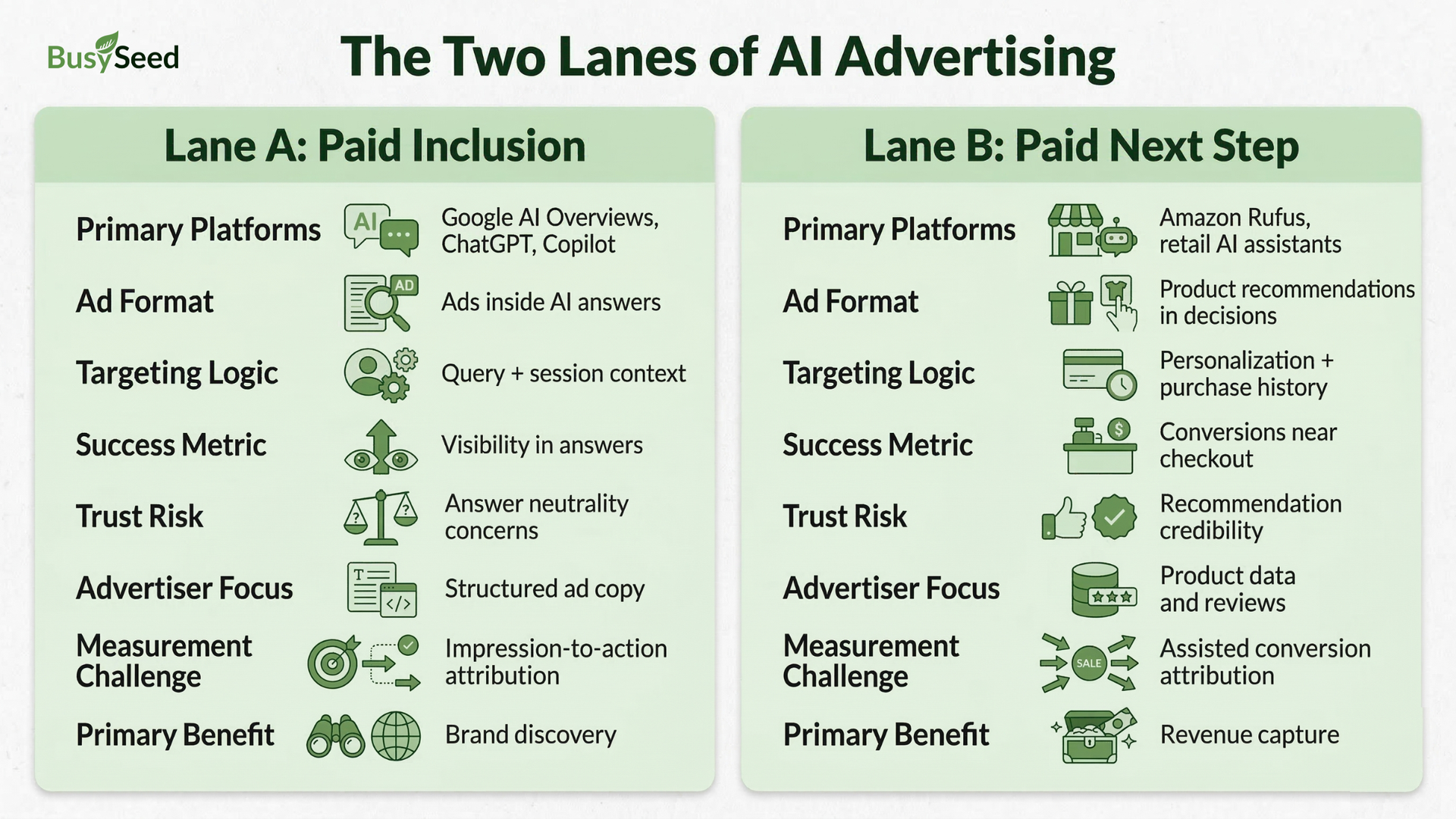
AI advertising has bifurcated into two distinct competitive lanes, and confusing them leads to mismatched strategies. Lane A is paid inclusion inside the generated answer surface. Lane B is the paid next step after the answer, typically routed toward a transaction or action.
Understanding the differences between these lanes is essential for brands looking to succeed in AI marketing.
Lane A is where most AI advertising discussion is currently focused, as it involves familiar ad-buying mechanics adapted to new surfaces. This lane is particularly important for brands looking to establish themselves as credible sources within AI answer generator systems. Lane B, however, is where the most commercially definitive outcomes are happening right now, as evidenced by Rufus' performance data. This lane is critical for brands focused on driving conversions through conversational AI platforms.
For most brands, winning requires competing in both lanes with channel-specific strategies rather than applying a single framework across both. This dual approach ensures that brands can maximize visibility and engagement in AI marketing while also driving conversions and revenue through AI advertising.
What Is the Regulatory Environment Shaping AI Advertising Credibility?
Regulation is accelerating, creating enforceable standards for the credibility signals that AI systems use to select sources. Understanding the regulatory layer is not optional for brands competing on conversational AI platforms. The regulatory environment is shaping the future of AI marketing and AI advertising, particularly in how credible sources are identified and prioritized.
How Is the UK CMA Reshaping Publisher Rights in Generative Search?
The UK Competition and Markets Authority is directly targeting AI Overviews and AI Mode through formal conduct requirements. The CMA's Publisher Conduct Requirement proposal argues that existing controls do not give publishers sufficient choice over how their content is used in generative AI features, and pushes for better attribution, clearer metrics, and transparency in reporting, including impressions, engagement, and CTR data.
The
CMA's Fair Ranking Conduct Requirement explicitly classifies AI Overviews and AI Mode as part of general search services, bringing them under existing fair-dealing obligations and seeking transparency about how ranking and presentation decisions are made. This regulatory push is designed to ensure that AI answer generator systems prioritize credible sources and maintain transparency in their operations.
The
CMA's User Choice Conduct Requirement proposes expanding choice screens across approximately 12 eligible providers, with randomization and advance-notice requirements to allow providers to run marketing campaigns around choice-screen timing. These regulatory changes are shaping the future of AI advertising and AI marketing, particularly in how brands interact with conversational AI platforms.
What Is the FTC Doing About AI-Related Deception?
In the U.S., the FTC has publicly highlighted AI-related consumer harm patterns and launched enforcement actions under Operation AI Comply, which targets deceptive claims about AI products and capabilities. For brands embedding AI into their marketing claims or using AI advertising systems, the FTC's posture signals that transparency and accuracy standards will be enforced, not just recommended. This regulatory focus is critical for brands looking to establish themselves as credible sources in AI answer generator systems.
What Does NIST's AI Risk Framework Mean for Marketers?
The NIST Generative AI Risk Profile (NIST AI 600-1) provides a cross-sector risk framework for generative AI systems tied to U.S. policy direction. For marketers, it functions as a trust checklist: provenance, attribution, transparency, and the ability to withstand scrutiny. These are not abstract governance concerns. They are increasingly the same signals that AI systems use to evaluate whether a source is credible in AI marketing and advertising.
The next competitive edge in AI marketing is not prompt optimization. It is defensible credibility built to regulatory-grade standards. Brands that align their strategies with these regulatory frameworks will be better positioned to succeed in the evolving landscape of conversational AI platforms and AI answer generator systems.
What Is the Budget Context for AI Advertising in 2026?
AI answer generator interfaces are not emerging in a flat or contracting market. They are expanding within the largest digital advertising ecosystem in history, and understanding its scale helps frame where AI-driven shifts will have the greatest impact on AI marketing and advertising.
IAB data shows U.S. internet ad revenue reached $258.6 billion in 2024, a 14.9% year-over-year increase. Retail media networks, which are the closest structural analog to AI shopping assistants in terms of revenue model, grew 23% to $53.7 billion. The creator economy generated $29.5 billion in ad spend in 2024, with IAB projecting $37 billion in 2025, a 26% increase. These growth pools align directly with the AI-assisted shopping and recommendation behaviors that platforms like Rufus and Copilot are monetizing through conversational AI platforms.
The brands that understand this alignment will be better positioned to argue internally for budget allocation toward AI advertising before it becomes a consensus. This budget context is critical for brands looking to invest in AI marketing strategies that drive visibility and engagement within AI answer generator systems.
How Do You Build a Winning Strategy for AI Visibility and Citation in 2026?
This is the operational question that matters most for growth teams. The research points clearly toward a three-part framework: build for citation, buy for adjacency, and optimize for selection. This framework is essential for brands looking to succeed in AI marketing and AI advertising within conversational AI platforms.
What Does an AI-Ready Content and Advertising Checklist Look Like?
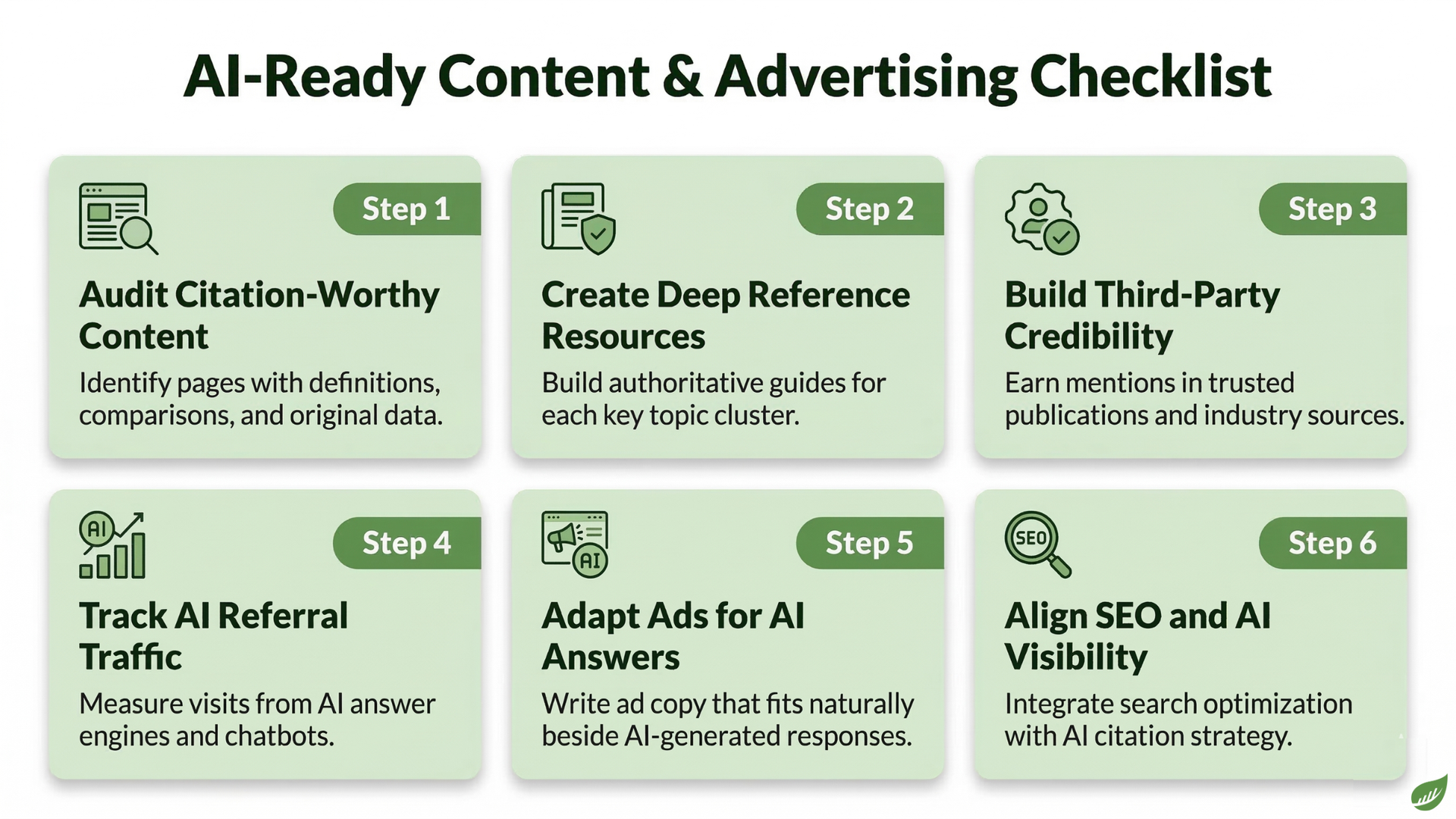
To succeed in the AI attention war, brands must follow a structured approach to content and advertising. Below is a checklist to guide your strategy:
1. Audit your existing content for citation-worthiness, not just ranking position. Identify pages that include definitions, comparisons, decision criteria, implementation details, and original data. These are the page types that BrightEdge's research identifies as disproportionately valuable for AI Overview citations in AI answer generator systems.
2. Build at least one deep, reference-grade resource per core topic cluster. This means going beyond 500-word overviews to content that serves as a primary reference document: constraints, trade-offs, examples, and evidence. This type of content is critical for establishing your brand as a credible source in AI marketing.
3. Pursue third-party credibility placements in high-trust publications, industry associations, and institutional contexts. LLM training data and RAG systems weigh sources that appear frequently across credible contexts. Being mentioned in those sources increases the likelihood of being cited as a credible source in generative answers on conversational AI platforms.
4. Instrument AI referral traffic as its own channel. Similarweb now provides AI Chatbot Referral Traffic reporting as a product category. Use this to establish a baseline and track whether your citation-building efforts are generating measurable referral volume from AI answer generator systems.
5. Adapt ad creative for answer adjacency, not clickbait. Ad units within conversational AI platforms, including OpenAI's bottom-of-answer placements and Microsoft Copilot's session-triggered units, should read as the logical next step in the user's plan rather than an interruption. This requires a different copywriting discipline than traditional display or search ads in AI advertising.
6. Design measurement frameworks for generative ad environments before you need them. Google's generative placements are evolving faster than the clarity of reporting. Build incrementality tests and blended KPIs, including brand search lift, assisted conversions, and lead quality, rather than relying exclusively on last-click attribution in AI marketing.
7. Optimize product data quality for retail AI assistants. If you sell physical products, your structured data, review volume, and differentiation clarity are what Rufus and similar assistants use to filter and recommend. This is an AI advertising channel where organic product data and paid placement interact, making it critical for brands to focus on data integrity.
8. Develop a trust governance process for your AI marketing claims. Given the FTC's Operation AI Comply posture and NIST's GenAI risk profile, any AI-related claims in your marketing materials should be reviewed against documented evidence. This protects you legally and strengthens your credibility signal with AI answer generator systems that are increasingly weighing provenance and accuracy.
9. Monitor regulatory developments on conversational AI platforms in your key markets. The CMA's conduct requirements could reshape how publishers and brands interact with Google's generative search products. Early awareness of these changes gives you time to adapt content and ad strategies before compliance deadlines create scrambles in AI advertising.
10. Align SEO and AI visibility as a unified discipline inside your growth team. The overlap between AI Overview citations and organic rankings has grown from 32% to 54% over 16 months. These are not separate channels. They are increasingly co-dependent, and teams that manage them in silos will underperform teams that integrate them into a cohesive AI marketing strategy.
FAQ
Q1) What are the best strategies for getting discovered through LLMs in AI marketing?
The best strategies for getting discovered through LLMs in AI marketing involve a combination of content optimization, credibility building, and strategic ad placement. First, brands must focus on creating deep, reference-grade content that serves as a primary resource for specific topics.
This type of content is more likely to be cited by AI answer generator systems as a credible source. Second, brands should pursue third-party credibility placements in high-trust publications and industry associations, as these mentions increase the likelihood of being referenced by LLMs. Third, brands must adapt their ad creative for answer adjacency, ensuring that ads on conversational AI platforms align with the user's conversational flow.
Finally, brands should monitor AI referral traffic as a distinct channel, using tools like Similarweb's AI Chatbot Referral Traffic reporting to track performance and optimize their AI advertising strategies.
Q2) What are the best tools to establish authority in AI data sources?
The best tools for establishing authority in AI data sources include content management systems that support structured data, analytics platforms that track AI referral traffic, and partnerships with digital marketing agencies that specialize in AI marketing. Tools like BrightEdge and Similarweb provide insights into how AI answer generator systems cite your content, allowing brands to refine their strategies to become credible sources.
Additionally, platforms like Google's AI Overviews and Microsoft Copilot offer ad placement opportunities that can enhance visibility within conversational AI platforms. Brands should also consider working with agencies like BusySeed, which have expertise in building citation-worthy content and optimizing for AI advertising.
Q3) What are the best resources for building credibility in your niche for AI advertising?
The best resources for building credibility in your niche for AI advertising include high-trust publications, industry associations, and institutional contexts that are frequently cited by AI answer generator systems. Brands should focus on securing mentions in these sources, as they are more likely to be recognized as credible sources by LLMs. Additionally, brands should invest in creating deep, reference-grade content that serves as a primary resource for specific topics, as this type of content is disproportionately valuable for AI Overview citations.
Tools like BrightEdge and Similarweb can help brands track their performance and refine their strategies for establishing credibility in AI marketing. Finally, brands should stay informed about regulatory developments, such as the CMA's conduct requirements and the FTC's Operation AI Comply, to ensure their AI advertising strategies align with evolving standards.
Q4) How can brands optimize their content to be cited by AI systems?
Brands can optimize their content for AI systems by focusing on several key strategies. First, they should create deep, reference-grade content that serves as a primary resource for specific topics, including definitions, comparisons, decision criteria, and original data. This type of content is more likely to be cited by AI answer generator systems as a credible source.
Second, brands should pursue third-party credibility placements in high-trust publications and industry associations, as these mentions increase the likelihood of being referenced by LLMs. Third, brands should ensure their content is structured with clear headings, bullet points, and tables, making it easier for AI systems to extract and synthesize information. Finally, brands should monitor AI referral traffic as a distinct channel, using tools like Similarweb to track performance and optimize their AI marketing strategies.
Q5) What are the key differences between traditional SEO and AI-driven discovery?
The key differences between traditional SEO and AI-driven discovery lie in the goals, strategies, and metrics of success. Traditional SEO focuses on ranking higher in search results, with success measured by click-through rates and organic traffic. In contrast, AI-driven discovery aims to be cited as a credible source in synthesized answers generated by AI answer generator systems. This requires a different content architecture, with a focus on deep, reference-grade resources that serve as primary references for specific topics.
Additionally, AI-driven discovery involves optimizing for visibility within conversational AI platforms, which often require ad creatives that align with the user's conversational flow. Finally, AI-driven discovery metrics include AI referral traffic and citation frequency, rather than traditional SEO metrics like keyword rankings and organic traffic. Brands must adapt their AI marketing and AI advertising strategies to account for these differences.
Works Cited
- BrightEdge. "Rank Overlap After 16 Months of AIO." BrightEdge Resources, https://www.brightedge.com/resources/weekly-ai-search-insights/rank-overlap-after-16-months-of-aio. Accessed 2026.
- BrightEdge. "Google AI Overviews Citations Deep Pages." Search Engine Land, https://searchengineland.com/google-ai-overviews-citations-deep-pages-453414. Accessed 2026.
- Competition and Markets Authority. "Fair Ranking Conduct Requirement." GOV.UK, https://assets.publishing.service.gov.uk/media/6979cebd5da1fd4ddea98c6f/Fair_ranking_conduct_requirement.pdf. Accessed 2026.
- Competition and Markets Authority. "Publisher Conduct Requirement." GOV.UK, https://assets.publishing.service.gov.uk/media/6979ceae75d443709655209c/Publisher_conduct_requirement.pdf. Accessed 2026.
- Competition and Markets Authority. "User Choice Conduct Requirement." GOV.UK, https://assets.publishing.service.gov.uk/media/6979cec91c24881f40a4d6de/_User_choice_conduct_requirement_v2.pdf. Accessed 2026.
- Federal Trade Commission. "AI Risk and Consumer Harm." FTC, https://www.ftc.gov/policy/advocacy-research/tech-at-ftc/2025/01/ai-risk-consumer-harm. Accessed 2026.
- Google. "Google Search AI Brand Discovery." Google Blog, https://blog.google/products/ads-commerce/google-search-ai-brand-discovery/. Accessed 2026.
- Interactive Advertising Bureau. "Internet Ad Revenue Report." IAB, https://www.iab.com/research/. Accessed 2026.
- Microsoft. "Transforming Audience Engagement with Generative AI." Microsoft Advertising Blog, https://about.ads.microsoft.com/en/blog/post/october-2024/transforming-audience-engagement-with-generative-ai. Accessed 2026.
- National Institute of Standards and Technology. "Generative AI Risk Profile (NIST AI 600-1)." NIST, https://nvlpubs.nist.gov/nistpubs/ai/NIST.AI.600-1.pdf. Accessed 2026.
- NORC at the University of Chicago. "AmeriSpeak AI Adoption Report." NORC, https://www.norc.org/content/dam/amerispeak/research/pdf/amerispeak-ai-adoption-report-may-2025.pdf. Accessed 2026.
- OpenAI. "Our Approach to Advertising and Expanding Access." OpenAI, https://openai.com/index/our-approach-to-advertising-and-expanding-access/. Accessed 2026.
- Pew Research Center. "Metered Data AI Report." Pew Research Center, https://www.pewresearch.org/wp-content/uploads/sites/20/2025/05/pl_2025.05.23_metered-data-ai_report.pdf. Accessed 2026.
- Similarweb. "Generative AI Publishers Report." Similarweb, https://www.similarweb.com/corp/reports/generative-ai-publishers/. Accessed 2026.
- Similarweb. "AI Chatbot Referral Traffic." Similarweb Support, https://support.similarweb.com/hc/en-us/articles/26004678126493-AI-Chatbot-Referral-Traffic. Accessed 2026.
- SparkToro. "New Research: 20% of Americans Use AI Tools 10x/Month." SparkToro Blog, https://sparktoro.com/blog/new-research-20-of-americans-use-ai-tools-10x-month-but-growth-is-slowing-and-traditional-search-hasnt-dipped/. Accessed 2026.
- Wired. "Perplexity Ads Shift Search Google." Wired, https://www.wired.com/story/perplexity-ads-shift-search-google/. Accessed 2026.