
Going viral isn’t a strategy anymore; it’s a side effect. TikTok now predicts what audiences want before they know it, pushing content based on behavior instead of follower counts. This deep dive breaks down how creators and brands turn fast attention into real momentum without burning out chasing trends.
TL;DR
- The TikTok algorithm now ranks content on behavior signals, not follower counts, meaning a brand-new account can reach 153 million U.S. adults aged 18+ if the right signals fire.
- 49% of U.S. consumers now use TikTok as a search engine, according to Adobe Express, making search-led content a non-negotiable part of all serious content marketing strategies.
- TikTok Shop hit $15.82 billion in U.S. sales in 2025, representing 18.2% of all U.S. social commerce, and is projected to reach 24.1% by 2027.
- Smart+ automation absorbed 42% of TikTok performance ad spend by Q3 2025, shifting the competitive advantage from bid management to creative production systems.
- 83% of weekly U.S. TikTok users who recall ads have taken action after seeing a product or service on the platform, making the For You page one of the highest-converting real estate spaces in digital marketing today.
Why Should Creators and Brands Treat TikTok as a Core Channel in 2026?
The TikTok algorithm is no longer an experimental bet for brands willing to take risks. With 37% of U.S. adults using TikTok in 2025, up from 21% in 2021, according to Pew Research, the platform has crossed the threshold from trend to infrastructure.
The numbers are not speculative. DataReportal's analysis of TikTok's ad planning tools confirms that 153 million U.S. users aged 18+ are reachable via TikTok ads, representing approximately 55.7% of U.S. adults, according to
DataReportal's 2026 United States report. That kind of reach used to require a combination of television and print to replicate.
What Has Changed in How TikTok Reaches People?
TikTok's distribution model is structurally different from every platform that came before it. Most social media platforms distribute content primarily through follower graphs, meaning your reach is bounded by who chose to follow you. TikTok distributes content through behavioral matching, meaning your content reaches people who are demonstrably interested in what you are saying, regardless of whether they have ever encountered your account before.
This distinction matters enormously for brands entering the platform today. A mid-sized brand with zero TikTok followers and a well-structured video can reach more qualified potential customers in 48 hours than a brand with 50,000 followers on a follower-graph platform can reach in a month. The architecture of the TikTok algorithm rewards relevance and satisfaction, not seniority.
For most category leaders in 2026, TikTok deserves a line item in the core channel budget, not the experimental channel budget. The scale is there, behavioral targeting is maturing, and the commerce infrastructure is now generating nine-figure revenue. The brands that treat it as a test are falling behind the brands that treat it as a system. Understanding the TikTok algorithm is essential for leveraging these opportunities effectively.
How Does the TikTok Algorithm Actually Work in 2026?
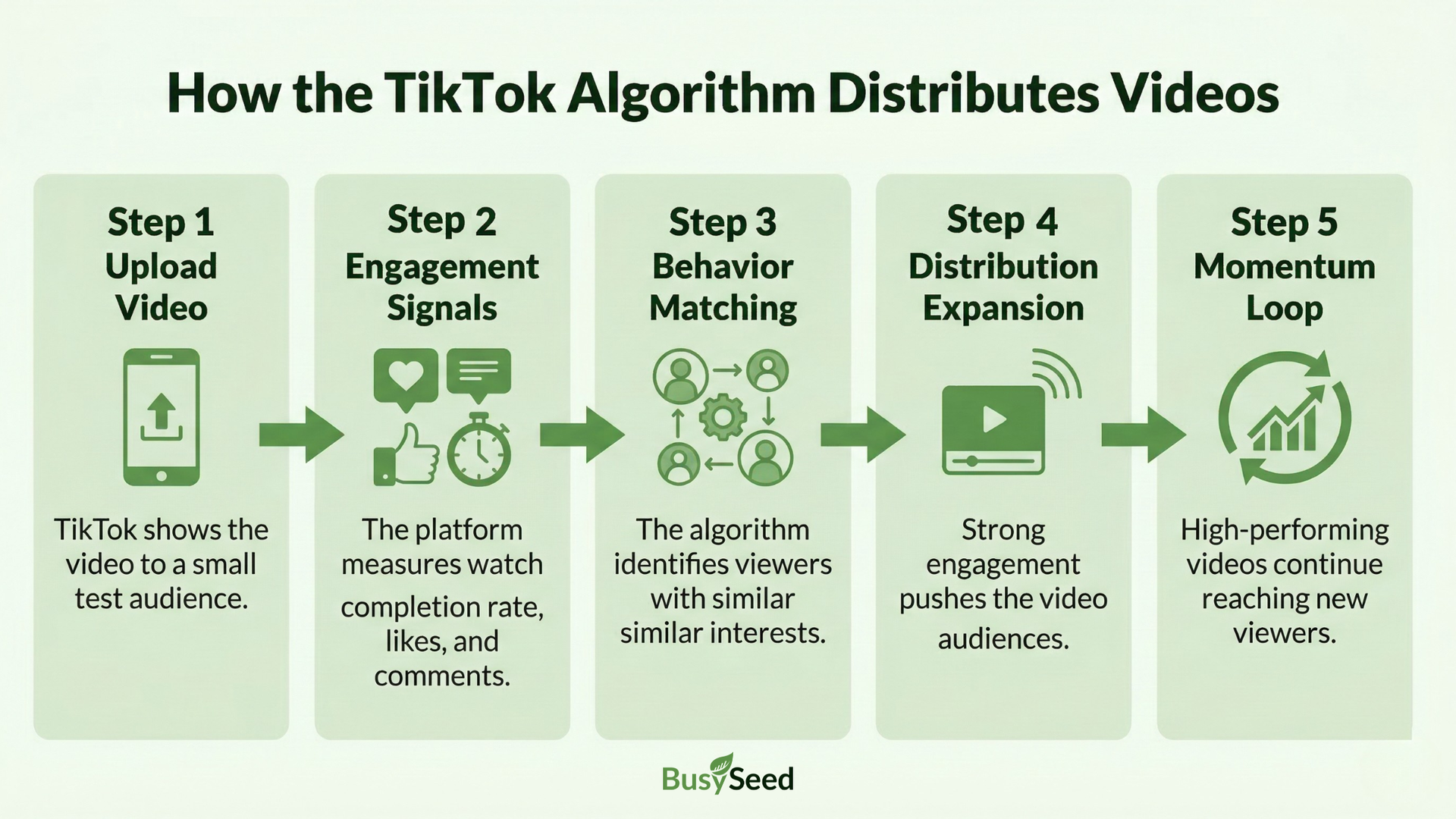
The TikTok algorithm operates on three primary signal categories: user interactions, video information such as captions, sounds, and hashtags, and device and account settings. According to TikTok's own newsroom explanation, completion rate on longer videos is explicitly called out as a strong indicator of content quality and is weighted heavily in distribution decisions.
What the TikTok algorithm does not factor into its ranking as a direct ranking signal is follower count. TikTok states this plainly. Follower count can help by giving a video an initial distribution pool to draw early engagement signals from, but it is not the reason a video gets pushed or suppressed. Behavior is the reason.
Why Does Behavior-First Distribution Change Content Design?
When distribution depends on behavior, content design has to work backward from the behaviors you want to generate. The TikTok algorithm rewards what researchers call "earned reruns," meaning rewatches, saves, and shares, because these signals indicate that a viewer found the content valuable enough to engage with it beyond a passive scroll.
Research audits of TikTok-style recommendation dynamics, published in a
study on reinforcement effects in personalized feeds, found that highly personalized feeds can produce compounding distribution effects for creators who lock in strong interest signals and maintain high satisfaction scores over time. This means that creators and brands who build consistent, high-signal content categories can generate increasing algorithmic momentum rather than starting from zero with each video.
The practical design implication is straightforward. Build videos in three layers: the first one to two seconds should frame the problem the viewer already has, the middle section should deliver proof and actionable steps, and the end should give a clear next action, such as a comment keyword, a download link, or a product purchase. This structure is foundational for scalable social media content creation because it aligns creative design directly with the behaviors the algorithm measures. It maximizes the behaviors the TikTok algorithm uses to decide whether to keep distributing your content. Implementing these content marketing strategies ensures your content aligns with TikTok's algorithmic preferences.
How Should Brands Think About Creator Partnerships Within This System?
Creator partnerships are not just a brand awareness play in 2026. They are a production capacity solution. Pew Research found that among U.S. adult TikTok users, the top 25% of posters produced 98% of publicly visible videos, and half of adult TikTok users have never posted a single video.
This concentration of supply means that people who can reliably create quality content are disproportionately valuable. IAB data shows that U.S. creator ad spend reached $29.5 billion in 2024 and is projected to hit $37 billion in 2025, representing 26% year-over-year growth. Brands that build structured creator pipelines, running from brief to production to safelisting to iteration, are treating social media content creation the way performance marketing teams treat paid search: as a systematic, optimizable channel rather than an artistic endeavor.
The brands winning on TikTok in 2026 are not the ones with the most creative talent on staff. They have the best systems for consistently delivering quality social media content into the feed and measuring its performance. These systems turn social media content creation into a repeatable operational capability rather than a one-off creative effort. Leveraging TikTok analytics is crucial for refining these systems and ensuring content aligns with the TikTok algorithm's distribution criteria.
Is TikTok Search Now a Rival to Google for Product Discovery?
TikTok search is no longer a secondary feature. According to TikTok's 2025 TikTok World announcements, the platform now processes billions of searches per day with over 40% year-over-year growth in search volume, and one in four users begins searching within 30 seconds of opening the app.
The cross-validation from outside TikTok is equally compelling.
Adobe Express surveyed U.S. consumers in early 2026 and found that 49% now use TikTok as a search engine, up from 41% in 2024. This is not a niche behavior among Gen Z. It is a mainstream consumer behavior that brands cannot afford to ignore in their content marketing strategies.
How Should Brands Build a TikTok Search Strategy?
Search on TikTok requires a different content architecture than trend-reactive posting does. The goal is to map high-intent search queries to specific creative assets and then publish them at a cadence that builds topical authority over time. TikTok's own ad materials confirm that 57% of users utilize TikTok search, and adding Search Ads alongside In-Feed Ads drives approximately 20% more conversions on average, according to TikTok's Search Ads campaign blog.
Eventbrite ran a search-led campaign on TikTok, achieving a 66% increase in click-through rate and a 33% reduction in cost per acquisition, according to the
Eventbrite TikTok Search Ads case study. These are not soft brand metrics. These are direct response numbers that performance marketers recognize. Integrating search-led content into your content marketing strategies can significantly enhance your brand's visibility and conversion rates on the platform.
The tactical execution is simple in principle and demanding in practice. For brands investing seriously in TikTok, this makes social media content creation a search-driven discipline rather than a trend-chasing one. Put the search query in three places in every video: the spoken hook in the first two seconds, the on-screen text overlay, and the caption. Use your comment section as a tool for researching search intent. The questions your audience asks in comments are the briefs for your next five videos. This approach transforms social media content creation from a reactive process into a structured system for demand capture. By leveraging TikTok analytics, brands can refine their search strategies and ensure that their content aligns with user intent and the TikTok algorithm's distribution logic.
What Does TikTok Commerce Look Like in 2026?
TikTok Shop is no longer a pilot program. It generated $15.82 billion in U.S. sales in 2025, following 407% growth in 2024 and 108% growth in 2025, capturing 18.2% of all U.S. social commerce, according to eMarketer's analysis of TikTok Shop. By 2027, eMarketer projects that TikTok Shop will account for 24.1% of U.S. social commerce.
The commerce automation tool driving much of this growth is GMV Max. TikTok's internal testing shows that GMV Max advertisers saw approximately 30% uplift in gross merchandise value compared to standard shopping ad strategies, according to
TikTok's GMV Max overview.
How Do Real Brands Produce Results With TikTok Shop?
The Arrae case study is one of the cleaner numbers-forward examples available. Arrae, a natural supplements brand, deployed TikTok Shop with GMV Max and recorded 75% more purchases, 25% higher ROI, and 17% better cost-per-acquisition efficiency compared to their prior standard shopping ads approach, according to the Arrae GMV Max case study.
The strategic implication of these results is that TikTok commerce is now a full-funnel tool, not just a discovery mechanism. The For You page introduces the product. The search layer captures intent. TikTok Shop closes the transaction. Brands that build content marketing strategies connecting all three layers are compressing the customer journey into a single platform session. That kind of conversion efficiency is difficult to replicate anywhere else in the current digital landscape. By leveraging TikTok analytics, brands can optimize their commerce strategies and ensure that their content aligns with the TikTok algorithm's distribution logic.
This is precisely the kind of revenue-first TikTok architecture that the team at
BusySeed helps brands build, combining search-led content, series-driven demand creation, and commerce integration into one coherent system. Understanding the TikTok algorithm is essential for maximizing the effectiveness of these strategies.
How Are Paid Advertising and Automation Reshaping TikTok Strategy?
Automation is no longer the future of TikTok advertising. It is the present. Tinuiti's benchmark report, drawing on over $4 billion in managed ad spend, found that Smart+ went from representing 9% of TikTok performance ad spend in Q1 2025 to 42% by Q3 2025, according to Tinuiti's Q3 2025 Digital Ads Benchmark Report.
TikTok's 2025 advertising updates formalize a unified automation stack that combines Smart+, Symphony AI creative tools, GMV Max, and expanded attribution options, as outlined in
TikTok's automation updates announcement. This stack is designed to reduce the manual optimization burden on media buyers and shift decision-making weight toward the TikTok algorithm.
Where Does the Real Competitive Advantage Live Now?
The advantage in TikTok advertising has shifted away from bid management and toward creative throughput and testing discipline. In practical terms, this means scaling social media content creation so the algorithm always has new creative variations to test. When the TikTok algorithm handles media buying decisions, the brand or agency that wins is the one supplying the algorithm with more varied, higher-quality creative to optimize against.
This is a structural change in how performance marketing teams should be organized. The TikTok analytics layer still matters for understanding what is working, but TikTok analytics now serves a different function than it did three years ago. Instead of informing bid adjustments, TikTok analytics should be informing creative briefs, identifying which hooks are driving completion, which formats are generating saves, and which calls to action are producing conversions.
TikTok's TransUnion meta-analysis found that 52% of purchasers who bought after seeing TikTok ads were only exposed to TikTok, not to any other measured channel, indicating genuine incremental reach rather than duplicated coverage with existing campaigns, according to
TikTok's TransUnion incrementality analysis. For brands running multi-channel attribution models, this is significant evidence that TikTok is reaching audiences that other channels are not. Leveraging TikTok analytics is crucial for understanding these dynamics and optimizing your content marketing strategies accordingly.
What Does a Complete TikTok Analytics Framework Look Like for Brands?
TikTok analytics is not just a reporting function. It is the feedback loop that makes social media content creation iterative and compounding rather than speculative and disposable.
The metrics that matter most align directly with what the TikTok algorithm uses to make distribution decisions: completion rate, rewatch rate, saves, shares, and comment volume.
The brands that use TikTok analytics most effectively treat it as a creative brief generator. In this model, social media content creation becomes an iterative loop driven by performance data.
- Every video that underperforms on completion rate signals that the hook is not working.
- Every video that overperforms on saves is a signal that the content format is worth repeating.
- Every question in the comments is a brief for the next video in the series.
By leveraging TikTok analytics, brands can refine their content marketing strategies and ensure their content aligns with the TikTok algorithm's distribution criteria.
How Should Brands Move Beyond Last-Click Attribution on TikTok?
Last-click attribution systematically undercounts TikTok's contribution to revenue. This is not a TikTok claim. It is a measurement methodology problem. Nielsen's marketing mix modeling case study found 9.4% incremental sales uplift when TikTok ads ran alongside television ads for four or more weeks, according to Nielsen's TikTok case study. These incremental sales would not appear in a last-click model because TikTok is rarely the last touchpoint before a transaction.
The correct approach is to build incrementality testing into the program from the start, using lift tests, marketing mix models, or holdout group analysis to measure TikTok's actual revenue contribution. TikTok analytics provides the in-platform signals, but a mature measurement framework connects those signals to business outcomes across channels.
For brands building this kind of measurement infrastructure, TikTok analytics becomes a strategic asset rather than a vanity dashboard. The teams using TikTok analytics to understand completion rates by hook type, share rates by content format, and conversion rates by call-to-action structure are building content marketing strategies that compound over time rather than reset with every post. Understanding the TikTok algorithm is essential for interpreting these analytics and optimizing your strategies effectively.
TikTok vs. Competing Platforms: How Does It Stack Up for Brands in 2026?
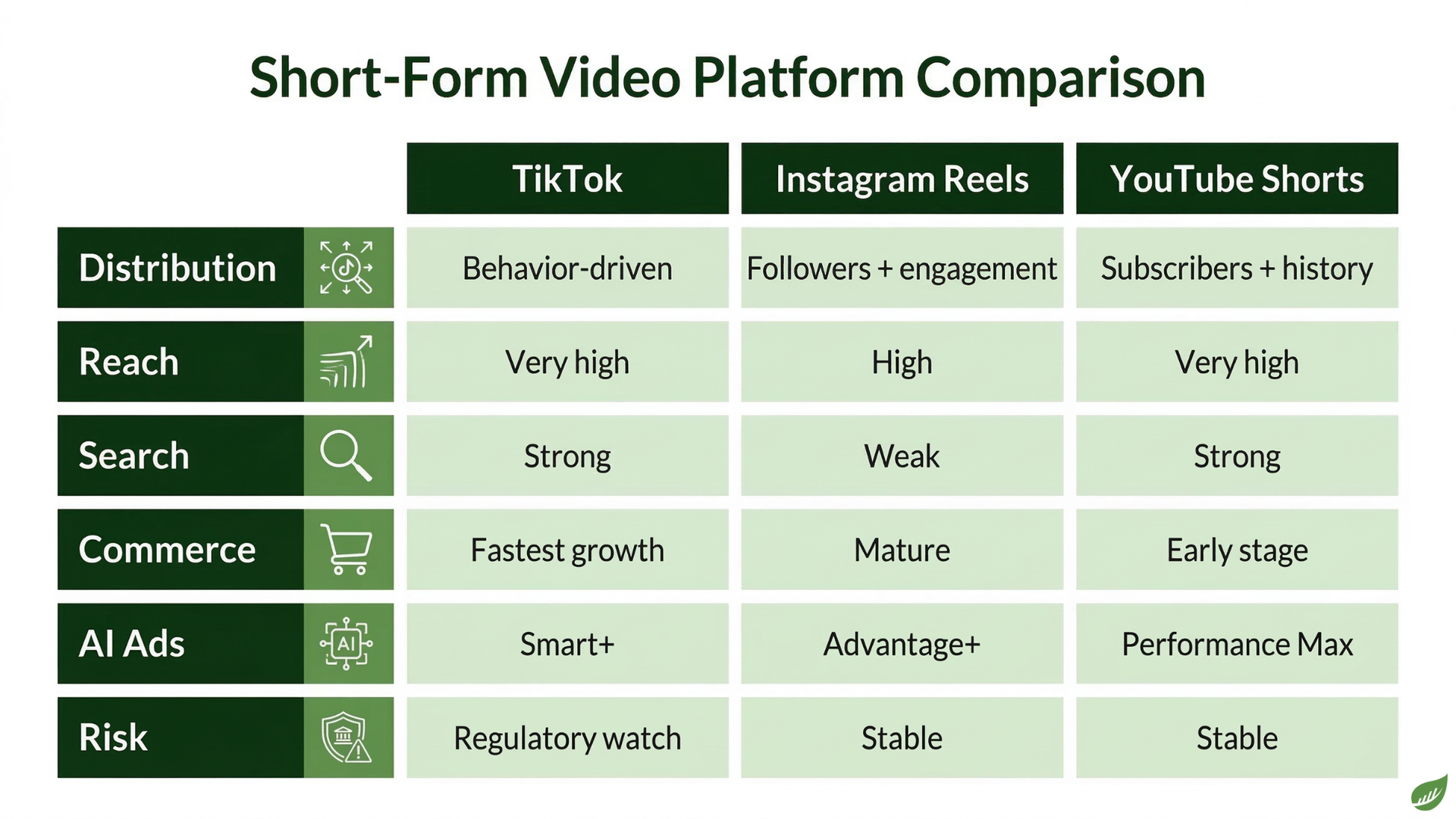
The table below compares TikTok with its primary competitors on the dimensions that matter most for brand and creator strategy in 2026.
The table is not an argument that TikTok replaces other platforms. It is an argument that TikTok's behavior-driven distribution, search functionality, and commerce integration create a distinct capability set that other platforms have not fully replicated. Brands running smart content marketing strategies in 2026 are building portable creative systems that can run across all three columns, but they are prioritizing TikTok-first architecture for discovery and conversion. Leveraging TikTok analytics is crucial for understanding these dynamics and optimizing your strategies effectively. The TikTok algorithm plays a pivotal role in this architecture, making it essential for brands to understand and align with its logic.
How Does the For You Page Shape Audience Behavior at Scale?
The For You page is not a feed of content from accounts you follow. It is a continuously updated model of what you are likely to engage with, built from your behavioral history on the platform. For brands, this means the For You page is both the primary distribution channel and the primary battleground in TikTok's attention economy.
Edison Research found that 83% of weekly U.S. TikTok users aged 13 and older who recall ads have taken some action after hearing about a product or service on TikTok, according to
Edison Research's Infinite Scroll 2025 report. The For You page is where that action-driving exposure happens. It is not where your followers go to check on your account. It is where your next customer discovers you. Understanding the TikTok algorithm is essential for maximizing your content's visibility on the For You page.
What Does the Engagement Data Tell Us About User Attention on TikTok?
The same Edison Research report that documents high action rates also reveals something brands need to take seriously. 42% of U.S. TikTok users who use the platform weekly believe they spend too much time on it, and 34% have actively tried to limit or stop their usage. The For You page is powerful precisely because it is engineered for extended engagement, and users are beginning to push back against that dynamic.
For content marketing strategies built on TikTok, this creates a clear directive. Content that respects attention, meaning it delivers high signal density in a short time and does not rely on artificial suspense or padding to inflate completion rates, will outperform content that games watch time in the long run. The TikTok algorithm rewards satisfaction, and users who feel respected by content are more likely to produce the satisfaction signals that drive distribution.
Series-based content formats perform well in this environment because they set clear expectations. When a viewer knows exactly what kind of value they will get from a specific creator or brand, they are more likely to watch through, save, and return. This predictability is an asset on the For You page, not a liability. By leveraging TikTok analytics, brands can refine their content strategies to better align with user preferences and the TikTok algorithm's distribution logic. For brands that publish consistently, series formats also simplify social media content creation by turning each episode into a reusable format.
What Are the Platform Risk and Compliance Factors Brands Must Account For?
TikTok's U.S. regulatory history has been volatile enough that any serious brand strategy document has to address it directly. The Protecting Americans from Foreign Adversary Controlled Applications Act established a framework with an original enforcement date of January 19, 2025, according to the Congressional Research Service documentation. Multiple executive orders extended enforcement windows through December 16, 2025, as documented in White House presidential actions.
According to
AP reporting, TikTok has signed agreements with Oracle, Silver Lake, and MGX to form a U.S. joint venture, with the deal expected to close in January 2026. This structure is designed to address the national security concerns underlying the legislation, but brands should monitor developments and build their TikTok programs with contingency planning in mind.
Understanding the TikTok algorithm and leveraging TikTok analytics can help brands navigate these uncertainties and optimize their content marketing strategies accordingly.
FAQ
Q1) What are the best TikTok marketing strategies for brands looking to maximize their reach and engagement?
The best TikTok marketing strategies for brands in 2026 revolve around understanding and leveraging the TikTok algorithm. Brands should focus on creating content that aligns with the behaviors the TikTok algorithm rewards, such as high completion rates, rewatches, saves, and shares. This involves structuring videos in three layers: a compelling hook in the first one to two seconds, a middle section that delivers proof and actionable steps, and a clear call to action at the end. Additionally, brands should integrate search-led content into their content marketing strategies to capture high-intent queries and build topical authority over time. Leveraging TikTok analytics is crucial for refining these strategies and ensuring that content aligns with user preferences and the TikTok algorithm's distribution logic.
Another key strategy is to build structured creator pipelines. Given that the top 25% of posters produce 98% of publicly visible videos, partnering with reliable creators can significantly enhance a brand's social media content creation capacity. Brands should treat these partnerships as a systematic, optimizable channel rather than an artistic endeavor. This approach ensures consistent, high-quality content that can generate increasing algorithmic momentum. Finally, brands should prioritize the For You page as the primary distribution surface, creating content that respects user attention and delivers high signal density in a short time.
Q2) Which are the top-rated tools for tracking TikTok audience behavior and optimizing content performance?
Several top-rated tools can help brands track TikTok audience behavior and optimize content performance. TikTok's native TikTok analytics dashboard is a fundamental tool that provides insights into completion rates, rewatch rates, saves, shares, and comment volume. These metrics align directly with how the TikTok algorithm makes distribution decisions, making them essential for refining content marketing strategies.
Third-party tools like Hootsuite, Sprout Social, and Later offer advanced analytics and scheduling features to help brands manage social media contentmore effectively. These tools provide detailed reports on engagement metrics, audience demographics, and content performance, allowing brands to make data-driven decisions. Additionally, tools like Brandwatch and Mention can help brands monitor brand mentions and track audience sentiment, providing a more comprehensive understanding of TikTok audience behavior.
For brands looking to optimize their paid advertising strategies, tools like Tinuiti and Smartly.io offer automation and optimization features that can enhance ad performance. These tools leverage machine learning to optimize ad spend, creative assets, and targeting, ensuring that brands get the most out of their advertising budgets. By integrating these tools with TikTok analytics, brands can create a robust framework for tracking and optimizing their TikTok strategies.
Q3) What are the best analytics tools to understand TikTok user preferences and tailor content accordingly?
The best analytics tools for understanding TikTok user preferences and tailoring content accordingly include TikTok's native analytics dashboard, third-party social media management tools, and specialized analytics platforms. TikTok's native TikTok analytics dashboard provides detailed insights into completion rates, rewatch rates, saves, shares, and comment volume. These metrics are crucial for understanding what types of content resonate with users and aligning with the TikTok algorithm's distribution logic.
Third-party tools such as Hootsuite, Sprout Social, and Later offer advanced analytics features that help brands dive deeper into TikTok user preferences. These tools provide detailed reports on engagement metrics, audience demographics, and content performance, allowing brands to identify trends and tailor their content marketing strategies accordingly. For example, if a brand notices that videos with a specific hook type have higher completion rates, they can create more content with similar hooks to maximize engagement.
Specialized analytics platforms like Brandwatch and Mention can help brands monitor brand mentions and track audience sentiment. These tools provide insights into how users talk about a brand, which topics are trending, and which types of content generate the most engagement. By leveraging these insights, brands can create content that aligns with TikTok user preferences and resonates with their target audience. Additionally, tools like Google Analytics and Adobe Analytics can help brands track the impact of their TikTok content on website traffic and conversions, providing a more comprehensive understanding of their overall digital marketing performance.
Q4) How can brands use TikTok analytics to refine their content marketing strategies and improve ROI?
Brands can use TikTok analytics to refine their content marketing strategies and improve ROI by treating analytics as a creative brief generator. Every video that underperforms on completion rate signals that the hook is not working, while every video that overperforms on saves signals that the content format is worth repeating. By analyzing these metrics, brands can identify patterns and trends that inform their content creation process.
For example, if a brand notices that videos with a specific call-to-action (e.g., "Comment below with your favorite tip!") generate higher engagement, they can incorporate similar calls-to-action into future videos. Similarly, if videos with a particular hook type (e.g., "Did you know that...?") have higher completion rates, brands can create more content with similar hooks to maximize engagement. Leveraging TikTok analytics in this way ensures that content aligns with TikTok user preferences and the TikTok algorithm's distribution logic.
Additionally, brands should use TikTok analytics to move beyond last-click attribution and build incrementality testing into their programs. Last-click attribution systematically undercounts TikTok's contribution to revenue because it is rarely the last touchpoint before a transaction. By using lift tests, marketing mix models, or holdout group analysis, brands can measure TikTok's actual revenue contribution and optimize their strategies accordingly. This approach ensures that TikTok analytics becomes a strategic asset rather than a vanity dashboard, helping brands build content marketing strategies that compound over time.
Q5) What are the key metrics to monitor in TikTok analytics to gauge content performance and audience engagement?
The key metrics to monitor in TikTok analytics to gauge content performance and audience engagement include completion rate, rewatch rate, saves, shares, and comment volume. These metrics align directly with how the TikTok algorithm makes distribution decisions, making them essential for understanding content performance and refining content marketing strategies.
Completion rate is a critical metric that indicates how many viewers watched a video to the end. A high completion rate signals that the content is engaging and relevant to the audience, which the TikTok algorithm rewards with broader distribution. Rewatch rate measures how many viewers watched a video more than once, indicating that the content is valuable enough to warrant repeated engagement. Saves and shares are strong signals of content quality, as they indicate that viewers found the content valuable enough to save for later or share with others.
Comment volume is another important metric, as it indicates that viewers are engaging with the content and initiating conversations.
Brands should monitor the types of questions and comments their audience leaves, as these can provide valuable insights into TikTok user preferences and inform future content creation. Additionally, brands should track metrics such as click-through rate (CTR) and conversion rate to understand how their content drives traffic and sales. By leveraging these metrics in TikTok analytics, brands can refine their content marketing strategies and ensure that their content aligns with the TikTok algorithm's distribution logic.
Works Cited
- Adobe Express. "Using TikTok as a Search Engine." Adobe Express Blog, 2026, www.adobe.com/express/learn/blog/using-tiktok-as-a-search-engine.
- AP News. "TikTok Signs Agreements with Oracle, Silver Lake, and MGX to Form U.S. Joint Venture." AP News, 2025, apnews.com/article/2fdb915cac5b6d06907a5a2de6764376.
- Congressional Research Service. "Protecting Americans from Foreign Adversary Controlled Applications Act." Congress.gov, 2025, www.congress.gov/crs_external_products/LSB/PDF/LSB11252/LSB11252.1.pdf.
- DataReportal. "Digital 2026: United States of America." DataReportal, 2026, datareportal.com/reports/digital-2026-united-states-of-america.
- Edison Research. "The Infinite Scroll 2025." Edison Research, 2025, www.edisonresearch.com/wp-content/uploads/2025/12/The-Infinite-Scroll-2025-Final-for-Publication.pdf.
- eMarketer. "TikTok Shop Makes Up Nearly 20% of Social Commerce in 2025." eMarketer, 2025, www.emarketer.com/press-releases/tiktok-shop-makes-up-nearly-20-of-social-commerce-in-2025/.
- Eventbrite. "Eventbrite TikTok Search Ads Case Study." TikTok for Business, 2025, ads.tiktok.com/business/en/inspiration/eventbrite-tiktok-success-story-search-ads.
- IAB. "U.S. Creator Ad Spend Reaches $29.5 Billion in 2024." IAB, 2024.
- Nielsen. "TikTok Case Study: Marketing Mix Modeling." Nielsen, 2024, www.nielsen.com/insights/2024/tiktok-case-study/.
- Pew Research Center. "8 Facts About Americans and TikTok." Pew Research Center, 2026, www.pewresearch.org/short-reads/2026/03/02/8-facts-about-americans-and-tiktok/.
- Pew Research Center. "How U.S. Adults Use TikTok." Pew Research Center, 2024, www.pewresearch.org/internet/2024/02/22/how-u-s-adults-use-tiktok/.
- TikTok. "Arrae GMV Max Case Study." TikTok for Business, 2025, ads.tiktok.com/business/en/inspiration/arrae-gmv-max-natural-supplements.
- TikTok. "GMV Max: Automate Shop ROI." TikTok for Business, 2025, ads.tiktok.com/business/en-US/blog/gmv-max-automate-shop-roi.
- TikTok. "How TikTok Recommends Videos for You." TikTok Newsroom, 2025, newsroom.tiktok.com/en-us/how-tiktok-recommends-videos-for-you.
- TikTok. "Introducing Search Ads Campaign." TikTok for Business, 2025, ads.tiktok.com/business/en-US/blog/introducing-search-ads-campaign.
- TikTok. "TikTok Announces New Automation Updates for Advertisers." TikTok Newsroom, 2025, newsroom.tiktok.com/en-us/tiktok-announces-new-automation-updates-for-advertisers/.
- TikTok. "TikTok World 2025 Announcements." TikTok Newsroom, 2025, newsroom.tiktok.com/tiktok-world-2025.
- TikTok. "TransUnion Meta-Analysis: Incremental Sales." TikTok for Business, 2025, ads.tiktok.com/business/en-US/blog/transunion-meta-analysis-incremental-sales.
- Tinuiti. "Q3 2025 Digital Ads Benchmark Report." Tinuiti, 2025, tinuiti.com/research-insights/research/digital-ads-benchmark-report-q3-2025/.
- White House. "Saving TikTok While Protecting National Security." White House Presidential Actions, 2025, www.whitehouse.gov/presidential-actions/2025/09/saving-tiktok-while-protecting-national-security/.