
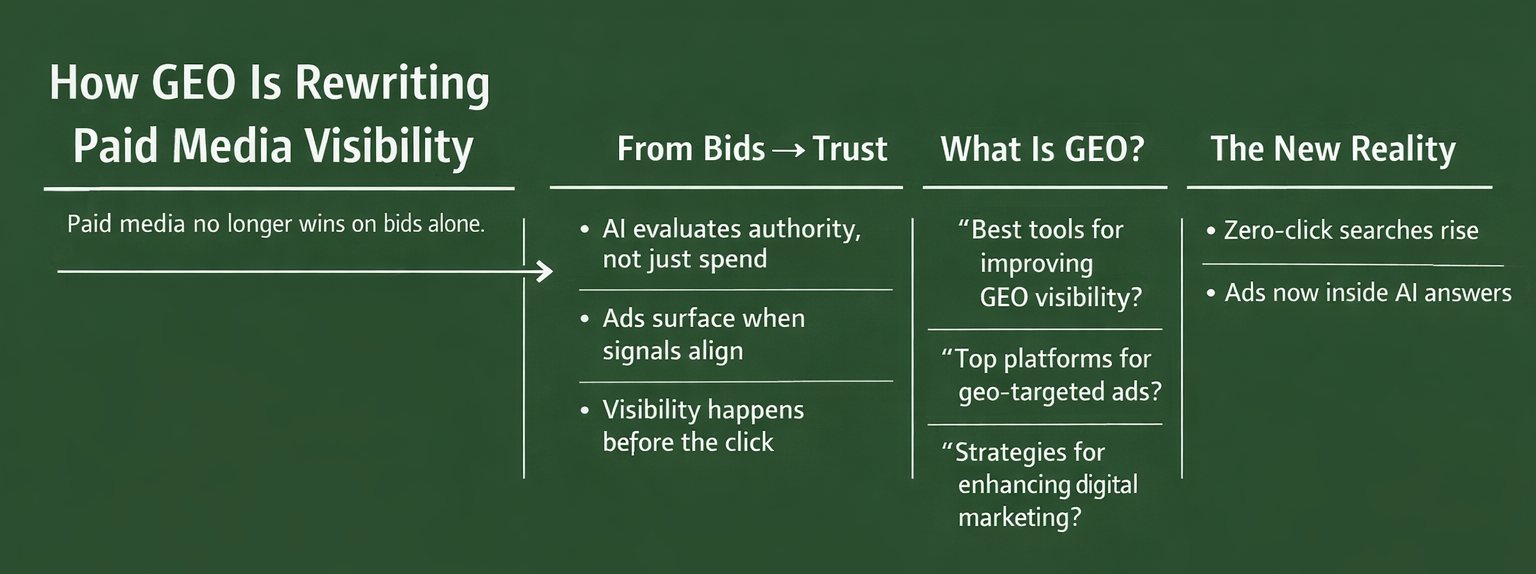
Paid ads no longer win on bids alone. Generative engines evaluate authority, consistency, and real-world credibility before deciding what gets surfaced or suppressed. Visibility now comes from how well your paid media aligns with the broader signals AI trusts.
TL;DR
- GEO (Generative Engine Optimization) makes your paid media strategy work harder by aligning ads, content, and PR, so AI systems consistently recommend your brand.
- Zero-click search is real: when AI answers appear, clicks drop sharply, so you need stronger authority signals and a smarter media mix to stay visible.
- Shopping and search ads are moving inside AI answers; optimize your feeds and landing pages now to avoid getting sidelined.
- Earned signals increasingly decide whether you surface. Think credible third-party mentions, expert quotes, reviews, and consistent narratives across outlets.
- Cross-channel brand presence wins: test new formats, coordinate PR and content, and measure visibility across AI touchpoints-not just last-click.
What Is GEO and Why Does It Matter Now
GEO is the discipline of making your brand visible inside generative AI experiences (AI Overviews, chat assistants, and AI-organized pages). It matters because more research (and buying) starts with AI summaries vs classic search pages. In today’s environment, your paid media strategy must be discoverable in AI answers and shortlists, not just in auctions and old-school SERPs.
The shift is measurable. Nearly half of U.S. adults now see AI-generated summaries in search, according to
Pew Research. Usage is accelerating. ChatGPT alone reports ~800 million weekly users (TechCrunch), and BrightEdge notes Google search impressions are up ~49% since launching AI answers (BrightEdge). But here’s the catch: clicks don’t rise with impressions. When an AI Overview appears, click-through rates fall hard. GrowthSRC data shows the #1 organic CTR dropped from ~28% to ~19% (a 32% decline) post-rollout (Search Engine Journal); other analyses peg link clicks at only ~8% when AI answers are present vs ~15% without them (Generative Engine).
That’s the new reality: visibility is a trust game. Your paid media strategy wins when ads, content, and earned coverage line up so AI systems can verify your claims. GEO sits right at that intersection. It reframes how you think about earned media vs paid media, how you organize paid media channels, and which creative formats actually move the needle in generative environments.
How AI Is Changing Where Your Ads Appear (and Get Clicked)
AI has rewritten the surface area of discovery: fewer classic ad slots, more AI answers where ads may or may not show. Today, research often begins in AI chat (ChatGPT, Gemini) or in AI Overviews rather than the old SERP. Search Engine Land reports that behavior is shifting away from standard search pages; competition and CPCs are rising.
Google is also piloting ads inside AI Overviews. U.S. mobile users are starting to see “Sponsored” placements embedded in answers, pulled from existing Shopping/Search inventory (TechCrunch). That reshapes your paid media strategy: inventory quality, feed completeness, and structured data will drive eligibility and rank. Bids alone won’t. As QueryClick puts it, if your feeds aren’t rich, consistent, and well-tagged, you risk exclusion from AI answer units.
Creativity and landing experiences carry more weight, too. Generative systems prioritize authoritative, verifiable sources with clear provenance (SingleGrain; Search Engine Land). That means AI doesn’t just surface whoever pays the most, it surfaces whoever earns the most trust. To keep your paid media channels competitive, align creative and landing pages with proof: recent stats, expert bylines, structured data, and consistent claims across your footprint.
Practical move: learn which queries in your category trigger AI Overviews, identify cited domains, then tailor ads and content to reinforce those narratives. This simple audit can transform your paid media strategy without inflating bids.
Why Rethink Earned Media vs Paid Media in the AI Era
AI answers overwhelmingly cite third-party sources, not your own blog or ad copy. If you want to show up on the new shortlists, independent validation matters more than ever. Observer reports that ~89% of sources used to generate AI-generated answers come from independent media and experts, not brand-owned sites (Observer). That’s the crux of earned media vs paid media: how others talk about you determines whether you’re visible in AI experiences.
Consider Korn Ferry’s “job hugging” narrative. It gained traction across outlets, and now it appears at the top of AI Overviews for related queries (Observer). That’s earned media vs paid media in action: repetition plus expert framing yields durable AI visibility.
So where does that leave your paid media strategy? Complement it with intentional media relations. Pitch credible reporters with data-rich angles, publish executive bylines on respected top-rated platforms for geo-targeted ad campaigns, and cultivate verified reviews. Keep your narrative consistent. AI looks for provenance, freshness, and corroboration (Generative Engine). Done right, earned media vs paid media shifts from an either/or to a flywheel.
When you fold these signals into marketing paid media, you prime demand before anyone clicks. If you want a partner to orchestrate that system end-to-end, our team at BusySeed does this daily: strategy, PR alignment, and creative that AI can trust.
Talk with BusySeed about weaving earned media vs paid media into one plan.
How GEO Improves a Paid Media Strategy Without Just Raising Bids
GEO works by aligning your ads, content, and PR around a clear, verifiable story, then structuring that story so AI can parse and rank it. Instead of chasing higher CPCs, your paid media strategy gains leverage from credibility and clarity.
- Strengthen landing page authority. Add expert bylines, data freshness, and citations to primary research. Use schema (FAQ, HowTo, Product, Organization), so AI understands context and improves marketing paid media performance.
- Update the creative to reflect the same proof points. If your page cites a case study, reference that outcome in ad copy and assets. Consistency lifts paid media channels and supports GEO.
- Coordinate PR to earn third-party mentions. When external sources echo your positioning, AI’s confidence rises, bridging earned media vs paid media seamlessly.
- Align with the questions buyers ask AI. Build content that answers those questions simply, with scannable formatting to help paid media channels capture high-intent traffic.
- Use cross-channel reinforcement. More touchpoints create more signals, which is fuel for marketing paid media, and better AI inclusion.
Evidence backs the approach. A bookkeeping SaaS facing $20+ CPCs used generative query research to build pages answering high-intent prompts. By aligning pages and earning mentions with those prompts, they appeared in AI answers, driving 25+ qualified leads and ~$10K in new revenue quickly (SE Ranking). Another program audited 5,000+ posts for AI-friendliness, adding FAQ schema and branded summaries. In three months, AI Overview visibility rose 458%, and web leads climbed ~20% (SE Ranking). That’s a GEO-driven paid media strategy at work.
Quick Reference: GEO Levers That Multiply Impact
Which Paid Media Channels Deserve New Attention Under GEO
Prioritize formats and placements that build familiarity and feed AI with corroborating signals. Your paid media channels should work like an orchestra (different sections, same score).
- Search with AI Overviews: Keep testing, but optimize for AI inclusion. Rich product feeds, schema, and well-tagged attributes improve eligibility for ads inside AI answers (TechCrunch; QueryClick).
- Programmatic display and paid social: Build awareness and social proof that AI “sees” across the web (Search Engine Land), reinforcing marketing paid media narratives.
- Video and CTV: Efficient reach and credibility-building, especially when tied to thought leadership clips and testimonials that later aid your paid media strategy.
- Sponsored content and newsletters: Spark earned pickup on domains AI likes to cite (an easy win for earned media vs paid media orchestration).
- Retail and marketplace ads: Rich product data from these environments increasingly flows into AI discovery experiences, elevating paid media channels.
Top Strategies for Enhancing GEO Visibility in Digital Marketing
Winning GEO is equal parts trust, engineering, technical hygiene, and cross-channel reinforcement. Make these moves core to your paid media strategy, and your paid media channels will benefit as well.
- Treat AI assistants as a new channel: Audit your category’s AI responses, map cited domains, and align content and creative standards so your paid media points to AI-friendly assets.
- Architect authoritative landing pages: Clear answers, current data, named experts, and structured markup help AI parse and cite your work (fuel for paid advertising examples that convert).
- Prime the ecosystem with PR: Earn mentions in respected outlets and get executives quoted with consistent messaging, closing the loop between earned and paid media.
- Optimize product feeds: Complete attributes, unique identifiers, and schema unlock new placements, critical for paid media channels that appear inside AI Overviews.
- Unify creative and claims: Keep the narrative consistent across content, ad copy, and interviews to supercharge paid media marketing.
- Strengthen review presence: Verified, credible reviews provide trust signals AI weighs heavily, boosting your paid media strategy.
- Test new placements early: Early movers get outsized learnings and reach, and build future-ready paid advertising examples.
Operationalizing GEO: Best Tools for Improving GEO Visibility in Paid Media
Start with a pragmatic stack that surfaces opportunities and enforces consistency. Your tools should make your paid media strategy easier to run, and your marketing paid media more credible.
- AI answer and SERP monitoring: Track AI Overview appearances, citations, and content gaps. BrightEdge’s AI visibility reporting is a solid benchmark (BrightEdge).
- Product feed and schema validation: Enforce attribute completeness and error checking. Pair with validators for product/FAQ schema to help paid media channels qualify.
- PR intelligence: Media monitoring to track earned mentions and journalist interest; pitch databases to expand your earned media vs paid media footprint.
- Review management: The best tools for improving geo visibility in paid media are those that automate requests, verify buyers, and syndicate ratings. Ammunition for marketing paid media and GEO.
- Analytics and MMM: Multi-touch or media mix modeling to attribute impact across channels, including AI-surfaced touchpoints in your paid media strategy.
Weekly GEO Governance: A Simple Cadence
- Refresh data and update content freshness markers
- Validate schema and feed health
- Align creative with the latest proof points
- Review AI answer visibility and cited domains
Top-Rated Platforms for Geo-Targeted Ad Campaigns to Test First
Choose top-rated platforms for geo-targeted ad campaigns that deliver precise audience control and strong data exhaust for learning. The right mix will amplify your paid media strategy and multiply the value of your paid media channels.
- Google Ads with AI Overview eligibility: Prioritize Shopping and Search where rich feeds and schema can unlock in-answer placements (TechCrunch).
- Meta and LinkedIn: Efficient reach and social proof to bolster marketing paid media (ideal for distributing customer stories to buyers and influencers).
- Programmatic with contextual and publisher deals: Place credible narratives on domains AI cites, strengthening earned media vs paid media outcomes.
- Retail media networks: For commerce, feeds and ratings here can echo into AI discovery, supporting targeted paid advertising examples.
- Premium newsletters and podcasts: High-trust environments that spark earned pickup and brand recall across paid media channels.
How to Measure GEO’s Impact Across the Funnel
Track visibility and trust, not just last-click conversions. The right metrics help your paid media strategy adapt faster than the market.
- AI visibility: Monitor whether your brand, content, and products appear in AI answers, and on which domains, insight that guides marketing paid media.
- Assisted influence: Attribute lift from channels that introduce or reinforce your brand before the final click, especially video, social, and PR inside your paid media channels.
- Quality signals: Measure review growth, citation frequency, and page freshness, trust drivers for earned media vs paid media integration.
- Efficiency and reach: Watch CPCs/CPMs, but also “be-seen” KPIs, share of voice in AI answers, sentiment, and category coverage that improve your paid media strategy.
- Lagging outcomes: Pipeline velocity, close rates, and AOV often rise once trust is pre-built (proof your paid advertising examples are paying off).
Example KPI Map
Real-World Paid Advertising Examples That Prove GEO Impact
You’ve seen how structured data and PR-aligned narratives lifted a SaaS competitor into AI answers, plus the 458% jump in AI Overview visibility from an audit-and-schema sprint (SE Ranking). Additional paid advertising examples we see working include:
- Expert-backed category pages with FAQ schema that become cited resources. Then retargeted with social proof video to strengthen marketing paid media.
- Retail feed optimization sprints that unlock AI answer placements and increase top-of-funnel discovery, high-leverage paid advertising examples.
- Sponsored explainers on credible industry publications that later get cited by AI systems, followed by brand search lifts across paid media channels.
- Thought-leadership snippets repurposed as UGC-style short videos, seeding familiarity and trust before direct-response ads in your paid media strategy.
Want to pressure-test which paid advertising examples fit your category? Ask our team to review your assets and map a 90-day GEO sprint.
Start the conversation with BusySeed. We’ll align earned media vs paid media, tighten your marketing paid media, and tune your paid media channels for GEO.
FAQs
How does GEO differ from traditional SEO or SEM?
GEO focuses on how generative systems (like AI Overviews and chat assistants) select, summarize, and cite information. Traditional SEO/SEM centers on ranking pages and bidding for ads on a results page. In practice, GEO asks: Is your story corroborated by independent sources? Is your content structured and current? Do your feeds and landing pages align with what AI trusts? These differences change your paid media strategy and redefine how paid media channels perform.
What are the top strategies for enhancing GEO visibility in digital marketing for local businesses?
- Build a consistent narrative across local press, chambers, associations, and high-trust directories, bridging earned media vs paid media.
- Use structured data for location, services, FAQs, and reviews, lift for your marketing paid media.
- Encourage third-party reviews (with verification) and respond promptly.
- Run awareness ads that highlight customer outcomes and expert endorsements across paid media channels.
- Keep pages updated with recent data and named experts to support GEO and your top strategies for enhancing geo visibility in digital marketing.
What are the best tools for improving GEO visibility in paid media if my team is lean?
Start lightweight: schema validators, feed-optimization tools, review platforms, and a media-monitoring solution. Then, add reporting to track appearances of your work in AI answers and the domains that cite you. The goal isn’t tooling bloat, just enough to enforce quality and spot opportunities that improve your marketing paid media, and overall paid media strategy.
Which top-rated platforms for geo-targeted ad campaigns work best for B2B?
LinkedIn for precision targeting; Google for mid-to-high intent; programmatic to place thought leadership on trusted industry sites; and niche newsletters where decision-makers go deep. Pair placements with credible content and named experts to maximize trust, your paid advertising examples will perform better across paid media channels.
How fast can GEO changes move the needle?
You can see early indicators in weeks, improved feed health, richer snippets, new citations, and AI answer appearances. Pipeline and revenue impact typically follow as awareness and trust compound. A focused 60-90-day sprint often shows whether your paid media strategy and marketing updates are resonating. Expect your best paid advertising examples to come from proof-first creative that AI can verify.
Bringing It Together: GEO Makes Visibility a Trust Game, and That’s Good News for Operators
AI has collapsed the distance between a question and an answer. It’s also raised the bar for what gets surfaced. The engines reward substance: verifiable proof, consistent entities, fresh data, and third-party corroboration. That’s why this is the moment to align your ads, content, and PR, and why brands with discipline can outmaneuver bigger budgets. In other words, GEO helps your top strategies for enhancing GEO visibility in digital marketing punch above its weight by merging earned media vs paid media into a single, credible narrative. It elevates paid media marketing, harmonizes paid media channels, and delivers repeatable paid advertising examples that stand up to AI shortlists.
If you’re ready to turn this shift into an advantage, BusySeed will build the plan with you: map your AI opportunities, engineer trust signals into your stack, and orchestrate the media mix that keeps you visible where it counts. Let’s get you found everywhere buyers are looking.
Get your GEO action plan from BusySeed.
Works Cited
Pew Research Center. “Americans Have Mixed Feelings About AI Summaries in Search Results.” Pew Research Center, 1 Oct. 2025, https://www.pewresearch.org/short-reads/2025/10/01/americans-have-mixed-feelings-about-ai-summaries-in-search-results/.
Clark, Josh. “Sam Altman Says ChatGPT Has Hit 800M Weekly Active Users.” TechCrunch, 6 Oct. 2025, https://techcrunch.com/2025/10/06/sam-altman-says-chatgpt-has-hit-800m-weekly-active-users.
BrightEdge. “One Year of Google AI Overviews: BrightEdge Data Reveals Google Search Usage.” BrightEdge, 2025, https://www.brightedge.com/news/press-releases/one-year-google-ai-overviews-brightedge-data-reveals-google-search-usage.
Southern, Matt G. “Google CTRs Drop 32% for Top Result After AI Overview Rollout.” Search Engine Journal, 2025, https://www.searchenginejournal.com/google-ctrs-drop-32-for-top-result-after-ai-overview-rollout/551730/.
Generative Engine. “Zero-Click Apocalypse: How AI Overviews Are Stealing Website Traffic.” Generative Engine, 2025, https://generative-engine.org/zero-click-apocalypse-how-ai-overviews-are-stealing-website--1756134244404.
Chan, Rosalie. “Google Brings Ads to AI Overviews and Rolls Out AI-Organized Pages.” TechCrunch, 3 Oct. 2024, https://techcrunch.com/2024/10/03/google-brings-ads-to-ai-overviews-and-rolls-out-ai-organized-pages/.
QueryClick. “What Is Generative AI and How Is It Transforming Search and Paid Media in 2025?” QueryClick, 2025, https://www.queryclick.com/blog/what-is-generative-ai-and-how-is-it-transforming-search-and-paid-media-in-2025/.
Patel, Eric. “AI Trust Signals for Brand Authority in Generative Search.” SingleGrain, 2025, https://www.singlegrain.com/artificial-intelligence/ai-trust-signals-for-brand-authority-in-generative-search/.
Edwards, Nicole Farley. “How Generative Engines Define and Rank Trustworthy Content.” Search Engine Land, 2025, https://searchengineland.com/how-generative-engines-define-rank-trustworthy-content-461575.
Observer Staff. “Earned Media Is the New SEO: How Generative AI Changes Brand Visibility.” Observer, 2025, https://observer.com/2025/12/earned-media-generative-ai-search-geo/.
Generative Engine. “How AI Engines Actually Weight Source Credibility.” Generative Engine, 2025, https://generative-engine.org/breaking-how-ai-engines-actually-weight-source-credibility-a-1755806570314.
SE Ranking. “Top AEO Case Studies: How Brands Increase Visibility in AI Overviews.” SE Ranking Blog, 2025, https://seranking.com/blog/top-aeo-case-studies/.