TL;DR
- 67% of B2B buyers prefer a sales-rep-free experience, and 70% prefer a completely digital, self-service buying experience, per a survey fielded from August to September 2025 (Gartner, 2026).
- But 69% of those same buyers turn to sales reps to validate AI-generated insights, which means the human isn't gone, just repositioned to the highest-stakes moment (Gartner, 2026).
- Only 7.2% of companies respond to a demo request within 5 minutes (Qualified, 2026), and Workato's 2026 experiment across 114 B2B companies clocked the average personalized email response at 11 hours and 54 minutes (Workato, 2026).
- 73% of B2B buyers actively avoid suppliers who send irrelevant outreach, per a survey of 632 buyers (Gartner, 2025a).
- Deals where buyers viewed 9 or more demos closed at 8 to 10 times the rate of low-engagement deals, according to a 2025 Buyer Behavior Report built on 6 million anonymized interactions (Consensus, 2025).
Why Most NYC B2B Lead Funnels Are Leaking (And How To Fix Them)
Lead qualification is the process of ranking prospects by their real likelihood to buy, so your team spends time on the accounts that actually move and ignores the ones that never will. That's it. Everything else people bolt onto the phrase is decoration.
And here's the uncomfortable part most agencies won't say out loud: your funnel probably isn't broken because you need more traffic.
It's broken because the handoff from "interested visitor" to "sales conversation" leaks like a cheap garden hose, and nobody's measuring where the water goes.
We've watched companies dump budget into top-of-funnel ads while a full 1 in 10 of their inbound leads never got contacted at all, according to a 2026 survey of 514 B2B marketing and revenue leaders (Qualified, 2026). Let that sit for a second. You paid for a lead-generation service. Then you ghosted it.
This guide is about building a lead funnel that matches how people actually buy in 2026, backed by recent data. It is structured so the expensive moments (a human sales conversation, a demo, a proposal) land exactly when they reduce a buyer's risk, rather than annoying them.
We'll cover buyer behavior, lead scoring, speed-to-lead, the compliance traps that quietly kill deliverability, and how one BusySeed B2B SaaS client turned better lead nurturing into a $193,616.50 opportunity.
What Does Today's Buyer Journey Actually Look Like?
Today's B2B buyer researches on their own first. They bring in a salesperson only to confirm a decision they've already mostly made. That reordering changes where you spend money and effort inside the funnel.
Gartner's data is blunt about it. In their survey fielded in late 2025 (Gartner, 2026):
- 67% of buyers prefer to navigate the purchasing process without a sales rep involved.
- 70% of buyers expect a fully digital, self-service experience.
Buyers drew on roughly 7 information sources for a recent purchase, and 45% used generative AI to research vendors and products. The evaluation is happening in tabs you can't see, in AI chats you'll never log, long before anyone fills out your form.
Here's what people get wrong, though. They read "rep free" and conclude sales are dying. It isn't.
The same Gartner release found 69% of buyers turn to a human rep specifically to validate the AI-generated insights they've gathered (Gartner, 2026). Buyers use AI for speed, then want a person to tell them they won't get fired for choosing you. AI changed what buyers do. It didn't change what they need.
So the funnel job splits cleanly:
- Let people self-serve through 80% of their evaluation with real assets (comparison pages, ROI math, product tours).
- Make the human moment unmistakably about risk reduction: implementation reality, internal buy-in, and edge-case validation.
If your first sales touch is "Hey, just checking in to see if you have questions," you've wasted the one moment when buyers actually wanted a person.
In B2B lead generation, this shift is even more pronounced. When it comes to lead generation for service businesses, companies must adapt to this self-serve expectation immediately. Buyers now expect to gather most of their information independently before engaging with a sales team. This means your content must be:
- Comprehensive
- Easily accessible
- Designed to answer key questions at each stage of their journey
For example, a buyer researching marketing automation tools might want to compare features, pricing, and implementation timelines without speaking to a salesperson. If your funnel doesn't provide these resources, you risk losing the lead before they even consider reaching out.
If your team needs help mapping out and creating these comprehensive, self-serve assets, the experts at BusySeed can help you build content that aligns perfectly with the modern buyer journey.
Why Relevance Beats Personalization (And Where Personalization Backfires)
Relevance beats personalization because buyers punish noise, and clumsy personalization often adds noise instead of removing it.
The goal isn't to prove you know their first name and their company's funding round. The goal is to make the next decision easier.
The numbers here should make anyone running a "personalized" nurture stream nervous. Gartner (2025b) found that personalized marketing led to negative experiences for 53% of customers. As a result, those buyers were:
- 3.2 times more likely to regret their purchase.
- 44% less likely to buy again.
Meanwhile, 73% of buyers actively steer away from suppliers who send irrelevant outreach (Gartner, 2025a).
Read those together. Bad personalization doesn't just fail to help. It actively drives people away and makes the ones who do buy resent it later.
Our mildly contrarian take: most "1:1 personalization at scale" projects are a waste of money for service businesses and mid-market SaaS. The industry loves them because they sound sophisticated.
But a buyer-controlled experience outperforms a creepy "we noticed you visited three times" email almost every time. Whether it is an interactive assessment, a pick-your-path demo, or a guided pricing flow, self-serve reduces the number of buyer decisions rather than piling more on.
Personalization should subtract cognitive load. If it adds any, kill it.
That said, this isn't an excuse to send generic blasts. Relevance still requires knowing the segment, the role, and the stage. It just doesn't require faking a personal relationship you haven't earned.
Want to stop guessing and start converting? Schedule a one-on-one call with our CEO, Omar Jenblat, to discover how we can build a highly relevant, buyer-driven funnel for your brand.
Why Is Speed-To-Lead The Cheapest Funnel Fix You're Ignoring?
Speed-to-lead is the single most underrated conversion lever because almost nobody does it well, which means the bar to win is embarrassingly low. Respond in five minutes, and you're already beating more than 90% of the field.
The data is almost comical (Qualified, 2026, Workato, 2026):
- A recent study found that only 7.2% of B2B companies respond to a demo request within 5 minutes.
- The finding that 1 in 10 inbound leads are never contacted should genuinely alarm anyone paying for those leads.
- Workato ran an actual experiment, submitting demo requests to 114 B2B companies, and found that over 99% failed to respond within 5 minutes.
- The average personalized email reply took 11 hours and 54 minutes.
Let us tell you where we've watched this play out. A client running lead generation for service businesses was convinced they had a "top of funnel problem". More ads, more content, more everything.
When we actually traced the timeline, the median first human response to a form fill was over a business day. They didn't have a traffic problem. They had a "we're not there when the buyer's hand is raised" problem. Fixing response time did more for their close rate that quarter than any creative test we ran.
Here's the fix, and it's boring on purpose:
- Write a 5-minute response SLA and get marketing ops, SDRs, and sales to sign it. Not a Slack agreement. A document.
- Add instant meeting booking to your confirmation flow so a hot lead can grab a time slot without waiting on anyone.
- Build automated qualified routing so the right rep gets pinged instantly, not a shared inbox nobody watches.
- Treat after-hours as a first-class citizen. Use AI or automation to triage and book, then have a human follow up the next business block.
- Track time-to-first-real-response as a reported metric, not a vibe. What you don't measure stays slow.
Implementing these rapid-response systems can be technically complex, but the team at BusySeed can help you integrate the automation and routing needed to consistently hit that 5-minute mark.
The new competitive moat is operational excellence after the form fill. Creative tweaks are fun. But when 99% of your competitors take half a day to answer, showing up in five minutes is a strategy.
What Separates High-Converting Funnels From The Rest?
High-converting funnels have stopped optimizing for lead volume. Instead, they have started optimizing for lead quality, attribution, and the conversion from marketing-qualified lead to real sales opportunity. Particularly in lead generation for service businesses, this shift is critical to protecting your experts' time.
That shift is happening across serious demand gen teams right now.
A 2025 Benchmark Survey outlined where teams are actually directing their attention (Demand Gen Report, 2025). Here is what they are prioritizing:
- 55% want to increase MQL conversion rates to opportunities.
- 52% want to measure ROI more effectively.
- 38% want tighter alignment between marketing and sales.
- 33% want to nurture leads to avoid missing opportunities.
- 31% flat-out want to shift from lead volume to higher-quality leads.
If your funnel reporting still shows a single big number labeled "MQLs generated", you're going to lose the internal argument.
The persuasive story in 2026 is "we improved MQL-to-opportunity conversion and protected sales time". That's the sentence that gets the budget renewed.
Where's the money going? The same survey shows tech and channel investment concentrated in these core areas (Demand Gen Report, 2025):
- Website: 64%
- Email & Multichannel Nurturing: 59% each
- Marketing Automation: 48%
- Intent and Signal Data: 47%
- Attribution Modeling: 41%
On the content side, teams are allocating their budget toward (Demand Gen Report, 2025):
- Case Studies: 57%
- Lead-Nurturing Campaigns: 47%
- Video: 45%
- Webinars: 38%
Notice case studies leading the content pack. That's not an accident, and it ties directly to trust, which we'll get to.
Your Funnel Is A Confidence Engine, Not A Conveyor Belt
The best mental model for a modern funnel is a confidence engine that repeatedly answers three buyer questions: is this relevant to me, is this credible, and is this safe to choose?
Every asset either raises confidence or wastes a click.
Trust is now an explicit KPI, not a soft brand feeling. Reports show that 94% of B2B marketers agree that building trust is the most important factor for B2B brand success (LinkedIn, 2025).
And the format that trust arrives in is shifting fast: B2B decision-makers are consuming 26% more video content year over year on the platform (LinkedIn, 2025). Credibility signals increasingly need to be fast to consume.
So your nurture stream shouldn't read like a drip of "just following up" emails. It should build confidence on purpose: proof points, peer stories, implementation walkthroughs, honest handling of objections, and clear "here's exactly what to do next" assets.
Every email answers one of those three questions, or it doesn't ship.
How Should You Score Leads In 2026?
For effective lead qualification, you should score leads on behavioral proof of buying intent, not just demographic fit. Engagement depth predicts deal outcomes far better than a job title does.
Demographics tell you if someone could buy. Behavior tells you if they will.
This is where the 2025 Buyer Behavior Report earns its keep. Across 6 million anonymized interactions, they found that deals with 9 or more demo views closed at 8 to 10 times the rate of those with fewer demo views (Consensus, 2025).
They also found that, on average, 4 unique stakeholders engage with each piece of product content, which is a direct signal of single-thread versus multi-thread deal risk (Consensus, 2025).
And attention runs short: the average demo lasts 15+ minutes, but buyers engage for only about 5 minutes and 44 seconds. This is a strong argument for modular, choose-your-path product experiences rather than a single bloated demo video (Consensus, 2025).
A modern lead scoring model should weigh three behavioral inputs:
- Product engagement depth: How many tours, demos, or interactive sessions did they consume? Nine-plus is a fire alarm, in the best way.
- Proof-point consumption: Did they read the case studies and ROI content? That's a buyer building an internal safety case.
- Stakeholder breadth: Is one person poking around, or are four people from three departments engaging? Multi-threaded deals are safer deals.
For B2B lead generation specifically, this beats the old "MQL = downloaded one ebook" model by a mile. Someone who binge-watched your role-based demos and forwarded your case study to a colleague is worth ten form-fill tourists.
In service businesses, where the sales cycle can be longer and more complex, this approach ensures that your team focuses on leads that are not only interested but also actively moving toward a decision. This is particularly important in industries where multiple stakeholders are involved in the purchasing process, and where the cost of acquiring a customer is high.
Comparison: The Old Funnel Model Versus The Modern One
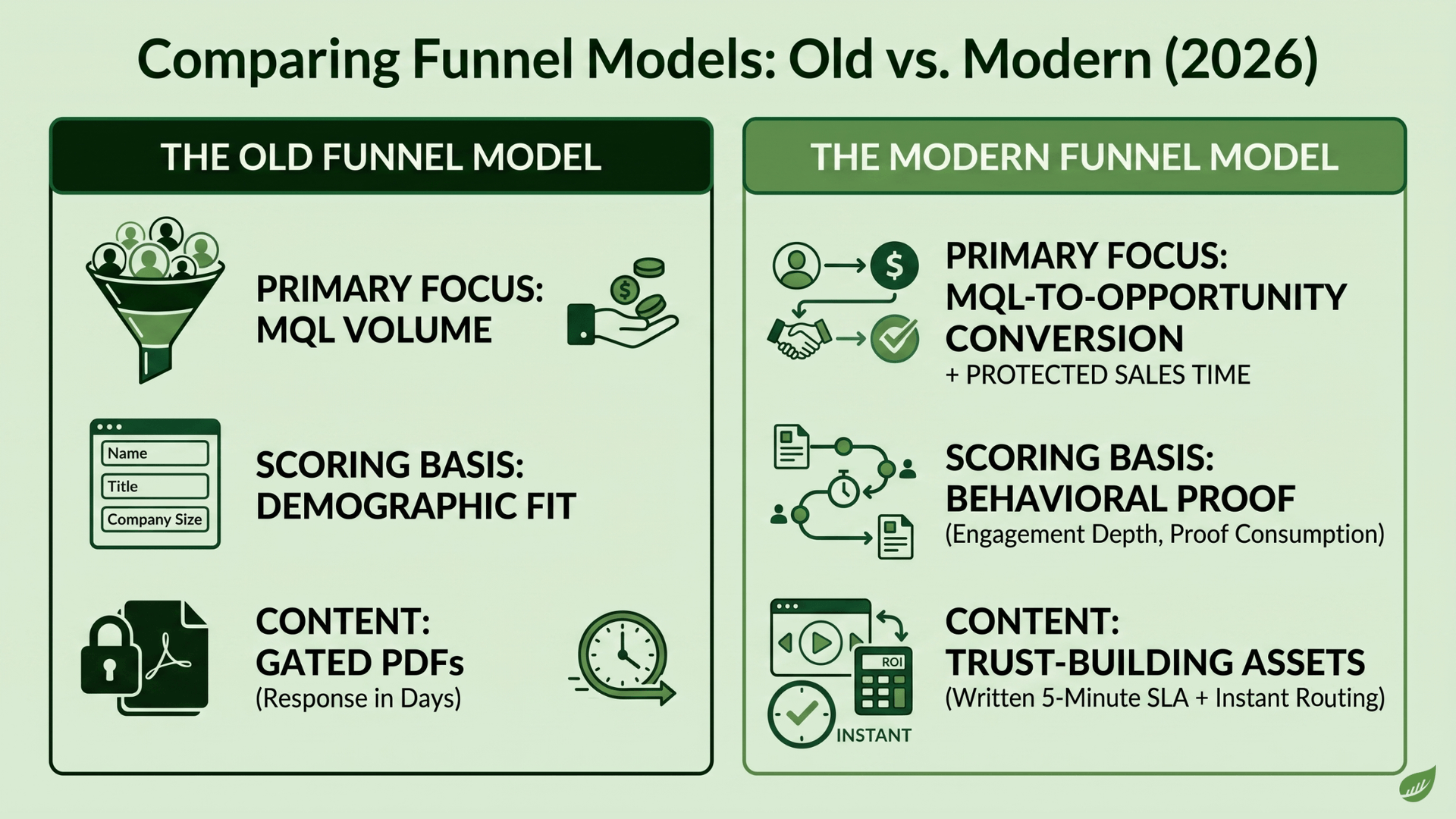
| Dimension | Old Funnel Model | Modern Funnel Model (2026) |
|---|---|---|
| Primary metric | MQLs generated | MQL-to-opportunity conversion + protected sales time |
| Lead scoring basis | Demographic fit (title, company size) | Behavioral proof: engagement depth, proof consumption, stakeholder breadth |
| Human involvement | Early and often | Delayed until it reduces buyer risk (validation, buy-in) |
| Personalization | 1:1 "we know you" outreach | Buyer-controlled paths that reduce decisions |
| Speed-to-lead | "Within a day or two" | Written 5-minute SLA + instant routing |
| Mid-funnel asset | One long "book a demo" step | Modular tours, ROI calculators, role-based paths |
| Content priority | Volume of gated PDFs | Case studies, video, and proof points that build trust |
When you adopt this modern model, your B2B lead generation strategy no longer relies on guesswork. You build a data-backed system designed to generate leads that service providers can actually convert into revenue.
How BusySeed Turned Better Nurturing Into A $193,616.50 Opportunity
A B2B SaaS client came to us with a problem we see constantly: solid, consistent website traffic and almost nothing to show for it in closed revenue. The visitors were there. The conversions weren't. The leak was in the handoff, capture, and nurturing of the sales conversation.
We didn't start by buying more traffic. We started by aligning the whole motion with how their buyers actually behaved. That meant building acquisition campaigns that fed into a nurture experience designed around self-serve research (because rep-free is the default expectation now).
Then we tightened relevance and stopped sending the kind of noise that makes 73% of buyers walk away (Gartner, 2025a). We layered in proof and trust assets, since trust is the single biggest brand success factor (LinkedIn, 2025).
The outcome was a 239% return on ad spend and a landmark $193,616.50 deal.
The lesson wasn't "run better ads". It was that connecting lead generation for service businesses to the complete buyer journey, from first click to sales validation, that moved the number. You can read more about how we generate leads service by service on the BusySeed website.
Not every brand sees a six-figure deal from the same playbook, and we won't pretend they do. This isn't a fix for a weak product or a market that doesn't want what you sell. But the underlying mechanics (align with buyer behavior, score real intent, respond fast, build trust) apply to almost any business.
The AI Personalization Trap Experts Will Expect You To Name
AI can personalize your funnel at scale, but only if your customer data is clean and governed, or you'll just automate spam faster than ever. That guardrail is the whole game.
A 2024 report found that (Twilio Segment, 2024):
- 89% of leaders believe personalization is crucial to business success over the next three years.
- 73% of brands agree AI adoption will fundamentally change personalization strategies.
But here's the part everyone skips: 61% of companies worry inaccurate data will compromise their AI's effectiveness. That fear is well-founded. Using algorithms for automated lead qualification or predictive lead scoring only works if the inputs are flawless. "AI generates variants" is table stakes now. Anyone can do it. The differentiation is AI plus clean customer data plus governance plus real measurement.
Point a language model at a messy CRM, and you don't get personalization; you get confident, well-written garbage sent at high volume. Which, given Gartner's regret data, is worse than doing nothing (Gartner, 2025b).
The Compliance Traps That Quietly Kill Funnels
Before you scale any outbound nurture, know that the U.S. government charges real money for getting email and calling wrong. This section isn't glamorous. It protects your revenue.
The CAN-SPAM guidance notes penalties of up to $53,088 per email in violation (Federal Trade Commission, n.d.). Per email. Multiply that by a sloppy list blast, and you understand why deliverability discipline matters.
On the phone side, a 2024 ruling clarified that consumers can revoke consent by any reasonable means, and callers must honor those requests within 10 business days (Federal Communications Commission, 2024). Build revocation handling into your automation now, not after a complaint.
None of this is a reason to fear outreach. It's a reason to keep clean lists, honor opt-outs fast, and protect the sending domain your entire funnel depends on.
An 8-Step Checklist To Rebuild Your Funnel Around The Modern Buyer
- Map the self-serve path first. Make sure a buyer can complete roughly 80% of their evaluation (comparison, pricing logic, ROI math, product tours) without talking to anyone.
- Replace the monolithic "book a demo" step. Offer a 2-minute tour, role-based demo paths, an ROI calculator, and an implementation preview, then offer the booking option.
- Write a 5-minute speed-to-lead SLA and get marketing ops, SDRs, and sales to formally sign it.
- Implement instant lead qualification, automate routing for qualified leads, and enable instant booking. This should include an after-hours triage handoff to AI with human follow-up in the next business block to keep your B2B lead generation engine running 24/7.
- Rebuild lead scoring around behavior: engagement depth, proof-point consumption, and stakeholder breadth, not just title and company size.
- Audit your nurture for relevance. Cut anything that adds decisions instead of removing them. Every email provides relevant, credible, or safe answers.
- Load the funnel with trust assets: case studies, short videos, peer stories, and honest handling of objections.
- Clean your data and set governance before scaling AI personalization, and build CAN-SPAM and TCPA compliance directly into your automation.
Executing this checklist requires precision and experience. Connect with BusySeed to let our team audit your current setup and implement these eight steps for you.
The Bottom Line: Stop Chasing Volume, Start Orchestrating Conversions
A high-converting lead funnel isn't built on generic email blasts or slow follow-ups. It is built on delivering immediate value, recognizing behavioral intent, and allowing buyers to self-serve until they are ready for human validation. By implementing a 5-minute response SLA, shifting to behavioral lead scoring, and maintaining strict data hygiene, you transition from simply collecting contacts to actively protecting and accelerating your pipeline.
If your funnel is generating interest but leaking revenue, the fix usually isn't more traffic. It's aligning every touchpoint with how buyers actually decide in 2026. That's the work that turned a stalled SaaS funnel into a $193,616.50 opportunity, and it's the work worth doing at BusySeed.
Ready to trade leaky handoffs for a faster, cleaner, higher-converting funnel? Let's build your next best move together. Start here.
Frequently Asked Questions
How do we generate leads that service businesses can actually convert, not just collect?
Focus on the handoff, not the top of the funnel. Most service businesses have enough traffic and interest; they lose deals because the response is slow and nurturing is irrelevant. Put a written 5-minute response SLA in place, build buyer-controlled self-serve assets, and use comprehensive digital marketing services to score leads based on real behavior, so your team spends time on prospects genuinely moving toward a decision.
What should I look for in the best digital marketing agency in NYC for B2B lead generation?
Finding the best agencies in NYC means looking for a partner that aligns with modern buyer behavior, prioritizing self-serve research, fast follow-ups, and behavioral lead scoring. Whether you are evaluating boutique firms or the top advertising companies in New York, ensure they combine creative excellence with data-driven strategies. Agencies like BusySeed prioritize these elements alongside strict compliance and deliverability, ensuring your funnel is optimized for both lead volume and lead quality in a competitive market.
What are the best AI tools for ethical lead qualification?
The best AI tools depend heavily on the data and governance behind them. Research shows 61% of companies worry that inaccurate data will compromise their AI's effectiveness (Twilio Segment, 2024). Any qualification tool is only as ethical and accurate as the clean, consented customer data feeding it. Prioritize platforms like HubSpot, Marketo, and Salesforce Einstein that let you audit scoring logic, honor consent and opt-outs automatically, and keep a human in the loop for high-stakes decisions rather than fully automated black-box scoring.
What are the top-rated AI models for scoring leads based on intent signals?
The top-rated AI models include those that analyze deep behavioral data, such as demo views, content consumption, and stakeholder engagement. Platforms like 6sense, Demandbase, and Bombora use AI to identify intent signals from across the web, helping you prioritize leads that are actively researching solutions like yours. These models are particularly effective for B2B lead generation, where understanding the buyer's journey and identifying multi-threaded deal risk is critical for conversion.
How fast should a B2B company respond to an inbound lead, and does personalization help convert them?
You should respond within 5 minutes to high-intent requests, such as demo bookings. Only 7.2% of B2B companies manage this (Qualified, 2026), making a genuine 5-minute response with instant meeting booking one of the most cost-effective competitive advantages available today. When you do follow up, keep personalization highly relevant to their problem. Forced personalization can increase cognitive load and hurt your conversion rates (Gartner, 2025b). Effective follow-up reduces the number of decisions a buyer has to make rather than performing familiarity you haven't earned.
Works Cited
- Consensus. Buyer Behavior Report 2025. 2025.
- Demand Gen Report. 2025 Benchmark Survey. June 2025.
- Federal Communications Commission. FCC 24-24. 2024.
- Federal Trade Commission. CAN-SPAM Act: A Compliance Guide for Business. n.d.
- Gartner. Gartner Survey Finds Sixty-Nine Percent of B-to-B Buyers Turn to Sales Reps to Validate AI-Generated Insights. 20 May 2026.
- Gartner. Gartner Sales Survey Finds 61 Percent of B2B Buyers Prefer a Rep-Free Buying Experience. 25 June 2025a.
- Gartner. Gartner Survey Reveals Personalization Can Triple the Likelihood of Customer Regret at Key Journey Points. 3 June 2025b.
- LinkedIn. B2B Buyer Trends. 2025.
- Qualified. Agentic Marketing Report. 2026.
- Twilio Segment. State of Personalization Report 2024. 2024.
- Workato. Lead Response Time Study. 2026.