TL;DR
- Ranking no longer guarantees a click, as top-ranking pages have an average click-through rate that is 58% lower when AI Overviews appear (Business Wire, 2026).
- AI citations do not follow traditional rankings, with only ~17% of AI Overview citations overlapping with the organic top 10 (BrightEdge, 2026).
- AI has become a down-funnel buying tool, with 50% of shoppers making a purchase after using AI in their research, and 77% using AI alongside traditional search (Semrush, 2026).
- Buyers phrase questions differently now, with 71% of consumers changing their queries post-GenAI to be more specific and conversational (Gartner, 2025).
- The shortlist determines revenue: in 95% of cases, buyers ultimately purchase from one of the four vendors on their Day One shortlist (6sense, 2025).
Why User-Intent SEO is the Only Strategy for the 2026 Zero-Click Search Landscape
User-intent SEO is a search strategy that maps content to what a person actually wants at each stage of their decision, so you show up whether they're asking a broad question, comparing two vendors, or ready to buy. In 2026, that framing isn't optional anymore.
The click you used to earn by ranking first?
It's evaporating. And if you're still building an on-page SEO strategy around transactional keywords alone, you're optimizing for a search results page that no longer behaves the way it did two years ago.
Here's the number that should reset your whole plan. SparkToro and Similarweb clickstream data show 68.01% of U.S. Google searches ended with no click between January and April 2026 (SparkToro, 2026; Similarweb, 2026).
So less than a third of searches send a click anywhere. The old scoreboard, sessions, and rankings are measuring a game that's already changed.
We'll walk you through the framework we use at BusySeed to build SEO content across every buyer stage, explain why getting cited now matters as much as ranking, and share a client story that shows what happens when you actually do this right.
Why Is Buyer-Journey SEO Different in 2026?
Buyer-journey SEO in 2026 is different because AI now sits inside every stage, not just at the top of the funnel. Buyers ask broad questions, compare options, and make final decisions with AI in the loop. This means your content has to be extractable and citable at each point, not just rankable for transactional terms.
Let us put a finer point on it. A Semrush consumer survey (published March 2026, fielded December 2025, 1,030 U.S. shoppers who've tried AI) found 85% use AI at least weekly, 57% use it to narrow choices, and 50% use it for final decisions (Semrush, 2026).
So AI isn't a curiosity people play with once. It's woven into how they buy.
And the queries themselves have shifted. Gartner (survey fielded June to August 2025) found that 51% of people say GenAI has changed their research habits, and 71% have changed how they phrase queries, making them more specific, question-based, and conversational (Gartner, 2025).
That single behavior change breaks many old keyword lists. If your SEO content targets short head terms and ignores the long, spoken-out-loud questions buyers now type, you're invisible in exactly the searches that are growing.
But here's the part most agencies skip. AI Overviews aren't top-of-funnel only anymore.
The Semrush AI Overviews study (Jan to Nov 2025, 10M+ keywords) found the share of AIO triggering keywords increased significantly (Semrush, 2025):
- Commercial intent grew from 8.15% to 18.57%.
- Transactional intent grew from 1.98% to 13.94%.
- Navigational intent grew from 0.84% to 10.33%.
AI summaries are marching straight down into consideration and purchase queries. So your product truth and proof need to be as machine-readable as your blog explainers. This evolution demands a comprehensive on-page SEO strategy that accounts for both traditional ranking factors and AI-driven content extraction.
The integration of structured data SEO has become particularly critical in this new landscape. By implementing JSON-LD markup for key product attributes, pricing information, and customer reviews, you create machine-readable signals that help AI systems understand and cite your content more accurately.
This technical layer works in tandem with your content strategy to improve both traditional rankings and AI citations.
What Does "Getting Cited" Mean, and Why Does It Beat Ranking Now?
Getting cited means an AI engine pulls your sentence into its answer and attributes it to you. This now matters more than a top ranking because the click often never happens.
BrightEdge found AI Overviews appeared on roughly 48% of tracked queries, up from about 30% a year prior. These overviews averaged over 1,200 pixels tall, pushing classic results below the fold (BrightEdge, 2026).
Now the uncomfortable part. Those AI Overviews cite differently from how they rank.
BrightEdge found that only about 17% of AIO citations overlapped with the organic top 10 (BrightEdge, 2026). Academic measurement (March to April 2026) backs this up: roughly 30% of cited pages didn't appear in first-page results at all.
We'll say the thing the wider industry still resists: ranking #1 and getting cited by AI are now two separate jobs that need two separate strategies.
Plenty of SEO leaders still treat citations as a byproduct of good rankings, assuming that a high search engine optimization score automatically translates to AI visibility. The data says otherwise. If a third of AI-cited pages aren't even on page one, then "just rank higher" is no longer the answer. You need content engineered for extraction, sitting alongside content engineered for rankings.
That said, this isn't a reason to abandon rankings. Pew's analysis of March 2025 browsing showed that people still clicked on a traditional result 15% of the time when no AI summary appeared, compared with 8% when one did (Pew Research Center, 2025).
Classic search still sends real traffic. You're building for both surfaces now, not trading one for the other. This dual approach requires a sophisticated search engine optimization score that accounts for both traditional ranking metrics and AI citation rates.
How Do You Build SEO Content for the Awareness Stage?
For the Awareness stage, publish definitional "what is / why it matters / how it works" content that leads with a tight 40- to 60-word definition. This is crucial because broad explanatory questions are the highest-probability triggers for AI Overview.
Academic measurement (March to April 2026) found AIO activation was 13.7% overall, but jumped to 64.7% for question-form queries.
A quick field observation before the mechanics. A few years ago, we watched a client's awareness blog rank first for a big informational term and celebrated. Traffic barely moved.
Why? An AI Overview sat on top of it, answered the question completely, and the searcher never had to scroll. The lesson stuck with us: at the awareness stage, your goal isn't the click; it's being the source of the AI quotes.
To ensure your on-page SEO strategy actually captures these AI citations, structure awareness content for extractability:
- Answer immediately: Lead each section with a standalone sentence that fully answers the header.
- Keep it crisp: Use clear headings and short lists, ensuring there is only one clean definition per concept.
- Anticipate the follow-up: Add a "next question" section because AI Overviews tend to predict what a user will ask next.
- Markup responsibly: Include structured data SEO markup only where it genuinely fits the page.
Google recommends JSON-LD but warns against marking up invisible content, so never markup-spam (Google, n.d.a). One more awareness lever most SEO teams under-invest in: social and community presence.
Sprout Social (May 2025) found that 41% of Gen Z go to social platforms first for search, ahead of the 32% who start with traditional search (Sprout Social, 2025).
And the Semrush AIO study noted that forum and video SERP features, often Reddit and YouTube, frequently co-occur with AI Overviews (Semrush, 2025). So a Reddit thread or a short explainer video isn't a "nice to have". It's part of your awareness and user-intent SEO footprint. If your team lacks the bandwidth to map and execute these cross-channel touchpoints, the experts at BusySeed can build a comprehensive awareness strategy for you.
How Do You Win the Consideration Stage?
For the Consideration stage, your user-intent SEO approach should focus on building genuine decision-support assets like "X vs Y" comparisons, "best for [use case]" pages, and honest alternatives pages, because buyers now use AI to synthesize vendor differences and narrow their shortlist.
The stakes here are enormous: 6sense reports that in 95% of cases, buyers purchase from one of the four vendors on their Day One shortlist (6sense, 2025).
Read that number again. Revenue is basically pre-decided at consideration. If you're not on the shortlist, purchase-stage optimization won't save you. So this is where a serious on-page SEO strategy earns its keep.
The mistake we see constantly is treating comparison content as thin listicle filler. AI tools are getting very good at spotting fluff and skipping it. Your comparison pages should read like an honest advisor:
- Side-by-side tables with features, constraints, ideal customer, and implementation time.
- A "who should not buy this" section.
- The common deal-killers.
Counterintuitively, admitting you're wrong makes you more citable, because AI engines reward pages that read like balanced evidence rather than sales copy. Here's the extraction angle. Academic research (March to April 2026) found 11% of atomic claims in AI Overviews were unsupported by their cited pages. That's your opening.
Be the page with receipts.
Name entities clearly, keep claims consistent, and cite your sources inline. When an AI engine needs a defensible fact to support a comparison, the page with clean, sourced, structured claims wins the citation.
Gartner also found AI summaries can widen consideration sets, giving buyers more options and more nuance (Gartner, 2025). So your SEO content has to survive a longer, more thorough evaluation than it used to. Deeper, more specific pages outperform broad ones when AI evaluates your claims.
This is where tools for evaluating content trust signals become particularly valuable, as they help identify gaps in your evidence and citation structure that could prevent AI systems from using your content as a source. If you need help identifying these gaps, BusySeed performs deep trust-signal audits to ensure your consideration-stage assets are perfectly tuned for AI extraction.
How Do You Optimize the Purchase Stage?
For the Purchase stage, make pricing, packaging, and trust content unmistakably real and compliant. Transactional queries increasingly trigger AI Overviews, and buyers use AI for final decisions.
The Semrush AIO study showed transactional-intent AIO triggers grew from 1.98% to 13.94% in roughly a year (Semrush, 2025). So purchase-stage content now needs to be machine-readable, not just persuasive.
Publish pricing pages that actually explain:
- Explain the cost: clearly break down what drives it and the typical price ranges.
- Detail the deliverables: State exactly what is included in the purchase.
- Outline the timeline: Explain the implementation process and what happens after someone buys.
- Leverage structured data SEO: Use schema markup on these product pages so AI bots can instantly pull your exact pricing and feature lists.
Buyers, and the AI tools helping them, want that clarity before they commit. Vague "contact us for pricing" pages give an AI engine nothing to cite.
Then there is trust, and 2026 raised the bar legally. The FTC's Consumer Reviews and Testimonials Rule took effect on October 21, 2024, and covers fake and AI-generated reviews, review suppression, and undisclosed insider reviews (Federal Trade Commission, 2024).
This matters twice over. Reviews drive conversions, and they are a visibility signal. If your review content isn't clean and compliant, you're carrying both a legal risk and an SEO liability.
And remember, the journey still ends in revenue even when clicks fall. U.S. Census data (Q1 2026) show retail e-commerce sales up 9.8% year over year, now accounting for about 16.9% of total retail sales (U.S. Census Bureau, 2026).
People are still buying. The purchase happens. Your job is to make sure the AI-assisted decision points to you.
A truly modern on-page SEO strategy requires a comprehensive approach to evaluating content trust signals, ensuring your pricing information, reviews, and product details are both accurate and presented in ways that AI systems can easily extract and verify.
Why Does the Post-Purchase Stage Matter for SEO?
The Post-purchase stage matters because support and onboarding content capture high-intent "how do I" and "error code" searches, win featured snippets and AI Overviews, and quietly reduce churn. It is one of the most underrated zero-click-era plays because it serves both customers and search engines.
Build a knowledge base with task-first information architecture:
- Troubleshooting flows
- A "first 30 days" onboarding hub
- Integration and setup guides
These pages answer exactly the fast, specific questions AI Overviews love to surface. Markup navigational elements, such as breadcrumbs, where appropriate, so search engines understand your structure (Google, n.d.b).
Most teams treat post-purchase content as a cost center. We'd argue it's a compounding SEO asset. Every solved problem you document becomes a citable answer, a deflected support ticket, and a signal that you're an authority worth trusting.
This content contributes to your overall search engine optimization score by demonstrating expertise and providing valuable information that AI systems can use to answer user queries. Partnering with a team like BusySeed can help you restructure this knowledge base into a compounding SEO asset that deflects tickets and drives brand authority.
Rank Strategy Vs. Citation Strategy: A Side-By-Side
You need both columns running at once. Neither one covers the whole board anymore.
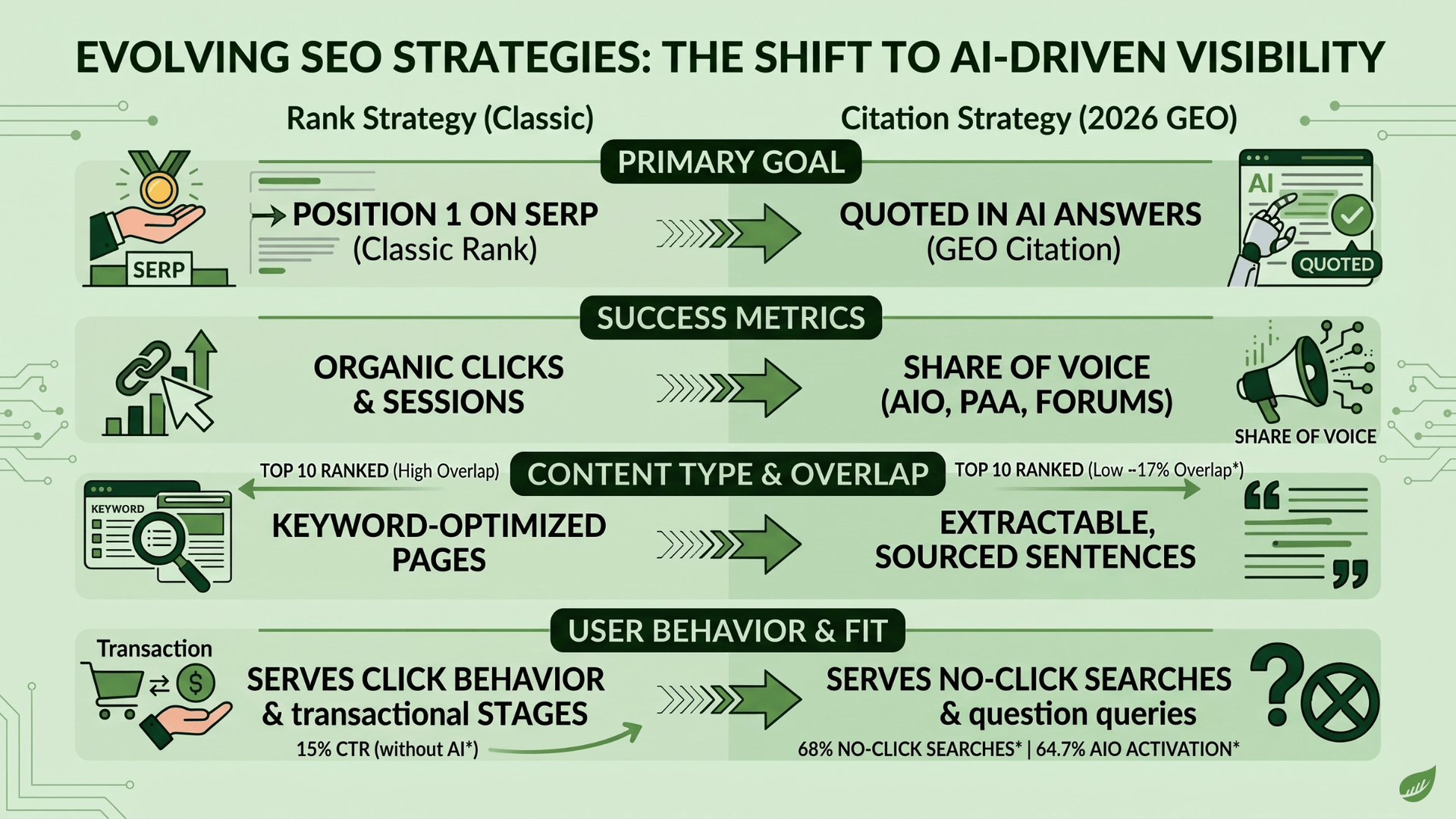
| Dimension | Rank strategy (classic) | Citation strategy (2026 GEO) |
|---|---|---|
| Primary goal | Position 1 on the SERP | Being quoted inside the AI answer |
| Success metric | Organic clicks, sessions | Share of voice on AIO, PAA, forum blocks |
| Overlap with top 10 | By definition, the top 10 | Only ~17% overlap with organic top 10 (BrightEdge, 2026) |
| Content shape | Keyword-optimized pages | Extractable, sourced, standalone sentences |
| Behavior it serves | 15% CTR when no AI summary (Pew Research Center, 2025) | 68% no-click searches (SparkToro, 2026; Similarweb, 2026) |
| Best-fit stages | All, especially transactional | Question-form queries (64.7% AIO activation) |
An 8-Step Checklist to Build Buyer-Journey SEO in 2026
- Map every target keyword to a stage. Bucket into Awareness, Consideration, Purchase, and Post-purchase to clearly see coverage gaps.
- Tag each keyword for AIO risk and opportunity. Note whether it triggers an AI Overview, because BrightEdge shows citation sources rarely match page-one rankings (BrightEdge, 2026).
- Rewrite awareness pages for extraction. Lead with a 40- to 60-word definition, crisp headings, and a "next question" section.
- Build honest comparison assets for consideration. Side-by-side tables, "who should not buy," and sourced claims that beat the 11% of unsupported AI claims in the wild.
- Make pricing and packaging concrete. Explain cost drivers, ranges, timelines, and what comes after purchase.
- Audit reviews for FTC compliance. Remove anything fake or AI-generated and disclose insider reviews to protect both conversions and visibility (Federal Trade Commission, 2024).
- Add structured data where it legitimately matches. Use JSON-LD per Google's guidelines and never mark up content that isn't on the page (Google, n.d.a).
- Shift your KPIs from sessions to visibility and demand. Track branded search growth, share of voice on SERP features, and organic-assisted conversions, not just last-click traffic.
The BusySeed Case Study: 23 to Over 1,500 Ranked Keywords
Before partnering with BusySeed, a client's organic visibility had plateaued at only 23 tracked keywords with inconsistent inbound traffic.
Through a GEO-focused SEO strategy, technical optimization, and AI-ready content development, we expanded their keyword footprint to more than 1,500 targeted rankings. This represents a 6,424% increase in the number of ranked organic keywords. Their brand now surfaces in ChatGPT search results for high-intent queries.
If you are ready to transition your site from traditional search to AI-driven visibility, explore our Generative Engine Optimization (GEO) services to see how we build this exact framework.
We want to be straight with you about why this worked, because the number alone can sound like a magic trick. It wasn't. Three things compounded:
- Technical fixes: These made crawling and indexing stable, so the content we built could actually be found and re-found.
- Intent-mapped content: This expanded the footprint across every stage, not just in transactional terms, which is how you go from 23 keywords to four figures without keyword stuffing.
- Structured, sourced content: This increased the odds of AI extraction and citation, which is why the brand started appearing in ChatGPT even as overall industry click volume fell.
That said, this isn't a fix for a weak product. Not every brand sees the same lift, and we'd be lying if we told you a number like 6,424% is typical. It's a strong result on a specific site with real technical debt to clear and genuine subject authority to build on. The framework is repeatable. The exact multiple is not a promise.
How Should You Measure a Search Engine Optimization Score That Reflects 2026?
Your search engine optimization score in 2026 should weigh visibility and downstream demand, not just rankings and sessions. This is because 68.01% of searches now end with no click (SparkToro, 2026; Similarweb, 2026).
Similarweb frames this as a structural shift toward measuring presence and demand rather than traffic, and that's the right instinct (Similarweb, 2026).
In practice, build a scorecard focused on these metrics:
- Branded search growth
- Share of voice across SERP features like AI Overviews and People Also Ask
- Organic-assisted conversions rather than last-click attribution
Keep an AIO risk-and-opportunity portfolio so you know which of your keywords are being summarized and which still drive clicks.
A high search engine optimization score used to mean "we rank". Now it means "we're present and cited across the journey, and demand is moving".
This evolution requires a more nuanced approach to SEO content that accounts for both traditional ranking factors and AI-driven content extraction patterns.
The Bottom Line
The shift to a zero-click search environment doesn't mean SEO is dead; it simply means the rules of engagement have changed. Success in 2026 requires engineering your SEO content for both human readers and AI extraction.
By mapping your on-page SEO strategy to every stage of the buyer journey and backing it with robust structured data SEO, you ensure your brand is cited exactly when and where buyers make their decisions. Ultimately, a strong search engine optimization score is no longer just about traffic; it's about driving pipeline momentum through sustained visibility.
Want a stage-by-stage keyword and content matrix built for your site? That's exactly the work we do at BusySeed. Bring us the plateau. We'll build the framework that gets you cited, ranked, and chosen. Let's elevate your search strategy together.
Frequently Asked Questions
1. What are the best digital marketing services for improving buyer-journey SEO in 2026?
The best digital marketing services combine technical SEO, intent-mapped content across all four buyer stages, and generative engine optimization (GEO) that targets AI citations rather than just rankings. Look for a partner who separates rank strategy from citation strategy, since BrightEdge found only about 17% of AI Overview citations overlap with the organic top 10 (BrightEdge, 2026). At BusySeed, we build coverage across Awareness, Consideration, Purchase, and Post-purchase so you're present wherever the buyer actually is.
2. How do we choose among marketing agencies in New York City for SEO and GEO work?
Choose an agency that can show real GEO outcomes, like brand appearances in ChatGPT or AI Overviews, not just keyword rankings, because rankings no longer guarantee clicks. Ask them how they measure visibility and downstream demand, given that 68.01% of U.S. Google searches now end without a click (SparkToro, 2026; Similarweb, 2026). A strong partner will have case studies showing measurable improvements in both your search engine optimization score and downstream conversions. They will also explain how they keep review content FTC-compliant (Federal Trade Commission, 2024). When evaluating top advertising companies in New York, look for those with proven expertise in both traditional SEO and developing SEO content for emerging AI-driven search optimization techniques.
3. What are the best tools to identify semantic gaps for AI ranking?
The best approach uses keyword and content tools that let you bucket terms by buyer stage and flag whether each term triggers an AI Overview, since Semrush's study of 10M+ keywords shows that AIO triggers spread into commercial and transactional intent (Semrush, 2025). Pair that with question-mining, because academic research found 64.7% of question-form queries triggered AI Overviews versus 13.7% overall. The gap you're hunting for is usually the conversational, specific question your competitors haven't answered cleanly enough to be cited. Tools like Clearscope, MarketMuse, and SurferSEO can help identify these semantic gaps in our SEO content strategy.
4. What are the best tools for evaluating content trust signals in the AI era?
Evaluate trust using tools that audit source citations, verify authenticity, and assess the validity of structured data, because AI engines reward pages with verifiable claims. Academic measurement found 11% of atomic claims in AI Overviews were unsupported by their cited pages, so being the page with clean, sourced receipts is a competitive edge. Also validate your structured data SEO implementation against Google's guidelines and confirm reviews meet FTC rules (Google, n.d.a; Federal Trade Commission, 2024), since fake or AI-generated reviews now carry legal risk on top of the SEO liability. Tools like ContentKing, Screaming Frog, and Google's Rich Results Test can help assess these trust signals in your content.
5. Do we still need to rank on page one if AI is answering the query?
Yes, because classic search still drives meaningful traffic. Pew Research Center found that people clicked on a traditional result 15% of the time when no AI summary appeared and that AI engines often draw from ranked pages (Pew Research Center, 2025). But ranking is no longer sufficient on its own. You need a parallel citation strategy for the roughly 30% of AI-cited pages that don't even appear in first-page results, which means engineering content for extraction alongside traditional ranking, bringing your user-intent SEO full circle.
Works Cited
- 6sense. Buyer Experience Report 2025. 6sense, 2025.
- Business Wire. New Research: Google's AI Overviews Now Cost Websites 58% of Their Clicks. Business Wire, 18 May 2026.
- BrightEdge. AI Overviews: One Year of Presence, Size, and Citing. BrightEdge, Feb. 2026.
- Federal Trade Commission. Consumer Reviews and Testimonials Rule: Questions and Answers. FTC, 2024.
- Gartner. Gartner Survey Finds Only One-Third of Consumers Say GenAI Rivals Search Engines; Marketers Must Optimize for Both AI-Driven and Traditional Search. Gartner, 2026.
- Google. Structured Data General Guidelines. Developers.Google (Google, n.d.a).
- Google. Breadcrumb Structured Data. Developers.Google (Google, n.d.b).
- Pew Research Center. How Americans Use Search Engines in 2025. Pew Research, March 2025.
- Semrush. AI Tools: The Modern Buyer Journey Study. Semrush, 2026.
- Semrush. AI Overviews Study: 10M+ Keywords Analyzed. Semrush, 2025.
- Similarweb. The Zero-Click Search Landscape in 2026. Similarweb, 2026.
- SparkToro. In 2026, Less Than One-Third of Google Searches Still Send a Click. SparkToro, 2026.
- Sprout Social. New Research from Sprout Social Finds Social Media Is the Top Place Gen Z Turns to for Search, Surpassing Traditional Search Engines. SproutSocial, May 2025.
- U.S. Census Bureau. Quarterly Retail E-Commerce Sales, 1st Quarter 2026. Census, 2026.