TL;DR
- 67% of B2B buyers prefer a rep-free buying experience, and 45% used AI during a recent purchase (Gartner, 2026).
- 72% of buyers encountered Google's AI Overviews during research, and 90% clicked at least one cited source to fact-check (TrustRadius, 2026).
- 87% of marketers say content helped create brand awareness, but only 49% say it helped generate sales or revenue (Content Marketing Institute, 2025). That gap is the whole problem.
- 69% of B2B buyers report inconsistencies between a company's website and what sellers tell them, a direct conversion killer (Gartner, 2026).
- 77% of buyers read user reviews during their journey, and 54% talk to an existing user before buying SaaS (TrustRadius, 2026).
NYC Content Strategy: Why Stopping At Awareness Creates A Confidence Gap
Most content strategies aren't broken because the writing is bad. They're broken because they stop one stage too early.
Awareness content vs decision content isn't a philosophical debate about funnels. It's the difference between a prospect who nods at your blog post and a prospect who walks into a buying committee and defends choosing you. Great SEO content earns the first. Almost nobody plans the second.
- Awareness content is top-of-funnel material that introduces buyers to your brand and builds early credibility.
- Decision content is bottom-of-funnel material that answers objections, proves outcomes, and reduces the risk of saying yes.
Both matter. The problem is that teams overload one side and starve the other. That imbalance creates what we call a confidence gap: the buyer knows who you are but can't build enough certainty to move. And in 2026, buyers are building that certainty mostly without you.
Here's the shift that changes everything. According to Gartner's 2026 sales survey, 67% of B2B buyers prefer a rep-free experience, and **45% used AI **during a recent purchase (Gartner, 2026).
If nearly half your prospects are asking an AI engine what to buy before they ever email you, your content has to do the convincing your sales team used to do in a discovery call. This shift makes user-intent SEO and AI content creation critical to ensuring your decision content surfaces when buyers seek answers. If you need a partner to orchestrate this shift, BusySeed crafts content ecosystems that guide buyers from their first click to their final buy-in.
What Is the Difference Between Awareness Content and Decision Content?
Awareness content builds recognition and trust early in the buyer journey, while decision content reduces risk and drives conversion at the end of the journey.
- Awareness content answers: *"Who are you and why should I care?"*
- Decision content answers: *"Why should I choose you over the three alternatives already open in my browser tabs?**"*
The jobs are genuinely different, and so are the formats.
The primary job of awareness content is to create preference before a buyer is even ready to act. These assets are designed to capture attention and build authority through:
- Category education to establish the landscape.
- Point-of-view pieces that challenge the status quo.
- Problem framing to clearly define the buyer's pain.
- Trend explainers that keep your brand relevant in the conversation.
While the primary job of decision content is to remove risk and answer objections to speed up internal buy-in. These assets focus on concrete proof points:
- Pricing clarity to remove friction and guessing.
- Comparison pages that position you against specific alternatives.
- Implementation timelines to show the path forward.
- Security details to mitigate compliance concerns.
- Quantified proof that demonstrates real-world outcomes.
Generating these specific assets doesn't have to drain your resources; strategic AI content creation can help you draft modular comparison pages and timelines efficiently.
The data shows exactly where teams get stuck. The Content Marketing Institute's 2025 outlook found 87% of marketers say content helped create brand awareness, while just 49% credit it with generating sales or revenue (Content Marketing Institute, 2025).
That 38-point spread is the confidence gap in a single statistic. You're really good at getting noticed. You're average, at best, at closing. This imbalance is why integrating social media marketing strategies and generating strong social signals that reinforce both awareness and decision stages is essential for a cohesive content strategy.
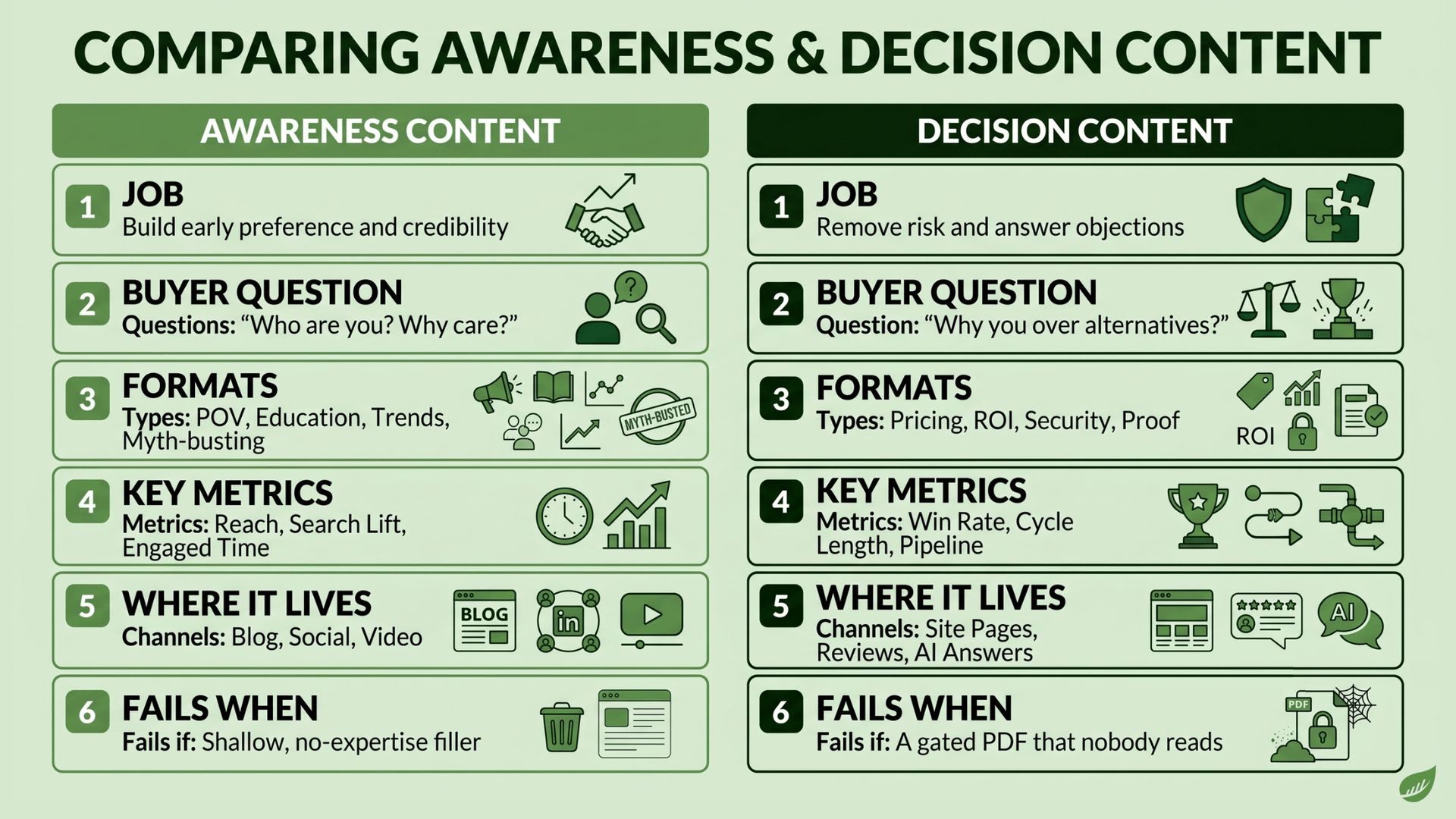
| **Strategy Element ** | Awareness Content | Decision Content |
|---|---|---|
| Job | Create preference and credibility early | Remove risk and answer objections |
| Buyer question | "Who are you? Why care?" | "Why you over the alternatives?" |
| Formats | POVs, education, trend explainers, myth-busting | Pricing, comparisons, ROI, security, proof |
| Key metrics | Reach, branded search lift, engaged time | Win rate, sales cycle length, self-serve pipeline |
| Where it lives | Blog, social, video | Site pages, review sites, AI answers |
| Fails when | It's high-volume SEO filler with no expertise | It only exists as a gated PDF that nobody reads |
Why the Missing Stage Isn't Consideration. It's Confidence.
The classic funnel says awareness, consideration, decision. We think that the middle word is misleading. The stage most teams actually skip isn't the consideration stage. It's confidence.
- Awareness content earns initial attention, engaging a prospect just long enough to introduce your brand and frame their problem.
- Decision content earns internal approval, arming a champion with the exact proof needed to say, "We've vetted this; we should buy it".
Gartner's research backs the stakes here. Confident buyers are twice as likely to report a high-quality deal, per the 2026 survey (Gartner, 2026). Read that again. Confidence isn't a soft feeling. It correlates with deal quality, meaning your content's role at the bottom of the funnel is to manufacture certainty, not just information.
And confidence is fragile. When your website says one thing and your sales rep says another, buyers stall. Gartner found that 69% of B2B buyers report inconsistencies between a company's website info and what sellers say (Gartner, 2026).
That is a conversion bug hiding in plain sight. You spent budget getting someone to the decision stage, and then two versions of your own story pushed them back into research. This inconsistency undermines social signals like shares and saves, which thrive on trust and clarity.
Your Biggest Competitor Isn't Another Brand. It's the Buyer's Shortcut.
A prospect opens ChatGPT or Perplexity, types "best options for X", and gets a shortlist in nine seconds. If your brand isn't in that answer, you're not in the first draft of their decision. You're not losing to a competitor with better positioning. You're losing to a shortcut that never mentioned you.
This is why AI content creation and user-intent SEO have merged into a single discipline. It's not enough to publish great SEO content. Your content has to be structured so an answer engine can lift it, cite it, and recommend it. G2's 2025 Buyer Behavior report shows that at decision time in North America, machines are winning. Here is who buyers trust most (G2, 2025):
- GenAI chatbots** (17.2%)**
- Software review sites** (13.4%)**
- Vendor salespeople** (only 9.3%)**
Note: They trust both GenAI chatbots and software review sites significantly more than vendor salespeople.
That same report found that research inputs scale with company size. For organizations with 5,000+ employees, the most used research inputs are (G2, 2025):
- Software review sites** (56%)**
- AI search (55%)
- Google (51%)
If your best decision assets only live behind a form on your own domain, you're absent from the exact places big buyers decide. To address this, ensure your decision content is optimized for social media marketing distribution, making it easily shareable and discoverable across platforms where buyers conduct their research.
The "Rep-Free" Buyer Forces Content to Become Buyer Enablement
Here's a field observation from a recent audit. A client came to us convinced they had a lead-gen problem. Traffic was strong, blog engagement was solid, and their social media marketing was consistent. But demos weren't converting.
When we mapped their library, 90% of it was awareness content. They had almost nothing that answered:
- "How much does this cost?"
- "How long is the implementation?"
- "Why you over the obvious alternative?"
They weren't missing leads. They were missing confidence assets. Their SEO content was driving traffic, but it wasn't matched to the specific, bottom-of-funnel user-intent SEO queries required to close the deal.
Buyers now expect to answer those questions themselves. Gartner's June 2025 survey found that 61% prefer a rep-free buying experience overall, and 73% actively avoid suppliers who send irrelevant outreach (Gartner, 2025).
You can't fix thin decision content by adding more sales calls. Buyers are penalizing exactly that behavior. The fix is content that serves as a stand-in for the early sales conversation.
Gartner's guidance is blunt: sellers can't rely on static collateral, and content should be structured into modular building blocks (Gartner, 2025). A single 40-page PDF isn't buyer enablement. True enablement is a buyer grabbing what they need, piece by piece:
- A pricing explanation
- An implementation timeline
- A comparison page
- A proof library
This modular approach aligns with user-intent SEO, ensuring each piece of content directly addresses specific buyer questions and needs.
What Actually Counts as Decision Content?
Decision content is anything that reduces the perceived risk of buying and accelerates internal approval. The four pillars are:
- Pricing clarity
- Comparison
- Risk reduction
- Proof
Miss any one, and you leave a specific objection unanswered.
Let's talk pricing, because this is where we will be mildly contrarian. Most agencies and SaaS brands hide pricing to "protect the sales conversation". We think that is a mistake in a rep-free world. TrustRadius found the number one thing buyers would change is more transparent pricing information (summarized as 49% in the report) (TrustRadius, 2026).
Hiding your price doesn't protect the deal. It removes you from the shortlist before the deal exists. Even a range with packaging logic beats a wall.
Proof is the second pillar that buyers actively seek. Notice the shift in where buyers get their information (TrustRadius, 2026):
- 77% of buyers read user reviews during their journey.
- 54% have a conversation with an existing user before purchasing a SaaS tool.
- Only 14% consult analyst reports during a purchase, a steep decline since 2022.
Buyers trust peers over analysts now. Your decision content should mirror that, leaning on real customer outcomes and third-party validation rather than borrowed authority. These social signals, such as reviews, testimonials, and user-generated content, are critical to building trust in your decision-stage content.
At BusySeed, the proof points we lead with are quantified, not adjectives, proving exactly why our digital marketing services deliver ROI:
- We helped ProPricer increase revenue 3x in one year, a run that led to its profitable acquisition by Deltek.
- A WealthVest campaign engaged 300 Fortune 1,000 C-level executives and created over $500M in opportunity.
- For Palisade Fence Company, our work drove 45% of total sales ($563K) with conversion rates up to 19.85%.
Those numbers are decision content. They answer "Does this actually work?" before anyone asks. When embedded strategically, this data transforms standard pages into high-converting SEO content. Aligning this transparency with user-intent SEO ensures your brand shows up exactly when buyers search for cost and performance comparisons.
That said, this isn't a fix for a weak product. Decision content accelerates good decisions. It can't manufacture a reason to buy something people don't want. If your proof is thin because your outcomes are thin, the content isn't the problem.
Why Awareness Content Still Matters (and Where It's Getting Riskier)
Awareness content isn't dead. Attention is genuinely expensive and getting more so. U.S. internet ad revenue hit $258.6B in 2024 (up 14.9% year over year) (IAB/PwC, 2024):
- Social alone reached $88.8B (+36.7%).
- Search reached $102.9B (+15.9%).
If you're paying those rising rates to attract attention and your decision content is thin, you're buying awareness that leaks. You pay to fill the top of a bucket with a hole in the bottom.
But awareness content is also where the SEO risk lives now. Google defines scaled content abuse as generating many pages primarily to manipulate rankings, including via generative AI, without adding value. With 86.4% of marketers now using AI tools per HubSpot's 2026 trends report (HubSpot, 2026), the volume play is more tempting and more dangerous than ever.
Because AI content creation is now table stakes, high-volume awareness SEO content is no longer a moat. Differentiation moved to original proof, specificity, and decision enablement. The social signals that matter (shares, saves, real engagement) follow substance, not word count.
Publishing more generic posts doesn't build authority. It builds risk. To mitigate this, focus on creating awareness content that aligns with user-intent SEO, ensuring it provides genuine value and answers the questions your audience is actively searching for.
How Do You Build a Balanced Content Strategy? A Practical Checklist
A balanced content strategy generates awareness and drives conversion by mapping every asset to a buyer's job and filling the confidence gap first. Here is the exact audit process our team at BusySeed runs to identify leaks and rebuild your strategy for conversion:
- Inventory everything and tag it. Label each asset as awareness or decision. Most teams discover a 90/10 split in favor of awareness. Seeing the imbalance is half the fix.
- Calculate your ratio. If awareness content outnumbers decision content more than 3 to 1, you have a confidence gap. Rebalance toward the bottom of the funnel first.
- Build the pricing asset. Publish a range, packaging logic, and what drives cost up or down. This alone addresses the top change buyers want.
- Create comparison pages. Cover "us vs. alternatives" and honestly, "who we're not for." Buyers respect the disqualifier and trust the rest of the page more.
- Assemble a proof library. Quantified case studies, customer quotes, and outcomes. Model it on numbers, not adjectives.
- Add risk reducers. Implementation timelines, onboarding steps, security and compliance details, service commitments. Answer the objections a nervous champion will face internally.
- Distribute decision content off-site. Get proof and reviews onto review ecosystems and structure content so AI engines can cite it. Decision content that only lives on your domain misses where big buyers actually decide.
- Fix website-to-sales alignment. Audit for the 69% inconsistency problem (Gartner, 2026). Make sure your pages and your reps tell one story.
- Make assets citation-ready. Use clear definitions, scannable tables, transparent methodology, and named experts, so answer engines can safely quote you. With 90% of buyers clicking a cited source to fact-check AI answers (TrustRadius, 2026), having the citation is the new page-one ranking.
- Measure both jobs separately. Track awareness with reach, branded search lift, and engaged time. Track decision content with win rate, sales cycle length, and self-serve pipeline. Different jobs, different scoreboards.
Not every brand sees the same lift from this, and we'll be honest about that. A business with a long, complex enterprise sale will weigh decision content differently from a self-serve SaaS tool. The ratio isn't universal.
The principle is: audit the gap, fill the confidence stage, then keep both engines running. This approach ensures your social media marketing efforts are aligned with both awareness and decision goals, maximizing the impact of your content across all stages of the buyer journey.
Bringing It Together: Stop Paying for Awareness That Leaks
Getting noticed is only half the battle. If your traffic is high but your demo requests are flat, you do not have an audience problem; you have a confidence gap. Buyers are actively seeking proof, pricing, and risk reduction, and they are turning to AI engines when your site falls short. They also look for strong social signals to validate their choices before escalating a product to their team. To win in 2026, your bottom-of-funnel content must do the heavy lifting of a great sales rep.
If you want a partner who can audit your current library and build the decision assets you are missing, let's talk. BusySeed helps brands align user-intent SEO directly with the buyer's journey, closing the gap between traffic and revenue. Reach out to our team today to build a cohesive strategy that turns passive awareness into a measurable pipeline.
Frequently Asked Questions
1. What is the difference between awareness content and decision content, and how do we spot a confidence gap?
Awareness content introduces your brand and builds early credibility, while decision content answers objections and reinforces purchasing confidence. Most strategies overinvest in awareness; the Content Marketing Institute found that 87% of marketers say content builds awareness, but only 49% say it generates revenue (Content Marketing Institute, 2025).
If your awareness content outnumbers decision content by more than 3:1, you have a confidence gap. Fixing this requires pricing clarity, comparison pages, and quantified proof. As one of the marketing agencies in New York City focused on full-funnel revenue, BusySeed runs this exact audit to close your confidence gap and accelerate your pipeline.
2. Why is decision-stage content more important now than it used to be?
Buyers now make decisions before ever talking to us. Gartner reports 67% of B2B buyers prefer a rep-free experience and 45% used AI during a recent purchase (Gartner, 2026). With nearly half your prospects consulting AI engines before contacting sales, your decision content must do the convincing a discovery call once did. Confident buyers are twice as likely to report a high-quality deal, making discoverable, persuasive decision content crucial for revenue quality.
3. How do we make our content get cited by AI engines and build trust in SEO?
Create citation-ready assets with original data, scannable tables, and direct, self-contained answers. This is vital because 72% of buyers encounter Google's AI Overviews, and 90% click on cited sources to fact-check (TrustRadius, 2026). To support this, utilize the Best tools for building trust in SEO, such as Ahrefs for user-intent alignment and Clearscope for AI readiness. Top techniques for building trust with AI-generated social media posts include clearly disclosing AI use, featuring real customer testimonials, and providing actionable insights.
4. What are the best trust signals for decision-stage content?
The strongest trust signals are transparent pricing, user reviews, and real peer validation. TrustRadius found 77% of buyers read user reviews and 54% talk to an existing user before buying SaaS, while only 14% consult analyst reports (TrustRadius, 2026). Buyers trust peers over borrowed authority, and transparent pricing remains their most requested change. Building a quantified proof library and a strong presence on review sites is critical for reinforcing credibility.
5. How do we choose the best agency for our business?
When evaluating the best digital marketing agency in NYC, look for services that address both awareness and decision stages of the buyer journey. Key services include SEO content creation, social media marketing, and AI-tailored content creation for your industry. A strong agency should also offer user-intent SEO strategies to ensure your content ranks for the right queries, as well as decision-stage content development, such as pricing pages, comparison guides, and proof libraries. Additionally, ask about our approach to social signals, including review management and user-generated content, which are critical for building trust and credibility.
Works Cited
- Content Marketing Institute. B2B Content Marketing Trends Research 2025. 2025, https://contentmarketinginstitute.com/b2b-research/b2b-content-marketing-trends-research-2025.
- Gartner. "Gartner Sales Survey Finds 67 Percent of B2B Buyers Prefer a Rep-Free Experience." Gartner Newsroom, 9 Mar. 2026, https://www.gartner.com/en/newsroom/press-releases/2026-03-09-gartner-sales-survey-finds-67-percent-of-b2b-buyers-prefer-a-rep-free-experience.
- Gartner. "Gartner Sales Survey Finds 61 Percent of B2B Buyers Prefer a Rep-Free Buying Experience." Gartner Newsroom, 25 June 2025, https://www.gartner.com/en/newsroom/press-releases/2025-06-25-gartner-sales-survey-finds-61-percent-of-b2b-buyers-prefer-a-rep-free-buying-experience.
- G2. 2025 G2 Buyer Behavior Report. 2025, https://images.g2crowd.com/uploads/attachment/file/1470753/2025-G2-Buyer-Behavior-Report.pdf.
- HubSpot. HubSpot Blog Marketing Industry Trends Report. 2026, https://blog.hubspot.com/marketing/hubspot-blog-marketing-industry-trends-report.
- IAB/PwC. Digital Ad Revenue 2024. 2024, https://www.iab.com/news/digital-ad-revenue-2024/.
- TrustRadius. Bridging the Trust Gap: B2B Tech Buying in the Age of AI. 2026, https://go.trustradius.com/rs/827-FOI-687/images/TrustRadius-Bridging-the-Trust-Gap-B2B-Tech-Buying-in-the-Age-of-AI.pdf.