TL;DR
- More than 50% of younger buyers will include 10 or more external influencers in a single purchase decision, shifting the buying journey from a funnel to a web of touchpoints (Forrester, 2024).
- Social media is now a larger driver of digital ad revenue than search, reaching $117.7B and growing 32.6% year over year (IAB and PwC, 2026).
- When an AI summary appears in search results, users click a traditional search result only 8% of the time and click a link inside the AI summary just 1% of the time (Pew Research Center, 2025b).
- In early 2026, 68.01% of U.S. Google searches ended without a single click, proving that securing visibility within AI-generated answers is more crucial than ever (SparkToro, 2026).
- Generative Engine Optimization (GEO) strategies can improve brand visibility within AI-generated responses by up to 40%, making reference-grade content the new baseline for AI SEO and modern SEO marketing (Princeton University, 2024).
What Is AI SEO And How Does It Connect Search, Social, And Paid Media Into One Revenue Engine?
AI SEO is a marketing discipline that optimizes your content, structure, and authority so that AI search engines like ChatGPT, Perplexity, and Google AI Overviews cite your brand inside their answers, not just so classic search engines rank your pages.
That distinction matters more than most marketers admit. Because the click you used to count on is disappearing, and the brands winning revenue right now treat SEO, social media marketing, paid media strategy, and AI search as one connected system instead of four teams that never talk.
Here is the uncomfortable truth we keep running into with new clients. Their budget is already spread across search, social, and paid. Their buyers are already bouncing between all of those channels before they ever convert.
The only thing that isn't integrated is the operating system connecting them. That gap is where revenue leaks out. Let us at BusySeed show you what the data says and what we would actually do about it.
Why Does A Single Marketing Channel No Longer Drive Sustainable Growth?
No single channel drives sustainable growth anymore because the buying journey has fractured into a network of touchpoints that no one channel controls.
Forrester predicted in October 2024 that (Forrester, 2024):
- More than 50% of younger buyers will include 10 or more external influencers in a single purchase decision.
- More than half of large B2B transactions over $1M will go through digital self-serve channels such as vendor sites or marketplaces.
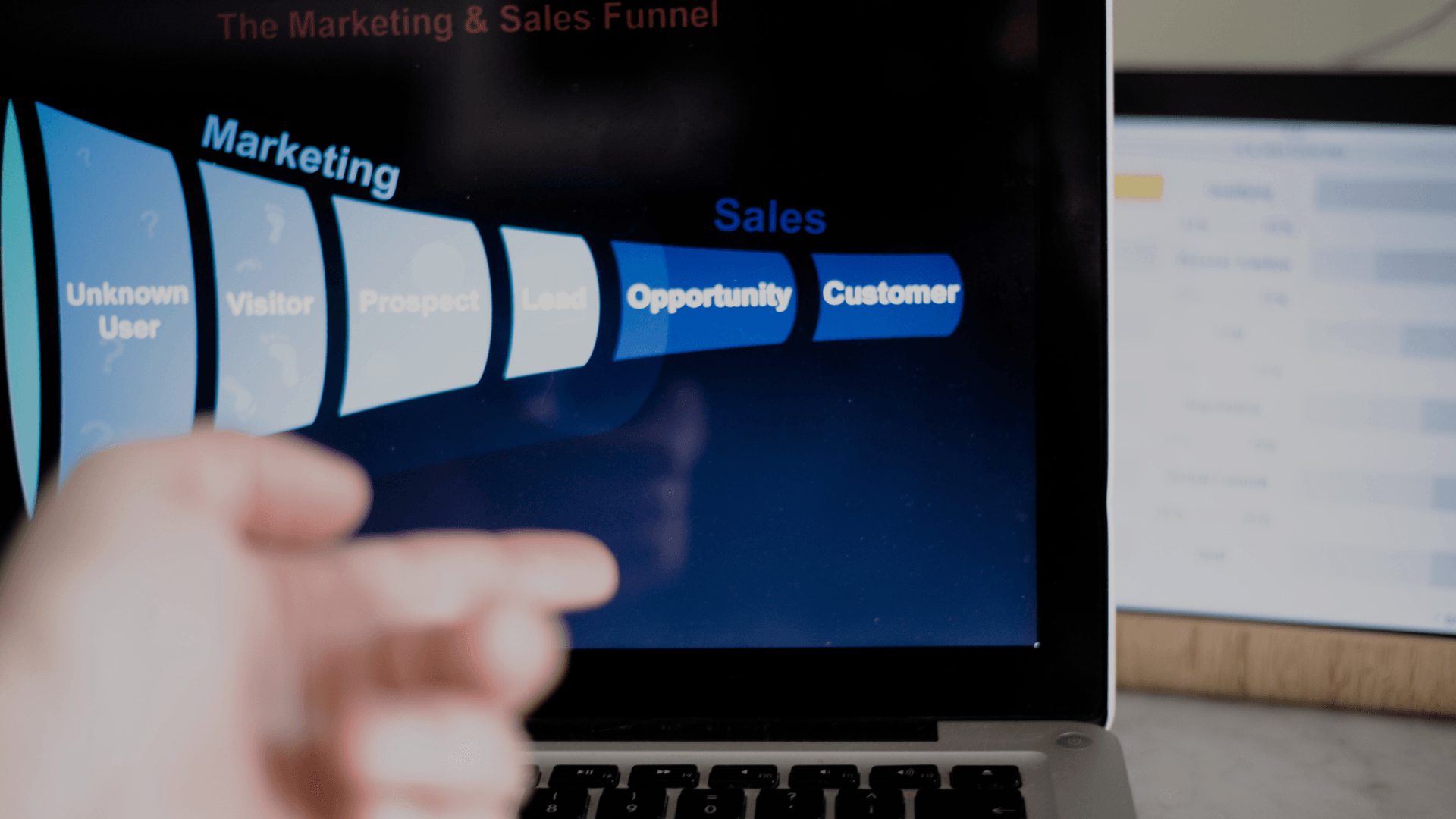
Think about what that means. A buyer might discover you through a creator's TikTok, verify you through a Google search, read an AI summary that mentions three competitors, check a review site, get retargeted by an ad, then search your brand name directly before converting.
That is not a funnel. It is a web.
And the money follows that web. U.S. digital ad revenue hit $294.6B in 2025, up 13.9% year over year. Search pulled $114.2B of that. Social pulled $117.7B (IAB and PwC, 2026).
Social is now a bigger ad revenue line item than search, and it grew 32.6% while search grew 11.0% (IAB and PwC, 2026). That is not a trend. It is an economic reallocation that tells you exactly where your buyers are paying attention before they ever type a query.
This shift underscores why a cohesive paid media strategy must align with organic efforts to capture demand across all touchpoints, especially as AI-driven search behaviors reshape how users interact with content. If your team is struggling to unify these efforts, explore how we at BusySeed integrate social media marketing and SEO marketing into cohesive cross-channel strategies to capture demand at every stage.
What Is Generative Engine Optimization And How Is It Different From SEO?
Generative engine optimization is the practice of structuring and sourcing your content so AI engines quote it directly inside generated answers, while traditional SEO marketing focuses on ranking a page in a list of blue links that a human clicks. The difference is subtle until you look at what is happening to clicks.
The Pew Research Center analyzed 68,879 Google searches collected in April 2025 (Pew Research Center, 2025b), revealing a massive shift:
- Users clicked a traditional search result only 8% of the time when an AI summary appeared, versus 15% when no summary was present.
- They clicked a link inside the AI summary itself just 1% of the time.
- AI-summary pages ended the browsing session 26% of the time, versus 16% otherwise.
So the summary answers the question, and the user leaves. The click never happens.
It gets sharper. SparkToro's June 2026 analysis found that 68.01% of U.S. Google searches ended without any clicks in early 2026, up from 60.45% in 2024 (SparkToro, 2026). Less than a third of searches now send a click anywhere.
Here is our contrarian take, and plenty of agencies will disagree: chasing rankings as your primary SEO goal in 2026 is a losing game. Rankings still matter in traditional SEO marketing, but they are no longer the overall finish line for AI SEO. The finish line is being the source that the AI pulls from.
Princeton's GEO research presented at KDD 2024 found that generative engine optimization strategies can improve visibility in AI-generated responses by up to 40% (Princeton University, 2024). That is the number we would chase now.
Their study examined over 10,000 AI-generated responses across multiple platforms, revealing that content optimized for citation, not just ranking, consistently outperformed traditional SEO approaches in AI-driven search environments.
The research also highlighted that AI engines prioritize content with clear attribution, structured data, and authoritative sourcing, which aligns with the shift toward reference-grade content. This isn't just about visibility; it is about becoming the default source for AI-generated answers, which now dominate the search landscape.
That said, this isn't a fix for a weak product or a page nobody trusts. GEO amplifies credibility. It doesn't manufacture it.
How Do You Get Cited By AI Search Engines?
You get cited by AI engines by writing content that reads like a reliable reference, featuring:
- Clear standalone claims that provide direct and definitive answers.
- Properly attributed statistics that point to verified, credible sources.
- Clean content structures that organize information logically and visually.
- Tight definitional sentences that engines can lift without surrounding context.
Sales pages that read like brochures rarely get pulled.
There is a telling detail in the Pew data. AI summaries linked to .gov sites 6% of the time, compared to 2% in traditional results (Pew Research Center, 2025b). Translation: AI engines favor content that looks authoritative and reference-grade. If your money pages read like a pitch, they won't get cited, no matter how well they're optimized for classic ranking.
We learned this the hard way with a mid-market SaaS client. Their pages ranked fine, but AI Overviews kept quoting a competitor.
We rewrote their core "how to choose" pages into tight fact blocks with clear definitions, attributed stats, and structured comparisons, rather than persuasive prose.
And the result? Within two months, the brand started appearing in AI answers for its core category terms. Not because we outranked anyone. Because our work became easier to quote.
If you want a partner who builds this into your foundation, our generative engine optimization services at BusySeed are designed around exactly this shift. By blending technical SEO marketing with content design, we ensure your brand is cited, not just indexed.
Are Paid Ads And AI Search Actually Converging?
Yes, paid ads and AI search are converging fast because ad inventory is moving directly into AI answer experiences.
Google documents that ads can appear above, below, or within AI Overviews (Google, n.d.a), and its Google Marketing Live 2025 announcements confirmed the expansion of ads in AI Overviews and the arrival of ads in AI Mode (Google, 2025).
Adapting your paid media strategy to include these AI-native placements ensures you don't lose ground as user behavior shifts.
So when organic clicks disappear into an AI summary, paid placement becomes the way to reclaim visibility on that same surface. AI search isn't only an SEO problem. It is a paid media strategy and measurement problem, too.
The other AI engines are building the same inventory. Microsoft Advertising reported that Performance Max boosted Product ad impressions on Copilot by 5x and improved click-through rate by 2x compared with traditional search, based on first-party data from August 2023 to August 2024 (Microsoft Advertising, 2024). AI-native placements are real inventory now, not an experiment.
Here is the connection people miss. Your GEO work and your paid strategy target the same real estate. If you optimize to get cited organically in an AI answer, and you also buy placement in that answer surface, you show up twice in the exact moment a buyer is deciding.
One team chasing rankings and another team chasing ROAS will never orchestrate that. One integrated paid media strategy will.
Where Does Social Media Marketing Fit In A Revenue System?
Social media marketing serves as the demand-creation engine that generates search queries and retargeting pools, which other channels later convert. It is where pre-search intent gets built, and the reach is enormous.
According to Pew's 2025 social media use report (Pew Research Center, 2025a), adoption across U.S. adults is massive:
- 84% use YouTube (48% daily)
- 71% use Facebook (52% daily)
- 50% use Instagram
- 37% use TikTok (24% daily)
But raw reach isn't the point, and vanity metrics are where a lot of social media marketing budgets go to die.
The point is that social content creates the language people later search. When a creator explains your category a certain way, buyers borrow that phrasing and type it into Google or an AI assistant weeks later. Your social program is quietly writing your future keyword list.
That is why we tell clients to plan keywords and creators together, not in separate meetings. Use paid social and creators to surface objections, comparison phrasing, and "versus" language.
You can then harvest that exact language for your SEO marketing and paid search.
And run search-lift thinking: if your social is genuinely working, you should see branded search and direct traffic climb, not just platform-reported ROAS.
Not every brand sees the same lift here. If your product has no strong point of view, social won't invent one for you. But when the positioning is sharp, social is the fastest way to seed demand for the rest of the system to harvest. Partnering with our team at BusySeed ensures your social media marketing seamlessly feeds your paid and organic pipelines.
The Four Channel Roles In One Integrated System
Here is the model we use to explain how these pieces fit, because most teams can execute each channel but can't articulate the job each one does.
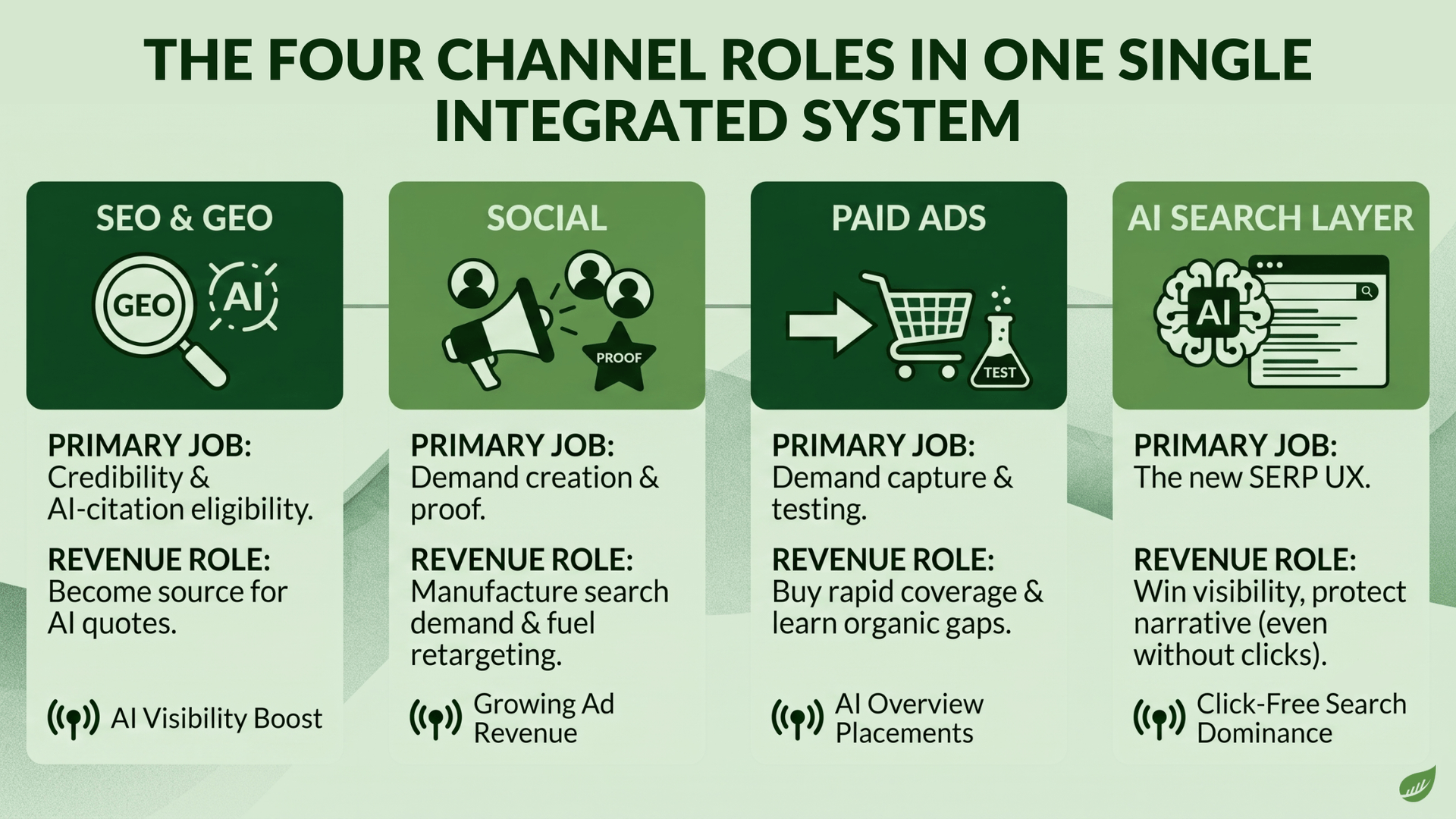
| Channel | Primary job | Revenue role | Key 2025–2026 signal |
|---|---|---|---|
| SEO and GEO | Credibility and AI-citation eligibility | Become the source of AI quotes; convert the shrinking share that still clicks | GEO can lift AI visibility up to 40% (Princeton, KDD 2024) |
| Social | Demand creation and proof | Manufacture search demand and fuel retargeting pools | Social ad revenue $117.7B, +32.6% (IAB/PwC) |
| Paid ads | Demand capture and testing | Buy coverage and rapid learning of organic compounds | Ads now appear within AI Overviews (Google) |
| AI search layer | The new SERP UX | Win visibility even when clicks drop; protect brand narrative | 68.01% of searches ended click-free in early 2026 (SparkToro) |
Read that table as one machine. Social creates the query. SEO and GEO make you the answer. Paid captures the demand that doesn't click organically. The AI layer is the screen where it all plays out. Miss one role, and the others carry a heavier load than they should.
Why is integration really a measurement problem?
Integration is fundamentally a measurement problem, because if you can't measure cross-channel and incremental impact, you keep over-funding the last-touch channel and starving the channels that created the demand.
That last-touch channel is usually branded search, which gets credit for conversions that social and content actually generated.
The scale of the blind spot is real. Nielsen's 2025 Annual Marketing Report found that only 32% of marketers globally measure their media spending holistically across digital and traditional (Nielsen, 2025). Two-thirds are flying with partial instruments.
And incrementality is where the money hides. Meta's "suite of truth" measurement whitepaper reported a 46% performance lift when campaigns were optimized for incremental conversions, based on 37 conversion-lift studies conducted from July through October 2024 (Meta, 2026).
That gap between attributed ROAS and true incremental lift is exactly what breaks single-channel thinking, especially when trying to measure the real impact of social media marketing on your AI SEO results. A channel can look great on last-touch and add almost nothing incrementally.
So don't build a single dashboard and call it truth. Build a suite of truth:
- Short-cycle conversion lift tests and holdouts where you can run them.
- Always-on attribution in GA4 and ad platforms treated as directional rather than gospel.
- Quarterly marketing mix modeling (MMM) to allocate budget and spot diminishing returns.
Google even open-sourced Meridian for that MMM workflow if you want a starting point. Setting up this architecture can be complex, but our experts at BusySeed can help you stand up your suite of truth to accurately measure incremental lift.
Why The Online Revenue Shift Makes This Urgent
More revenue is happening online every year, which multiplies touchpoints and makes cross-channel orchestration a requirement rather than a nice-to-have.
The U.S. Census Bureau reported that 2025 total e-commerce sales reached $1,233.7B, up 5.4% over 2024, and e-commerce climbed to 16.4% of total retail sales from 16.1% the prior year (U.S. Census Bureau, 2025).
Commerce media sits squarely in the middle of that shift, serving as a bridge between awareness and conversion. IAB and PwC put 2025 commerce media at $63.4B, up 18.0% year over year (IAB and PwC, 2026).
Every dollar that moves online adds another measurable touchpoint, and every touchpoint you can't connect is a story your attribution tells wrong.
An 8-Step Integrated Revenue Playbook
Here is the sequence we would run for a brand starting from four disconnected channels.
- Map your buyer's actual network. Document every touchpoint from first exposure to conversion, including social discovery, AI summaries, review sites, and branded search. Stop drawing funnels.
- Audit your money pages for AI citations. Rewrite them as definitional sentences, with attributed stats and a clean structure so AI engines can quote them, not just rank them.
- Pull category language from social. Mine creator content and social comments for the exact phrasing buyers use, then feed it into your SEO and paid keyword sets.
- Claim AI-answer real estate on both sides. Optimize for organic citation through generative engine optimization and buy paid placement in AI Overviews and AI Mode surfaces.
- Build retargeting pools from social engagement. Treat social reach as demand generation that feeds paid capture, not as a standalone ROAS line within your paid media strategy.
- Instrument branded-search lift. Watch branded search and direct traffic as proof that your upper-funnel work is landing.
- Stand up for your suite of truth. Combine lift tests, directional attribution in GA4, and quarterly MMM so no single channel takes false credit.
- Reallocate quarterly on incrementality, not last touch. Move budget toward channels that create demand, using incremental lift as the deciding metric.
That is the difference between four channels running in parallel and one system compounding. If you don't have the internal bandwidth to execute these eight steps, we at BusySeed are ready to orchestrate this entire playbook for you.
Bringing It All Together
Your buyers don't live in silos, and your marketing shouldn't either. As clicks disappear into AI summaries and social platforms write tomorrow's search queries, the brands that win will be the ones that connect these fragmented touchpoints into a single, measurable revenue engine. It's no longer just about ranking; it's about being cited, being present, and proving incremental lift across every channel.
If you want an expert team to pressure-test your current SEO marketing and social media marketing efforts to prioritize the highest-ROI moves, let's talk. BusySeed can help you audit your money pages for AI citation, align your paid and organic efforts, and build a "suite of truth" measurement framework that stops revenue leaks. Connect with us today if you'd like us to rebuild your cross-channel strategy end-to-end. We're ready to help.
Frequently Asked Questions
1. What are the best digital marketing services for a business that wants to show up in AI search?
The most useful digital marketing services for AI visibility combine generative engine optimization, technical SEO, and paid placement in AI answer surfaces, because organic citation and paid coverage now compete for the same screen space. Look for a partner who can rewrite your core pages to be citation-eligible and simultaneously buy placement inside AI Overviews and AI Mode. A Princeton study at KDD 2024 found that GEO can lift AI visibility by up to 40% (Princeton University, 2024), so the organic side is worth a real investment alongside paid channels.
2. How do marketing agencies in New York City approach integrated cross-channel strategies?
Strong marketing agencies in NYC and elsewhere increasingly build around cross-channel orchestration and incrementality measurement rather than siloed channel management, because that is where the revenue actually hides. Businesses seeking these strategies should look for partners with documented case studies in generative engine optimization and paid media placement within AI Overviews.
The tell is whether an agency measures holistically: Nielsen found only 32% of marketers do (Nielsen, 2025). The best teams demonstrate deep experience in mapping buyer touchpoints across AI search, social, and paid channels, executing coordinated campaigns that capture demand at every stage of the journey.
3. Which top advertising companies NYC should brands evaluate for paid media in AI search?
When evaluating top advertising companies NYC, brands should prioritize partners who can execute paid placements within AI experiences and demonstrate incremental lift, since ads now appear in Google AI Overviews and Microsoft Copilot (Google, n.d.a). Ask whether they have run campaigns on AI-native inventory. Microsoft reported that Performance Max drove 5x more Product ad impressions on Copilot and achieved a 2x higher CTR, indicating this inventory is already producing measurable results (Microsoft Advertising, 2024). Agencies that specialize in paid media strategy for AI-driven environments will have the most relevant experience.
4. Which generative engine optimization solutions actually move the needle?
The generative engine optimization (GEO) solutions that work focus on making your content reference-grade: tight definitions, clearly attributed statistics, structured comparisons, and authoritative sourcing that AI engines prefer to quote. Pew's analysis showed that AI summaries cite .gov sites 6% of the time, versus 2% in traditional results, a signal that reliability-signaling structure is rewarded (Pew Research Center, 2025b). Pair that with paid coverage on the same surface, because 68.01% of searches now end without a click (SparkToro, 2026). Solutions that integrate AI SEO with paid media placement tend to deliver the strongest results.
5. How can platforms implement top AI tools for social media marketing with privacy safeguards?
Top AI tools with privacy safeguards support strong security compliance when they rely on aggregated, consented first-party data rather than invasive tracking, which aligns with the shift toward incrementality-based measurement. The safer path is to combine privacy-respecting measurement, such as marketing mix modeling, with tools that use consented data, since Google's open-source Meridian supports MMM workflows that don't depend on individual-level tracking (Google, n.d.b). Choose tools that let you measure lift without over-collecting personal data. Many leading advertising companies now offer these privacy-focused solutions as part of their social media marketing toolkits.
Works Cited
- Forrester. The Future of B2B Buying. October 2024.
- Google. Google Marketing Live 2025. 2025a.
- Google. About ads in AI Overviews. No date (n.d. a).
- Google. Meridian: Marketing Mix Modeling. No date (n.d. b).
- IAB and PwC. Internet Advertising Revenue Report: Full Year 2025. April 2026.
- Microsoft Advertising. Transforming Audience Engagement with Generative AI. October 2024.
- Nielsen. 2025 Annual Marketing Report: The Power of Data-Driven Marketing. 2025.
- Meta. Suite of Truth: Measurement Whitepaper. April 2026.
- Pew Research Center. Social Media Use in 2025. November 20, 2025a.
- Pew Research Center. Google Users Are Less Likely to Click on Links When an AI Summary Appears in the Results. July 22, 2025b.
- Princeton University. GEO: Generative Engine Optimization. KDD 2024.
- SparkToro. In 2026, Less Than One-Third of Google Searches Still Send a Click. June 2026.
- U.S. Census Bureau. Quarterly Retail E-Commerce Sales, 4th Quarter 2025. 2025.