Buyers are using AI just as much as advertisers are. They research faster, filter harder, and arrive with stronger expectations. Lead generation now has to earn trust before the first form is filled out.
TL;DR
- Buyers use AI tools before they ever see your brand. Meet them with self-serve proof, not generic pitches, and design AI lead generation around trust, speed, and relevance.
- Cold outreach loses; precision wins. Personalize your AI ads and content with intent data and protection-first experiences, then blend automation with expert humans.
- ROAS growth comes from orchestration, not more noise. Integrate paid search and YouTube, unify measurement, and optimize for qualified intent to improve the efficiency of performance marketing.
- Trust is your multiplier. Transparent data practices, verified proof, and smart lead nurturing sequences convert AI-savvy buyers who double-check everything.
- The future is hybrid. Use automation to qualify and educate, and bring in specialists for validation and deal pacing. That’s how you reduce CAC and shorten the buyer journey.
Why are AI-driven buyers changing the rules in 2026?
Your prospects often arrive with answers already in hand. Roughly 94% of B2B buyers now use AI tools during research, often long before a form or demo request is even on the table (6sense). At the same time, about 60% of internet users encounter AI-generated answer summaries while browsing, which compresses the early buyer journey from weeks to minutes (Pew Research).
What that means for AI lead generation: your first touch is rarely your first impression. Buyers consult AI assistants, read synthesized comparisons, and expect immediate, data-backed clarity. If your AI ads, landing experiences, and lead nurturing streams don’t mirror that speed and substance, you’ll lose the click and the conversation. This is happening as budgets flood into AI. Gartner forecasts worldwide AI spending to hit $2.5T by 2026, with more than 80% of enterprises deploying generative AI applications by then (Gartner;
Gartner). You’re not just competing with brands, you’re competing with an
AI-shaped research layer and an
AI-shaped ad market that pressure-tests every message.
How do you redesign the funnel when buyers first research with AI?
Start by building a self-serve spine that front-loads proof. The buyer journey still matters, but it needs more “show, don’t tell” earlier and fewer gates until the buyer is ready.
- Put expert-grade clarity in front of forms. Comparison sheets, live calculators, and outcome simulators answer the questions an assistant would ask. Your AI lead generation doesn’t replace content; it accelerates the right content to the right person at the right time.
- Use intent signals to personalize without being creepy. Between search queries, content consumption, and session behavior, you can tune AI ads and landing pages to the job-to-be-done. Disclose how data is used and let users set preferences to maintain trust.
- Shift from volume to velocity. When AI condenses research, speed-to-proof beats speed-to-lead. Optimize page load, snappy summaries, and micro-interactions to guide the buyer journey.
- Integrate trust from the first pixel. Prominent reviews, case studies, benchmarks, and certifications shorten the path to “Yes”, especially for AI-equipped buyers who cross-check claims. The IAB found AI tools now rank as the #2 most influential shopping source, yet only about 46% fully trust AI product recommendations, 89% still validate claims (IAB via PR Newswire). Help them validate you.
These principles form the foundation of the top-rated strategies for capturing AI-first buyers: front-loading proof, designing self-serve validation paths, orchestrating AI ads with trust-forward landing experiences, and
pairing automation with
on-demand human expertise. When aligned, they create a buyer journey that feels credible, fast, and buyer-controlled from the first interaction.
Curious what this looks like in practice? Explore our self-serve, trust-first approach to
AI lead generation at BusySeed.
How do we rebuild trust before the form is filled out?
By removing doubts proactively and making it safe -and worthwhile- to engage. The best strategies for building trust online before form submission combine radical clarity with control.
- Be transparent about data. Deloitte reports ~70% of consumers worry about privacy, and only ~10% are comfortable sharing sensitive data (Deloitte). Put your privacy policy in plain English, explain how first-party data improves their experience, and let them choose how and when to hear from you. Transparency boosts lead nurturing outcomes.
- Front-load social proof. Verified case studies, analyst quotes, customer videos, and third-party benchmarks should appear above the fold and throughout the buyer journey. Make your proof scannable and specific.
- Create an expert-facing knowledge layer. Technical briefs, architecture guides, ROI models, and migration plans help AI-driven researchers go deeper on your site. Your AI lead generation then captures truly qualified interest.
- Offer “rep-free” clarity. Gartner notes 61% of B2B buyers prefer a rep-free experience, and 73% avoid vendors who send irrelevant outreach (Gartner). Publish pricing ranges, SOW templates, and evaluation checklists so buyers can self-score fit before lead nurturing starts.
How can we personalize at scale without crossing the line?
Personalize on intent, not identity, and explain the value exchange. You can craft highly relevant AI ads and landing experiences by tuning to the task the visitor is trying to accomplish, rather than by over-collecting personal data.
- Segment by problem and progress. Map the buyer journey as a series of jobs-to-be-done, then align content and CTAs to each job. That keeps AI lead generation helpful rather than invasive.
- Use predictive models as guardrails. Let scoring models prioritize who gets what message, but keep human-reviewed rules for sensitive segments. This balance improves performance marketing and protects brand trust.
- Provide preference centers up front. Let people choose cadence, channel, and topic depth. When someone opts into a “technical deep dive” track, your lead nurturing can go richer without triggering unsubscribes.
How do AI ads meet AI-first buyers without adding to the noise?
Orchestrate creative, context, and credibility as one system. The point isn’t to flood feeds with more variations; it’s to serve the one message that makes next-step logic obvious.
- Connect Search and video to win the second look. Google’s data shows campaigns that blend Search and YouTube deliver around 21% higher ROAS than other combinations (Think with Google). Your AI ads might capture initial interest, while YouTube delivers proof via customer stories or product walkthroughs, then Search closes with a trust-forward landing page.
- Structure narrative for multi-touch. If a prospect first sees a claim in an AI-generated overview, your first-party content must corroborate it instantly. Use hero statements that can stand on their own, with deeper evidence one click away. This is essential for modern performance marketing.
- Optimize for qualified intent, not lowest CPA. With AI-driven bidding, cheap clicks will come. Wins come from weighting aQL and SQL signals over raw lead volume. That’s how AI lead generation moves the pipeline, not spreadsheets.
How should attribution evolve for 2026 performance marketing?
Move from channel-first to question-first attribution. The buyer journey is being compressed and re-ordered by assistants and summaries, so linear and last-click models will mislead.
- Instrument micro-proofs. Track interactions that verify claims: case study scroll depth, ROI calculator completion, proof asset downloads, and repeat visits to “validation” pages. These are leading indicators of lead nurturing success.
- Model against jobs-to-be-done. Create cohorts around core buyer questions (build vs. buy, migration risk, payback period) and map which assets and AI ads lift progression within each cohort. This yields stable signals even as channels shift.
- Blend MMM with incrementality tests. Run lightweight geo/city split tests and sequential holdouts for creative narratives. Your performance marketing dashboard should unify these, not force teams to choose between them.
What does lead nurturing look like when buyers prefer self-service?
Shorter, tighter, and anchored in proof. Prospects don’t want a drip for the sake of dripping; they want help making the right decision, faster.
- Build “choose-your-own-proof” sequences. Instead of 12 generic emails, build three short tracks: business case, technical feasibility, and change management. Gate nothing until the pricing request. This keeps AI lead generation aligned to autonomy.
- Pair automated education with optional expert sessions. Gartner projects that by 2030, 75% of B2B buyers will prefer experiences that prioritize human interaction over AI at key decision points (Gartner). Offer bookable expert AMAs, architecture office hours, or hands-on demos. Lead nurturing should open doors; humans should close them.
- Put retention-level assets pre-sale. Bring success plans, onboarding timelines, and time-to-value playbooks forward in the buyer journey. It lowers perceived risk and raises conversion.
How do we architect the creative, targeting, and measurement system end-to-end?
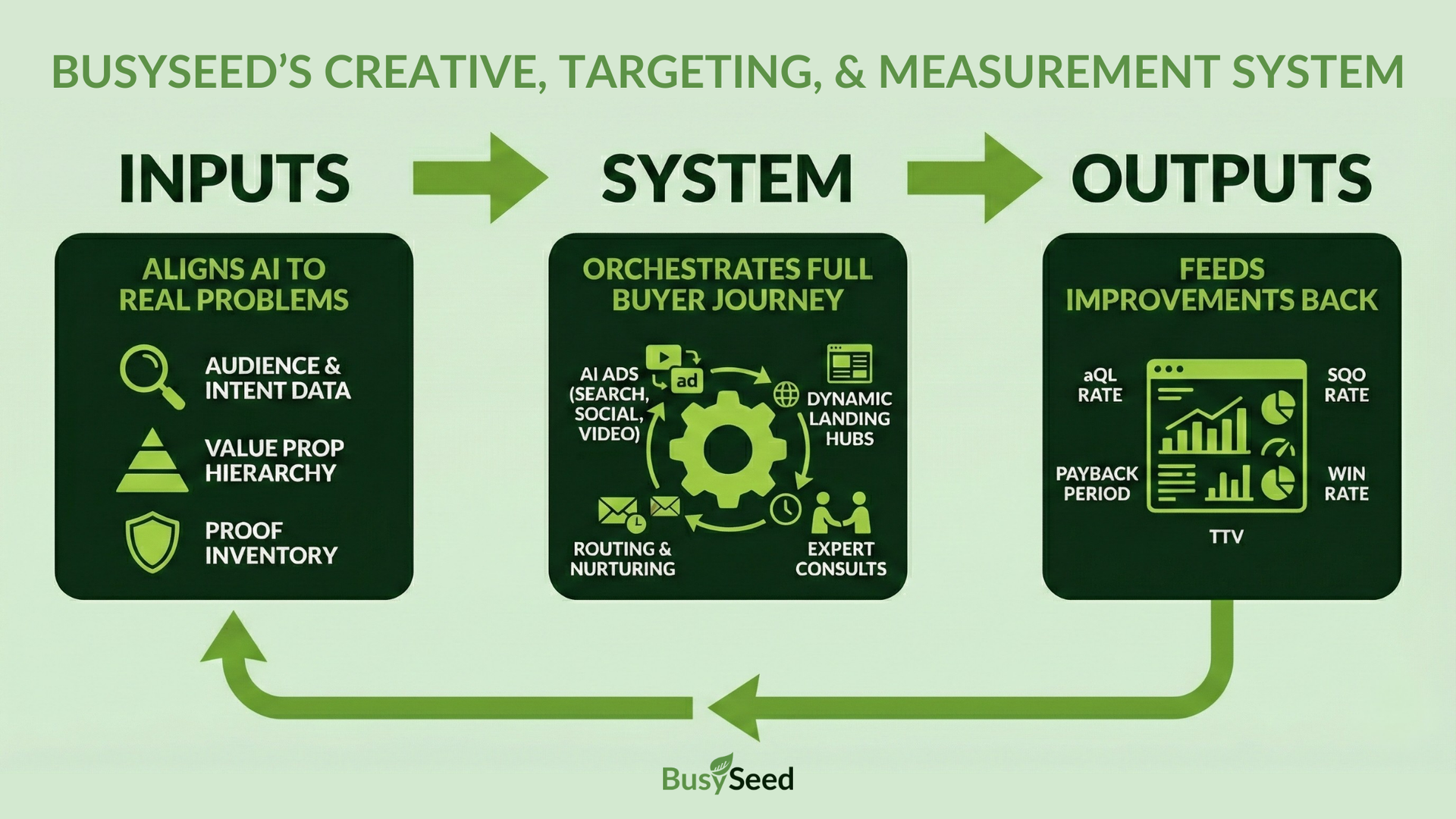
Treat it like a product, not a campaign. Define the inputs, outputs, and feedback loops, and instrument everything.
Want a system like this without trial-and-error? Explore how BusySeed operationalizes AI-driven B2B lead generation and B2C lead generation using a trust-first framework.
How do we balance bots and humans to serve AI-savvy buyers?
Use bots for speed and humans for stakes. Automated systems should qualify, educate, and recommend; experts should validate, tailor, and de-risk.
- Bot layers: instant answers, personalized resource curation, pricing estimators, and intent-based meeting scheduling. These touchpoints improve AI lead generation efficiency throughout the buyer journey.
- Human layers: problem framing, solution tailoring, security and compliance walkthroughs, and stakeholder alignment. This pairing addresses lead nurturing needs and accelerates decision-making.
Which metrics matter most for 2026?
Choose metrics that capture quality, not just quantity. Metrics should help your performance marketing team focus on impact.
- aQL → SQL lift: Measures how well your AI lead generation and qualification align with true fit.
- Proof engagement score: A composite of interactions with validation content across channels. It predicts the close rate and informs lead nurturing.
- Pipeline velocity by intent cohort: Tells you whether your AI ads and content reduce friction for specific jobs-to-be-done in the buyer journey.
- ROAS with context: Track blended Search + YouTube ROAS and compare it to channel silos (remember Google’s 21% finding). This is a real performance marketing discipline.
- Trust health: Opt-in quality, unsubscribes, preference center use, consent rates, and privacy-related support tickets. Given Deloitte’s findings, these aren’t soft metrics; they’re revenue multipliers.
How do we operationalize: team, tools, and governance?
Start small, knit tight, and design for explainability. You don’t need every tool; you need the right ones connected well.
- Team:
- Growth strategy (value prop and jobs-to-be-done)
- Media and AI ads orchestration
- Content and proof (narratives and assets)
- RevOps (routing, scoring, attribution)
- Sales specialists (validation and tailoring)
- Process: Weekly intent reviews, monthly creative/proof retros, quarterly attribution, and cohort recalibration to sharpen performance marketing.
- Governance: A clear AI policy for data use, content generation, and model oversight. Document how lead nurturing content is produced and reviewed, and how decisions are audited for bias or drift.
Looking for a partner who’s done this before?
BusySeed can help you stand up the system that brings your AI lead generation to life.
What are the best lead gen tools for AI-first buyer behavior?
Choose tools that see intent, surface proof, and route fast. Here’s a practical, stack-friendly view:
- Data and intent
- Search console + paid search query mining to map questions shaping the buyer journey.
- Site analytics with event tracking built around validation actions (calculator completes, proof downloads).
- Predictive scoring that prioritizes problem fit over firmographics for better AI lead generation.
- Activation
- AI ads and creative optimization for Search/YouTube combinations (Think with Google).
- Dynamic landing hubs that morph CTAs based on job-to-be-done in the buyer journey.
- On-site assistants who are trained on verified documentation and case studies to support lead nurturing.
- Orchestration
- RevOps routing with rules for qualification, enrichment, and speed-to-human.
- Lead nurturing automation that supports three tracks (business case, technical, and change management).
- Governance and trust
- Consent management and preference centers aligned to privacy expectations (Deloitte).
- Content verification processes ensure that claims align with public evidence, which is critical because buyers validate AI recommendations (IAB).
For a tailored plan, we can audit your stack, map your proof inventory to high-intent cohorts, and launch an MVP in 45 days.
Get started with BusySeed.
How do we create content that AI assistants will surface, and buyers will trust?
Write for humans, structure for machines, and prove every claim. Assistants assemble answers; your job is to provide the highest-signal evidence they can cite.
- Clarity first: Start pages with a two-sentence answer to the core question. It helps humans and trains models on your positioning, which is key to AI lead generation.
- Evidence in layers: Put metrics, customer logos, and methodology near the top, then link to deeper sources. This fuels both discovery and lead nurturing.
- Schema and snippets: Mark up FAQs, product specs, and reviews so assistants and search can extract summaries. Keep it accurate; buyers cross-check.
How do we cut CAC while increasing velocity?
Reduce waste, not spend. Concentrate budget around validated problems, orchestrate Search and video, and use proof-led landing experiences to improve conversion rates.
- Tighten audience definitions based on intent and problem framing. That allows AI ads to find match-quality rather than loose lookalikes.
- Sequence proof. Tease value in video, answer specifics in landing copy, and provide calculators or ROI ranges to convert. Your performance marketing becomes an efficiency engine, not just a reach machine.
- Kill what doesn’t compound. If an asset doesn’t lift aQL-to-SQL by cohort, rework it or retire it. In AI lead generation, every asset is either an accelerant or a drag.
How should sales engage when buyers avoid reps?
Offer expert validation, not gatekeeping. The Gartner survey shows a preference for rep-free experiences, but the same buyers seek human validation at critical points (Gartner). Make your reps the specialists who remove risk:
- “Ask an architect” sessions for technical decision-makers.
- Security and compliance workshops for regulated industries.
- ROI and CFO sessions with transparent assumptions and sensitivity analysis.
When sales shows up as a value layer, lead nurturing becomes a welcome runway rather than a holding pattern, and your performance marketing story holds up under scrutiny.
Quick reference: Proof-first experiences
- Above-the-fold case study metrics
- Interactive ROI calculators
- Clear pricing ranges and timelines
- Analyst quotes and certifications
- Bookable expert AMAs
FAQ
Q1). What are the best strategies for building trust online before form submission for AI lead generation?
Start with verifiable proof front and center: case studies, benchmarks, methodology notes, and customer videos. Buyers using assistants verify claims, so meet them with substance (IAB). Be explicit about data and consent, 70% are concerned about privacy, and ~10% are comfortable sharing sensitive data (Deloitte). Offer self-serve clarity -pricing ranges, implementation timelines, evaluation checklists- so the buyer journey stays in their control. Finally, give prospects preference centers to tailor lead nurturing without friction.
Q2). How do AI ads and YouTube+Search orchestration improve performance marketing ROI?
Blending Search with YouTube typically drives a 21% higher ROAS because Search captures intent while video builds trust through proof-rich narratives (Think with Google). For AI lead generation, feed qualified conversion signals (aQLs) into bidding so your AI ads prioritize the right clicks, funnel them to a trust-forward landing page with clear next steps, then convert that attention into a pipeline to strengthen your performance marketing flywheel.
Q3). What’s the most effective lead nurturing framework for an AI-first buyer journey?
Build three short tracks aligned to jobs-to-be-done: business case, technical feasibility, and change management. Keep each touch actionable (one proof, one CTA). Make expert sessions bookable from emails and chat. This lets automation do the education while humans provide validation; exactly what modern lead nurturing needs to accelerate the buyer journey without pressure.
Q4). Which attribution updates matter most for 2026 AI lead generation and performance marketing?
Instrument micro-proofs (ROI calculator completes, case study depth, repeat visits to validation pages) and use question-first cohorts to track progression across AI ads and content. Combine MMM, geo split tests, and sequential holdouts to measure lift. This hybrid model keeps your AI lead generation and performance marketing decisions grounded in reality, even as channels and formats evolve.
Q5). How can sales add value without disrupting a rep-averse buyer journey?
Be the validation layer. Offer “Ask an Architect,” security reviews, and CFO-grade ROI modeling. Buyers want control, but they also want confidence. Make experts easy to book from lead nurturing flows, and ensure they arrive with full context gathered by bots. That balance showcases empathy and expertise, two traits AI can’t fake.
Summary: Your edge is trust at AI speed
AI has changed both sides of the market: your media is smarter, and your customers are too. The winners in 2026 will match AI-driven precision with human credibility: fast, relevant answers paired with proof and empathy. Build a self-serve spine, orchestrate AI ads across Search and video, measure the micro-proofs that matter, and elevate experts where stakes are high. That’s how AI lead generation turns into revenue, how the buyer journey accelerates without losing confidence, how lead nurturing becomes welcome, and how performance marketing spends less to win more.
Ready to build a trust-first growth system that moves with the market? Let’s map your proof, tune your orchestration, and launch your next growth chapter.
Talk to BusySeed today.
Works Cited
- “AI Ranks Among Consumers’ Most Influential Shopping Sources, According to New IAB Study.” PR Newswire, 10 Oct. 2024, www.prnewswire.com/news-releases/ai-ranks-among-consumers-most-influential-shopping-sources-according-to-new-iab-study-302595768.html.
- “Connectivity and Mobile Trends Survey.” Deloitte, 2025, www.deloitte.com/us/en/about/press-room/connectivity-mobile-trends-survey.html.
- “Gartner Sales Survey Finds 61% of B2B Buyers Prefer a Rep-Free Buying Experience.” Gartner, 25 June 2025, www.gartner.com/en/newsroom/press-releases/2025-06-25-gartner-sales-survey-finds-61-percent-of-b2b-buyers-prefer-a-rep-free-buying-experience.
- “Gartner Says More Than 80% of Enterprises Will Have Used Generative AI APIs or Deployed Generative AI-Enabled Applications by 2026.” Gartner, 11 Oct. 2023, www.gartner.com/en/newsroom/press-releases/2023-10-11-gartner-says-more-than-80-percent-of-enterprises-will-have-used-generative-ai-apis-or-deployed-generative-ai-enabled-applications-by-2026.
- “Gartner Says Worldwide AI Spending Will Total $2.5 Trillion in 2026.” Gartner, 15 Jan. 2026, www.gartner.com/en/newsroom/press-releases/2026-1-15-gartner-says-worldwide-ai-spending-will-total-2-point-5-trillion-dollars-in-2026.
- Pew Research Center. “What Web-Browsing Data Tells Us About How AI Appears Online.” 23 May 2025, www.pewresearch.org/data-labs/2025/05/23/what-web-browsing-data-tells-us-about-how-ai-appears-online.
- Sixth Sense (6sense). “94% of B2B Buyers Use AI for Research, Here’s Why Your Demand Gen Team Doesn’t Need to Panic.” 2025, 6sense.com/blog/94-of-b2b-buyers-use-ai-for-research-heres-why-your-demand-gen-team-doesnt-need-to-panic/.
- Think with Google. “AI Is Transforming Lead Generation.” 2025, www.thinkwithgoogle.com/intl/en-emea/marketing-strategies/automation/ai-lead-generation-marketing/.
- “By 2030, 75% of B2B Buyers Will Prefer Sales Experiences That Prioritize Human Interaction Over AI.” Gartner, 25 Aug. 2025, www.gartner.com/en/newsroom/press-releases/2025-08-25-gartner-says-by-2030-that-75-percent-of-b2b-buyers-will-prefer-sales-experiences-that-prioritize-human-interaction-over-ai.