
AI can generate sequences quickly, but speed doesn’t equal persuasion. Effective nurture depends on timing, empathy, and context that generic generation often misses. The difference shows up in sales conversations, not open rates.

TL;DR
- AI is now mainstream in marketing. Teams that adopt the right AI marketing tools and guardrails are moving faster and winning more often (HubSpot).
- GPT can draft high-quality nurture assets in minutes, but humans still need to edit for brand voice, emotional resonance, and compliance across customer journeys (CMSWire).
- Personalization scales with AI, especially for personal ads and triggered sequences, but results improve when humans set rules and approve outputs (McKinsey).
- Choose your stack intentionally: the top AI marketing automation tools for lead nurturing and the best AI tools for paid media funnels should integrate with your CRM and review process (Deloitte Digital).
- Want a safe, high-ROI rollout? BusySeed blends strategy, data, and oversight so you move quickly, without risking your brand.
Why is GPT even on the table for nurture now?
Because AI works, adoption is high, and marketers are strapped for time. In 2024, 74% of marketers said they used at least one AI marketing tool, more than double a year earlier, and 43% already use AI to draft copy, with 86% editing before publishing (HubSpot). Deloitte also reports that 26% of teams already use generative AI for marketing content, with 45% planning to adopt it by year-end (Deloitte Digital). Demand for content jumped 1.5× last year, while teams could fulfill only about 55% of requests, so AI marketing tools are filling a very real capacity gap (Deloitte Digital).
For teams running performance programs, this makes sense: resource constraints don’t pause growth goals. As a result, AI marketing tools are being embedded into workflows for ideation, audience research, copy drafts, QA, and creative iteration, especially for high-volume channels like email, SMS, and personal ads. The upshot is not replacement, it’s acceleration. Many marketers report spending less time on manual tasks and more on strategy as AI shoulders production tasks (HubSpot).
What’s the short answer to whether GPT should write your nurture?
Yes, as a co-pilot with human oversight. Use GPT to produce first drafts, variant ideas, and quick refreshes for emails, landing pages, and personal ads. Then rely on expert editors to polish tone, prioritize value props, and ensure messaging aligns with the stage and intent signals across your customer journeys. The evidence is consistent: when humans guide and govern AI outputs, results, and ROI (McKinsey; HubSpot). When humans step away entirely, persuasion suffers (CMSWire).
What changed in 2024 that makes AI viable across the funnel?
- Volume and velocity: Content demand outpaced supply by a wide margin; teams could only fulfill about 55% of requests in 2023. Generative AI and modern AI marketing tools help close that gap with rapid first drafts and variations (Deloitte Digital).
- Real results: Early adopters reported around a 12% return on generative AI investments and meaningful time savings (Deloitte Digital).
- Platform guardrails: Even Google is adding more controls so marketers can steer generated headlines/descriptions and maintain brand voice. Small businesses using its AI-assisted Search builder are 63% more likely to achieve “Good/Excellent” ad strength, with greater control over outputs and alignment (Google Ads Blog).
- Proof of personalization at scale: Michaels used AI-driven platforms to personalize 95% of emails (up from 20%), which drove a 25% lift in email CTR and 41% lift in SMS CTR (McKinsey). This is the kind of uplift performance teams have wanted for years, and it’s now realistic to deliver with human oversight.
If you’re investing in paid media, you want a path to ship more creative, more often, with a better fit for each segment. The best AI tools for paid media funnels make that practical, provided you build for safety and control, and connect them to your
BusySeed-calibrated processes.
Where does GPT excel, and where does it fall short in nurture?
1. Where GPT shines:
- Drafting: Headlines, CTAs, and body copy variations for emails, landing pages, and personal ads, fast.
- Summarizing: Turning product sheets, webinars, and case studies into digestible sales enablement or email snippets.
- Personalization scaffolding: Creating variants by persona, industry, and funnel stage, with dynamic fields and segments pre-baked.
- QA helpers: Spotting tone mismatches or compliance gaps you ask it to check for.
2. Where GPT struggles:
- Original insight: “AI is really good at creating a collage, but humans have the ability to create something entirely new and original,” as one marketing leader notes (CMSWire).
- Emotional persuasion: Influencing people often requires another human who understands nuance and timing (CMSWire).
- Edge cases: Sensitive industries, unusual objections, and complex buying committees still demand human judgment.
In short: Use GPT for speed and variation; use your team for strategy, story, and final polish. The top AI marketing automation tools for lead nurturing work best when editors add the heart and context across your customer journeys.
How should you architect an AI-assisted nurture system without risking your brand?
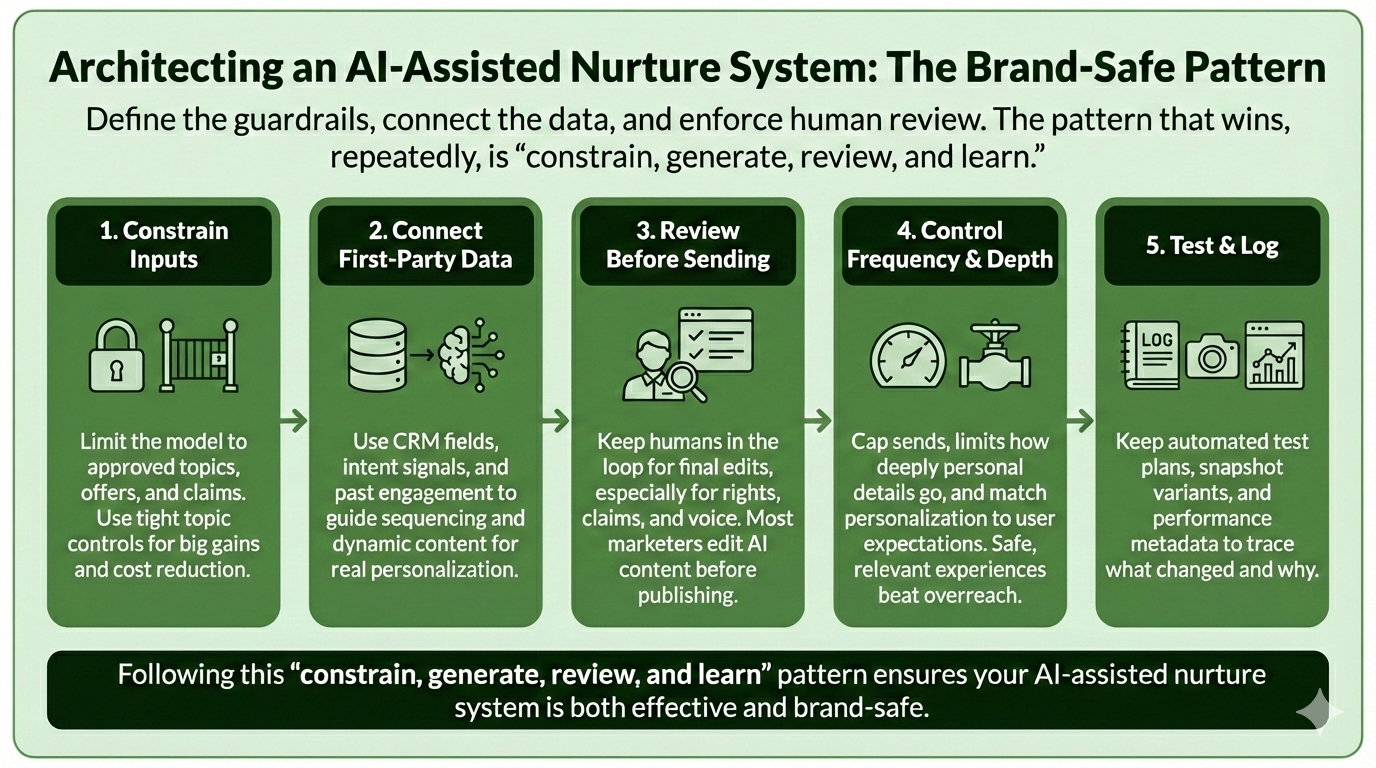
Define the guardrails, connect the data, and enforce human review. The pattern that wins, repeatedly, is “constrain, generate, review, and learn.”
- Constrain inputs: Limit the model to approved topics, offers, and claims. McKinsey documents big gains (40%+ response lift, 25% cost reduction) from projects that used tight topic controls and human oversight at every step (McKinsey).
- Connect first-party data: Use CRM fields, intent signals, and past engagement to guide sequencing and dynamic content. Blending AI with your own data unlocks real personalization across customer journeys (McKinsey).
- Review before sending: Keep humans in the loop for final edits, especially for rights, claims, and voice. HubSpot found 86% of marketers edit AI-written content before publishing (HubSpot).
- Control frequency and depth: Cap sends, limits how deeply personal details go, and matches personalization to user expectations. Safe, relevant experiences beat overreach, particularly in personal ads where visibility is high and tolerance for missteps is low.
- Test and log: Keep automated test plans, snapshot variants, and performance metadata so you can trace what changed and why.
How do you keep brand voice while moving fast?
- Lock the canon: Give GPT a style guide with approved phrases, banned words, tone sliders, and examples. Keep it updated if positioning evolves.
- Ground in your sources: Provide battlecard snippets and competitive notes. Ask the system to avoid me-too framing.
- Use platform controls: Ad platforms now offer more settings to shape generated creative and ensure brand alignment (Google Ads Blog).
How do you scale personalization without being creepy?
- Personalize the context, not the person: Use behavioral signals and explicit preferences; avoid unnecessary personal details.
- Focus on moments: Trigger outreach based on behaviors (visited pricing, downloaded a comparison, returned after 14 days) rather than overly specific individual attributes across your customer journeys.
- Offer value at each stage: for early-stage readers, provide education; for evaluators, provide proof and ROI; for buyers, remove friction.
- Human-edit high-stakes messages: Any copy that could feel intrusive or sensitive should be reviewed by a human before it ships.
How do you choose the right tools for an AI-powered nurture stack?
Look for interoperability, governance, and measurable lift, not just flashy features. You want the top AI marketing automation tools for lead nurturing to sing together with the best AI tools for paid media funnels in one coherent system.
- Anchor to your CRM/CDP: Your system of record must feed audiences and events to the content layer and receive performance back.
- Governance features: Role-based approvals, prompt templates, audit logs, and content snapshots are non-negotiable.
- Experimentation built in: A/B and multivariate testing, creative clustering, and automated significance checks should be standard.
- Channel breadth: Email/SMS, on-site prompts, and personal ads all require consistent tagging, sequencing logic, and reporting.
If you’re evaluating the top AI marketing automation tools for lead nurturing, insist on a proof-of-value pilot where you can test one stage-to-stage sequence end-to-end. And if you’re comparing the best AI tools for paid media funnels, pressure-test how well they handle your compliance needs, brand voice, and complex segments across your customer journeys. For a shortlist and pilot design, talk to
BusySeed. We’ll meet you where you are.
What does a human + GPT nurture sequence look like in practice?
A smooth handoff between automation and editors, with measurement wired in from day one. The right AI marketing tools accelerate each step without removing human judgment.
1. Strategy and data setup:
- Define one ICP and one primary conversion per sequence.
- Map the trigger logic, channel mix, and stage-specific value for each touch.
- Pull first-party segments and intent: past site behavior, product interest, lifecycle stage, and last engagement.
2. Drafting with GPT:
- Prompt for a concept pack: 10 subject lines, 3 body frameworks, 3 CTA angles per stage.
- Ask for tone variants: confident, consultative, challenger.
- Provide guardrails: approved claims, positioning, and competitive notes.
3. Human edit:
- Select the best base, tune the story and proof points, and add specificity.
- Calibrate length, clarity, and friction-reducing microcopy.
4. QA and governance:
- Run a rights and claims checklist.
- Ensure accessibility (readability and contrast in creative), and confirm the preference center links.
5. Launch and learn:
- Ship to 10-20% of the segment with A/B tests on micro-angles.
- Hold back a control cohort to baseline lift.
- Iterate every 7-14 days until the lift stabilizes.
6. Channel coordination:
- Orchestrate email/SMS with on-site prompts and retargeting. Keep copy families consistent so prospects experience a coherent narrative through their customer journeys.
- When running social retargeting, keep personal ads value-led and contextual (e.g., “Get the ROI calculator you previewed” rather than hyper-specific behavioral callouts).
For inspiration on managing personalization, McKinsey showcases programs that constrained topics and added human review, delivering a 40% lift in response rates and a 25% cost reduction (McKinsey). For volume and productivity gains, HubSpot and Deloitte Digital provide adoption and ROI benchmarks worth bookmarking (HubSpot;
Deloitte Digital).
How do you measure success and ROI when AI drafts the nurture?
Define the baseline, instrument your experiments, and attribute properly. The top AI marketing automation tools for lead nurturing and the best AI tools for paid media funnels should help automate measurement, so you can focus on insights.
1. Start with a clean baseline:
- Historical open rate, CTR, reply rate, demo rate, qualified pipeline created, and revenue per recipient.
- Consent rates, deliverability, and spam complaint trends for health across your customer journeys.
2. Attribute rigorously:
- Multi-touch attribution with consistent UTMs across all assets.
- Cohort-based analysis: compare recipients first touched by the new sequence to matched historical cohorts.
3. Evaluate velocity:
- Time-to-first-response and time-to-SQL often improve with better stage-fit messaging. Track both.
4. Track efficiency:
- Cost per qualified conversation, cost per opportunity, and production time saved. Early adopters report ~12% ROI on generative AI investments (Deloitte Digital).
5. Inspect content quality leading indicators:
- Reply sentiment, manual “great fit” tags from SDRs, and sales meeting hold rates can all inform whether the story is working before hard revenue shows.
When should you not let GPT write the nurture?
Pause or narrow scope in sensitive, regulated, or emotionally charged contexts, and whenever ethical lines are blurry. The right call here protects trust across your customer journeys.
- Regulated claims: If you’re communicating in markets with strict requirements (financial services, healthcare, legal), you’ll need rigorous human review or legal signoff for any generated copy.
- High-stakes moments: Messaging that addresses layoffs, security incidents, or personal data breaches is not a fit for automation.
- Sensitive targeting: If the audience could infer private attributes from personal ads, scale back. Keep personalization contextual and value-based.
- Complex buying groups: Enterprise buying committees with competing incentives deserve original thought leadership and bespoke outreach, use AI for research and formatting, not final persuasion.
Why combine AI with first-party data instead of using AI in a vacuum?
Because that’s where relevance, and a defensible advantage, come from. Your CRM data tells you what customers valued, when they engaged, and what they did next. McKinsey calls blending AI models with your own data the path to “unequalled customization” (McKinsey). In practice, this means:
- Trigger logic from actual behavior and lifecycle signals.
- Stage-fit value props that match historical conversion patterns.
- Offer/channel/time decisions optimized per segment over time via the top AI marketing automation tools for lead nurturing and the best AI tools for paid media funnels.
AI without your data is a talented writer with no context. Give it the context, and it becomes a force multiplier for your customer journeys.
Choosing and using AI tools: a practical mini-checklist
- Inventory your stack: where AI marketing tools already live and where gaps remain.
- Prioritize one sequence: prove value fast before scaling.
- Wire governance: add prompts, approved claims, and an approval workflow.
- Integrate measurement: tie outcomes to revenue, not just opens.
- Plan a 90-day rollout: stack the top AI marketing automation tools for lead nurturing with the best AI tools for paid media funnels and your CRM.
Why partner with BusySeed for an AI-powered nurture rollout?
Because you want speed, control, and ROI, without risking your brand or customer trust. We’re warm, direct, and savvy about what actually moves numbers. When you work with BusySeed, here’s how we help you operationalize the right AI marketing tools and processes:
- We establish the guardrails: tone, claims, and compliance rules the model must follow.
- We orchestrate your data: CRM fields, segments, and event triggers wired to sequence logic and reporting across your customer journeys.
- We operationalize human-in-the-loop: clear approvals, versioning, and performance logging.
- We build the learning engine: experiment design, creative clustering, and weekly optimization cadences.
Want a pragmatic roadmap that respects your constraints and produces measurable uplift? Start the conversation today with
BusySeed. We’ll match the top AI marketing automation tools for lead nurturing and the best AI tools for paid media funnels to your goals.
FAQ: Your AI nurture questions, answered
Q1) Is it safe to use GPT to draft nurture emails in regulated industries?
Yes, with strict constraints and legal review. Provide the model with approved claims, disclaimers, and examples, and require human signoff before anything ships. Archive prompts and outputs to maintain auditable trails. The top AI marketing automation tools for lead nurturing often include governance features to help here, while the best AI tools for paid media funnels add extra controls for ad copy.
Q2) How do we avoid “creepy” personalization in personal ads?
Personalize context, not identity. Tie messages to explicit behaviors (content viewed, trial milestones) and preferences, not inferred sensitive attributes. Offer clear frequency controls and opt-down choices so your customer journeys stay trust-first. Choose AI marketing tools that let you set these limits up front.
Q3) What’s a simple way to pilot an AI-assisted nurture program?
Choose one segment, one trigger, and one conversion goal. Generate multiple angles for three touches using AI marketing tools, edit them, and ship to a holdout-tested cohort. Instrument end-to-end. Only then extend your pilot to the best AI tools for paid media funnels for retargeting, and complement them with the top AI marketing automation tools for lead nurturing via email/SMS.
Q4) What are the best tools for writing lead nurturing sequences?
Tools like GPT, HubSpot, and marketing automation platforms can speed up drafting and delivery, but effective nurture still depends on strategy, segmentation, and buyer context. AI excels at generating first drafts, variations, and scale, while platforms like HubSpot, Marketo, or Customer.io handle timing, triggers, and orchestration.
Q5) Which guardrails matter most when generating copy at scale?
A tight style guide, banned-claims list, frequency caps, and a human approval step before anything reaches customers. Add checklists for privacy, accessibility, and legal compliance where required. The right AI marketing tools make these guardrails easy to enforce.
Bottom line (and next step)
ChatGPT can, and should, help you produce more relevant nurture at greater speed, but only within a system where humans set the strategy, guardrails, and final say. Done right, you’ll scale personalization, maintain voice, and convert more prospects, without sacrificing trust. If you want a clear, safe plan to unlock the upside, BusySeed can design and operate your AI-enabled nurture engine, from data wiring to creative workflows and optimization. Let’s build a system that makes growth feel inevitable.
Works Cited
- “Marketers Double AI Usage in 2024.” HubSpot, 2024, https://www.hubspot.com/company-news/marketers-double-ai-usage-in-2024.
- “Deloitte Digital’s Latest Research Forecasts Generative AI’s Transformation of Content Marketing.” Deloitte Digital, 2023, https://www.deloittedigital.com/us/en/news/press-releases/2023/deloitte-digitals-latest-research-forecasts-generative-ais-transformation-of-content-marketing.html.
- “How Generative AI Can Boost Consumer Marketing.” McKinsey & Company, 2024, https://www.mckinsey.com/capabilities/growth-marketing-and-sales/our-insights/how-generative-ai-can-boost-consumer-marketing.
- Rawat, Richa. “How Human Insight Enhances AI-Driven Marketing Personalization.” CMSWire, 2024, https://www.cmswire.com/digital-marketing/how-human-insight-enhances-ai-driven-marketing-personalization.
- “New AI Features in Google Ads: More Control, Better Results.” Google Ads Blog, Sept. 2024, https://blog.google/products/ads-commerce/google-ads-ai-features-update-september-2024/.