Why NYC Marketing in 2026 Requires Automated Systems, Not Traditional Services
The hyper-competitive, fast-paced marketing landscape of New York City in 2026 has made it virtually impossible to scale using traditional, manual marketing services alone. To survive high acquisition costs and fragmented consumer attention, brands must pivot from relying on slow, disconnected vendor support to implementing robust, automated digital systems. This deep dive contrasts the limitations of one-off, manual campaigns with the immense power of centralized data hubs, automated lead routing, and real-time performance insights. By investing in trackable, repeatable tech infrastructures, NYC businesses can eliminate workflow bottlenecks, outpace local competitors, and establish a permanent foundation for aggressive, predictable revenue growth.
That's where BusySeed's proprietary technology comes in. The SeedTech Ecosystem by BusySeed is a comprehensive, proprietary technology stack designed to function as a unified, end-to-end growth engine that synchronizes every stage of the marketing and sales funnel. The journey begins with high-octane visibility, where SeedDriver dominates traditional local search by emulating real-world behavioral signals for Google Maps, while the SeedGEO suite—including SeedGEO Prompt, Competitor, Revenue, and Tracking—future-proofs the brand by optimizing its "Citation Score" across major AI models like ChatGPT and Claude. Once this multi-channel traffic is captured, SeedLanding takes over, delivering hyper-personalized, dynamic user experiences that adapt content in real time to maximize conversion rates. By ensuring that the visibility layer and the conversion bridge are digitally aligned, BusySeed creates a seamless transition from a user’s initial search to a high-intent interaction on the website.
This incoming lead data is then instantly processed by SeedLeads, which filters for quality and provides real-time notifications to the sales team, while LeadChaser (also known as SeedChase) acts as the ecosystem's AI-driven first responder. By ensuring "speed-to-lead" through immediate, automated SMS and voice follow-ups, these tools work together to strike while prospect interest is at its absolute peak, effectively removing the human bottleneck from the initial sales touchpoint. To fuel outbound growth and scale, SeedEnrich utilizes advanced AI to turn raw prospect lists into deeply enriched, outreach-ready campaigns, applying the winning messaging patterns identified throughout the funnel to cold prospecting.
All of these proprietary tools are seamlessly tethered by the foundational SeedTech engine, which provides the custom code, API integrations, and automated lead routing necessary to ensure that data flows flawlessly across the entire stack. This technical core enables the various software components to communicate with one another and with external CRMs, transforming a business's technology from a fragmented collection of siloed software into a synchronized, scalable, revenue-generating machine. By integrating visibility, conversion, response, and enrichment into a single proprietary loop, BusySeed ensures that every marketing dollar spent is supported by a robust technical framework that prioritizes ROI and long-term digital authority.
TL;DR
- Over 8,400 businesses closed their doors in Q2 2025 in New York City alone, making it the worst quarter for business formation in five years (NYCEDC, 2025b). The pressures on businesses to survive in this competitive market are substantial and not merely a reflection of the economic cycle.
- U.S. internet advertising revenue hit $258.6B in 2024, up 14.9% from the year prior (IAB/PwC, 2024). Yet most NYC brands are running campaigns that are still piecemealed, siloed, and managed manually, a tactic and technology strategy too slow to convert on today’s available market opportunity.
- Salesforce's State of Marketing report finds that 75% of marketers are using AI, but 84% are still running generic campaigns (Salesforce, 2026) - i.e., AI marketing adoption without operational systems yields little to no competitive advantage.
- Only 9% of marketing teams have fully automated their customer journey (Ascend2, 2024) - the gap between AI automation adoption and AI operations maturity, where NYC brands are losing revenue.
- BusySeed’s SeedTech Ecosystem provides a proprietary growth loop that combines visibility, conversion tracking, lead response, and outbound enrichment into a single stream of automated customer development intelligence, delivering companies a constant and predictable growth rate in the country's most competitive urban marketplace.
Why Does My Real Estate Business Fail in NYC?
There is a simple reason why, in 2026, New York City’s marketing environment is moving at a pace that no human can keep up with. However, there are also several more complex reasons why the confluence of exploding new competitive entries, skyrocketing digital acquisition costs, and a fragmenting consumer attention layer requires a vendor-by-vendor marketing management services approach that cannot be managed by humans for large, successful brands.
New business formation was active in New York City, with
roughly one in eight businesses in the City being a start-up from last year. About
25,500 businesses started in NYC in the past year (NYCEDC, 2025a).
This is the opposite of what was reported for Q2 2025:
3,500 new businesses started and an estimated
8,400 business closures, making it the
weakest quarter for business start-ups in five years (NYCEDC, 2025b). But this is a reason to double down, not to retreat. Your market infrastructure must be designed to handle large swings in momentum over several years. Simply relying on current momentum isn't enough; you need a strong underlying marketing plan to weather a decline in business start-ups.
The brands that will still be around at the end of 2026 won’t be the ones with the biggest creative budgets. It will be the brands with the
most disciplined, automated, and data-unified growth systems. This report outlines what these systems will look like and how AI automation can transform your growth rate in a competitive landscape.
We Asked. You Told Us.
Most traditional marketing services aren’t bad; they just suck to stack. This doesn’t mean individual services are worthless or incorrect. It’s just that, as you grow from a one-off campaign to managing multiple agencies and various activations, the way most traditional marketing services are set up makes scaling increasingly difficult.
Campaigns can’t compound, vendor integrations break, and daily reporting can’t be automated to fuel real-time decision-making. Instead, analysts must piece together manually aggregated data for you.
New York City has some of the most expensive architecture in the world, and that’s in every direction. The NYC metro area's
mean hourly wage in May 2024 was $40.65, compared with
$32.66 nationwide (Bureau of Labor Statistics, 2024). That means management occupations were averaging a
cool $92.78 per hour.
So when you look at every manual touchpoint in your funnel (from the agency that developed your website to CRM data entry and finally the follow-up calls from your sales team), the cost isn’t just expensive. It’s
expensive at NYC labor rates.
Right now, every company has people and processes scrambling to keep up. Meanwhile, the best organizations are moving at lightning speed. When you factor in the coordination delays and expenses of
three to five separate, often unconnected vendors, what do you get? An inexcusable lack of velocity in your customer journey at a time when every other company is gaining speed.
The architectural failure of traditional services manifests most visibly at the moments that matter most in the funnel: at the lead, as it sits in a cold inbox, as it is routed from one individual to the next, and as a follow-up is delayed by just a few days. Meanwhile, the prospect is happily comparing four different services side by side, two of which
respond to a query in under 60 seconds via pure AI automation. It’s no contest.
This is
NOT a sales training problem. It is a
systems problem and therefore requires a fundamentally different marketing plan for businesses in high-velocity urban environments.
Fragmented Consumer Attention: What Is It and How Is It Changing the Value of a Marketing Plan for NYC Businesses?
New York City in 2026 is a multifaceted landscape where consumer time and attention are distributed across myriad new surfaces. To maintain a competitive marketing strategy in this hub, one must consider:
- Traditional search
- Google Maps
- AI-powered “ask it” answer interfaces
- Streaming services
- Social video
- Reviews across multiple platforms
Streaming reached a new high of
40.3% of total TV viewing in June 2024 (Nielsen, 2024). Furthermore, a survey found that
77% of consumers polled use multiple review sites when researching a business online, and a staggering
31% will only do business with a company that has an average rating of 4.5 stars or higher (BrightLocal, 2024).
At the point where an NYC consumer is deciding which brand to choose, the location listings at the triangulation point will make or break the sale if one platform dominates the picture.
Now, every brand competitor is making reputation a priority, and every touchpoint must deliver consistent brand reputation at
high quality
and velocity, without human intervention. The implication for the marketing plan's strategy is that it cannot be based on a single channel or a quarterly cadence. To stay competitive, brands must adopt AI marketing systems that can adapt in real time.
How Do Shifts in Zero-Click Search Behavior Influence Competitive Dynamics for NYC Brands and Retailers?
Zero-click has transitioned from a hypothetical risk to a reality that must be understood and grappled with in the battle to remain competitive in organic search. For every 1,000 U.S. Google searches, only approximately 374 clicks go to something elsewhere on the open web, while in the EU, that number is 360 (SparkToro and Datos, 2024). The remainder do not result in any open-web click, instead culminating in information within Google’s own walls.
For NYC-based brands whose business models rely heavily on understanding the flow of the clickstream, a loss of reliability in this vital aspect of customer experience means that every advantage will have to be won through instrumentalization and rapid iteration, particularly through the instrumentation of user experience. This means that NYC digital marketing agencies will need to focus on areas such as
centralized data tagging and
lead-source tracking, as well as AI automation of features like routing and closed-loop reporting. For more information on these shifts, Google provides an overview of AI in documentation on Google’s AI Mode (Google, 2024).
A look ahead to the future of digital ads reveals that creatives will face unprecedented challenges. Ads are appearing in AI Overviews for
approximately 13% of queries, a figure likely to continue rising (Skai, 2025). This means that measurement and the testing of different creative versions will have to happen faster than typical agencies are accustomed to.
At some point in the evolution of AI marketing infrastructure, what once seemed optional turns into the playing field. Here, brands must be able to:
- Determine whether they appear in AI-powered answer generators.
- Test how they’re summarized by large language models.
- Track the attribution of zero-click searches.
To maintain a competitive edge, your marketing plan must include AI automation strategies that adapt to these changes. If you need an expert to pressure-test your search visibility and prioritize the highest-ROI moves,
BusySeed can help you adapt.
Why Is AI Automation the Operational Differentiator That Most NYC Brands Are Still Missing?
AI automation can theoretically do many things, but most value comes from where others are not yet operationalizing it. While 75% of marketers report using AI, a massive 84% run generic campaigns, and 69% cannot respond promptly to their customers (Salesforce, 2026). AI marketing adoption is common, but AI operations maturity is not. In a market as competitive as NYC, maturity matters.
The difference between brands that market “AI automation” and those that drive revenue from it lies in the structural gap between adoption and operations:
- Only 9% of organizations report being fully automated along their customer journey.
- 32% report being mostly automated.
- 59% report being partially automated (Ascend2, 2024).
Additionally, the biggest challenges to further AI automation in marketing are
collecting high-quality data (52%) and
creating an overall strategy (47%) (Ascend2, 2024). While the tools are available, the greatest obstacle to continued adoption is system design.
For the brand, running a considered and thorough marketing plan for the NYC market presents an enormous asymmetric opportunity. The brand is unlikely to make any material mistakes over the next couple of quarters, while competitors are still putting together spreadsheets by hand and emailing leads manually. This is where AI marketing systems can provide a significant competitive advantage.
There is growing concern around inaccurate data affecting the performance of AI/ML-powered personalization (Twilio Segment, 2024). More surprisingly,
72% of marketers are now using a Customer Data Platform for personalization (Twilio Segment, 2024), signaling that a robust centralized data stack is now table stakes for competitive AI marketing execution.
The Evolution from Traditional to Automated Marketing Platforms
This chart breaks out key differences for core services offered by traditional marketing agencies and the
SeedTech Ecosystem, BusySeed’s cutting-edge and automated marketing platform. The contrasts here are not hypothetical; they represent
real pain points in the day-to-day workflow for NYC businesses, resulting in
lost opportunities and
reduced marketing efficiency, ultimately leading to a slower growth rate.
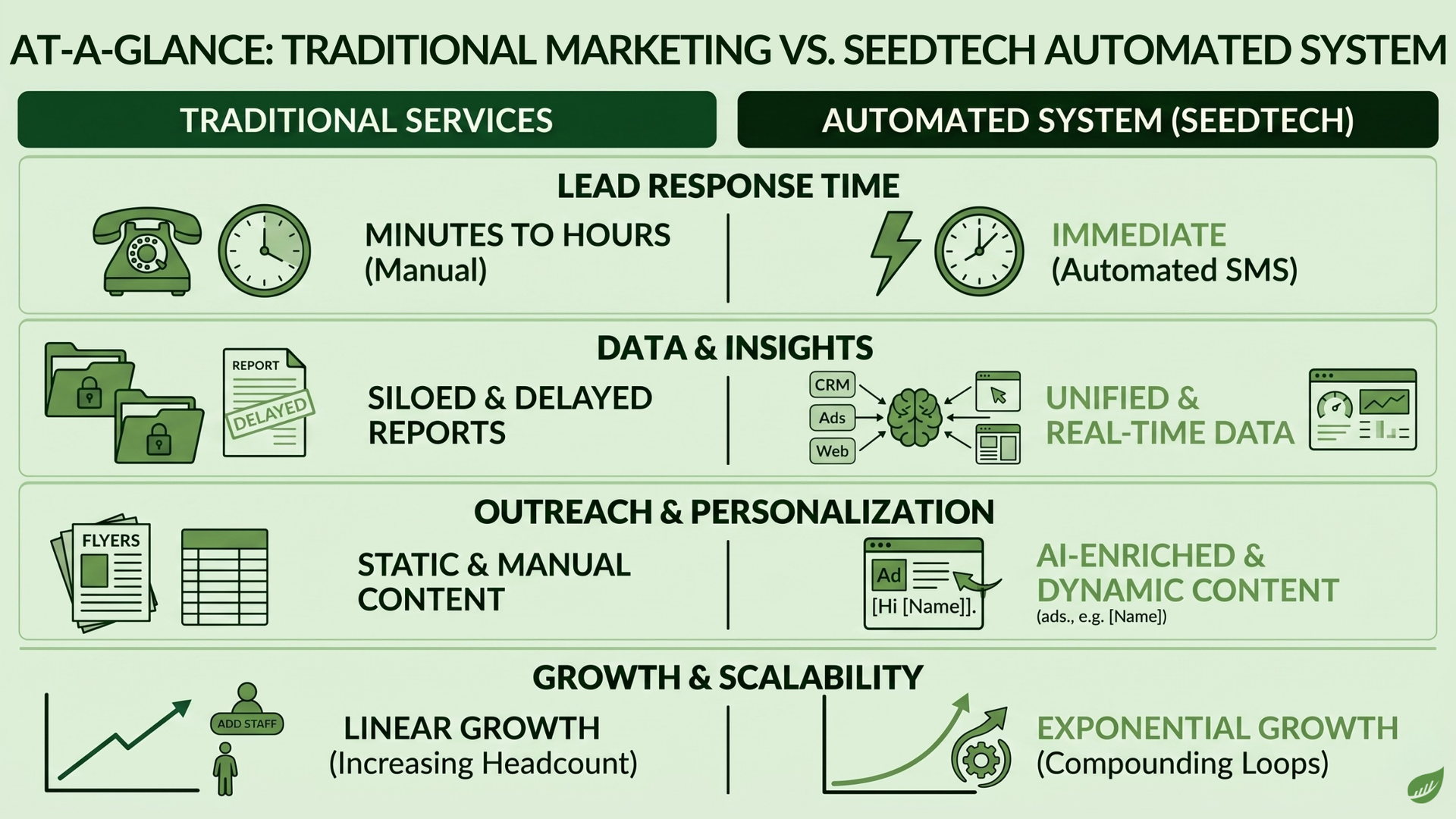
| Capability | Traditional Marketing Services | Automated System (SeedTech Ecosystem) |
|---|---|---|
| Lead Response Time | Minutes to hours (when humans are involved) | Immediate - Automated SMS and voice follow-ups triggered within 60 seconds |
| Data Flow | The information is stored in isolated silos amongst vendors and is manually collated and compared to validate results | All client data is brought together in one place, through comprehensive, unified data coverage of CRM, Ads, Website Forms, and Sales via deep API connections |
| Campaign Personalization | Static content and videos that have to be manually re-requested, as new leads feed into the campaign for personalization | Dynamic, automatically updating content on one page dedicated to a lead (e.g., a landing page with the lead's named URL) |
| Local Visibility Management with Higher Quality Reviews | Manual profile updates and single-platform focus | Automated behavioral signals with integration into Google Maps and signals across multi-platform review sites |
| AI Search Presence | Unmeasured; no structured monitoring | Active scanning across AI engines via SeedGEO prompt testing |
| Outbound Prospecting | Manual list research; variable quality | AI-enriched prospect lists with pattern-matched messaging via SeedEnrich (by Topo) |
| Performance Reporting | Currently manually compiled and somewhat delayed due to the vendor schedule | Real-time performance dashboards that provide closed-loop attribution from ad spend to revenue |
| Competitive Responsiveness | Slow; based on the cycles of agency contracts | Continuous, with the system running around the clock and conducting updates and tests without bottlenecks in the human workflow |
| Growth Rate Predictability | Growth rate is highly inconsistent and largely depends on the performance of previous campaign(s) | Growth rate compounds with each loop, with previous runs improving subsequent runs due to unified data feedback mechanisms |
| Scalability | Linear - with increasing spend, you need to increase headcount | Exponential - infrastructure scales with little to no increase in cost, while spend increases |
You might expect the key difference between the two columns to lie in bleeding-edge marketing technology that drives engagement. But the real takeaway for marketers in the competitive city that never sleeps is far simpler: the ability to learn and adapt faster than your peers in order to scale your marketing efforts at a rate of multiple times year-over-year, quarter-over-quarter. This is how AI marketing systems can transform your growth rate and ensure your marketing plan for success in 2026.
BusySeed Platform: How Does SeedTech Ecosystem Fill the Gaps That Manual Processes Are Unable to?
BusySeed’s SeedTech Ecosystem is a unified, end-to-end growth solution, not a bunch of point solutions. Our suite of tools addresses specific gaps in venture outcomes that traditional seed-stage venture capital firms don’t.
Each tool addresses a specific pain point in the venture-building process and tackles it holistically. By routing data from every module into the BusySeed SeedTech Ecosystem, we create
integrated gains across venture funnels.
How Does SeedDriver and SeedGEO Solve the Visibility Layer Problem?
Visibility in 2026 is a multi-dimensional problem that demands a multi-dimensional solution. Focusing on local search visibility, SeedDriver from BusySeed generates site-specific behavioral signals to improve rankings on Google Maps, targeting users with high intent who conduct location-specific searches.
It is therefore crucial for businesses to choose a local visibility solution that complies with Google’s Business Profile content policies (a list of dos and don’ts that clearly state that
creating fake engagement is not allowed). Businesses should always consult with expert practitioners and look for alignment with platform policy when choosing a local ranking tool.
With AI search on the rise,
BusySeed has launched the SeedGEO suite of AI-powered tools to scout out competitors online. SeedGEO Prompt, Competitor, Revenue, and Tracking help marketers and webmasters prepare for the new AI-first search landscape.
According to a Salesforce report,
88% of marketers are now trying to optimize for AI-powered search results, just like those delivered by ChatGPT or Google’s new AI Overview feature (Salesforce, 2026). SeedGEO serves as an observability tool that connects multiple AI engines to show how a brand appears in generative search results. It also monitors
Citation Score across leading AI models, a critical feature for any brand or company building a serious marketing plan for the AI-first search era.
SeedLanding: An Autonomous Landing Module Dedicated to Converting Traffic Into Real Leads
Traffic without conversion architecture is just spend. SeedLanding by BusySeed generates highly personalized, hyper-relevant content delivered through landing pages that change in real time for individual users.
Without needing to assign dev work to push out new offers or audience segments, SeedLanding eliminates the
biggest bottleneck to conversion testing (the dev ticket) and allows your team to iterate as fast as the competitive NYC market dictates.
As visibility and conversion become increasingly aligned, the search signal that brought the user to your site is also the trigger for which content appears. And when you think about it, the difference between someone’s search query and someone submitting their information for a high-intent conversion action is
dramatically reduced, meaning your digital marketing investment is paying more than just immediate conversion; it is also paying in future value as well. This is how AI marketing systems can enhance your growth rate.
How Do SeedLeads and SeedChase Work?
Speed-to-lead is not a sales rep problem. It’s a systems problem, and that’s why SeedLeads filters all incoming lead data in real time to weed out bot submissions.
Alert sales teams receive instant notifications so they can jump on leads as soon as they come in.
One-click status updates allow reps to tell leads they are on it in seconds, without manually contacting prospects for status updates.
SeedChase (also known as LeadChaser) is an artificial intelligence first responder that provides automated follow-up leads that are needed immediately after they are captured. With today’s customer comparison shopping at an all-time high and the first to respond often getting the sale, SeedChase employs both SMS and voice follow-up
within the first few minutes to keep up the growth rate without relying on a sales team to check their email on time.
Any SMS and calling
AI automation must be implemented in compliance with all applicable local regulations. For automated SMS and calling, the
FCC has issued guidance and rulemaking in the
Federal Register that brands must follow when implementing consent, opt-out, and recordkeeping processes before leveraging automated communications.
SeedEnrich Enhances Outbound Campaigns by Maximizing Matches & Ensuring Personalization
SeedEnrich utilizes advanced AI to holistically enrich your prospect lists, fueling the most efficient outbound campaigns. It applies winning messaging patterns identified across the inbound funnel to cold, outbound prospecting.
By doing so, it optimizes your outreach using the AI marketing intelligence gathered from every single inbound conversion. This is one of the
most underleveraged levers available to NYC brands looking to rapidly scale without a corresponding, drastic, linear increase in headcount.
Ready to trade volume for velocity?
Contact BusySeed to upgrade your outbound logic today.
Core SeedTech Software Interface
SeedTech is the technical underpinning of the connected business model outlined above. This is the custom programming, APIs, and lead-routing rules that integrate all components for seamless, automated operation across all lines of business, from visibility and conversion to lead capture and response/outreach. SeedTech seamlessly integrates with any external CRM and keeps everything in sync, enabling access to and analysis of all data from any point in the stack.
A great point that highlights a key difference between an “AI Marketing Stack” and just an “AI Marketing Tool”: Most AI marketing tools require humans to string the different sources and features together. An AI marketing stack
automatically, continuously, and accurately connects the dots, ensuring data fidelity and the scaling needed for meaningful optimization. This is how AI automation can transform your growth rate and ensure your marketing plan for success in 2026.
Step-by-Step Roadmap for NYC Businesses to Build, Launch & Optimize an Automated System for Maximum Measurable Results
How Do You Implement a Scalable Automated Marketing Infrastructure in New York City?
This checklist outlines the steps from a siloed, manually intensive marketing system to an automated, exponentially growing marketing system. The steps are outlined so you can systematically go from problem identification to building a powerful solution for yourself or your business. Complete all steps to map out your strategy for growing your business, improving marketing, or building a career in marketing.
- Audit your data flow. Look at your process end-to-end from ad click to closed revenue. Identify every manual step in your data flow. Places where data is lost, or sits idle, are your biggest bottlenecks. These may not be the ones you assume they are.
- Define a single source of truth for leads, opportunities, and revenue. Ensure the new AI marketing automation system is integrated with the system that owns the relevant data. AI marketing systems fail to meet expectations when different systems are providing conflicting data.
- Govern UTM & event tagging across all paid channels, organic sources & referrals to ensure clean, attributable data exists to support closed-loop reporting and optimize your marketing plan for future cycles.
- Activate real-time lead routing with defined SLAs: Move away from relying on the inbox and automatically route leads based on geography, service lines, and reps’ availability. Establish key SLA targets for first response time, contact rate, and show rate.
- Implement automated speed-to-lead response with consent and compliance measures in place. One of the key differentiators for your company to outcompete your competition is to send an SMS or voice message within the first 60 seconds of lead submission. Before implementing any automated lead response, however, make sure you have obtained opt-in consent from leads, understand how to opt consumers out, and are keeping proper records to ensure FCC compliance.
- Make Dynamic Landing Pages Fully Personalized: Most campaigns currently use static content on the landing page, which doesn’t account for the visitor’s source, geo, or behavioral signals. Enabling personalization allows the lander to adapt for each visitor. Often, this can provide the biggest boost in conversion rate per unit of projected spend without increasing traffic.
- Build an AI search visibility monitoring practice. Implement a process to test for brand visibility in LLMs (e.g., ChatGPT, Claude) and regularly record Citation Score over time to use as evidence in structuring content and clarifying entities for optimization. You can do this with SeedGEO.
- Create multi-platform review and reputation operations. Since 77% of consumers use at least two review sites to write reviews, and 31% will only consider a business with a 4.5-star rating or higher (BrightLocal, 2024), managing your reputation cannot be a reactive process; it must be fully automated and streamlined.
- Apply your inbound funnel learnings to outbound prospecting. Use messaging patterns and audience signals that work well in your conversion data to improve cold outreach campaigns. SeedEnrich and other AI automation tools make this loop executable at scale.
- Build a closed-loop revenue attribution dashboard. Set up a system to track and show, in real time, ad spend, landing page performance, lead quality and volume, pipeline stage, and revenue that has closed (revenue). Having this type of dashboard is what takes an AI marketing tactic and turns it into a strategy for accelerating growth rate.
AI Operations Maturity: So You Don’t Have to Be the Fastest in 2026; NYC Brands, This Means Run for It
While adopting AI has become a prerequisite for successful organizations, operating AI at levels of learning, routing, personalization, and monitoring without humans in the loop is what will create a level playing field for NYC brands competing in 2026.
The Marketing AI Institute report (produced in partnership with Drift) for the 2024 State of Marketing AI Report found that
only 34% of organizations have generative AI policies, and
only 19% of marketing teams have an AI roadmap for the next one to two years (Marketing AI Institute and Drift, 2024). With the levels of competition in a place like New York City, it’s frightening to think that the majority of competitors are using AI marketing tools in an ad-hoc manner with little to no governance framework in place, lacking a strategic roadmap to generate returns from AI, and the critical data infrastructure to drive exponential business returns.
This margin is not perpetual. As
54% of marketers said in Ascend2’s The State of Marketing Automation 2024: A Survey Summary Report, they will receive an increase in budget for AI automation in the next year (Ascend2, 2024). The window for earning operational maturity as a competitive advantage is limited.
The company that develops a unified marketing automation system, accurate marketing database, and intelligent marketing automation response architecture today will be
very difficult to beat in 12 months. The gap between the growth rate of AI-powered, operationally mature, and fully automated marketing systems and those that rely on manual, labor-intensive marketing execution will continue to compound significantly in the quarters ahead.
Speed is a channel in NYC. The
fastest system to close, convert, and retain will win in 2026, regardless of great creativity, big budgets, and experienced agencies. This is why your marketing plan for 2026 must prioritize AI marketing and automation to stay ahead of the competition.
How Will a Marketing Plan Look for NYC Success in 2026?
Our marketing plan for NYC's success in 2026 isn’t a document. It’s an architecture: a system of integrated structures, data governance rules, and automated responses, all designed to maximize the return on every dollar we spend and to enable learning from each campaign, so we can rapidly apply those lessons in future efforts.
In the next two years, certain brands will be able to earn share in New York City. And while some of those brands will execute brilliant creative, it will be the brands with
more disciplined operational infrastructure that ultimately earn the greater share. Their growth rates will not be subject to the vicissitudes of which vendor is available from which agency, which human at which organization checked their inbox earliest, or which campaign happened to run in an earlier window. Their growth rates will compound as the system learns.
Our point is not that copywriters could be replaced by AI at that level. Our point is that AI at that level could automate systems-level email automation, connecting visibility, conversion, response, and enrichment into a
single, self-learning loop. This is how AI marketing and AI automation can transform your growth rate and ensure your marketing plan for success in 2026.
BusySeed's SeedTech Ecosystem is optimized to help businesses of all sizes thrive in this climate. We work with companies based in NYC and across the country that want to move from running campaigns to building systems that deliver consistent improvements in growth rates.
The Bottom Line: Orchestrating Your Growth Engine
If your customer acquisition costs are rising and your pipeline is stalling, manual processes are often the quiet culprit. The highly competitive environment of NYC demands speed, adaptability, and precision. True AI automation rewards highly structured systems over disjointed, manual tools. Tightening your entire operational stack through a unified platform remains the absolute most reliable path to a predictable growth rate and steadier revenue.
If you want a partner that can implement this front-to-back, pressure-test your strategy, and prove the lift with real numbers, BusySeed is ready to help. We can operationalize AI tools for marketing, from local visibility and conversion tracking to lightning-fast lead response, without the headaches of managing multiple isolated vendors.
Connect with us to start building your automated growth architecture today.
FAQ: Practical Marketing Questions from Real NYC Business Owners - The Way to Build a Scalable Marketing Machine!
1. How to implement scalable marketing systems in NYC?
You don’t have to start from scratch. Instead, build a scalable system by adding an orchestration layer over your existing CRM, ad stack, and lead forms. Focus on automating the three most expensive manual touches first:
- Lead notification
- Lead routing
- First response
By incrementally adding AI automation while preserving your team's human expertise, you maximize your potential for an accelerated growth rate by processing leads rapidly at scale.
2. How to centralize marketing data for better performance?
Data centralization begins with marketing governance. Establish a unified data model across email, web, social, and search to clearly define leads, lifecycle stages, and UTM formats.
From there, you can easily implement a Customer Data Platform (CDP) or an API integration, such as SeedTech. With 61% of marketers concerned that inaccurate data impedes AI (Twilio Segment, 2024), having clean, centralized data to kick off the marketing plan for your next campaign is more important than ever.
3. What are the top digital marketing firms in NYC?
Look for infrastructure builders, not just basic tool managers. A strong firm builds systems that report for you. When interviewing partners for AI automation capabilities, ask them to:
- Walk through their fully automated lead data process (from capture to closed revenue).
- Share their median first-response time.
- Explain how they monitor AI-driven search rankings.
Avoid firms that rely on expensive manual workflows to justify their retainer fees in a highly competitive market.
4. How to find a full-service marketing partner in NYC?
Look behind the interface at the firm's core technology stack. Most agencies operate in separate, competing silos for SEO, paid media, and CRM.
A truly full-service partner connects search signals directly to dynamic landing pages and CRM routing without data fragmentation.
BusySeed’s SeedTech Ecosystem was designed from the ground up to consolidate all data into a single unified environment, eliminating disconnected silos.
5. What are the best strategies when approaching digital marketing for B2B tech companies?
You need a unified stack that supports both B2B and B2C funnels without maintaining two separate systems. Your AI marketing logic should adapt automatically:
- B2B visitors: Serve dynamic content based on company size or industry, and route them through targeted follow-up cadences.
- B2C visitors: Adapt content based on location and contact them immediately within the speed-to-lead window.
By funneling all leads through a single integration layer, the marketing plan for both segments can be tracked and measured using a single unified revenue metric.
6. Who can help with online marketing for my business in New York?
Look for a partner that can deliver AI marketing and AI automation solutions tailored specifically to your needs. The right firm must possess:
- A deep understanding of the competitive NYC market.
- A proven track record of implementing systems that drive a measurable growth rate.
- Expertise in automated communication compliance (like FCC regulations).
BusySeed’s SeedTech Ecosystem is designed precisely to meet these needs, providing a comprehensive, unified solution to help your business thrive.
Works Cited
- Ascend2. The State of Marketing Automation 2024: A Survey Summary Report. March 2024. https://ascend2.com/wp-content/uploads/2024/03/The-State-of-Marketing-Automation-2024-Survey-Summary-Report.pdf.
- BrightLocal. Local Consumer Review Survey 2024. 2024. https://www.brightlocal.com/research/local-consumer-review-survey-2024/.
- Bureau of Labor Statistics. Occupational Employment and Wages, May 2024: New York-Newark-Jersey City, NY-NJ-PA. 2024. https://www.bls.gov/regions/northeast/news-release/occupationalemploymentandwages_newyork.htm.
- Federal Communications Commission. FCC Guidance on Automated Calls and Texts. 2024. https://docs.fcc.gov/public/attachments/DA-24-910A1_Rcd.pdf.
- Google. About AI Overviews and AI Mode in Search. 2024. https://search.google/pdf/google-about-AI-overviews-AI-Mode.pdf.
- IAB/PwC. Internet Advertising Revenue Report: Full Year 2024. 2024. https://www.iab.com/news/digital-ad-revenue-2024/.
- Marketing AI Institute and Drift. The 2024 State of Marketing AI Report. 2024. https://www.marketingaiinstitute.com/hubfs/The%202024%20State%20of%20Marketing%20AI%20Report%20from%20Marketing%20AI%20Institute%20and%20Drift.pdf.
- New York City Economic Development Corporation (NYCEDC). NYC Economic Snapshot: July 2025. 2025a. https://edc.nyc/sites/default/files/2025-07/NYCEDC-NYC-Economic-Snapshot-July-2025.pdf.
- New York City Economic Development Corporation (NYCEDC). NYC Economic Snapshot: December 2025. 2025b. https://edc.nyc/sites/default/files/2026-01/NYCEDC-NYC-Economic-Snapshot-December-2025.pdf.
- Nielsen. Time Spent Streaming Surges to Over 40 Percent in June 2024. 2024. https://www.nielsen.com/news-center/2024/time-spent-streaming-surges-to-over-40-percent-in-june-2024/.
- Salesforce. State of Marketing, 10th Edition. 2026. https://www.salesforce.com/news/stories/state-of-marketing-2026/.
- Skai. Q2 2025 Quarterly Trends Report. July 2025. https://skai.io/wp-content/uploads/2025/07/Skai-Q2-2025-Quarterly-Trends-Report.pdf.
- SparkToro and Datos. 2024 Zero-Click Search Study. 2024. https://sparktoro.com/blog/2024-zero-click-search-study-for-every-1000-us-google-searches-only-374-clicks-go-to-the-open-web-in-the-eu-its-360/.
- Twilio Segment. The State of Personalization 2024. 2024. https://segment.com/content/dam/segment/global/en/misc/state-of-personalization-report/State-of-Personalization-Report-Twilio-Segment-2024.pdf.