Discovery is fragmenting across generative interfaces. Businesses still need paid visibility, but the mechanics of demand capture are shifting away from keyword-only thinking. The question isn’t replacement, it’s adaptation.
TL;DR
- No, ChatGPT won’t replace Google Ads by 2026. It will sit alongside it, and smart brands will treat AI chat as a new channel within their mix.
- Zero-click search is rising fast; win more demand by appearing in AI answers and SERP features, not just through website clicks.
- Rebalance budgets to test new AI chat ad inventory, while protecting proven programs in search. Don’t chase shiny objects. Pilot, measure, then scale.
- Shift from keyword-only tactics to answer-first content and structured data. Utilize modern search optimization tools to make your expertise easy for AI to cite.
- Plan for a new measurement. AI environments may drive fewer clicks, but more assisted conversions and brand lift.
How should business owners think about 2026: disruption or opportunity?
Opportunity. ChatGPT won’t replace Google Ads, but it’s changing how discovery happens, how ads appear, and which teams win growth. For leaders using AI in business to get ahead, this is the moment to rethink how your brand is found and recommended.
Here’s what the data says. People are using longer, more conversational queries, and visual/voice inputs are booming. Google reports queries of 5+ words are growing 1.5x faster than shorter searches, while Google Lens processes roughly 12 billion queries each month (Think with Google). At the same time, a majority of queries now end without a click: about 58.5% of U.S. searches result in no site visits (Search Engine Land), with only ~360-374 of every 1,000 searches sending traffic to the open web, depending on region (SparkToro). That means more answers are delivered on the results page or inside AI chat, and fewer traditional opportunities to win a click. For growth leaders, this means rethinking paid media as a system that captures demand across search, assistants, and emerging AI-driven surfaces.
So what do you do? Double down where demand has already been proven and profitable, and layer in tests where attention is shifting. The brands that adapt fastest to conversational discovery and make their content easy for assistants like ChatGPT to “quote,” will harvest more demand at lower cost through targeted AI advertising and improved presence in SERP features.
- AI advertising is becoming a real channel with its own inventory, formats, and measurement.
- Google Ads remains one of the most efficient ways to harvest intent, and the interface is evolving.
- Paid media plans should diversify to include new placements in chat and assistants.
- Search optimization tools and workflows must evolve toward answer-first, structured, and verifiable content.
- AI in business is mainstream, and your marketing ops should take advantage of it, not fear it.
If you want help evaluating your mix and building an action plan, our team at BusySeed has you covered. We’ve been early to every major shift in performance media, and we’ll bring the same discipline to this one. Start a conversation with us at
BusySeed, or explore our
services and
case studies.
What’s actually changing in search behavior in 2026?
Discovery is becoming conversational, visual, and guided by assistants. Users are asking full questions, not just typing keywords into Google Ads-era boxes. This shift is where AI advertising and modern search optimization tools intersect, and it’s reshaping how AI in business drives growth.
- People are using more natural language and longer queries. Google notes that multi-word searches are growing faster than short ones, as users expect more nuanced, assistant-style answers (Think with Google).
- Visual and voice inputs are exploding. Google Lens now processes ~12B queries per month, a signal that “show-and-ask” is part of the path to purchase (Think with Google).
- Early-stage discovery is growing. Queries like “best places to eat with kids” or “unique vacation ideas” are rising sharply, not just transactional searches (Think with Google).
Implication: The brands that design content (and campaigns) around real questions, “How do I choose…?,” “What’s the best…?,” “What should I avoid…?”, will win share earlier in the journey. This is where updated search optimization tools shine: they help your team uncover question clusters, map them to intent stages, and structure pages, so ChatGPT and other assistants can lift and cite your answers. It’s also where AI advertising can meet prospects in context with helpful, credible recommendations they’ll actually want, making AI in business both practical and profitable.
Why does “zero-click” search matter to your funnel?
It means your next customer might never visit your website before they decide. A 2024 study found that roughly 58.5% of U.S. Google searches end without a click (Search Engine Land). SparkToro’s 2024 analysis put open-web clicks around 360-374 per 1,000 searches, depending on region (SparkToro). In practice, a growing share of answers lives in SERP features (snippets, panels) or in AI summaries generated by systems like ChatGPT, not just in Google Ads click-throughs. This shift forces paid media teams to think beyond clicks and consider influence, visibility, and assisted conversions across the funnel. This doesn’t reduce the value of paid search, but it does change where and how influence happens before the click.
Here’s what to do:
- Treat on-SERP presence as a KPI. Build Q&A sections, how-to steps, concise summaries, and schema so your expertise surfaces inside AI summaries and featured snippets (Search Engine Land).
- Use intent-driven content planning. Map question types to funnel stages and measure brand lift alongside downstream conversions. This is a mindset shift for teams used to a bottom-funnel-only approach.
- Reevaluate the creative for “answerability.” Clear headings, short explanations, supportive data, and authoritative citations make your content easier for assistants to quote.
This is also where Google Ads still punches above its weight: when a user is deep in the decision phase and asks a precise query, capturing that intent profitably remains as valuable as ever. Surround that with test-and-learn in AI advertising placements to ensure your guidance shows up when users ask assistants for options. The right search optimization tools help you stitch this together and turn AI in business from buzz to results.
Will ChatGPT replace Google Ads?
No. It will complement Google Ads by creating new, conversation-first placements, while search remains a core driver of performance. Expect AI advertising to unlock new inventory without diminishing the power of Google Ads. In practice, this means paid media is expanding from a single-channel tactic into a multi-surface visibility strategy. In 2026, winning teams treat paid media as an adaptive system, not a fixed set of channels.
The evidence:
- Marketer budgets are diversifying. A Mediaocean survey shows 54% of marketers plan to increase spending on AI/chat platforms compared with 47% on traditional search channels (PPC Land). That’s not abandonment, it’s expansion.
- Google Ads is still massive and growing. Alphabet posted a $102B+ quarter (Q3 2025), credited in part to AI-infused search and apps. Google’s Gemini app surpassed 650M monthly users (PYMNTS).
- ChatGPT is poised to add advertising. Industry reporting suggests that ChatGPT may introduce ads “woven into the conversation,” potentially by 2026 (Forbes).
Ultimately, Google Ads remain essential for harvesting demand; AI advertising opens new ways to shape demand as users ask assistants like ChatGPT for ideas, recommendations, and next steps. Plan for both, and support both with the right search optimization tools, a pragmatic way to scale AI in business, responsibly.
How should you rebalance your paid media in 2026?
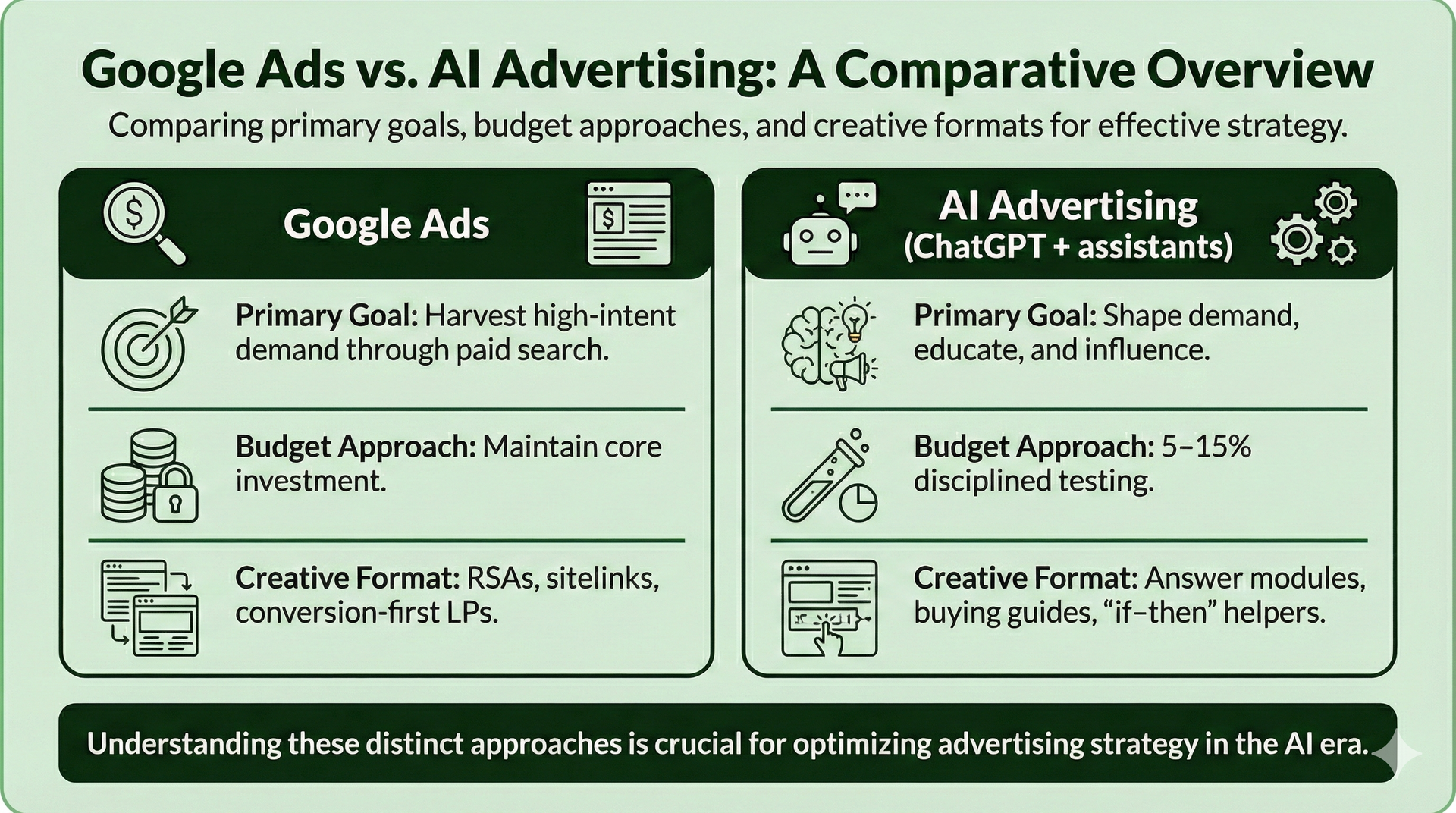
The strongest paid media strategies in 2026 balance proven intent capture with controlled experimentation in AI-driven discovery environments. Protect what’s profitable and fund disciplined tests as attention shifts. That means keeping Google Ads efficient while exploring AI advertising placements in ChatGPT and similar assistants, guided by data from your search optimization tools. This is how AI in business moves from idea to ROI.
- Preserve your proven programs. Maintain your winning campaigns in paid search and branded intent. Don’t starve what already funds growth.
- Carve out a test budget. Allocate 5-15% of your spend to new placements in AI chat ecosystems as inventory becomes available. Start small, measure often.
- Pilot conversational creative. Develop modular copy that can slot into assistant answers: educational mini-guides, side-by-side recommendations, and “if this, then that” guidance. This is how AI advertising will likely appear inside ChatGPT.
- Expand your retargeting logic. Expect fewer clicks, but more assisted conversions. Build audiences from any measurable interaction: calls, messages, store visits, and video views.
- Strengthen the content you can cite. Assistants reward clarity and authority. Use modern search optimization tools to improve structure, speed, and data coverage, so your content is eligible for citation. This approach ensures paid search continues funding growth while new channels are tested responsibly.
This framework helps paid media teams align budget, creative, and expectations across both legacy and emerging channels.
How do you optimize for AI answers (GEO) without sacrificing SEO?
Design content to be quoted by assistants and easily parsed by crawlers, two sides of the same coin. In other words, use search optimization tools to make your expertise machine-readable and human-friendly, so that ChatGPT and Google can trust it and surface it. This is the practical application of AI in business content ops. Strong GEO foundations also improve paid search performance by increasing relevance, Quality Score signals, and on-SERP engagement.
Direct answer: Continue building authoritative, structured, and sourced content. Add question-led sections, schema, and FAQs, so AI can safely and accurately lift your material (Search Engine Land).
- Start with questions. Pull real queries from SERP tools, site search, sales calls, and customer support logs. Organize by intent: learn, compare, act.
- Structure like an answer engine. Use clear H2/H3 questions, a 1-2 sentence direct answer, then supporting detail. This makes your content “quotable” in ChatGPT and SERP summaries.
- Add evidence and citations. Include stats, examples, and links to reputable sources (Think with Google; Search Engine Land; SparkToro).
- Implement schema. Mark up FAQs, how-tos, products, and reviews. It improves SERP features now and increases machine readability for AI.
- Maintain E-E-A-T. Feature author bios, real-world experience, and third-party mentions. Get reviewed and referenced by reputable sites; this boosts your trust signals.
- Uplevel your stack. Modern search optimization tools can surface question clusters, detect unlinked mentions, and audit structured data. Use them to close gaps faster.
When your team operationalizes AI in business with these processes, you’re not “gaming” algorithms; you’re making your expertise easier to find, verify, and present inside any answer engine that competes with or complements Google Ads.
Which metrics will matter as AI platforms roll out ads?
Expect a mix of brand-lift and assistive metrics to rise in importance alongside conversions. If ChatGPT introduces conversation-embedded AI advertising, some outcomes will look more like awareness and influence than immediate last-click wins, so make sure your search optimization tools and analytics support this broader view. That’s how AI in business becomes measurable.
- View-through and engagement proxies. If conversation-embedded recommendations run on CPMs, track brand lift, search volume lift, and assisted conversions over 7-30 days.
- On-SERP interactions. Monitor calls, messages, and direction requests originating from SERP features and AI overviews, not just clicks.
- Time-to-decision. For high-consideration journeys, measure whether deliberation windows shrink as users get clearer, faster AI guidance.
- Content “citation” rate. Use log analysis and qualitative testing to see which pages and FAQs are consistently referenced by assistants. Improve those pages first.
How can your team use ChatGPT today to improve Google Ads performance?
As a force multiplier for research, drafting, and iteration, even before ads arrive in chat. These AI in business workflows make your people faster without replacing judgment. It also reinforces your readiness for AI advertising while sharpening your Google Ads fundamentals. Reliable search optimization tools can pair with ChatGPT to accelerate every step. These workflows directly support paid search teams by speeding research, iteration, and testing cycles.
- Keyword landscape scans and clustering by intent.
- Query expansion for long-tail opportunities related to your best themes in Google Ads.
- Drafting headline and description variations aligned to unique value propositions.
- Building negatives from “lookalike, but wrong” queries and competitor terms.
- Drafting structured prompts for assets (images, video scripts) and landing pages.
- Audience hypothesis generation from reviews and call notes.
- “Compare vs.” frameworks that respect compliance and policy.
- Rapid A/B concept generation for RSAs and sitelinks.
- Writing concise, on-page FAQs aligned to the top questions.
- Competitive gap analysis: what rivals overpromise or miss.
Independent experiments show GPT tools can speed PPC workflows across research, ad copy, and landing page drafting (Claire Jarrett). It doesn’t replace strategy; it frees your experts to spend more time on modeling, incrementality, and offer testing. Paired with trusted search optimization tools, these AI in business gains are meaningful today and foundational for tomorrow’s AI advertising.
What campaigns should you test on day one of ChatGPT ads?
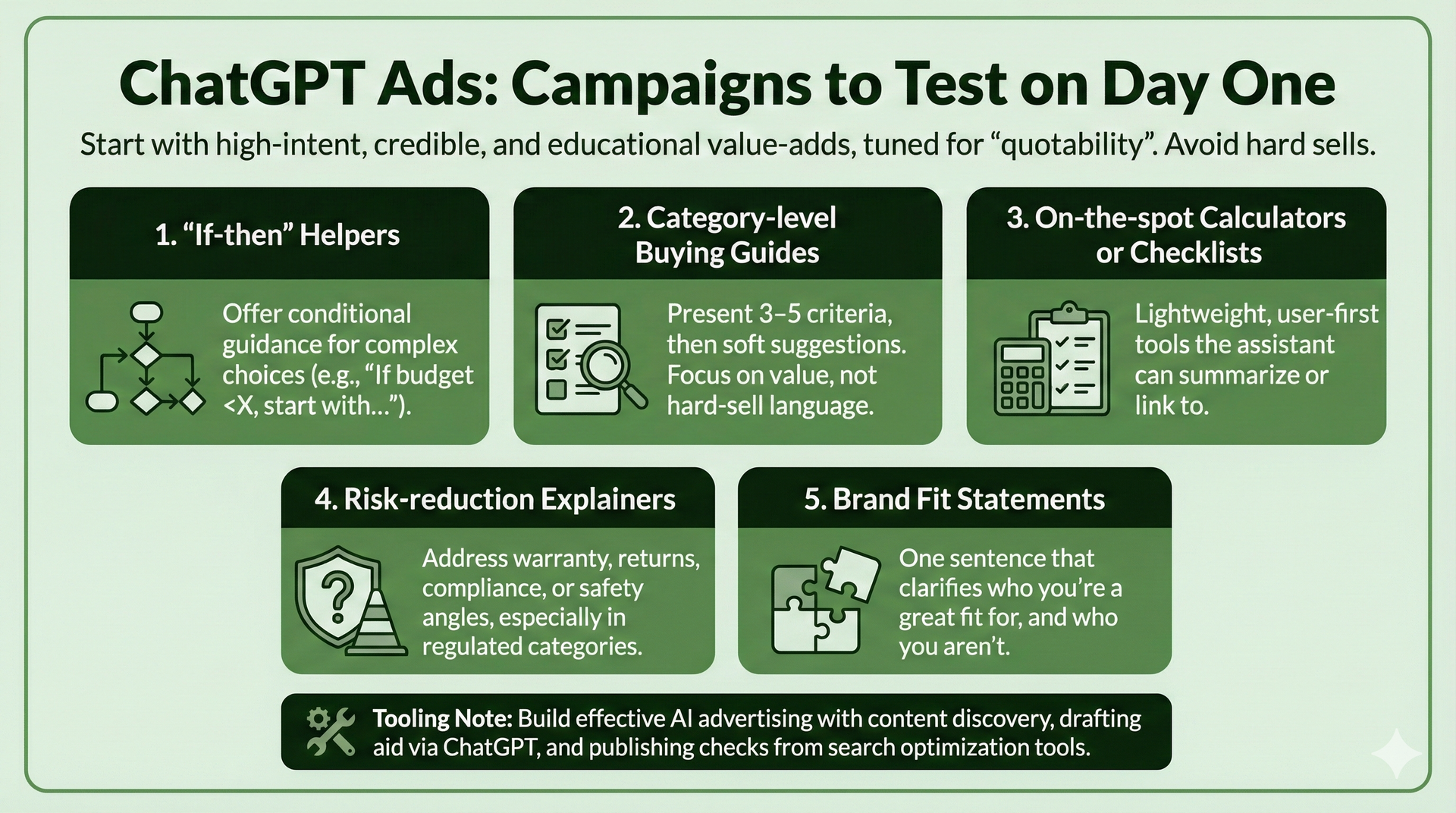
Start where the assistant's intent is strongest, and your credibility is demonstrable. As conversation-native AI advertising launches in ChatGPT, begin with educational value-adds supported by data and sources. Ensure your search optimization tools have tuned the destination content for “quotability”, another proof point that AI in business is execution, not hype.
Ideas to prioritize:
- “If-then” helpers. For complex choices, offer conditional guidance (“If budget <X, start with…”).
- Category-level buying guides. Present 3-5 selection criteria, then a soft suggestion based on the profile. Avoid hard-sell language.
- On-the-spot calculators or checklists. Lightweight tools that the assistant can summarize or link to, framed as a user-first value.
- Risk-reduction explainers. Warranty, returns, compliance, or safety angles, especially in regulated categories.
- Brand fit statements. One sentence that clarifies who you’re a great fit for, and who you aren’t.
Tooling note: shortlist the
best solutions your team needs on day one, content discovery, drafting aid via ChatGPT, and publishing checks from search optimization tools. These are the building blocks of effective AI advertising and sustainable AI in business operations.
What should small and mid-sized businesses do first?
Adopt a 30/60/90 plan that balances quick wins with durable advantages. Bring your Google Ads engine and AI advertising tests together with modern search optimization tools, so your AI in business roadmap is realistic and measurable.
30 days
- Audit your current paid search coverage and results. Which high-intent queries are profitable? Where are you exposed?
- Spin up answer-first pages. Prioritize FAQs and how-tos tied to your top 10 revenue-driving questions.
- Add basic schema and speed fixes; modern search optimization tools can accelerate this.
- Stand up a small test budget in emerging AI advertising chat environments as inventory opens, with ChatGPT on your watchlist.
60 days
- Expand question-led content. Publish buying guides and comparison explainers informed by real sales objections.
- Refresh creative. Build conversational, “assistant-ready” assets and deploy them across extensions and landing pages in Google Ads.
- Align measurement. Add brand lift and assist metrics to your dashboard; validate how non-click interactions influence the pipeline using your search optimization tools.
90 days
- Scale what’s working. Increase investment in formats and surfaces that deliver incremental performance across Google Ads and AI advertising, including ChatGPT-style assistants.
- Develop playbooks by the intent stage. Document messaging, offers, and formats by “learn,” “compare,” and “act.”
- Plan your next tests. Include top demand-generation strategies for search marketing, such as category-level thought leadership and collaborative guides with creators or SMEs.
Want an expert partner to stand up this plan? Explore our
solutions, or
contact us to schedule a strategy session.
How could this play out for a regional service brand?
Let’s take a multi-location home services company entering peak season with a strong paid search foundation. A smart blend of Google Ads and AI advertising, supported by search optimization tools, can translate AI in business ideas into booked jobs.
- Current state: Strong branded and local intent coverage via Google Ads; decent rankings; rising competition increases CPCs.
- Plan: Preserve high-ROAS campaigns. Build an answer-first hub: “How to choose a [service] provider,” “What does a [service] visit include?”, and “Seasonal maintenance checklist.” Add clear FAQs, schema, and short explainer videos backed by search optimization tools.
- New tests: Pilot conversational placements with educational snippets, “3 safety checks before you hire,” and “When DIY becomes risky” are ready for ChatGPT environments. Include a soft CTA to schedule a technician.
- Measurement: Track calls from on-SERP features and AI summaries, not just site clicks. Monitor “brand + service” query lift and store visit conversions.
Expected result: Higher early-stage visibility, steadier lead volume despite rising CPCs, better close rates thanks to clearer prequalification and trust, exactly how AI in business should feel: practical, helpful, and aligned with revenue. The combination of Google Ads rigor and AI advertising savvy, enabled by your search optimization tools, is a competitive edge.
Where do BusySeed’s experts come in?
Our team designs paid media systems that evolve with platforms while protecting performance and brand trust. We’ve helped brands scale performance across every major shift in the last decade, and we’re doing the same in today’s assistant-led landscape. Our media strategists, content SEOs, and data scientists build integrated programs that:
- Protect proven performance while we pilot emerging formats in AI advertising and Google Ads.
- Translate your subject-matter expertise into assistant-ready answers for ChatGPT and SERPs.
- Implement and tune the stack of search optimization tools that your team needs.
- Design measurement frameworks that capture true incrementality across Google Ads and AI touchpoints.
- Build training and workflows, so your team can confidently operationalize AI in business.
If you want a battle-tested plan, not just theory, reach out. We’ll meet you where you are and accelerate what’s next. Start here:
BusySeed. You can also learn more about our
services or see our
client wins.
FAQ
Q1) Will ChatGPT ads cannibalize my Google Ads traffic?
Unlikely in the short term. Think of assistant placements as complementary influence points earlier in the journey. Users who are primed by conversational guidance often convert later through branded queries, direct traffic, or retargeting. As inventory matures, you’ll calibrate budgets based on incrementality, not clicks alone. External data indicate concurrent growth in assistant usage alongside sustained search monetization (PYMNTS; Think with Google). This is a classic case of AI in business: additive, not zero-sum, especially when guided by your search optimization tools and AI advertising tests.
Q2) What are the best ChatGPT ad tools for small business owners?
The best ChatGPT ad tools for small business owners are those that support ideation, ad copy variation, audience hypothesis testing, and rapid iteration, without fully automating strategic decisions such as budget allocation or brand positioning.
Q3) How should I measure success if clicks decline?
Use a layered model: brand lift, assisted conversions, on-SERP actions (calls, messages), and eventual revenue. In discovery-heavy categories, these proxy signals are leading indicators that your influence is growing, even if click counts drop due to richer SERP and AI answers (Search Engine Land; SparkToro). The right search optimization tools and dashboards bring it to life, so your AI in business plan doesn’t miss what matters as AI advertising grows.
Q4) Are there policy or compliance concerns with conversation-embedded promotions?
Yes, especially in regulated industries. Prepare clear disclaimers, ensure claims align with sourced content, and involve legal counsel early. Build a library of compliant talking points and templates to accelerate reviews. When in doubt, bias toward education over persuasion, and let the assistant invite the next step. These habits keep your AI advertising safe and make AI in business more resilient, particularly when scaled with search optimization tools.
Q5) What are the top-rated solutions for AI-driven content discovery?
Top-rated AI-driven content discovery solutions combine large language models with behavioral and intent signals to surface relevant content across search, social, and generative interfaces, rather than relying solely on traditional keyword rankings. If you want a curated stack tuned to your goals, let’s talk.
The bottom line (and your next move)
ChatGPT won’t replace Google Ads in 2026. It will broaden the landscape and move more discovery into conversation-driven experiences. The winners will be the brands that:
- Keep their proven Google Ads performance engines running.
- Build answer-first content and structure it for assistants like ChatGPT to cite.
- Pilot new chat-native AI advertising formats with disciplined measurement.
- Modernize their tech and workflows with search optimization tools to move fast without breaking trust.
If you’d like an expert partner to help you build this plan and execute it, we’re here to make it simple, measurable, and effective. Book a strategy session with BusySeed today:
Schedule now. Prefer to browse? Explore our
services and
client stories, then let’s map your next step together.
Works Cited
- “Generative AI: Search Trends and Transformations.” Think with Google, Google, 2025, https://business.google.com/in/think/marketing-strategies/generative-ai-search-trends-and-transformations/. Accessed 4 Feb. 2026.
- Sullivan, Barry. “Majority of Google Searches Result in Zero Clicks.” Search Engine Land, 2024, https://searchengineland.com/google-search-zero-click-study-2024-443869. Accessed 4 Feb. 2026.
- Fishkin, Rand. “2024 Zero-Click Search Study: For Every 1,000 US Google Searches, Only 374 Clicks Go to the Open Web.” SparkToro, 2024, https://sparktoro.com/blog/2024-zero-click-search-study-for-every-1000-us-google-searches-only-374-clicks-go-to-the-open-web-in-the-eu-its-360/. Accessed 4 Feb. 2026.
- “Marketers Bet on AI Media Despite Struggling with Generative AI Adoption.” PPC Land, 2025, https://ppc.land/marketers-bet-on-ai-media-despite-struggling-with-generative-ai-adoption/. Accessed 4 Feb. 2026.
- Williamson, Debra Aho. “Analyst Predicts AI Platforms Will Become Media Giants in 2026.” PPC Land, 2025, https://ppc.land/analyst-who-forecasted-social-media-advertising-predicts-ai-platforms-will-become-media-giants-in-2026/. Accessed 4 Feb. 2026.
- PYMNTS. “Pichai Says Alphabet Is Firmly in the Generative AI Era.” PYMNTS.com, 2025, https://www.pymnts.com/google/2025/pichai-says-alphabet-is-firmly-in-the-generative-ai-era/. Accessed 4 Feb. 2026.
- Moran, Gene. “Ads Coming for ChatGPT?” Forbes, 28 Dec. 2025, https://www.forbes.com/sites/quickerbettertech/2025/12/28/this-weeks-small-business-technology-news-ads-coming-for-chat-gpt-and-10-free-windows-apps-for-productivity/. Accessed 4 Feb. 2026.
- Garcia, Nicole. “How AI Is Reshaping SEO: Challenges, Opportunities, and Brand Strategies for 2025.” Search Engine Land, 2025, https://searchengineland.com/how-ai-is-reshaping-seo-challenges-opportunities-and-brand-strategies-for-2025-456926. Accessed 4 Feb. 2026.
- Jarrett, Claire. “How to Use ChatGPT for Google Ads: An Experiment + Top 10 Use Cases.” ClaireJarrett.com, 2024, https://www.clairejarrett.com/how-to-use-chatgpt-for-google-ads-an-experiment-top-10-use-cases/. Accessed 4 Feb. 2026.