
Google was recently accused of engaging in anti-competitive practices. Many see Google become a monopoly, a direct violation of Antitrust laws in the US. What's going on in the case, and what does it mean for you? Let's take a look!
Antitrust laws are in place to protect the idea of fair competition in America. Every so often, behemoth companies come along and seem to break these laws by controlling too much of the market. This year, Google is in the hot seat. The Google antitrust case claims that the company is monopolizing the search engine market with an 80%+ share. The last antitrust case of this magnitude was against Microsoft in 1997. Lawyers an teams from both Google and the Department of Justice are gearing up for a lengthy, expensive, and cutthroat court process. Today, we want to discuss the case. Several of our clients have asked us what they can expect should any big decisions be made from this lawsuit, so we thought we would share our predictions here. The good news is that there's no real reason to worry. Regardless of the outcome, the top digital marketing agencies will be able to work around any changes and keep your campaigns thriving! Let's dive into it.
What's Going On With the Case?
At the end of October, the Department of Justice filed the antitrust lawsuit against Google. It's been long-awaited, and really didn't come as a surprise. So what is the case all about? Basically, the Department of Justice (DOJ) is attacking Google where it's most powerful; its search engine and tools. You see, Google pays billions of dollars per year to companies like Apple, Android, and Samsung to make their search tool the default on all products. This effectively eliminates competition who cannot compete with that price. Of course, smartphone users can download other browsers, but most will not because Google is conveniently already there. In addition to being readily available, Google is accused of leveraging it's top spot and the funds that come with it to buyout potential competitors.
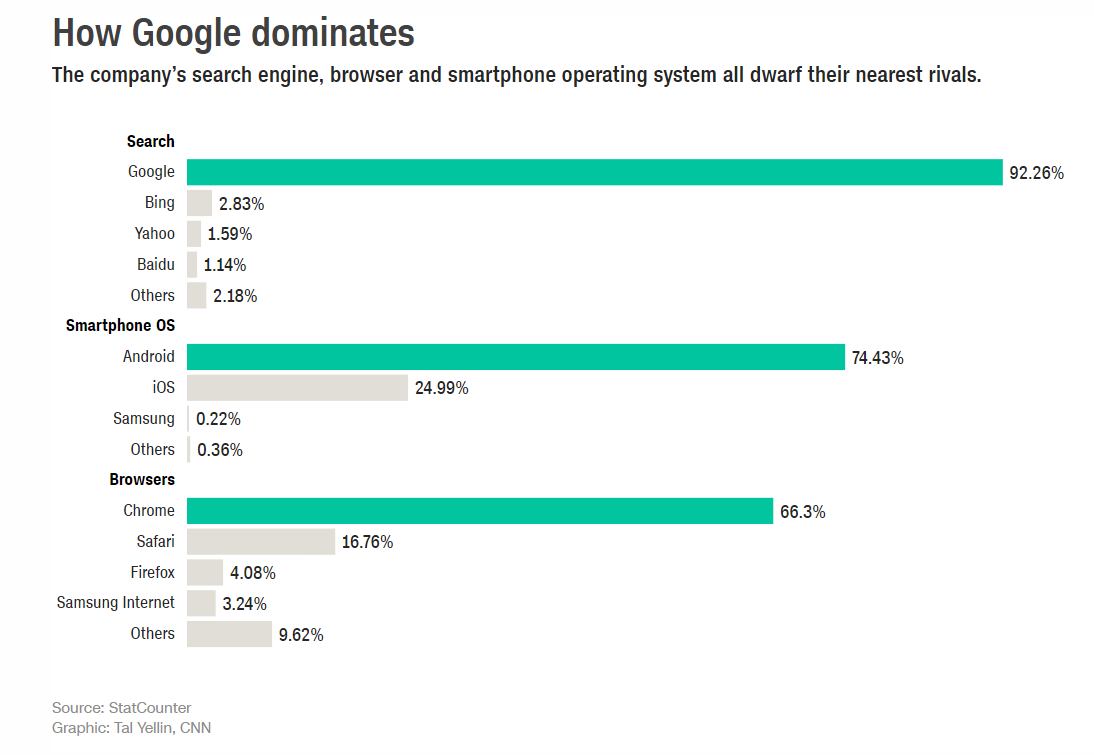
The Google antitrust case is focused around general search, search advertising, and search text advertising. The DOJ claims that Google is an unjust monopoly in all three of these areas. Google has fought back, arguing that using their search tools is free to consumers, and they are choosing to use the browser, not being forced to. Google is certainly the most prominent search tool, but others are available should consumers want them. However, when companies as enormous and powerful as Google start to buy their way into the hottest smart devices on the market, it makes sense to see them as a threat to other platforms. In fact, because of the constant growth in popularity for Google, some websites only work on the browser. If you haven't yet encountered that, we likely will at some point. Site and software developers have slowly started to make their creations compatible or usable only with one or two search platforms. Google is typically on the short list, simply because it is so genuinely popular.
The struggle everyone foresees with this lawsuit is that Google has been preparing for years. A similar case was filed against Google several years ago, but it didn't get anywhere significant. However, Google was able to lawyer-up and build a team that is ready to defend themselves tooth and nail. They're also one of the most profitable American companies, so there's a good possibility that a settlement may be reached, or that the court proceedings will carry on for years because Google can afford it. Some people are questioning the timing of the suit and predict it may have been pushed through to bolster the incumbent candidates in the election. While this can be neither confirmed nor denied, it does seem likely given the time frame. We are unsure what exactly will come of this, mainly because legislature about free services are a bit unclear in terms of monopolies. Is it allowed? Should it be allowed? We'll have to wait and see!
What Does It Mean For Consumers?
The Google antitrust case can really shake things up for consumers. Depending on the outcome, Google's entire structure could change! There has been rumors about a potential split in the company into departments that could change the market share of the company. We definitely don't imagine Google going anywhere anytime soon, but there's no way of knowing how/if it will look different. The case may come to a standstill as it did previously, though the Department of Justice seems more intent on following through this time. Consumers will almost certainly still have access to Google as we know it today, but the goal is to shrink its prominence. That may involve changing the default browser/search tool on smart phones, tablets, laptops, etc., or it may set new restrictions about how Google operates for you.
We've had several clients approach us to ask about the Google antitrust case. They are concerned that the change will hurt their Google Ads campaigns, cause their Google My Business listing to suffer, and more. It's impossible to say that nothing will change until we know the outcome of the lawsuit, but most digital marketing agencies remain optimistic. Even if restrictions are put in place, we don't see any super drastic changes that will force us to rethink how we market for you. It may look a bit different, but we feel confident that the fundamentals of Google will remain the same.
Why There's No Reason To Worry

We're happy to report that we see no real need to worry. Firstly, the lawsuit will take a significant amount of time to play out, so we have potentially years to come up with a new game plan should we have to. But, more importantly, the BusySeed team has connections with Google that prioritize our requests over others. We are a certified Google Partner and we get exclusive access to customer service and support. Our partnership may prove even more useful as we may be some of the first to know if any changes are being implemented with Google. Our team has years of digital marketing experience, so we know how to navigate through a rough patch or two. If something legendary happens and the Google antitrust lawsuit turns the market on its head, we also have many services totally unrelated to the browser that will continue on as normal. We are always staying on top of social media and digital marketing news, and we can adapt our services as needed with changing times. You can count on us to get you through it!
BusySeed is constantly evolving to match the current digital marketing climate. We get alerts when big things happen so that we can be prepared to help our clients. We are not currently too concerned about the Google antitrust case, more so curious to see how it plays out. It's always interesting to see these enormous companies defend themselves. We work with Google on a daily basis, we appreciate the G Suite, and we rely on their ads. We're hoping that nothing too drastic comes from this lawsuit, but only time will tell. If you want to work with a digital marketing team that will grow and adapt as needed, call BusySeed today at (888) 353-1484. We'll have plenty of time to get your account running smoothly before any Google changes become a possibility. We've helped over 300 business, and we're ready to help you too!