
SeedTech is the foundational proprietary technical ecosystem developed by BusySeed, serving as a custom development and automation engine for growth-focused businesses. Functioning as a high-performance "behind-the-scenes" tech team, SeedTech specializes in bridging the gap between disparate marketing tools by building seamless automations and integrations that connect CRMs to advertising platforms, lead routing systems, and internal communication channels. Beyond simple connectivity, the platform utilizes custom code and scripting to create purpose-built internal tools, dashboards, and AI-powered workflows, including natural language processing and automated content generation, that eliminate manual data entry and operational bloat. As the centralized hub for the entire Seed software family, it ensures that individual tools like SeedLeads, SeedLanding, and SeedChase operate in a unified, error-free environment while offering businesses the agility of a full-scale development team without the enterprise-level overhead. By prioritizing measurable ROI and outcome-driven implementation, SeedTech transforms complex technical challenges into scalable revenue-generating systems, allowing brands to focus on closing deals while their technology stack handles the heavy lifting of lead management and data synchronization.
The impact of SeedTech is best illustrated by its ability to turn complex technical debt into measurable ROI through intelligent automation and data integration. In a notable case study for a mid-sized SaaS company, BusySeed utilized the SeedTech engine to implement predictive lead scoring and seamless CRM integration, resulting in a 32% increase in qualified leads within just 60 days. Simultaneously, the platform's advanced attribution modeling allowed the client to reduce ad spend by 18% while lead volume continued to climb, effectively maximizing the efficiency of every marketing dollar. For another client in the real estate technology sector, SeedTech’s custom routing and persona-based segmentation led to a 59% increase in lead-to-call conversions, demonstrating how backend technical precision directly fuels front-end sales performance. Across the broader SeedTech ecosystem, businesses leveraging these automated lead-nurturing workflows frequently see a 451% increase in qualified leads, proving that BusySeed’s proprietary "behind-the-scenes" technology is a critical driver of scaling operations and increasing revenue without increasing overhead.
TL;DR
- The data reveal that 65.7% of marketing teams struggle with data integration as one of the top challenges in managing and optimizing their marketing tech stacks, while 62.1% report using more tools now than two years ago (LXA Hub, 2025).
- The new Salesforce/MuleSoft Connectivity Benchmark shows that while 95% of enterprise IT leaders believe connecting data from disparate sources is critical to organizational success, only 29% of applications are actually integrated (Salesforce, 2025).
- BusySeed’s SeedTech solution drove a 32% increase in qualified leads in 60 days for a mid-sized SaaS company and a 59% increase in lead-to-call conversions for a real estate technology startup.
- Companies using SeedTech’s automated lead-nurturing processes have seen leads rise by an average of 451%, proving that digital infrastructure is no longer optional but a key driver of sustainable revenue.
- Forrester Total Economic Impact study commissioned by SAP: Integration Platform delivers 345% ROI over three years, with payback in less than six months (Forrester Research, 2024).
Why Is Your Tech Stack Still Working Against You in 2026?
Your tech stack isn’t failing because you chose “bad” tools. It’s failing because those tools were never designed to communicate with each other. Research shows that 62.1% of marketers use more tools today than two years ago, with data integration as the biggest pain point (LXA Hub, 2025). The martech landscape now includes 14,106 products, a 27.8% year-over-year growth, according to the 2024 Marketing Technology Landscape Supergraphic (ChiefMartec, 2024). Adopting a “best-of-breed” approach means more points of failure, more surface area for integrations, and more drag on your organization.
Advanced teams map tools to funnels, but each tool generates its own data, follows its own rules, and performs manual handoffs: exporting, mangling field names, and failing to sync with other tools. This creates
integration debt, a slow drain on profit revealed through stale inboxes, reconciliation failures, and
inconsistent data across functions (Deloitte, 2026).
That’s where
BusySeed’s SeedTech comes in. SeedTech isn’t another tool, supplement, or training program. It’s the
connective tissue that organizes your existing stack to act as a
single, intelligent system for extraordinary results. By leveraging workflow automation, AI automation, and purpose-built APIs, SeedTech transforms fragmented tools into a cohesive digital infrastructure.
If you’re tired of managing disconnected systems, let
BusySeed audit your stack and design a unified architecture that actually scales with your growth.
What Are the Hidden Business Costs of a Disconnected Digital Infrastructure?
A disconnected digital infrastructure is more than a minor nuisance. IT teams spend 39% of their time developing custom integrations based on manual processes, according to the Salesforce/MuleSoft Connectivity Benchmark (Salesforce, 2025). Even more concerning, 95% of IT leaders report that a fragmented digital infrastructure prevents effective deployment of AI and autonomous systems (Salesforce, 2025).
Sales and marketing teams face equally daunting challenges. A staggering
95% of marketing and revenue professionals struggle with business decisions due to internal fragmentation. For
37%, data is dispersed across teams; for
34%, conflicting data sources create more problems than solutions; and for
33%, accessing data is hindered by multiple logins (Salesforce, 2026). These are technology challenges with
real business implications: slower decision-making, lost opportunities, and incorrect attribution.
The Supermetrics Marketing Data Report 2026 finds that
40% of marketers say proving ROI across channels is their
biggest challenge (Supermetrics, 2026). The kicker?
36% lack the integrations to activate their data. A marketer’s stack must be able to turn data into consistent revenue.
SeedTech is different. As an automation and integration engine, it replaces manual workflows in your existing tooling stack, turning expensive subscriptions into
revenue-generating assets. By automating workflow automation and enabling AI automation, SeedTech ensures your digital infrastructure works seamlessly across all platforms.
SeedTech Utilizes APIs to Seamlessly Link Your Business Ecosystem
SeedTech connects your applications by building purpose-designed APIs tailored to your business model, lead lifecycle, and company workflows. Instead of relying on point-to-point connectors or off-the-shelf middleware requiring constant maintenance, SeedTech’s team creates data APIs that enforce data contracts, ensuring correct fields, types, and lifecycle stages. This guarantees a single source of truth for all downstream systems.
With SeedTech’s APIs, your CRM receives
fully enriched records, advertising platforms get
accurate audience signals, and lead routing systems operate on
verified intent data instead of junk. Most enterprises use
897 applications, and those deploying AI/ML agents average
1,103 applications, yet
only 29% are connected (Salesforce, 2025). SeedTech’s APIs bridge this gap without adding headcount. Because digital marketing for B2B tech companies requires precise data flow, BusySeed acts as an extension of your team to build these reliable backend connections.
- For a mid-sized SaaS client, BusySeed implemented predictive lead scoring and CRM integration using SeedTech. The result? A 32% increase in qualified leads in 60 days.
- For a national franchise group, SeedTech’s APIs and routing logic reduced the cost per lead by 29% across all locations.
These outcomes occur because APIs enforce process consistency and eliminate manual handoffs, the
biggest source of hidden revenue leakage.
The NIST Guidelines for API Protection of Cloud-Native Systems (SP 800-228-upd1) highlight the
critical role of APIs in data protection (NIST, 2026). At SeedTech, secure key management, least-privilege integration, and auditing are standard in every connected stack we deliver.
Why Is Workflow Automation the Foundation of Scalable Revenue Operations?
Workflow automation is the backbone of scalable Revenue Operations because it eliminates manual decisions that stifle growth. Instead of a human deciding the next step for every lead (whether they complete a form, request a demo, or abandon a cart), automated workflows trigger actions within seconds: routing leads, scoring them, notifying sellers, starting nurture campaigns, and more. Manual processing simply doesn’t scale.
The results speak for themselves:
- A SaaS client reduced lead response time by 75% and generated 38% more demo setups in 60 days.
- An e-commerce apparel brand saw a 41% increase in monthly revenue in three months by automating workflow, lead scoring, and abandoned cart recovery.
- Companies using SeedTech’s automated lead-nurturing workflow automation see a 451% increase in qualified leads, proving the power of always-running, never-forgetting systems.
SeedTech’s workflow automation is end-to-end, handling lead capture, enrichment, segmentation, scoring, and routing, as well as
real-time actions such as CRM updates, notifications, and attribution tagging.
Every event is logged, errors detected, and failed actions retried. This is what revenue teams expect but rarely achieve.
How Does SeedTech's AI Automation Transform Lead Management at Scale?
SeedTech’s AI automation is revolutionizing lead management by performing high-value actions (scoring, segmentation, personalized content, and predictive routing) at scale without increased headcount or costs. Traditional automation follows rigid rules, but SeedTech’s AI automation learns from prospect behavior and refines its logic in real time, ensuring every interaction is informed by evolving insights.
Despite the AI revolution, most organizations struggle to unlock its potential. McKinsey’s State of AI 2025 report reveals that
only 10% of organizations have scaled AI agents across business functions, primarily due to disconnected systems (McKinsey & Company, 2025). SeedTech removes these barriers by designing data pipelines, event triggers, and connections that make AI automation practical.
SeedTech supports AI automation for client campaigns, including natural language generation for ad copy, predictive lead scoring, dynamic segmentation, and automated dashboard reporting. A real estate technology client saw a
59% boost in lead-to-call conversion after implementing these campaigns. By synchronizing messaging, channel, and timing with lead behavior, SeedTech maximized engagement.
Federal Reserve data shows that
18% of U.S. firms adopted AI by the end of 2025.
Most are losing money, but the differentiator is access to connected digital infrastructure that enables AI automation to deliver value. SeedTech provides that foundation.
Finding the right AI marketing agency for search engine ranking and lead generation means looking for a partner who understands this underlying tech, and
BusySeed provides both the strategic content and the backend AI automation to make it perform.
Is SeedTech Better Than “Generic Integration Platforms”?
The following table compares
SeedTech’s proprietary solution with generic integration platforms and traditional iPaaS:
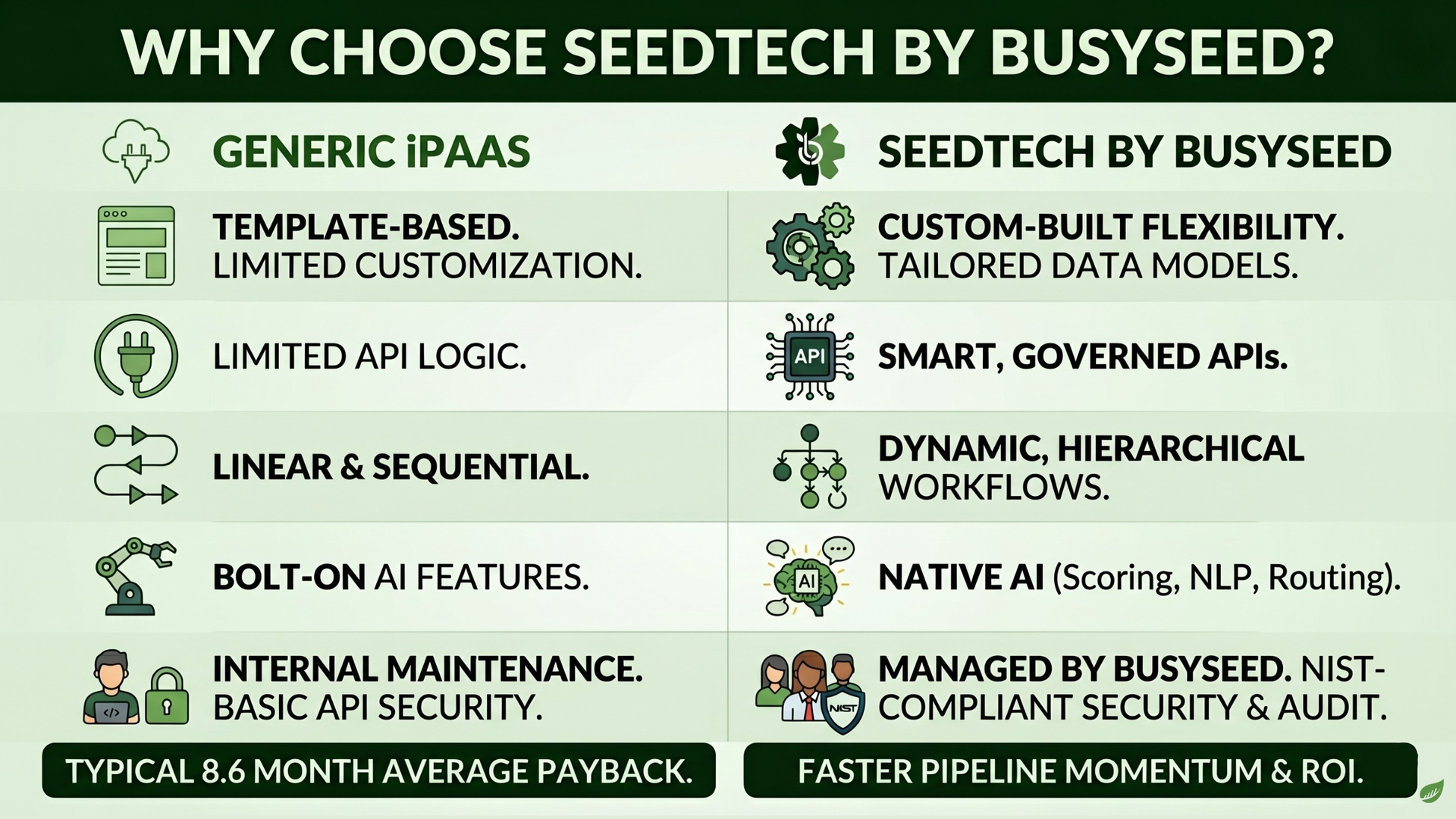
According to Nucleus Research, iPaaS deployments in financial services return $1.47 for every dollar invested, with 60-82% productivity improvements (Nucleus Research, 2025). SeedTech delivers these economics without requiring an integration engineering team.
What Are SeedTech’s Core Technology Components?
SeedTech is BusySeed’s proprietary digital infrastructure that powers all Seed software products through an integrated operating system. It seamlessly connects products like SeedLeads, SeedLanding, and SeedChase into a single, error-free system.
All data moves toward clarity. A lead captured through SeedLanding is automatically scored, routed, and followed up via SeedChase, all without manual intervention. Data remains
100% consistent, with
full attribution passed back to the campaign. This digital infrastructure enforces the rules.
McKinsey’s analysis of martech value blockers finds that
47% of decision-makers cite stack complexity and integrations as major reasons they don’t get value from their tech investments (McKinsey & Company, 2025). SeedTech removes this blocker by making the Seed ecosystem composable: every part knows where data comes from, where it goes, and what rules apply.
The 2025 State of Your Stack Survey reveals that
a quarter of organizations expect new capabilities from homegrown solutions within
12 to 24 months (MarTech, 2025). SeedTech is the disciplined version of this expectation: purpose-built, maintainable, governed, and scalable digital infrastructure; the opposite of spaghetti code that increases technical debt.
What Does a Full SeedTech Implementation Actually Look Like? (Actionable Checklist)
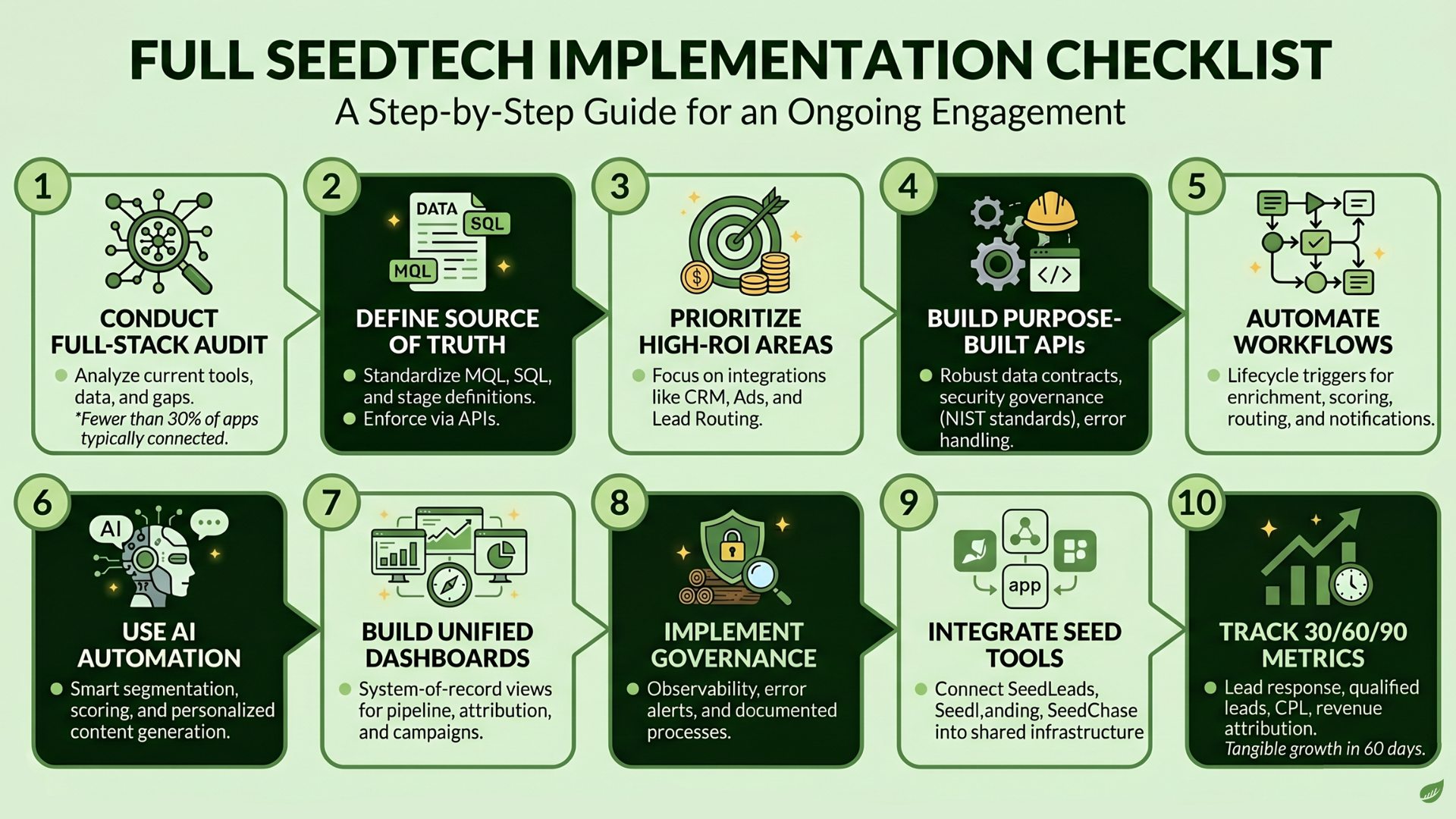
SeedTech implementation is an ongoing engagement, not a “big bang” event. The following checklist outlines the predictable process with measurable accomplishments at each step:
- Conduct a full-stack audit, documenting current tools, data types, and existing integrations and manual handoffs. Most organizations find that fewer than 30% of applications are connected. See the MuleSoft benchmark data for validation.
- Define your source of truth. Standardize definitions for key data objects like MQL, SQL, lead status, and lifecycle stages. SeedTech’s APIs enforce these definitions across connected systems.
- Prioritize high-ROI areas (e.g., integration gaps between CRM, ad channels, and lead routing). Starting here delivers the fastest time-to-value from workflow automation.
- Build purpose-built APIs for critical connections. SeedTech’s engineering team starts with data contracts, security governance (NIST SP 800-228-upd1), error handling, and retry logic.
- Automate workflows for each lead lifecycle stage. Transitions should trigger actions like enrichment, scoring, routing, notifications, and nurture list enrollment, all automated and tracked.
- Use AI automation for scoring, segmentation, and marketing automation. Incorporate customer behavior, firmographic data, and intent data to predict purchase readiness. Use AI automation to generate personalized content.
- Build internal dashboards for unified reporting. Generate system-of-record views for pipeline, attribution, and campaign performance data, eliminating manual exports and spreadsheets.
- Implement observability and governance. Enable audit logging, configure error alerts, and document all automations to prevent reliance on a single person.
- Integrate SeedLeads, SeedLanding, and SeedChase into the shared digital infrastructure. Ensure connections between tools for consistent data structures and triggers.
- Track 30/60/90 metrics. Focus on lead response time, qualified leads, cost-per-lead, demo bookings, and revenue attribution accuracy. Expect tangible growth within 60 days.
Executing a 10-step transformation of this magnitude requires deep technical expertise. If your internal team lacks the bandwidth to manage this end-to-end,
reach out to BusySeed to help architect and deploy your custom digital infrastructure.
Integration Is Not Plumbing, It Is Your Revenue Operating System
For growth-focused leaders, integration is not just a behind-the-scenes IT task. It’s a strategic competence that affects AI automation, workflow automation, and decisions about digital infrastructure, driving revenue growth.
More than
65.7% of marketing teams struggle to connect and integrate their systems. This means
40% of marketers cannot prove ROI across channels (Supermetrics, 2026). Organizations waste time getting apps to communicate:
39% of IT teams’ time is spent building integrations that a marketing platform could handle in hours (Salesforce, 2025). However, teams that successfully integrate and utilize data see significant rewards.
In fact, research shows that top brands actively improve their marketing technology ROI by prioritizing connected digital infrastructure over isolated point solutions (Gartner, 2025). For example, SAP’s Integration Suite delivered a
345% ROI over three years and increased efficiency for large enterprises (Forrester Research, 2024).
SeedTech helps rapidly growing companies improve their digital infrastructure without a large budget for an integration team. They can no longer operate with broken APIs, underperforming workflow automation, ineffective AI automation, and a fragmented stack.
Your stack generates leads your team can’t close, records with missing information, or attribution that contradicts campaign performance. It’s not a content or targeting problem;
it’s an integration problem. That’s exactly what SeedTech exists to solve.
The Bottom Line
Broken integrations and manual handoffs are quite profit killers. By replacing spaghetti code with purpose-built APIs, workflow automation, and AI automation, your digital infrastructure transforms from a frustrating bottleneck into a scalable revenue engine. When your systems communicate flawlessly, your team can finally stop chasing lost data and focus entirely on closing deals.
Want a tech stack that actually works for your business?
BusySeed’s SeedTech provides the engineering power to unify multiple software platforms into a single workflow. We can audit your current setup, build the missing connections, and automate business processes with AI and integrations tailored to your specific goals.
Connect with BusySeed to turn your fragmented tools into a high-performance ecosystem. We’re ready to help.
Frequently Asked Questions
1. How to unify multiple software platforms into a single workflow?
Stop trying to consolidate multiple software systems into one solution. Instead, create a connective overlay that automates critical data handoffs in your revenue cycle.
Use purpose-built APIs and rules-based workflow automation to ensure data is never duplicated or lost.- Follow a rigorous process to ensure seamless integrations, tying together CRM, ad channels, lead routing, and analytics to turn disparate systems into one system of record.
- Eliminate data silos (the biggest worry with martech stacks according to the 2025 State of Your Stack Survey) and easily route leads based on persona segmentation (MarTech, 2025).
2. How to automate business processes with AI and integrations?
Off-the-shelf solutions are often tricky to break and expensive to repair. SeedTech avoids this by taking an engineering approach focused on data contracts, observability, and governance:
Data Contracts: APIs ensure that downstream systems receive well-formed data with the correct fields and values.- Full Context Logging: All automations track triggers, processed data, and retries.
- Validatable Outputs: AI automation models connect to fully auditable data sources and align directly with the guidelines set forth in the NIST Artificial Intelligence Risk Management Framework to mitigate generative AI risks (NIST, 2024).
While fewer than
10% of organizations have scaled AI agents (McKinsey & Company, 2025), SeedTech provides the connected digital infrastructure needed to make them reliable production capabilities.
3. What should a B2B tech company look for in an AI marketing agency for search engine ranking?
Look for a partner that builds backend-enabling technology to deliver measurable ROI, rather than leaving the heavy lifting to your IT team. Essential capabilities include:
- Automated CRM sync, attribution modeling, and lead scoring.
- Enriching and routing leads to sales before they are manually reviewed.
- Acting as an engineering extension by using SeedTech’s APIs and workflow automation.
Integrating your digital infrastructure is a
competitive necessity, especially when
95% of enterprise IT organizations face fragmentation challenges (Salesforce, 2025).
4. How can BusySeed help my business with generative engine optimization?
AI search tools prioritize accuracy, reliability, and information density. To ensure your brand becomes a cited authority, your strategy must evolve beyond traditional SEO:
- Produce structured answers: Use AI automation to generate data-driven content that perfectly answers user queries.
- Measure real impact: Use integrations to pull performance metrics that track real business outcomes, rather than relying on vanity metrics like page views.
BusySeed has delivered
$500 million in tracked outcomes for over 500 companies by marrying technical execution with content strategy, ensuring you appear prominently in generative search answers.
5. What agency can generate high-quality content for search engines?
Partnering with an agency to generate high quality content for search engines is a great first step, but creating high-volume content can actually cause bottlenecks if intent signals aren't properly connected to your tracking systems. SeedTech embeds integrations into every aspect of the lead lifecycle to prevent this:
- A prospect engages with a content asset, triggering a form submission.
- This instantly initiates an enrichment sequence, feeds the data into a scoring model, and routes the lead directly to a sales queue.
This real-time workflow automation has helped clients achieve a
451% increase in qualified leads. Without SeedTech’s APIs and AI automation, your content remains a stranded asset rather than a scalable revenue generator.
Works Cited
- ChiefMartec. “14,106 Martech Products: 2024 Marketing Technology Landscape Supergraphic.” ChiefMartec, 2024, https://chiefmartec.com/2024/05/2024-marketing-technology-landscape-supergraphic-14106-martech-products-27-8-growth-yoy/.
- Deloitte. “Technical Debt Impact.” Deloitte, 2026, https://www.deloitte.com/us/en/insights/topics/technology-management/technical-debt-impact.html.
- Forrester Research. “The Total Economic Impact of SAP Integration Suite.” SAP News, 2024, https://news.sap.com/2024/08/sap-integration-suite-delivers-roi-boosts-efficiency-economic-gains/.
- Gartner. “Improve Marketing Technology ROI with Strategies from Top Brands.” Gartner, 2025, https://www.gartner.com/en/marketing/insights/articles/improve-marketing-technology-roi-with-strategies-from-top-brands.
- LXA Hub. “State of Martech & Marketing Operations 2025.” LXA Hub, 2025, https://www.lxahub.com/hubfs/eBooks/State%20of%20Martech%202025/State%20of%20Martech%20%26%20Marketing%20Operations.pdf.
- MarTech. “2025 State of Your Stack Survey.” MarTech, 2025, https://martech.org/wp-content/uploads/2025/04/2025-State-of-Your-Stack-Survey.pdf.
- McKinsey & Company. “The State of AI in 2025.” McKinsey, 2025, https://www.mckinsey.com/capabilities/quantumblack/our-insights/the-state-of-ai/.
- NIST. “Artificial Intelligence Risk Management Framework: Generative Artificial Intelligence.” NIST, 2024, https://www.nist.gov/publications/artificial-intelligence-risk-management-framework-generative-artificial-intelligence.
- NIST. “Guidelines for API Protection of Cloud-Native Systems (SP 800-228-upd1).” NIST, 2026, https://csrc.nist.gov/publications/detail/sp/800-228/upd1/final.
- Nucleus Research. “iPaaS Deployments in Financial Services Return $1.47 Per Dollar Invested.” Nucleus Research, 2025, https://nucleusresearch.com/research/single/ipaas-deployments-in-financial-services-return-1-47-per-dollar-invested/.
- Salesforce. “Connectivity Report Announcement 2025.” Salesforce, 2025, https://www.salesforce.com/news/stories/connectivity-report-announcement-2025/.
- Salesforce. “State of Marketing 2026.” Salesforce, 2026, https://www.salesforce.com/news/stories/state-of-marketing-2026/.
- Supermetrics. “Marketing Data Report 2026.” Supermetrics, 2026, https://supermetrics.com/marketing-data-report-2026.