
BusySeed’s SeedGEO suite represents the cutting edge of Generative Engine Optimization (GEO) and AI Optimization (AIO), designed to ensure brands remain visible and authoritative as search transitions from traditional links to AI-generated answers. Each tool within this proprietary ecosystem targets a specific layer of the AI and hyper-local search landscape.
SeedGEO is a groundbreaking proprietary Generative Engine Optimization (GEO) platform developed by BusySeed to address the modern digital crisis, in which nearly 90% of brands remain invisible to artificial intelligence. As the flagship tool in the SeedTech ecosystem, it functions as a comprehensive audit suite that measures a company’s presence across the world’s leading Large Language Models (LLMs), including ChatGPT, Claude, Gemini, and Perplexity. By calculating a unique, mathematically rigorous Citation Score, SeedGEO determines the exact probability that a brand will be mentioned or recommended in AI-generated answers. This proprietary technology goes beyond traditional SEO by analyzing the specific sentiment and authority signals that trigger AI citations, providing businesses with a mission control for AI Optimization (AIO) to ensure they are presented as the primary, most trustworthy solution in the generative search era.
TL;DR
- Less than 10% of brands achieve consistent indexing by AI engines to build brand authority indexes. Google’s AI Overviews now reach over 1.5 billion users monthly, making generative engine optimization critical for business visibility (Alphabet, 2025).
- Click-through rates on traditional search results drop from 15% to 8% when an AI summary appears, while session-end behavior increases from 16% to 26%. This shift directly impacts whether your brand is discovered through AI ranking (Pew Research Center, 2025).
- Ahrefs analyzed 300,000 keywords and found that top-ranking organic content with an AI Overview had a 34.5% lower CTR, underscoring citation presence as a new competitive variable for both a free tool and paid strategies (Ahrefs, 2024).
- BusySeed’s SeedGEO platform provides a mathematically robust Citation Score that calculates the probability of a brand appearing in answers generated by AI models such as ChatGPT, Claude, Gemini, and Perplexity. This offers marketers a new way to measure visibility in generative engine optimization.
- Brands cited by Seer Interactive’s AI service (AIO) see 35% higher organic clicks and 91% higher paid clicks than uncited brands. This data, based on a 15-month analysis of 3,119 queries (as of September 2025), proves that tracking growth rate in AI environments delivers real business value (Seer Interactive, 2025).
Why Does AI Invisibility Threaten Your Business Right Now?
The way people search online has dramatically changed, with this new landscape expanding at a documented growth rate that pressures brands to adapt. Over a billion searchers now interact with AI-generated answers, making brands without an AI ranking strategy irrelevant to most searches. The new answer layer created by AI is the primary way users engage with the web, and brands lacking a strategy for optimized generative engine optimization are missing critical opportunities (Bain & Company, 2025).
Alphabet, Google’s parent company, reports that AI Overviews reached
1 billion users in 2024 (Alphabet, 2024) and approximately
1.5 billion monthly users by Q1 2025 (Alphabet, 2025). This is not a marginal shift; it is a
seismic change in how people receive answers online. Brand managers, CMOs, and growth strategists must understand this new paradigm to optimize for search in this evolving model.
A More Granular Dive into Organic Performance
This isn’t just speculation; real data backs it up. The Pew Research Center analyzed 68,879 unique Google searches by 900 U.S. adults in March 2025 and found that when Google displays an AI summary above regular search results, users are 45% less likely to click on those results. Most users clicked the link just 8% of the time when an AI summary was present, compared to 15% when it wasn’t (Pew Research Center, 2025).
What’s more valuable for brands?
Users clicked on cited sources from the summary only 1% of the time. The real value lies in the answer itself. Brands mentioned in the answer are positioned as authorities, while others with traditional search rankings become structurally invisible.
Seer Interactive provided a 15-month update on AIO’s impact on Google CTR in June 2024. Here’s the latest data from
3,119 queries,
42 organizations, and
25.1 million organic impressions:
- Organic CTR declined by 61% for queries with AI Overviews, dropping from 1.76% to 0.61%.
- Paid CTR decreased by 68%, dropping from 19.70% to 6.34%.
This isn’t a temporary fluctuation; it is a
permanent shift requiring permanent changes in how businesses structure content online (Seer Interactive, 2025).
If you need an expert team to help you navigate this transition and stop the traffic bleed,
partnering with BusySeed ensures your content is structured for the AI era.
What Is Generative Engine Optimization and Why Does the Research Back It?
Generative engine optimization (GEO) is the discipline of optimizing a brand’s content, authority signals, and digital footprint to consistently appear in large language models and AI-powered search algorithms. The goal is to be cited in the generated answers and improve your overall AI ranking, not just to rank first on page one.
There’s no marketing lingo to “generate” more traffic, but there is research on generative engine optimization. Introduced at a recent academic conference and documented in Princeton’s publication record, this research was later expanded in an ArXiv preprint on achieving
higher citation probability through targeted content interventions (read the full research summary).
How Has GEO Research Advanced Into Practical Citation Engineering?
Generative engine optimization has evolved from a hypothetical concept to an empirical test case in just two years. A 2026 arXiv paper proposed a structural feature-engineering approach to optimize web citation rates. Experiments on six popular generative engines showed an average 17.3% increase in citation rates across a controlled dataset of 1,000 papers.
For those tired of vague brand storytelling about “generating content”, generative engine optimization is not a guessing game.It is a rapidly expanding discipline backed by research on structures that increase citation probability and elevate your AI ranking, now actionable via
BusySeed’s SeedGEO platform to provide data-driven insights.
SeedGEO: Measuring What Other SEO Tools Can’t
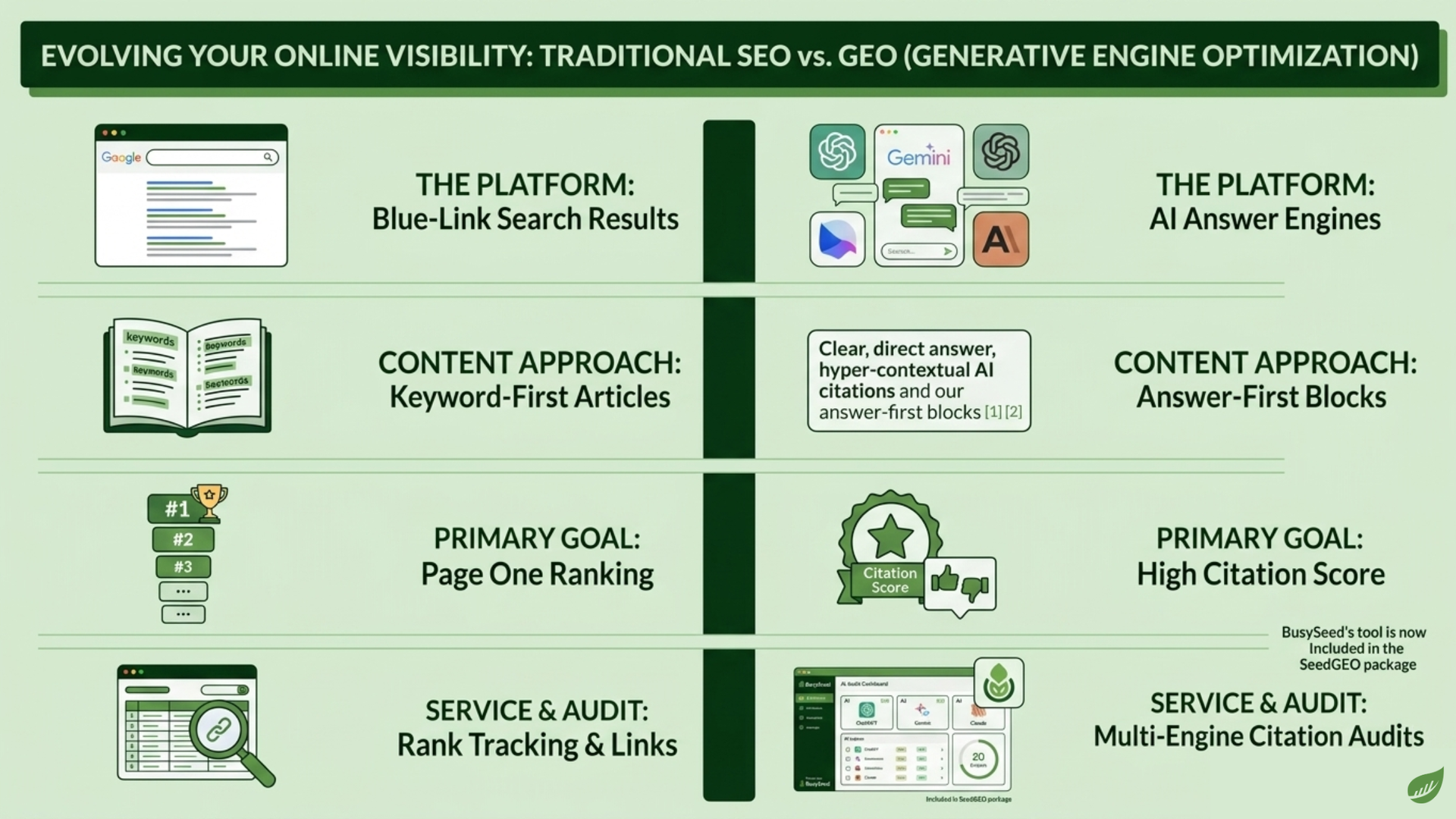
BusySeed developed SeedGEO, a unique solution and free tool based on its proprietary generative engine optimization platform. Unlike traditional SEO tools that track page rankings, SeedGEO shows where brand names, citations, and accurate content appear in AI answers across leading large language models.
Our service dynamically monitors
ChatGPT, Claude, Gemini, and Perplexity for real-time updates, scanning user queries with location data to provide
hyper-local and “near me” intelligence. We also calculate the
probability of brand appearance in AI-generated answers using our
Citation Score, presenting sentiment and authority signals based on BusySeed’s methodology.
Citations: Are They the New Klout Score for Marketing?
The Citation Score offers valuable metrics for teams to gauge content effectiveness, prioritize author optimization, and plan local visibility campaigns. Instead of providing keyword rankings, SeedGEO delivers an evidence-based Citation Score benchmark representing probabilistic outputs from leading AI platforms.
Many wonder about the relationship between organic ranking and AI citations. A BrightEdge study tracking
16 months of data revealed surprising dynamics (BrightEdge, 2025b):
- In May 2024, AI Overview citations represented only 32.3% of eligible pages (organic ranking positions).
- By September 2025, this number rose to 54.5%.
Your organic ranking increasingly determines citation eligibility, while your Citation Score measures performance within that pool. Using a free tool like SeedGEO takes the guesswork out of this process.
Access SeedGEO, BusySeed’s free tool, to run your first AI-powered visibility audit and receive your Citation Score across multiple engines with a free trial.
Why Are Trust Signals Now More Important Than Keyword Density?
It’s easy to assume “AI ranking” simply means “faster SEO”, but the reality is more complex. The new competitive variables involve citation probability, answer accuracy, and reference-grade trust signals, which are far removed from traditional SEO factors like link authority and keyword density. Recognizing this distinction is crucial for the future of SEO efforts, including generative engine optimization.
Pew’s data shows that AI models prioritize specific source types for summaries, including Wikipedia, YouTube, Reddit, and governmental sources (.gov), which comprised
6% of all cited sources. Governmental sources were represented
three times more than in regular search results (6% vs. 2%), likely due to AI’s trust-routing mechanisms favoring verifiable, consistent signals (Pew Research Center, 2025).
How Do AI Models Use Reviews as "Trust Currency" for Local Search?
The signals AI models follow to build answers are their “trust currency”. A brand with a rich online presence (consistent across review sites, industry media, and proper citations) is easier for AI to “trust-route” than a brand with strong legacy SEO but thin authority signals.
This has important implications for local search. Most consumers read online business reviews, and according to BrightLocal’s 2025 consumer review survey of
1,026 U.S. adults, just
4% never read reviews. Moreover,
74% use two or more review sites when researching a company (BrightLocal, 2025). Review signals play a critical role in how AI models select local businesses for hyper-contextual queries.
Comparison: Traditional SEO vs. Generative Engine Optimization
What Insights Can a Business Extract From an AI Visibility Audit?
The insights from an AI visibility audit differ fundamentally from traditional SEO audits, leading to vastly different strategic decisions. An AI-led audit reveals whether your brand is mentioned, the language AI engines use to describe it, sentiment comparisons with competitors, and content gaps reducing citation chances, all of which directly impact your AI ranking.
BusySeed’s SeedGEO uses advanced technology to provide unique insights by comparing performance across leading large language models on
category-specific, location-contextualized prompts. These insights correlate with content strategy actions, authority-building strategies, and local listing quality improvements that collectively affect the Citation Score over time.
How Is AI Reshaping the B2B Tech Buyer’s Journey?
For B2B technology companies, strategic decision-making insights differ from those for consumer-facing organizations. Today’s B2B tech buyers increasingly use AI-driven models to compare vendors on price, features, and user experience. These models vet vendors, validate capabilities, and shortlist candidates before any human interaction occurs. Organizations prioritize citations on vendor comparison queries and accurate sentiment analysis on technical differentiators.
When it comes to digital marketing for B2B tech companies, navigating these shifting B2B buying behaviors can be complex, but the specialists at
BusySeed have the exact frameworks needed to capture this high-intent traffic.
Another critical data point is the accelerating growth rate of AI-driven B2B research behavior. In our research on “AI Search Visits in a Surging 2025,” we found that while AI search referrals account for
less than 1% of total referral traffic for most organizations, their growth rate outpaces that of other acquisition channels (BrightEdge, 2025a). Brands that act quickly will find that AI-driven search activity is one of the
highest-priority emerging acquisition layers (Similarweb, 2025).
How Can You Assess Your Baseline Visibility Without Commitment?
BusySeed’s SeedGEO offering provides free access to its tool for brands interested in assessing their current AI visibility, with no commitment required. Our goal is to provide sufficient real-world signal to help marketing teams understand the problem’s scope before engaging in broader strategic conversations.
This free tool runs AI prompts across leading engines and provides a
Citation Score baseline with location-focused generative search results. For small or cash-strapped teams, SeedGEO offers a starting point for understanding current standings and addressing gaps through analysis.
What Tangible Diagnostic Insights Does a SeedGEO Audit Provide?
The free tool model removes abstraction by generating tangible outputs such as Citation Scores, AI-generated rankings, and brand language. For smart marketing teams, this is more than a handy tool; it is a diagnostic, not a vendor pitch. Independent research from organizations like the Pew Research Center, Ahrefs, Seer Interactive, and BrightEdge has consistently confirmed the real-time AI behavior and CTR impacts we observe. Instead of wondering whether the problem exists on your site, you can log in to see your Citation Score and discuss velocity and competitive positioning.
Start your free AI visibility audit with SeedGEO. Within minutes, you’ll have your first Citation Score.
Translating Industry Insights Into an Actionable Strategy
The answer to improving your AI ranking isn’t simple. It requires a
structured, step-by-step strategy that translates these
industry-wide insights into an actionable plan.
Create Targeting Strategies for GEO that Drive Meaningful Growth Rate Increases
Develop focused plans to leverage generative engine optimization data to maximize local reach and impact, and assess their potential to drive substantial growth-rate improvements. While hard to measure, the growth rate of citation frequency climbs steadily as all three layers are fine-tuned. Brands integrating answer-first content structures with reference-grade authority signals and local trust infrastructure outperform those optimizing only one layer.
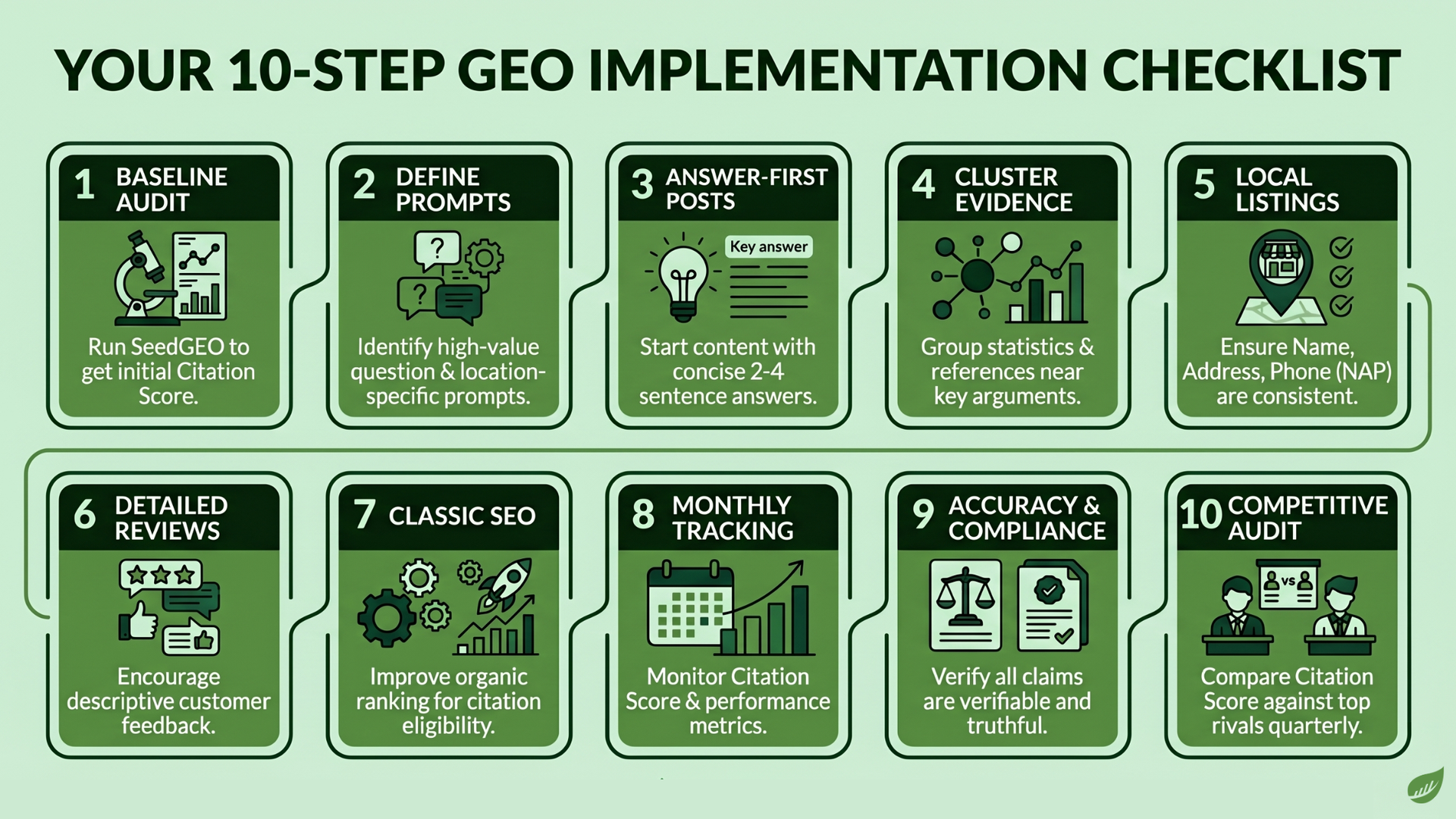
Your 10-Step GEO Implementation Checklist:
- Run your SeedGEO baseline audit. Use BusySeed’s free tool here to generate a Citation Score across ChatGPT, Claude, Gemini, and Perplexity with location context enabled. This establishes your growth rate starting point.
- Use a high-value prompt set. Identify 15 to 25 prompts customers use to evaluate products and services in your industry, including “best for x, y, or z” and competitor-focused prompts like “how is ours different from x, y, or z?” Include location-qualified prompts like “what about Los Angeles?” or “what about in London?”
- Turn top content into answer-first posts. Reorganize answers to lead with a 2-4 sentence answer block followed by supporting content. Pew’s data shows question-word queries receive AI summaries 60% of the time, so answer-first formats increase citation potential for high-volume prompts (Pew Research Center, 2025).
- Organize evidence into clusters. Use relevant statistics, citations, and links near key arguments. AI models use proximity to sources to infer trustworthiness, as seen in Pew’s findings that .gov content is cited three times more in AI summaries than in regular search results (Pew Research Center, 2025).
- Audit and clean local listing infrastructure. Ensure business name, address, phone number, and category data are accurate and consistent across major platforms. Inaccurate information undermines the trust-routing signals that AI models rely on for hyper-local generative search.
- Encourage review velocity and detail. Teach customers to write descriptive reviews that include neighborhood names, problems faced, solutions provided, and results achieved. Reviews are distributed across multiple sites; BrightLocal found that 74% of customers check two or more review sites, with 51% checking two (BrightLocal, 2025). Review density is key to authority-profile AI models.
- Prioritize organic ranking for citation-eligible pages. BrightEdge’s 16-month study found citation overlap with organic rankings grew to 54.5%, making classic SEO fundamentals the eligibility layer for AI citation in most verticals (BrightEdge, 2025b). Don’t ignore these fundamentals; they form the basis of generative engine optimization and a strong AI ranking.
- Track Citation Score and relevant metrics monthly. Use our free tool, SeedGEO, to monitor variations in Citation Score, sentiment shifts, and competitors’ citation frequency.
- Ensure accuracy and compliance. The FTC’s Operation AI Comply enforcement action shows that organizations using AI must verify the accuracy of advertising claims (Federal Trade Commission, 2024). AI models prioritize trusted, verifiable sources, so ensure all AI-related marketing descriptions are accurate and substantiated.
- Run quarterly competitive citation audits. Use SeedGEO to compare your Citation Score against primary competitors on your high-value prompt set, uncovering content gaps, authority deficits, and local signal discrepancies.
How Do You Connect GEO Performance to Business Revenue?
The effect of generative engine optimization extends beyond marketing into the boardroom. A top AI ranking and citations produced by AI have a substantial revenue impact, measured empirically.
Seer Interactive’s dataset revealed that brands mentioned in AI Overviews receive
35% more organic clicks and
91% more paid clicks on comparable queries than uncited brands (Seer Interactive, 2025). While this data shows correlation, not causation, the paid CTR lift from citation presence is too significant to ignore for resource allocation decisions.
What Does the Growth Rate of AI-Driven Search Mean for Budget Allocation?
While AI search is rising fast, its growth rate hasn’t been incorporated into most marketing attribution models, presenting both a measurement challenge and a first-mover advantage. AI search referrals currently account for less than 1% of referral traffic for most brands, while organic search remains the largest driver of referral traffic. Brands entering this channel now invest in citation authority to tap into a rapidly growing, unsaturated channel.
Our experiments with GEO investment mirror the exponential growth of early SEO investments. Brands that dominated organic authority in the early 2000s reaped compounding growth-rate advantages over newer entrants. Now, as AI citations become crucial for online reputation and authority, BusySeed’s SeedGEO provides the critical tool to measure standings before competitors do.
Connect with BusySeed’s team of SeedGEO specialists to build a full GEO strategy from the ground up.
What Is the True Cost of AI Invisibility in Today's Market?
This evidence reveals that generative engine optimization is not a future consideration; it is a competitive force right now. With AI Overviews reaching 1.5 billion users monthly, organic click-through rates on these queries have fallen by 61% over 15 months (Seer Interactive, 2025). Even the paid CTR data paints a similar picture, with cited brands achieving a 91% higher CTR than non-cited brands. The cost of AI invisibility reveals itself quarter by quarter.
BusySeed developed SeedGEO to provide the insights businesses need to function effectively in today’s competitive landscape. The Citation Score from SeedGEO delivers real data on your company’s current AI ranking and actionable advice for improvement. Since SeedGEO is offered as a free tool, there are no barriers to businesses gaining new insights into their AI ranking and specific improvement strategies.
The foundation for using generative technology to optimize engines is strong; the business case for investing in AI ranking is well documented; and the technology exists to measure and improve search engine rankings. The only question is whether your company will lead in creating citation authority or let competitors take advantage.
Run your SeedGEO audit to see your Citation Score!
Your Next Best Move
The shift to AI-generated answers is not a future trend; it is a current reality. If your brand relies solely on traditional search, you are rapidly losing visibility. The brands that win in 2026 will be those that adapt their answer-first content structures, build verifiable trust signals, and continuously measure their performance using a reliable free tool.
If you want a partner who blends cutting-edge technology with proven marketing strategies, let’s talk. BusySeed can help you navigate this transition, from establishing your baseline Citation Score to executing a comprehensive authority-building campaign. If you want a partner who can implement this front-to-back and prove the lift with real numbers, we're ready.
Run your free SeedGEO audit today to get started.
FAQs: Answers to Your Most Pressing Questions on GEO, AI Visibility, SeedGEO, and More
1. How to track AI-driven brand visibility across search engines?
Tracking visibility requires moving beyond static result lists to monitor dynamic queries. BusySeed’s SeedGEO platform scans major AI engines to measure your citations, using location-specific prompts to deliver a Citation Score that reflects your true authority. For new teams, the free tool entry point is the fastest way to establish a baseline before competitors do. Track your scores monthly and conduct competitive analyses quarterly to stay ahead.
2. How to optimize generative search results for business growth?
Treat citation probability as your primary KPI. Optimization requires answer-first content, evidence clustering, and local trust signals. Through generative engine optimization, cited queries drive 35% more organic clicks and 91% more paid clicks than non-cited counterparts (Seer Interactive, 2025). Establish a baseline with SeedGEO, identify competitor gaps, and track your growth rate improvement over 90-day intervals to prove your investment performance.
3. How can BusySeed help my business with generative engine optimization?
BusySeed starts by running a SeedGEO audit to generate a Citation Score report before any content is written. Research shows that 54.5% of AI citations for top terms now overlap with organic rankings (BrightEdge, 2025b), meaning your existing SEO matters. We build a strategy to close authority and content gaps addressable within 60 days. The resulting increase in your growth rate and Citation Score serves as a clear return on strategy.
4. What should I look for in an AI marketing agency for search engine ranking in the generative era?
Choosing a partner requires new criteria to ensure the best AI driven SEO content agency can actually measure citation probability. BusySeed employs an audit suite to provide a definitive measure of AI ranking, backed by peer-reviewed research. Always look for an agency taking a trust-first approach to comply with the FTC's Operation AI Comply initiative (see recent enforcement actions), as AI models heavily prefer trusted, verifiable sources.
5. What are the key criteria when selecting a digital marketing partner for a B2B technology company?
B2B buyers now use AI to compare vendors before speaking with sales. The brand that earns the most accurate citations during this research phase gains significant influence. BusySeed delivers timely insights into where your brand is cited and how it stacks up against competitors. Building a generative "moat" now secures your visibility at the lowest competitive cost this channel will ever offer.
Works Cited
- Alphabet. 2024 Annual Report. 2024. https://s206.q4cdn.com/479360582/files/doc_downloads/annualreport2024-web.pdf.
- Alphabet. Q1 2025 Earnings. 2025. https://www.sec.gov/Archives/edgar/data/1652044/000165204425000040/googexhibit991q12025.htm.
- Ahrefs. AI Overviews CTR Study. 2024. https://ahrefs.com/blog/ai-overviews-reduce-clicks/.
- Bain & Company. Consumer Reliance on AI Search Results Signals New Era of Marketing. 2025. https://www.bain.com/about/media-center/press-releases/20252/consumer-reliance-on-ai-search-results-signals-new-era-of-marketing--bain--company-about-80-of-search-users-rely-on-ai-summaries-at-least-40-of-the-time-on-traditional-search-engines-about-60-of-searches-now-end-without-the-user-progressing-to-a/.
- BrightEdge. AI Search Visits in Surging 2025. 2025a. https://www.brightedge.com/resources/research-reports/ai-search-visits-in-surging-2025/.
- BrightEdge. Rank Overlap After 16 Months of AIO. 2025b. https://www.brightedge.com/resources/weekly-ai-search-insights/rank-overlap-after-16-months-of-aio.
- BrightLocal. 2025 Local Consumer Review Survey. 2025. https://www.brightlocal.com/research/local-consumer-review-survey-2025/.
- Federal Trade Commission. Operation AI Comply: FTC Announces Crackdown on Deceptive AI Claims and Schemes. 2024. https://www.ftc.gov/news-events/news/press-releases/2024/09/ftc-announces-crackdown-deceptive-ai-claims-schemes.
- Pew Research Center. Google Users Are Less Likely to Click on Links When an AI Summary Appears in the Results. 2025. https://www.pewresearch.org/short-reads/2025/07/22/google-users-are-less-likely-to-click-on-links-when-an-ai-summary-appears-in-the-results/.
- Princeton University. GEO: Generative Engine Optimization. 2024. https://collaborate.princeton.edu/en/publications/geo-generative-engine-optimization/.
- Seer Interactive. AIO Impact on Google CTR September 2025 Update. 2025. https://www.seerinteractive.com/insights/aio-impact-on-google-ctr-september-2025-update.
- Similarweb. AI Referral Traffic Winners. 2025. https://www.similarweb.com/blog/insights/ai-news/ai-referral-traffic-winners/.